Wall Sinks in Commercial and Institutional Buildings: Issues to Consider for AEC Professionals
Wall-mounted sinks continue to be among the most popular types of healthcare, educational, and transportation facility sinks, and others that are heavily utilized and hence must meet functionality, functionality, and maintainability criteria. Of more interest to architects and engineers who specify healthcare sinks, for instance, than to mere consumers, the functional utility of such sinks has more to do with how they are integrated into building design, plumbing, and accessibility systems that span a lifetime of 20+ years. Some of the important technical factors for wall-mounted sinks are presented below, referencing common guidance from the
U.S. Access Board (ADA),
EPA WaterSense,
and model code frameworks such as
IPC (International Plumbing Code)
and
IAPMO/UPC.
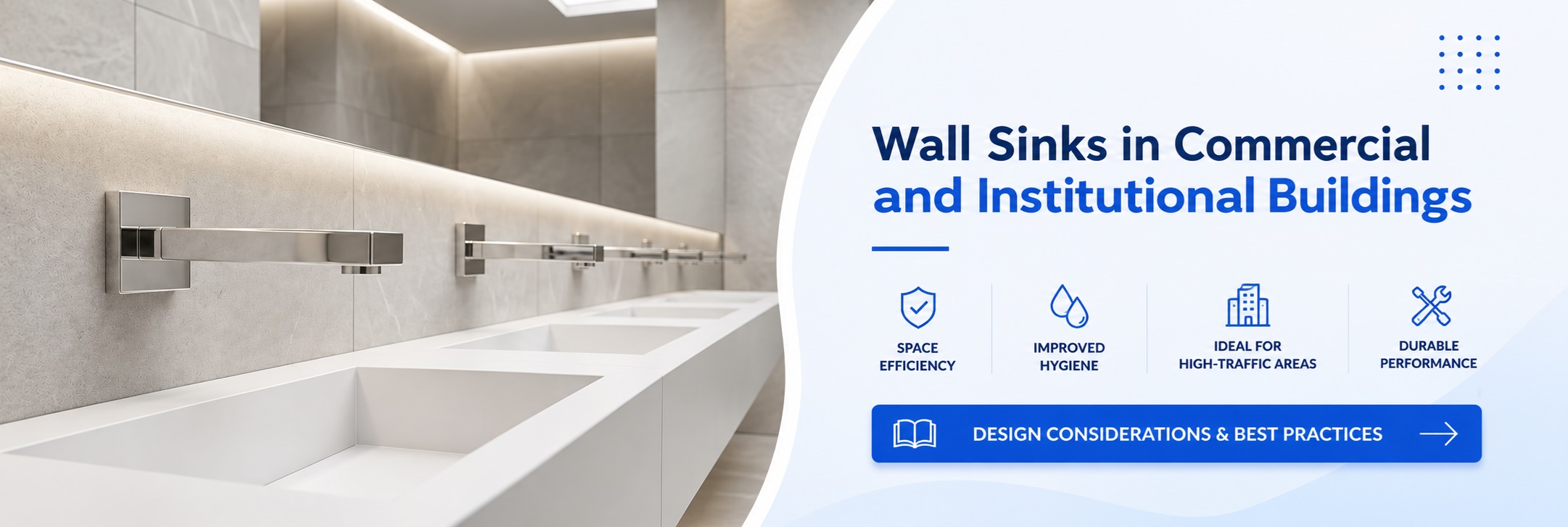
Wall-mounted sinks are engineered to maximize space efficiency while improving hygiene and accessibility in modern bathrooms. By eliminating floor-mounted cabinetry, these systems can increase usable space and simplify cleaning, making them a preferred solution for residential, hospitality, and commercial restroom environments.
A wall-mounted sink should never rely on sheathing, tile, or thin-wall studs alone for support. It is necessary that the loads bear on the proper-rated carrier or assembly, consistent with the project structural framing documents and applicable building code (see
International Building Code).
Carrier selection
Carrier Selection: The carrier needs to be rated for static and dynamic loads that are expected in a public environment, including misuse, such as leaning on or sitting on the fixture. Typically, carriers are rated between 300 and 500 lb. (1.3 and 2.2 kN). For general engineering references, see
AISC.
Framing coordination
Framing coordination Mounting heights, carriers, and reinforcement coordination need to match the spacing of the studs and the location of the horizontal bracing. In the case of metal-studded partitions, the heavier gauge studs and the backing plates are typically required at the location of the fixtures. For standardization references, see
ASTM.
Tolerances
Tolerances: The rough-in tolerance for the carrier bolts, wastewater connections, and plumbing supply offsets will typically be close. There will thus be little need for plumbing alignment repairs to the sinks. For coordination workflows, see
NIBS BIM resources.
Substrate and Finish Integration
Wall-mounted sinks impose point loads on hanger bolts and carrier arms. The finish and material description shall include the following features to ensure. For surface durability and cleaning references, see
EPA Safer Choice.
Shear and pull-out resistance and continuity
Shear and pull-out resistance The use of support materials like structural plywooods or steel plates backing gypsum wallboard, or direct attachment to concrete or concrete masonry unit walls. Continuity The tile and panel assemblies shall allow accessibility for the mounting and hiding of penetrations without compromising water-resistant barriers. A continuous wall protection and solid surface wall cladding could offer distinct advantages in high-abuse applications around a sanitary fixture. For standards context, see
AWC
and
ACI.
ADA, Accessibility, and Dimensional Criteria
Mounting Heights and Clearances
In projects within the United States, accessibility can typically be furnished through the
ADA Standards for Accessible Design,
or assisted by the applicable building codes. In designing an accessible wall-mounted sink, the following should be considered:
Rim/Counter height: The rim/counter height may be a maximum of 34 in. (865 mm.) Above the finished floor AFF (see
ADA scoping and technical).
Knee and toe clearances: A wall mounted sink shall require knee clearance of no less than 27 in. (685 mm) from the front and sufficient toe clearance below the sink basin. Clear floor space: A clear floor space shall be provided that is no less than 30 in. X 48 in. and shall relate to surrounding partitions, dispensers, and door swings (see
ADA guide: Lavatories and Sinks).
Under-Sink Components
Detail-oriented installation is necessary for components located under sinks, as this area can be viewed from underneath. Water trap protection: These protective covers conform to ADA standards to shield from hot or sharp edges (reference
ADA technical requirements).
Pipe routing The routing of supply pipes and mixing valves/sensor controllers must take place in a manner that does not affect the space (see
IPC
and
UPC).
Skirts or Shrouds: These may be used to hide piping, but they cannot be used to decrease clearance (see
ADA clearances).
Material Selection and Durability
Vitreous China and Fireclay
High resistance to wear and tear of materials in high-traffic commercial and institutional environments maximizes their lifespan. The following are the common choices available: Advantages include high surface hardness and resistance to staining and rubbing. For generalized material standards context, see
ASTM.
Vitreous China and Fireclay – Consideration
Consideration: The risk of chipping when impacting; think about corner radii, depths of bowls, and safeguarding designs where abuse may occur. For performance certification pathways, see
IAPMO product certification.
Solid-Surface and Composite Materials
Advantages: Integral backsplashes are caulk-free and easily maintained and repaired. Use: Medical and educational environments. For infection control references, see
CDC resources.
Solid-Surface and Composite Materials – Considerations
Considerations The quantity of support and reinforcement will, thus, vary. Larger spans demand more support points. In a trough and pencil support, there are considerations for expansion due to temperature variations. For building envelope and moisture control references, see
NIBS guidance.
Stainless Steel and Heavy-Gauge Metals
It offers ultra-high impact resistance, extraordinary cleanability, and proper vandal-resistant suitability. There are anti-ligature versions for applications in the area of behavioral health. For general safety context, see
The Joint Commission.
Stainless Steel and Heavy-Gauge Metals – Considerations
Considerations The specs must include minimum gauge and finish type, quality of welding, and edge safety. Good specification of performance requirements like impact, scratch, and chemical resistance ensures that the material specified can handle operational requirements. For standards context, see
ISO.
Hydraulics, Water Efficiency, and Code Compliance
Flow Rates and Water-Sense Features
Whenever practical, use faucets that are
EPA WaterSense
certified. Public lavatory faucets may be mandated to be low-flow faucets with or without pulsation at 0.35 to 0.5 gpm (1.3 to 1.9 L/min). Wall-mounted sinks: Match faucet flows to bowl shapes to prevent splashing. Ensure that the deck, wall, or mounting type corresponds to operational types of sensor faucets or mechanical faucets. For sensor faucet options and general product context, see
Fontana Touchless Faucets.
CALGreen and Regional Requirements
In California, or any region with efficiency requirements, it is necessary to ensure flow rates and mixingratios comply with
CALGreen
requirements. In larger installations where there may be a multitude of sink installations, it is likely necessary to model aggregate water use reductions (see also
WaterSense program resources).
Fixture Standards and Certification
Wall-type sinks and fixtures generally meet standards for performance set by ASME and ANSI. ASME / ANSI Standards: Must meet standards for material, performance tests, overflow action, and drainability. Listing requirements: Verify that the sink meets listing requirements from organizations like
IAPMO
or
CSA Group.
Backwater valve installation: Verify that faucet assemblies meet proper requirements for backflow prevention (see
IPC).
Water Sensor Faucet Interface
Sensor faucets are being increasingly fitted along wall-mounted sinks in healthcare institutions, educational institutions, and public spaces. The factors to consider: Power configuration: Low-voltage hardwiring, line-voltage transformer-powered, and battery-powered operation. Access for maintenance The valves and control units should remain easily maintainable without interfering with the sinks and without damaging the finish and appearance of the surroundings. Software: The times of execution and ranges of detection should conform to the operational characteristics of the owner of the device. For touchless product context, see
FontanaTouchlessFaucets.com.
BITag and Gateway
All faucets connecting to BMS/smart building platforms: Device Location, Power, and Data Routing Fix congested areas around gateways and controlling units situated in the adjacent wall spaces or ceilings. Cyber Security and Device Identification: Engage the help of the information technology and facility operation departments. For baseline cybersecurity guidance, see
NIST Cybersecurity Framework.
Sanitation, cleaning, and infection control
Hygiene, cleaning, and infection control Wall sinks have cleanerability advantages compared to floor sinks, with little chance of dirt accumulating in the area beneath the bowl since this area is not enclosed. In situations where infection control is a priority: Geometry and detailing should reduce pathogen habitat and support low maintenance without long-term staining. Joint detailing, including continuous sealant or integral upstands, helps eliminate water entry into wall systems. For infection control references, see
CDC Infection Control.
Coordination, Documentation, and Specification Strategy
Wall-mounted sinks are a system where the coordination of carriers, finishes, plumbing, and control elements must all be integrated together. For plumbing engineering references, see
ASPE.
Drawings, Specifications, and Schedules
Specifications: Describe the relevant ASME/ANSI specification guidelines, ADA guidelines, WaterSense guidelines, CALGreen guidelines, and the desired performance in Division 22 documents. Schedules: Include details such as material, mounting height, rate of flow, and special features of desired performance like vandal resistance and anti-ligature characteristics. Reference sets may include
ADA,
WaterSense,
and
IPC.
Structural, plumbing, and control integration with a thoughtful consideration of wall-mounted sink design enables a long-term functionality and maintainability in commercial and institutional settings (see
ASPE).
Architects and engineers will actually benefit by considering the fixture as an assembly that requires technical documentation (see
NIBS).
Well-written and harmonized requirements for the performance of the material, for example, impact, scratching, and chemicals, will ensure that the chosen material will perform within the required operation environment (see
ASTM).
Personal Hygiene, Cleaning, and Infection Control
Integration with Touchless Control Systems and Building Systems
Sensor Faucet Integration
Sensor faucets are also being widely used in conjunction with wall-mounted sinks in healthcare institutions, educational centers, and other public amenities. For examples of touchless solutions, see
Fontana Touchless Faucets.
Power strategy
Power Strategy: Hardwired Low Voltage, Line Voltage with transformers or Battery-Powered. For electrical code context, see
NFPA 70 (NEC).
Maintenance access
Maintenance Access The valves and controls shall be maintenable without stripping the sink and without damaging any finishes. For facility maintenance guidance references, see
IFMA.
Sensor settings
As Sensor settings should provide the predetermined time of execution and the range of the detection that must adjust to the operational parameters of the owner. For water efficiency context, see
WaterSense.
Building Management System Connectivity
Where faucets meet BMS or smart building platforms: Coordinate device schedules, power routes, and data routes Ensure adequate room around gateways or controllers that might be situated in adjacent wall spaces or ceilings. For BAS interoperability context, see
BACnet.
Cybersecurity and operations
Focus on cybersecurity issues and device identification by working in partnership with IT and facilities operation personnel. Reference
NIST CSF
and internal facility policies.
Coordination, Documentation, and Specification Strategy
Included
Inside Drawings: Illustrate Reinforcing, Locations of Carriers, Clearances, Access Panels, Protection of P-TRAPS, and Rough (see
ASPE).
Schedules: Extract information regarding materials, mounting heights, flow rates, and special performance requirements such as vandal or ligature resistance (see
The Joint Commission
for safety context where relevant).
Well-written performance requirements, like impact resistance, scratch resistance, and chemical resistance, improve the chances that the chosen material meets those performance requirements (see
ASTM
and
ISO).
Wall-mounted sink fixtures must instead be considered part of a system that is well-coordinated for carriers, materials, plumbing connections, and control components. There is benefit for architects and engineers to consider the sink fixture not solely from the standpoint of aesthetic selection but from that of a technical assembly, aligned with
ADA,
WaterSense,
and applicable plumbing codes such as
IPC.
Customer Field Review
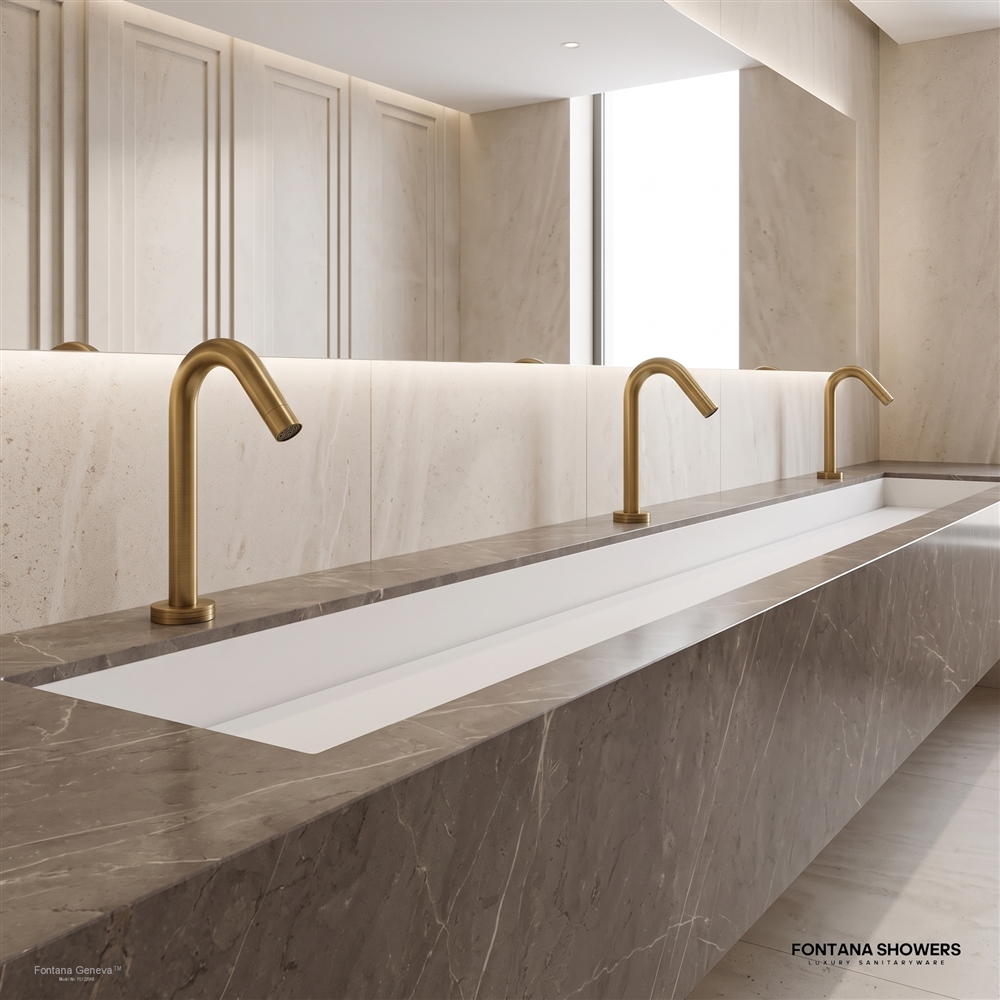
Fontana Geneva Antique Brass Commercial Sensor Faucet Field Review
A specification-focused evaluation of same-series FS1226 customer and facility records
covering sensor stability, reflective-surface behavior, shutoff timing, inlet-pressure
variation, commissioning, maintenance demand, finish coordination, and long-term commercial use.
✔ Same-Series FS1226 Records Referenced✔ Multi-Year Field History✔ Commercial Facility Context2021–2026 Review Records
Same-Series Field ReviewCommercial Sensor FaucetModel FS1226AB
Finley Whitmore, Infrastructure Advisor — Spokane, Washington
Transportation and Municipal Retrofit Evaluation
Review record date: March 30, 2026 • Rating: 5 out of 5
Customer Review
The selected same-series field record compares the FS1226 family with older touchless fixtures
used in transportation and municipal restroom retrofits and reports noticeably steadier
performance across projects completed from 2022 through 2025.
Read More
Finley Whitmore specifically cites fewer complaints involving false triggering,
delayed shutoff, and interrupted stream behavior after replacement. The same record
notes fewer interruption-related service requests once the faucets entered regular use,
which is highly relevant to the FS1226AB specification because the sensing platform and
installation format are shared within the Geneva series.
Installation
FS1226AB is identified as a commercial, deck-mounted, single-hole faucet with a ceramic
valve core and antique brass finish. Same-series review records also report
clean coordination with standard deck-mount rough-ins.
Read More
A. Reynolds' same-series FS1226 record notes that the installation aligned cleanly with standard
rough-ins and reduced contractor coordination time. D. Chen's same-series record adds
that commissioning proceeded without sensor recalibration on that project.
Sensor Response
The deepest same-series FS1226 records describe stable activation under changing ambient lighting,
reflective wall materials, fluctuating inlet pressure, and continuous public use, with
only localized sensitivity adjustment required on one compact sink configuration.
Read More
A separate same-series office record reports no lag or false activation during peak
usage. Transportation-hub feedback also notes responsive sensing under changing lighting,
while the 2026 record documents long-term infrared and valve stability after setup.
Finish and Design
The current FS1226AB product page specifies an antique brass finish and contemporary
commercial styling. Same-series customer records also support the Geneva line as a refined
upgrade path where finish coordination and touchless operation are both important.
Read More
Finish condition should still be tracked against the facility's actual cleaning chemistry,
mineral exposure, and housekeeping frequency. Long-term finish wear is a separate maintenance
metric from the sensor and valve performance documented in the field records.
Operating Function
Same-series FS1226 records repeatedly reference immediate or consistent automatic shutoff,
controlled flow without splashing, quiet internal valve operation, moisture-protected
internal components, and straightforward maintenance access.
Read More
Healthcare feedback highlights well-sealed internal components and service access for
continuous-operation environments. Corporate-campus feedback adds quiet valve operation
and low maintenance demand, while the 2026 record documents fewer interruption-related calls
across same-series installations.
Recommended Use
The review evidence is strongest for offices, healthcare projects, transportation hubs,
municipal restrooms, hospitality-adjacent restrooms, and other commercial facilities where
sensor stability, controlled shutoff, service access, repeatable commissioning, and a warm finish matter.
Read More
Project teams should document basin reflectivity, nearby wall materials, ambient-lighting
conditions, inlet-pressure behavior, and any sensitivity adjustment during commissioning so
later maintenance teams have a clear performance baseline.
Review Summary
Primary RatingFive out of five in the selected 2026 same-series field record.
Operating HistoryTransportation and municipal retrofit history extends across same-series projects from 2022 through 2025.
Recurring PatternStable sensing, controlled shutoff, fewer nuisance events, and reduced service demand.
Read More
Reviewer Context
Evidence combines multiple same-series FS1226 customer, MEP, facility, healthcare, and infrastructure records.
Product Configuration
FS1226AB: deck-mounted, single-hole commercial sensor faucet with ceramic valve core and antique brass finish.
Same-Series Evidence
Seven same-series FS1226 records support the page, including infrastructure, MEP, healthcare, facility, and end-user observations.
Extended Operating Context
The strongest record tracks retrofit performance from 2022 through 2025 and reports fewer nuisance events and service calls.
Product-Specific Specs
Mounting, valve-core, finish, style, and commercial-use details follow the current FS1226AB product page.
Transparent Attribution
Customer and facility observations are kept separate from product-page specifications and commissioning recommendations.
Find Out First
Get FontanaShowers emails of inspiration, new product releases, and more!