FontanaShowers™ FACILITY MANAGEMENT RESOURCES
Commercial Touchless Faucet
Facility Manager Guide.
Facility managers are responsible for much more than keeping plumbing fixtures operational. They must protect building uptime, occupant safety, hygiene, accessibility, water efficiency, maintenance productivity, and the long-term value of every installed system.
Restrooms, locker rooms, hospitality bathrooms, clinical handwashing areas, staff facilities, and public washrooms can experience highly variable use. A fixture may remain quiet for an hour and then serve hundreds of users within a concentrated period. This operating pattern requires systems that remain responsive during demand surges while also being practical to inspect and maintain.
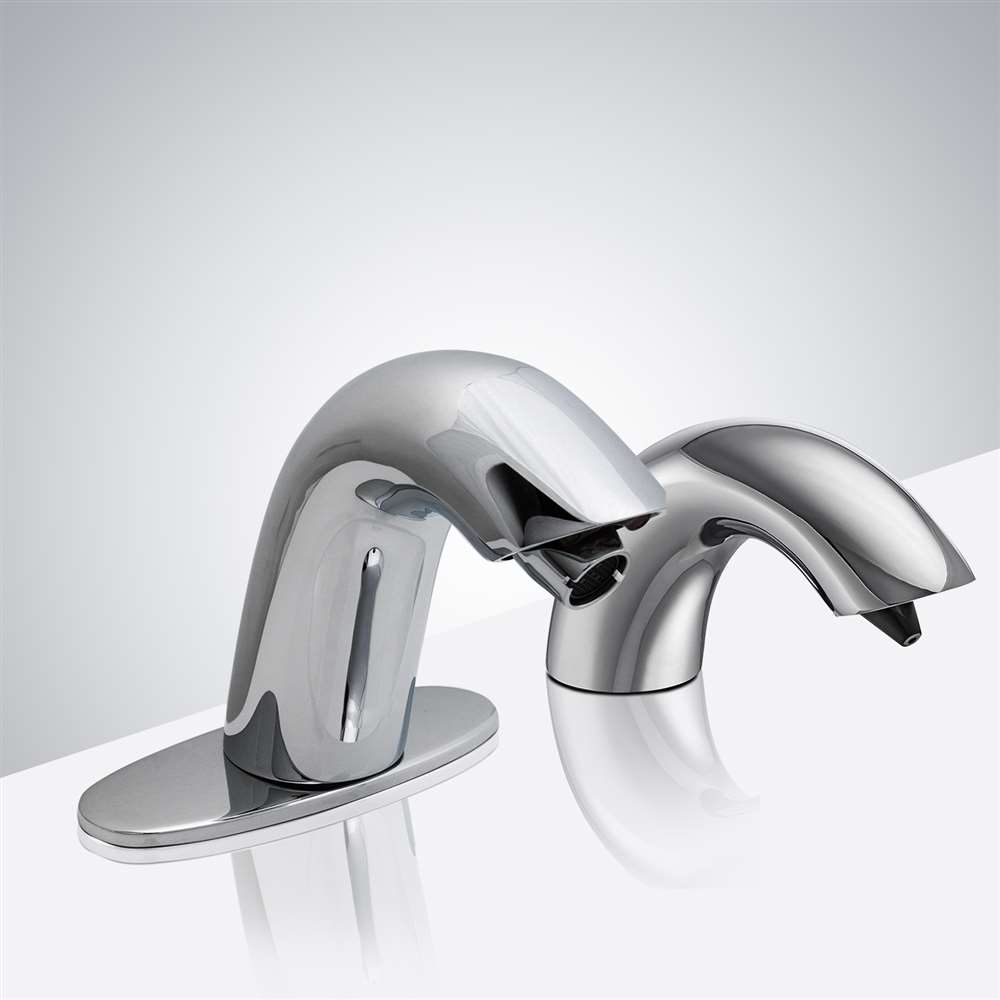
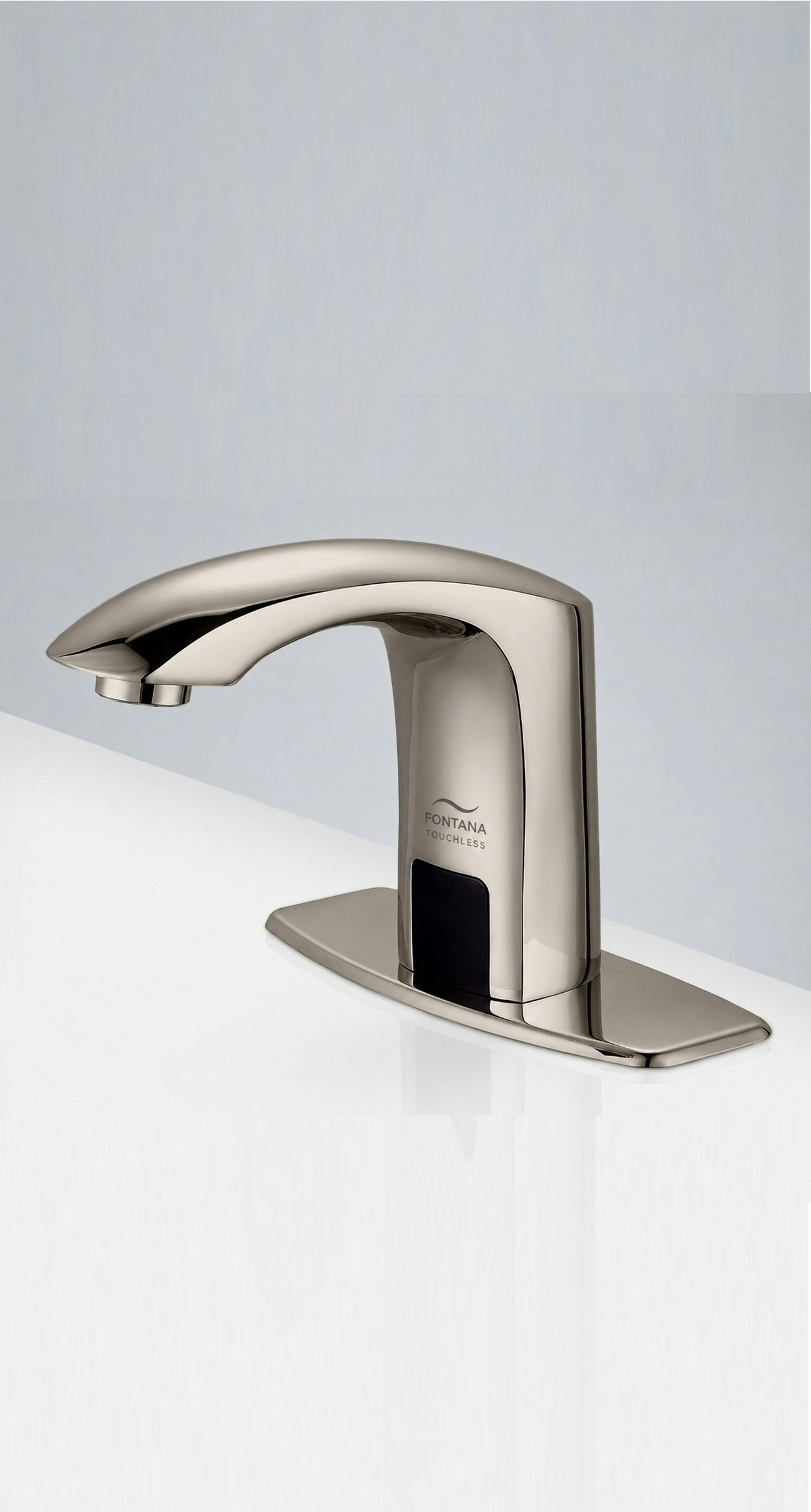
FontanaShowers™ and Fontana Touchless Faucets™ support facility teams with commercial fixture choices, technical documentation, architectural resources, touchless technologies, and application-specific planning information.
✓
Support for high-traffic commercial restroom operations
✓
Touchless activation and coordinated soap-delivery options
✓
BIM, Revit, specification, and commercial project resources
✓
Maintenance-focused selection for long-term facility ownership
TECHNICAL RESOURCES
COMMERCIAL FIXTURES
PROFESSIONAL GUIDE
Find the Issue. Find the Action.
FACILITY MANAGER TECHNICAL QUESTION HUB
Commercial Touchless Faucet Questions Facility Teams Actually Need Answered
Use this section as a fast operating reference for maintenance, troubleshooting, power, serviceability, large-facility management, water performance, and lifecycle decisions. The detailed technical and application sections already on this page remain below so none of the existing engineering content or imagery is lost.
01 — Maintenance & Preventive Service
How much maintenance do commercial touchless faucets require?
Maintenance demand depends on traffic, water quality, power architecture, basin conditions, and the installed model. A practical program includes sensor-window cleaning, aerator and strainer inspection, leak checks, activation and shutoff testing, power verification, and documentation of recurring issues.
How often should touchless faucet batteries be replaced?
Use activation history and the exact model guidance rather than a fixed calendar date. For Fontana AC/DC systems, the battery is the backup power source; facility teams should record installation dates, verify backup condition during planned inspections, and replace approved batteries before depletion.
How often should inlet filters or strainers be cleaned?
Inspect them according to traffic, water quality, construction history, and observed flow restriction. New or renovated buildings may require closer inspection after commissioning because residual debris can migrate into small water pathways.
What preventive maintenance should be performed?
Inspect activation, shutoff, flow, splash, leaks, mounting stability, power condition, filters, aerators, sensor cleanliness, finish condition, and below-deck connections. Record what was inspected, what changed, and the next required action.
How often should sensors be inspected?
High-use or high-criticality locations should be checked more frequently than low-use restrooms. Inspection should focus on cleanliness, response consistency, detection-zone alignment, and changes caused by basin reflectivity, lighting, or nearby activity.
What components typically require periodic service?
Common service points include aerators, strainers, power connections, backup batteries, solenoid valves, sensor or control modules, flexible supplies, mixing components, and mounting hardware. Exact serviceability varies by model.
How long should routine maintenance take?
A standardized inspection should be short and repeatable. The goal is not a fixed number of minutes but a consistent sequence that lets technicians identify abnormal behavior quickly without unnecessary disassembly.
02 — Troubleshooting & Diagnostics
Why does a touchless faucet stop working?
Start by separating sensing, power, and water delivery. Check the power source and backup, water isolation valve, sensor cleanliness, wiring connections, detection zone, strainers, solenoid operation, and control module before replacing parts.
Why does a touchless faucet keep running?
Possible causes include a continuous sensor command, reflective trigger, debris in the solenoid, valve damage, wiring problems, or a control fault. Determine whether the electronic command remains active or the valve is mechanically failing to close.
Why does a touchless faucet turn on randomly?
False activation can come from an overly broad detection zone, reflective basins, pooled water, sunlight, moving cleaning tools, nearby users, or sensor misalignment. Document the environmental condition before changing hardware.
Why does the faucet not detect hands?
Check sensor cleanliness, available power, detection-zone alignment, hand position, basin geometry, lighting, and the exact sensing technology. A clean, powered sensor can still perform poorly if the installation geometry is wrong.
Why does the faucet have low flow?
Inspect supply pressure, isolation valves, aerators, strainers, scale, debris, and flow-control components. Weak flow is often hydraulic rather than an electronic sensor failure.
How do you diagnose sensor vs. solenoid failure?
First confirm whether the sensor and controller issue an activation command. If the command occurs but water does not open or close correctly, investigate the solenoid and hydraulic path. If no valid command occurs, investigate sensing, power, calibration, and controls.
How do you know if a problem is power-related?
Look for loss of activation, intermittent response, low-power indicators where provided, repeated resets, weak or loose connections, or loss of primary power. Verify the primary AC/DC supply and the battery backup independently using model-specific procedures.
How can a clogged filter be identified?
A restricted strainer often presents as reduced or inconsistent flow while the sensor still activates normally. Compare nearby fixtures, verify pressure, and inspect the water path before replacing electronic components.
When should a sensor be recalibrated?
Recalibration may be appropriate after basin, lighting, mounting, or surrounding-surface changes, or when the detection zone no longer aligns with normal hand position. Use only the procedure permitted for the exact model.
03 — Reliability & Service Life
How long should a commercial touchless faucet last?
Service life depends on usage, water quality, pressure, maintenance, power stability, environment, and component support. Evaluate actual service history and repair frequency rather than using age alone.
How many activation cycles should a commercial faucet withstand?
Cycle ratings are useful engineering references, but they do not replace field conditions. High-traffic facilities should review component cycle ratings together with water quality, power, serviceability, and replacement-part continuity.
How long should a commercial solenoid last?
The existing page uses roughly 500,000 to more than 1,000,000 operating cycles as a general commercial planning reference depending on construction and conditions. Actual service life can be shortened by debris, scale, pressure, voltage, or restricted pathways.
What components normally fail first?
There is no universal sequence. Batteries or backup packs, aerators, strainers, connections, sensors, control modules, and solenoids are all affected by different site conditions. Track actual failure modes by fixture family.
How should faucet reliability be measured?
Measure successful activations, false activations, downtime, repeat service calls, parts replaced, technician time, and operating cycles. Reliability should be assessed as a system outcome, not just as a sensor specification.
Does high restroom traffic shorten service life?
Higher cycle counts accelerate accumulated use, but well-selected commercial components are designed for repeated operation. Peak demand, water conditions, cleaning practices, and maintenance access can matter as much as raw traffic volume.
04 — Power & Battery Backup
What is the preferred power architecture for large commercial facilities?
Where electrical infrastructure is available, AC/DC operation with battery backup reduces dependence on routine battery-only operation while preserving continuity during selected power interruptions. Final architecture should match the exact model and project electrical design.
What happens during a power outage?
For models designed with battery backup, the backup can support continued operation when primary power is interrupted. Facility teams should verify that the backup is installed, maintained, and tested as part of planned service.
How can facilities reduce battery-replacement labor?
Standardize power architecture where possible, use primary AC/DC power with battery backup, record backup-battery age, replace by zone when warranted, and avoid mixing unapproved battery types.
Can multiple faucets use centralized power?
Some commercial projects can coordinate shared or centralized electrical infrastructure, but circuiting, transformer capacity, service isolation, voltage drop, and manufacturer requirements must be reviewed by the project electrical and plumbing teams.
What should be documented for power service?
Record the primary power source, transformer or power-supply location, backup-battery type, circuit identification, wiring access, installation date, and any repeated power-related symptoms.
05 — Parts & Serviceability
Can the solenoid be replaced without replacing the faucet?
Many commercial systems treat the solenoid as a serviceable component, but compatibility and procedure are model-specific. Confirm the exact product number and approved replacement before disassembly.
Can the sensor be replaced separately?
Some systems use modular sensing and control components. Confirm whether the sensor, control module, cable, or complete electronic assembly is the approved service part for the installed model.
What spare parts should a facility keep on-site?
Typical categories include backup batteries, power supplies, aerators, strainers, flexible supplies, solenoids, sensor/control modules, mounting hardware, and approved cleaning materials. Stock levels should reflect installed quantity, criticality, lead time, and service history.
Can faucets be serviced without removing them from the sink?
This depends on the model and the below-deck or wall access provided. Serviceability should be reviewed before standardizing a faucet family across a large property.
Why is long-term parts availability important?
Parts continuity directly affects downtime, technician productivity, inventory complexity, and whether repair remains economical. It is a major total-cost-of-ownership factor for large facilities.
06 — Large Facility & Portfolio Management
How do you maintain 100+ touchless faucets?
Divide the property into service zones, give each fixture an asset ID, standardize inspection checklists, record model and configuration, stock common service parts, and use history to prioritize high-traffic or repeat-failure locations.
Should a facility standardize on one faucet platform?
Standardization can simplify training, parts, diagnostics, and procurement, but only where the platform fits the basin, traffic, accessibility, power, finish, and service requirements of each location.
How can airports and stadiums reduce downtime?
Plan around peak-event demand: common parts, rapid service access, stable power, predictable sensing, pressure stability, and pre-event inspection. Restroom capacity can be affected by even a small number of unavailable fixtures during surges.
How should universities manage multiple buildings?
Use approved fixture families, maintain building-specific pressure and power records, standardize technician procedures, and track age, parts, and service history by building.
How should hotels manage public areas and guestrooms?
Separate the operating profiles. Public restrooms may require higher-cycle planning; guestrooms may emphasize finish consistency and quieter operation. Maintain accurate model and finish schedules for replacement.
How can a facility reduce repeat service calls?
Track failure mode, root cause, part replaced, location, and technician action. Repeated symptoms across several fixtures may point to water quality, power, installation geometry, or pressure rather than defective individual faucets.
07 — Water, Flow & Operating Performance
What flow rate is appropriate for commercial touchless faucets?
The existing page uses 0.35–0.5 GPM as a common commercial planning range. Final selection must consider project codes, pressure, basin geometry, splash, handwashing experience, and the exact outlet specification.
0.35 GPM vs. 0.5 GPM: which should a facility choose?
0.35 GPM can reduce consumption; 0.5 GPM may provide a fuller stream in some installations. Compare both against basin depth, spout reach, pressure, splash, user behavior, and project water targets.
What water pressure is required?
The current page uses 10–100 psi as a general commercial operating reference. Exact operating and maximum static pressure must be confirmed against the selected model and project plumbing design.
Can high pressure create maintenance problems?
Yes. Excessive pressure can increase splash, noise, connection stress, and valve wear. Compare static and operating pressure when several nearby fixtures show similar symptoms.
Can low pressure look like a sensor problem?
Yes. The faucet may detect hands correctly while delivering weak or delayed water because of low pressure, a restricted strainer, a partially closed valve, or a blocked aerator.
How does basin geometry affect performance?
Basin depth, reflectivity, drain position, faucet reach, mounting height, and user hand position influence both sensing and splash. Large programs benefit from coordinated faucet-and-basin review or a representative mockup.
08 — Lifecycle Cost, Repair & Replacement
What is the lifecycle cost of a commercial touchless faucet?
Include purchase price, installation, power infrastructure, water consumption, routine maintenance, batteries or backup packs, replacement parts, technician labor, downtime, and eventual replacement. First cost alone is not a complete comparison.
When should a faucet be repaired instead of replaced?
Repair is usually favored when the failure is isolated, approved parts are available, the fixture remains serviceable, and repair cost and downtime are reasonable. Use service history rather than age alone.
When should a facility replace a touchless faucet?
Consider replacement when service calls become frequent, parts become difficult to obtain, downtime affects capacity, the fixture is difficult to service, water performance no longer meets goals, or renovation requires a new standard.
Is the cheapest sensor faucet the least expensive to own?
Not necessarily. A lower purchase price can be offset by more technician time, unique parts, frequent battery service, poor access, repeated false activations, or limited component support.
How should facilities compare bids?
Compare sensing architecture, power and backup, flow, pressure requirements, service access, approved parts, warranty, documentation, lead times, finish continuity, technical support, and expected lifecycle—not only unit price.
See More: How to Use the Full Facility Manager Resource Below
The original 12603 page contains valuable deeper sections on preventive maintenance, asset records, standardization, replacement-component planning, lifecycle management, BIM documentation, water performance, flow and pressure, commissioning, sensor technology, calibration, power, solenoids, connected systems, professional references, project decision paths, and field feedback. Those sections are intentionally preserved below rather than removed.
Use the question hub for fast answers; use the original engineering sections for deeper operational context, diagrams, product imagery, matrices, and project-resource links.
Fast Answers Above. Full Engineering Resource Below.
The question hub is designed for search and AI discovery, while the original technical sections, product imagery, BIM references, application guidance, field feedback, and facility-management content remain available for professionals who need deeper review.
BUILT FOR FACILITY OPERATIONS
Facility Management Begins with Operational Visibility
Facility management brings people, buildings, technology, maintenance procedures, service providers, and organizational objectives into one coordinated operating strategy. In restroom environments, this means understanding how each faucet, dispenser, valve, sensor, aerator, power supply, pipe connection, and finish performs under actual building conditions.
A fixture that appears satisfactory during initial installation may become difficult to manage when deployed across hundreds of wash stations. Facility teams must therefore evaluate more than purchase price. They must consider inspection frequency, expected traffic, power accessibility, sensor positioning, water pressure, flow control, cleaning procedures, replacement-part continuity, vandal exposure, finish durability, and the time required to restore a unit to service.
FontanaShowers™ facility resources are intended to help bridge the gap between architectural selection and long-term building operations. The goal is to give facility managers, engineers, contractors, owners, and procurement teams a clearer path from early specification through installation, commissioning, preventive maintenance, and future component replacement.
SYSTEM SELECTION
Match Fixture Performance to Building Demand
Evaluate restroom traffic, maintenance staffing, water conditions, power strategy, accessibility, user expectations, and service access before standardizing a fixture across the property.
FACILITY MANAGEMENT PRIORITIES
Three Foundations of Restroom System Performance
A successful fixture program must perform for users while remaining manageable for maintenance personnel, custodial teams, engineering departments, and property ownership.
◉
Dependable User Access
Restroom fixtures must remain available during ordinary occupancy and peak-use periods. Consistent activation, suitable detection range, controlled flow, stable power, and appropriate placement all contribute to reliable access.
REVIEW RELIABILITY ›
⚙
Simplified Maintenance
Maintenance planning should account for sensor cleaning, aerator inspection, strainer service, battery replacement, valve access, component identification, and standardized procedures across multiple restroom locations.
MAINTENANCE GUIDANCE ›
◇
Controlled Water Delivery
Automatic shutoff and specified flow performance can help facilities manage water use while reducing the operational risk associated with faucets being left running in unattended public spaces.
WATERSENSE RESOURCES ›
TOUCHLESS RESTROOM SYSTEMS
Touchless Technology as a Managed Building System
Touchless faucets should not be evaluated as isolated electronic products. Their performance depends on the relationship between the sensor, control module, solenoid valve, power source, water pressure, aerator, installation geometry, basin surface, supply condition, and the surrounding environment.
Facility managers should confirm that the chosen configuration is appropriate for the building's maintenance capabilities. Battery-powered models may simplify certain retrofit conditions, while hardwired or hybrid arrangements can support standardized power planning in larger developments. Wall-mounted and deck-mounted products also create different service-access requirements.
Early coordination prevents avoidable field problems. Facility teams should participate in fixture review before purchasing so that operational requirements are considered alongside finish, appearance, architectural intent, and initial construction cost.
SYSTEM OPERATION
SELECTION GUIDE
COMMERCIAL APPLICATIONS
Facility Requirements Change by Building Type
HEALTHCARE
Hygiene-Sensitive Environments
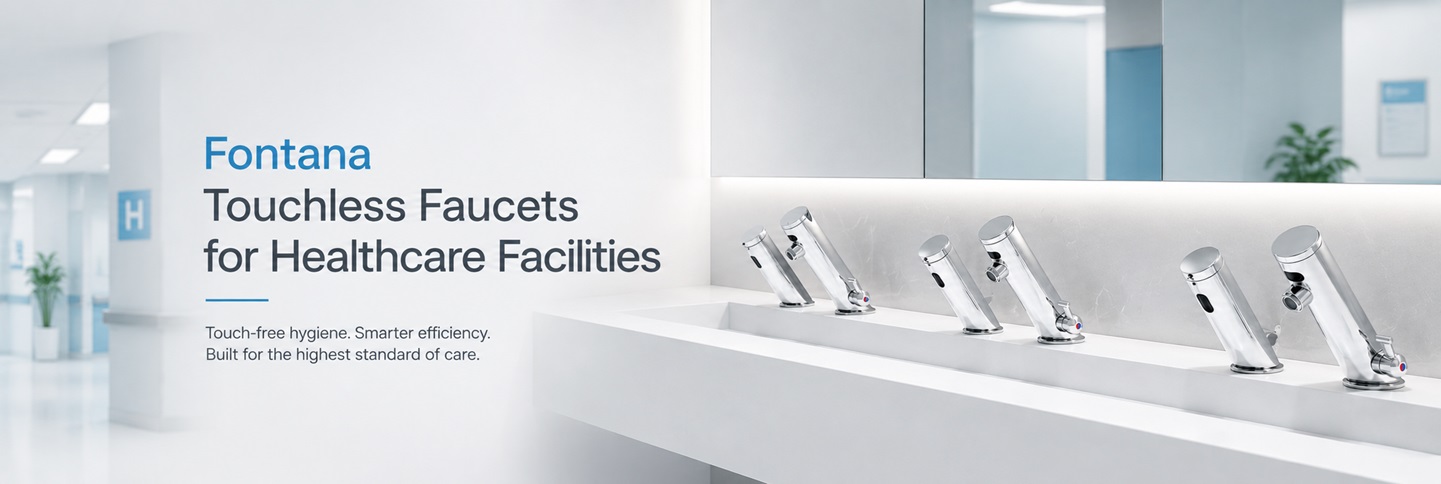
Healthcare facilities may prioritize touch-free operation, controlled flow, accessible servicing, clinical cleaning procedures, and coordinated handwashing stations.
HEALTHCARE RESOURCES ›

PUBLIC BUILDINGS
High-Volume Public Restrooms
Airports, government properties, transportation facilities, schools, entertainment venues, and civic buildings require durable systems that can support variable daily traffic.
PUBLIC RESTROOMS ›

COMMERCIAL PROJECTS
Architect and Facility Coordination
Coordinating architectural intent with maintenance access, plumbing conditions, finish schedules, accessibility, and replacement planning improves long-term project outcomes.
ARCHITECTURAL RESOURCES ›
CONTINUED IN PART 2
Preventive Maintenance, Asset Records, and Lifecycle Planning
PREVENTIVE MAINTENANCE
Move from Emergency Repairs to Planned Facility Care
Preventive maintenance gives facility managers greater control over restroom availability, labor requirements, replacement expenses, and occupant experience. Instead of waiting for a faucet, dispenser, valve, or power source to fail, the facility team establishes routine inspection intervals and documents the condition of every important component.
A structured program is especially important when a property contains dozens or hundreds of similar fixtures. Small problems that appear insignificant at one sink can become a major operational burden when repeated throughout an airport, hospital, hotel, office complex, university, shopping center, or public venue.
FontanaShowers™ and Fontana Touchless Faucets™ resources can help maintenance teams understand product configuration, sensor operation, power requirements, water-control components, and recommended service pathways before an issue disrupts facility operations.
MAINTENANCE GUIDANCE
TECHNICAL RESOURCES
PLANNED SERVICE CYCLE
A Repeatable Maintenance Process for Every Restroom
A consistent maintenance sequence helps reduce missed inspections, unnecessary component replacement, and differences in service quality between buildings, floors, departments, or outside contractors.
01
Inspect
Check fixture activation, water delivery, sensor condition, aerator output, visible leaks, mounting stability, finish condition, soap level, and user-access areas.
02
Clean
Remove residue from sensor windows, spouts, aerators, dispenser outlets, basins, and surrounding surfaces without using abrasive tools or unsuitable chemicals.
03
Test
Confirm activation distance, response consistency, automatic shutoff, flow quality, soap delivery, battery condition, and proper operation under normal lighting.
04
Document
Record the fixture location, model, observed condition, maintenance performed, parts used, technician, date, and recommended follow-up action.
05
Schedule
Assign the next inspection based on traffic, water quality, operating history, environmental exposure, manufacturer guidance, and facility standards.
MAINTENANCE STANDARDIZATION
Standard Procedures Reduce Variability
Clear inspection instructions allow in-house teams and outside service providers to evaluate fixtures consistently. Standardization also makes it easier to compare recurring failures, track component life, and identify locations that require redesign rather than repeated repair.
FIXTURE INSPECTION
Inspect More Than the Visible Spout
The visible faucet body represents only one part of a touchless fixture system. A complete inspection should include all accessible components that influence activation, water delivery, safety, stability, and serviceability.
✓
Sensor window cleanliness
✓
Automatic shutoff timing
✓
Aerator and flow condition
✓
Spout mounting stability
✓
Supply-line connections
✓
Solenoid valve operation
✓
Battery or transformer condition
✓
Finish and surface condition
FACILITY ASSET RECORDS
Build a Reliable Record for Every Installed Fixture
Facility teams frequently lose time because fixture information is incomplete, scattered across departments, or unavailable when a service call begins. A technician may arrive at the restroom without knowing the model number, power configuration, finish, installation date, replacement component, or previous repair history.
A digital asset record creates a permanent operational reference. Each fixture should receive a unique facility identifier connected to the room number, floor, building, sink position, manufacturer, product family, and technical documents. Photographs of the fixture, control box, valve, wiring, and below-deck installation can further simplify future service.
Asset data is most valuable when it is updated after every inspection or repair. Over time, these records reveal component replacement patterns, recurring water-quality issues, difficult service locations, and fixture groups that may require modernization.
SPECIFICATION RESOURCES
Recommended Asset Record Fields
|
Facility ID
|
Unique fixture reference
|
|
Location
|
Building, floor, room and sink
|
|
Model
|
Manufacturer and product number
|
|
Power
|
AC/DC primary power with battery backup, model-dependent
|
|
Flow Rate
|
Installed aerator specification
|
|
Finish
|
Chrome, brushed, matte or specialty
|
|
Installation
|
Date and responsible contractor
|
|
Service History
|
Inspections, repairs and parts
|
|
Documents
|
Manuals, BIM files and diagrams
|
FACILITY-WIDE STANDARDIZATION
Reduce Complexity by Limiting Unnecessary Product Variation
Standardizing selected fixture families can reduce training requirements, simplify parts storage, improve purchasing consistency, and help technicians develop familiarity with recurring service procedures.

Common Components
Select compatible product families where practical so maintenance teams can reduce the number of unique replacement parts.

Finish Control
Maintain accurate finish schedules so replacement fixtures and visible components remain coordinated throughout the property.

Technician Familiarity
Repeated experience with the same fixture architecture can shorten diagnostic time and improve repair consistency.
Easier Procurement
Approved product schedules help purchasing teams reorder fixtures and parts without repeating the full selection process.
REPLACEMENT COMPONENT PLANNING
Keep the Right Parts Without Overloading Inventory
Spare-parts planning should reflect the number of installed fixtures, criticality of each location, supplier lead times, service history, and the ability to temporarily close a wash station. Large public facilities generally need a more formal inventory strategy than a small office with several restrooms.
Common inventory categories may include batteries, power supplies, aerators, strainers, flexible supply connections, sensor modules, control boxes, solenoid valves, soap-delivery components, mounting hardware, and approved cleaning materials. Every stored part should be labeled with the compatible model family and reviewed periodically for continued relevance.
Facility managers should avoid uncontrolled accumulation. Obsolete parts, unidentified components, and duplicate inventory can occupy valuable storage while failing to support the fixtures currently installed.
FAUCET & SOAP SYSTEMS
LIFECYCLE MANAGEMENT
Plan for Renewal Before Performance Declines
Every fixture eventually reaches a point where continued repair becomes less practical than planned replacement. Lifecycle planning helps the facility team identify that point before widespread failures, finish deterioration, unsupported components, or changing accessibility requirements create operational pressure.
Replacement decisions should not be based on fixture age alone. A well-performing fixture in a moderate-use restroom may remain suitable, while a newer unit in a difficult high-traffic environment may accumulate repeated failures. The service record, cost of downtime, availability of parts, water performance, hygiene requirements, and compatibility with future building plans should all be considered.
Planned modernization also creates an opportunity to standardize product families, improve power infrastructure, revise flow rates, enhance accessibility, coordinate finishes, and introduce integrated faucet and soap-dispenser systems where appropriate.
Consider Replacement When:
✓
Service calls are becoming more frequent.
✓
Required components are difficult to obtain.
✓
Fixture downtime affects restroom capacity.
✓
The existing configuration is difficult to service.
✓
Water performance no longer meets project goals.
✓
Building renovations require coordinated finishes.
✓
New operational or accessibility requirements apply.
DIGITAL FACILITY INFORMATION
Preserve Project Documents for Future Operations
BIM files, Revit objects, cut sheets, plumbing diagrams, installation manuals, finish schedules, warranties, commissioning records, and product photographs should remain accessible after construction is complete. These documents help facility teams identify installed systems and make better decisions during renovation or replacement.
Documents should be organized by building and fixture family rather than stored only within the original construction archive. Facility managers should also retain the final approved product schedule because substitutions made during construction may differ from the early design documents.
BIM OBJECTS
BIM FILES
REVIT & CSI
FACILITY CHECKLIST
Questions to Ask During Every Maintenance Review
Does the fixture activate consistently for intended users?
Does the water stop automatically after use?
Is the flow stream stable and properly directed?
Are the sensor window and aerator clean?
Are there signs of leakage below the deck or wall?
Is the battery or power connection operating correctly?
Is the product model recorded in the asset system?
Are required replacement parts currently available?
Has the service activity been documented?
Is a follow-up inspection or replacement required?
LONG-TERM FACILITY VALUE
Maintenance Information Is a Facility Asset
A well-managed restroom system is supported by more than periodic cleaning and occasional repair. It depends on accurate asset records, trained personnel, accessible documentation, approved components, predictable inspection routines, and timely lifecycle decisions.
By connecting FontanaShowers™ product information with facility-specific maintenance planning, building teams can improve service consistency, reduce unnecessary downtime, protect finish quality, and make better long-term purchasing decisions.
COMMERCIAL CATALOG
TOUCHLESS SYSTEMS
CONTINUED IN PART 3
Water Efficiency, Flow Control, Pressure, and Operating Conditions
WATER PERFORMANCE MANAGEMENT
Control Water Use Without Compromising User Experience
Water efficiency in a commercial restroom is not achieved through low flow alone. Facility managers must balance consumption, handwashing effectiveness, fixture response, operating pressure, stream quality, user comfort, cleaning requirements, and the time required to complete each handwashing cycle.
A faucet with an unsuitable aerator, unstable pressure, excessive activation time, or poorly directed stream may frustrate users and create splash beyond the basin. Conversely, a properly selected touchless faucet can deliver water only when hands are present and stop automatically when the user moves away.
FontanaShowers™ and Fontana Touchless Faucets™ systems should be evaluated as part of the complete plumbing environment. Flow rate, pressure range, supply quality, temperature control, basin geometry, sensor position, and maintenance access all influence actual facility performance.
TOUCHLESS SYSTEMS
WATERSENSE
ENGINEERING REFERENCE
Typical Commercial Touchless Faucet Operating Parameters
Final requirements should always be confirmed against the selected model's technical documentation, project plumbing design, applicable codes, and local operating conditions.
|
Engineering Parameter
|
Typical Commercial Range
|
Facility Management Relevance
|
|
Faucet Flow Rate
|
0.35–0.5 GPM
|
Influences water use, stream feel, basin splash, and handwashing duration.
|
|
Operating Water Pressure
|
10–100 psi
|
Affects activation performance, stream quality, valve operation, and fixture consistency.
|
|
Maximum Static Pressure
|
125–145 psi
|
Helps identify whether pressure regulation or additional system protection may be required.
|
|
Sensor Detection Range
|
1.2–10 in. adjustable
|
Supports calibration for basin geometry, user position, and surrounding reflective surfaces.
|
|
Sensor Response Time
|
Less than 300 ms
|
Helps create immediate, predictable activation for users entering the detection zone.
|
|
Operating Temperature
|
39–176°F
|
Must be coordinated with mixing valves, supply conditions, and the selected valve design.
|
|
Power Supply
|
6V battery, 12V DC or AC/DC hybrid
|
Determines maintenance access, battery planning, electrical coordination, and backup strategy.
|
|
Environmental Protection
|
IP65–IP67 depending on component
|
Indicates resistance to dust and water exposure for selected electronic enclosures.
|
Values shown are general professional reference ranges and are not a substitute for model-specific cut sheets or project engineering review.
FLOW RATE SELECTION
Select Flow for the Actual Basin and Application
Lower flow does not automatically guarantee better facility performance. The selected aerator must produce a usable stream at the available operating pressure and direct the water toward the intended handwashing area. Basin depth, drain position, spout reach, mounting height, and user position should be reviewed together.
A stream that lands too close to the rear wall of the basin may encourage users to place their hands outside the ideal sensor zone. A stream that lands too near the front edge may create splash onto counters, floors, clothing, and accessibility clearances. These conditions can increase custodial work and generate complaints even when the faucet itself is functioning correctly.
Facility managers should request coordinated review of the faucet, basin, aerator, mounting dimension, and supply pressure before large quantities are installed. A representative mockup can reveal operating conditions that are difficult to identify from drawings alone.
COMMERCIAL FIXTURES
WATER-DELIVERY CONDITIONS
Four Conditions That Influence Faucet Performance
↓
Low Pressure
Insufficient pressure can reduce stream strength, affect valve performance, extend handwashing time, and create inconsistent operation between floors or buildings.
↑
High Pressure
Excessive pressure can increase splash, accelerate component wear, amplify noise, and place unnecessary stress on supply connections and control valves.
≈
Debris and Scale
Sediment, construction debris, and mineral scale can restrict strainers, aerators, cartridges, and solenoid pathways, reducing flow and reliability.
◇
Basin Geometry
Basin depth, shape, reflectivity, drain position, and faucet reach influence splash, sensor calibration, accessibility, and the user's hand position.
PRESSURE STABILITY
Consistent Pressure Supports Consistent Restroom Performance
Facility teams should investigate recurring differences between floors, wings, or buildings. Pressure instability may indicate broader system conditions rather than a defect in the individual fixture.
SYSTEM DIAGNOSTICS
Diagnose the Water System Before Replacing the Faucet
When multiple fixtures display weak flow, intermittent delivery, unusual noise, or pressure variation, the underlying condition may be located elsewhere in the plumbing system. Replacing individual faucets without investigating the common supply can increase cost while leaving the original problem unresolved.
Facility teams should compare nearby fixtures, review pressure at different times, verify isolation valves, inspect strainers, confirm pressure-reducing valve operation, and determine whether pumps or building demand are influencing the affected area.
A documented diagnostic process helps distinguish fixture-level issues from building-wide conditions. This reduces unnecessary replacement and provides better information to plumbing contractors, engineers, and manufacturers.
Pressure Investigation Checklist
Measure static and operating pressure.
Compare affected and unaffected fixtures.
Verify isolation valves are fully open.
Inspect aerators and supply strainers.
Review pressure-reducing valve settings.
Check for simultaneous high-demand events.
Record measurements in the asset history.
WATER QUALITY
Protect Small Water Pathways from Debris and Mineral Accumulation
Commercial touchless faucets rely on controlled water pathways through strainers, solenoid valves, cartridges, and aerators. Construction debris, pipe scale, mineral deposits, seal fragments, and sediment can restrict these pathways and create symptoms that resemble electrical or sensor failure.
Newly constructed and renovated buildings should be thoroughly flushed before final fixture commissioning. After occupancy, inspection frequency should reflect local water quality, building history, pipe condition, and the amount of debris found during prior maintenance.
Where scale accumulation is persistent, facility managers should coordinate with plumbing and water-treatment professionals rather than repeatedly replacing aerators and valves. Addressing the source can improve performance throughout the entire property.
MAINTENANCE REFERENCE
ACTIVATION CONTROL
Water Efficiency Depends on Correct Sensor Behavior
Touchless operation can reduce unnecessary run time only when activation and shutoff occur predictably. Poor calibration, reflective surfaces, sensor obstruction, or unsuitable basin geometry can undermine both water-control and user-experience objectives.
1.2–10 in.
Adjustable Detection Range
Calibration helps align the activation zone with the basin, faucet reach, intended hand position, and surrounding surface conditions.
<300 ms
Responsive Activation
Fast response helps users understand where to place their hands and reduces repeated movement in and out of the sensing area.
AUTO-OFF
Controlled Shutoff
Water should stop when hands leave the active zone, helping prevent extended flow in unattended or high-volume public restrooms.
TEMPERATURE MANAGEMENT
Coordinate Touchless Faucets with Safe Temperature Control
Touchless activation does not replace temperature-control planning. The facility design must still address hot- and cold-water distribution, mixing strategy, maximum delivered temperature, user population, local code requirements, and the intended application.
Facilities serving children, older adults, patients, or other sensitive populations may require additional safeguards and closer temperature verification. Central mixing, point-of-use mixing, thermostatic controls, and recirculation arrangements should be reviewed by the project's plumbing professionals.
Maintenance teams should document temperature settings, verify delivered conditions during inspections, and investigate unexpected changes rather than adjusting controls without understanding the underlying supply condition.
SYSTEM COMMISSIONING
Verify Performance Before the Facility Opens
Commissioning provides an opportunity to confirm that installed fixtures match the approved schedule and operate under real building conditions. This review should occur after the plumbing system has been flushed, power is available, basins are installed, and surrounding finishes are complete.
Each fixture should be tested for activation, shutoff, detection range, flow, splash, temperature, leakage, mounting stability, power condition, and service access. Deficiencies should be corrected before occupancy rather than transferred to the facility team as unresolved operational problems.
✓
Measure flow performance
✓
Record baseline settings
PROFESSIONAL RESOURCES
Water Efficiency and Plumbing Coordination
Use model-specific Fontana documentation together with applicable project specifications, plumbing codes, facility standards, and independent professional guidance.
FACILITY WATER STRATEGY
Efficient Fixtures Require Efficient System Management
Commercial restroom water performance depends on more than the faucet flow rating. Pressure, temperature, debris, aerator selection, sensor calibration, basin geometry, supply conditions, maintenance procedures, and commissioning all contribute to the final result.
Facility managers who document these conditions can identify problems earlier, communicate more effectively with service professionals, and protect the intended performance of FontanaShowers™ and Fontana Touchless Faucets™ systems throughout the building lifecycle.
COMMERCIAL CATALOG
SELECTION GUIDE
CONTINUED IN PART 4
Sensor Technology, Power Systems, Calibration, and Troubleshooting
TOUCHLESS CONTROL TECHNOLOGY
Understand the Technology Behind Reliable Touchless Operation
Touchless faucet performance depends on a coordinated electronic and hydraulic system. The sensor identifies the user's hands, the control module processes the signal, the power source supplies operating energy, and the solenoid valve opens or closes the water pathway. A problem in any one of these areas can affect the entire fixture.
Facility managers do not need to become electronics engineers, but they should understand the basic relationship between sensing, power, valve control, calibration, installation geometry, and water conditions. This knowledge helps teams diagnose problems accurately instead of replacing unrelated components.
FontanaShowers™ and Fontana Touchless Faucets™ systems can include battery, transformer, hardwired, or hybrid power configurations. Model-specific documentation should always guide service, adjustment, and replacement decisions.
SYSTEM OPERATION
TECHNICAL RESOURCES
SYSTEM ARCHITECTURE
Five Components Behind Every Activation
Reliable operation requires each system component to perform correctly and remain compatible with the selected faucet model, installation method, water supply, and facility power strategy.
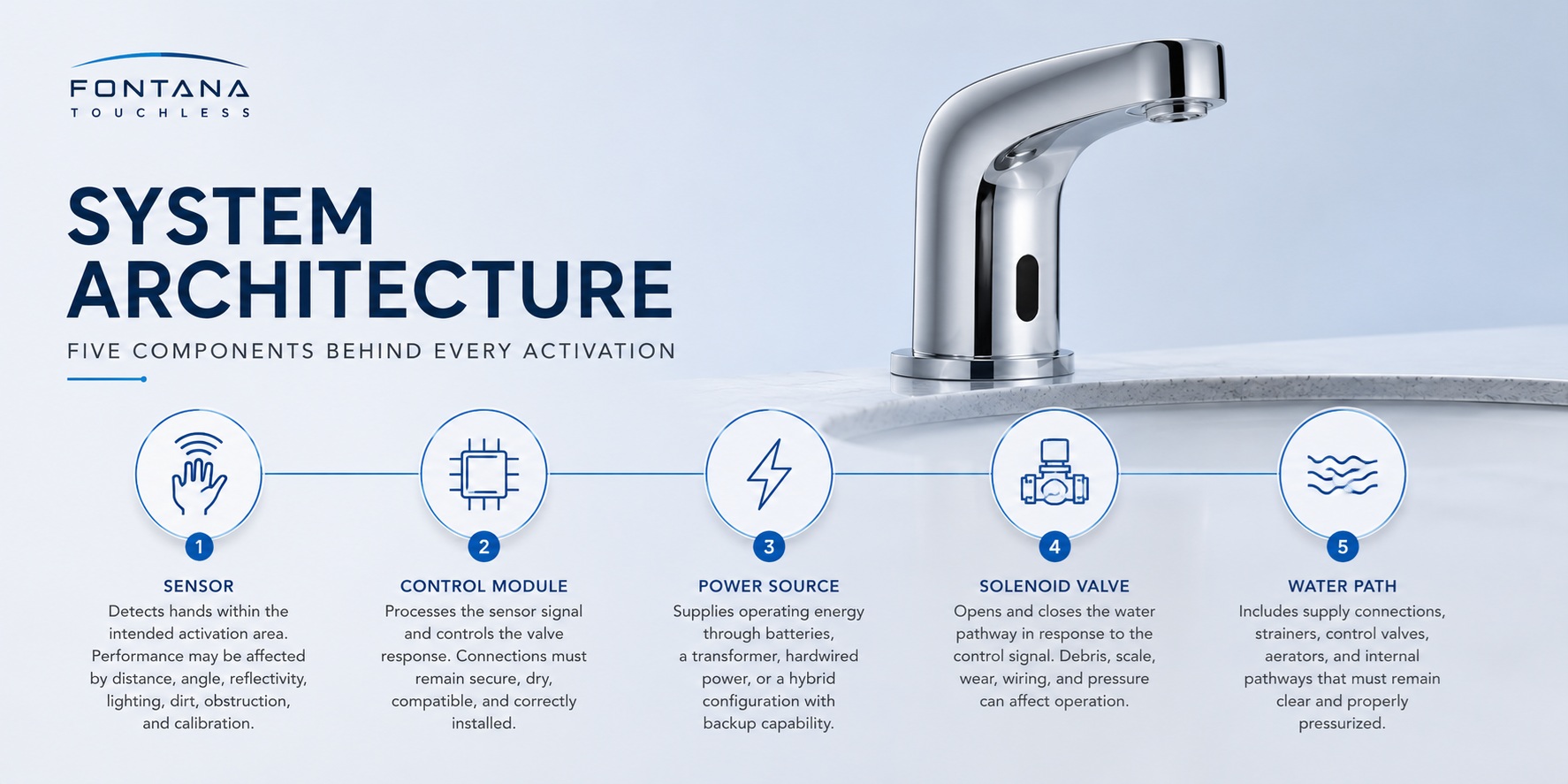
◉
Sensor
Detects hands within the intended activation area. Performance may be affected by distance, angle, reflectivity, lighting, dirt, obstruction, and calibration.
▣
Control Module
Processes the sensor signal and controls the valve response. Connections must remain secure, dry, compatible, and correctly installed.
⚡
Power Source
Supplies operating energy through batteries, a transformer, hardwired power, or a hybrid configuration with backup capability.
⇄
Solenoid Valve
Opens and closes the water pathway in response to the control signal. Debris, scale, wear, wiring, and pressure can affect operation.
≈
Water Path
Includes supply connections, strainers, control valves, aerators, and internal pathways that must remain clear and properly pressurized.
SENSOR PERFORMANCE
Detection Quality Depends on More Than Sensor Range
Sensor range describes the distance over which the system may detect a target, but dependable operation also depends on angle, field of view, surface reflectivity, target movement, environmental light, basin geometry, mounting position, and signal-processing settings.
Some touchless fixtures use infrared sensing, while others may use Time-of-Flight or hybrid sensing technologies. Infrared systems evaluate reflected light, while Time-of-Flight systems determine distance through measured signal travel. The most appropriate technology depends on product design and application conditions.
Facility managers should evaluate actual installed performance rather than relying on one sensor specification alone. A well-designed system should activate consistently for intended users while resisting unintended activation from the basin, nearby surfaces, cleaning activity, or environmental interference.
SENSOR RELIABILITY
INSTALLATION VARIABLES
Conditions That Influence Sensor Behavior
Sensor problems are often caused by the relationship between the fixture and its surroundings rather than failure of the sensor itself.
01
Basin Reflectivity
Highly polished, mirrored, metallic, glass, or wet basin surfaces may reflect sensor energy differently than matte ceramic surfaces.
02
Mounting Geometry
Faucet height, spout reach, sensor direction, basin depth, and hand position determine whether the active zone aligns with actual use.
03
Lighting Conditions
Strong sunlight, changing daylight, direct task lighting, and nearby reflective materials may influence selected sensing technologies.
04
Sensor Cleanliness
Soap residue, water spots, dust, cleaning product film, and physical obstruction can reduce sensing accuracy and response consistency.
05
Target Characteristics
Gloves, dark materials, fast movement, hand angle, and distance can influence detection depending on the sensing technology and calibration.
06
Nearby Activity
Cleaning tools, moving objects, soap dispensing, pooled water, and adjacent fixtures may enter an excessively broad or misdirected sensing area.
SENSOR CALIBRATION
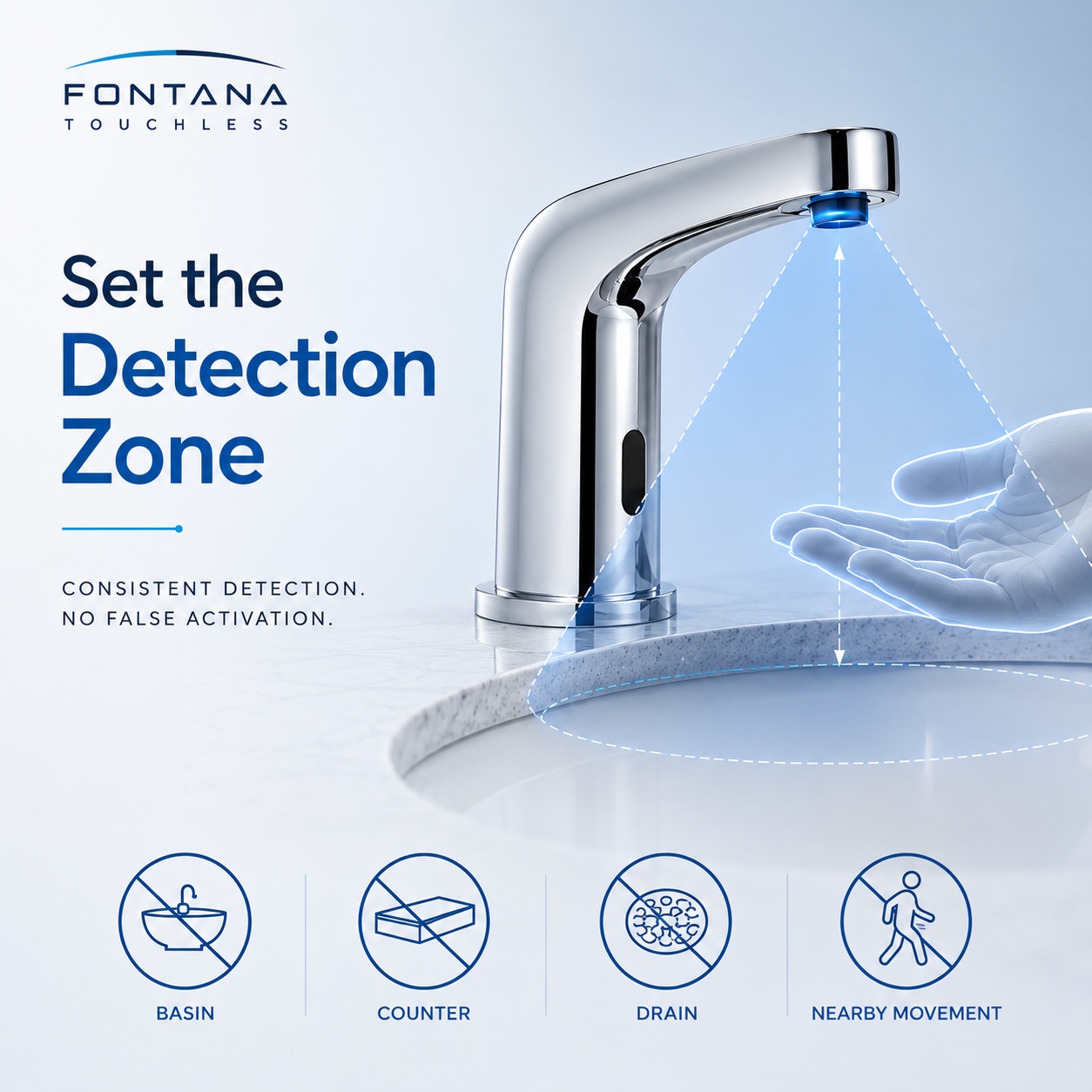
Set the Detection Zone for the Installed Environment
Calibration establishes the effective activation distance and response threshold. The objective is consistent hand detection without false activation from the basin, counter, drain, or nearby movement.
CALIBRATION PROCEDURE
Calibrate Only After Installation Conditions Are Complete
Calibration should occur after the faucet, basin, counter, drain, backsplash, surrounding finishes, lighting, water supply, and power system are in their final positions. Adjusting a fixture before these conditions are complete can produce settings that no longer perform correctly after construction is finished.
The technician should begin with the manufacturer's recommended procedure, confirm the intended user position, test several hand sizes and movement patterns, and observe whether the fixture activates when the basin is empty, wet, being cleaned, or exposed to normal lighting changes.
Final calibration settings should be documented in the facility asset record. When several identical fixtures are installed, the team should verify each location rather than assuming one setting will perform equally in every basin configuration.
Calibration Verification Checklist
Confirm final basin and counter installation.
Clean the sensor window and basin surface.
Verify stable power and water pressure.
Set detection within the intended hand area.
Test multiple users and approach angles.
Check for activation from the basin or drain.
Confirm shutoff after hands are removed.
Record final settings and technician date.
POWER STRATEGY
Match the Power Configuration to Facility Operations
Commercial power planning should evaluate AC/DC primary power, transformer location, wiring access, and battery backup as an integrated continuity strategy, with exact requirements confirmed by model.
BATTERY
Backup Battery
Provides backup continuity for compatible systems and must be coordinated with the model-specific primary power architecture.
Facility teams must plan battery inspection, replacement access, storage, disposal, and service intervals.
12V DC
Transformer-Powered
Supports continuous operation without routine battery replacement when appropriate electrical infrastructure is available.
Transformer location, wiring access, circuit identification, and future replacement must remain manageable.
AC/DC
Hybrid Power
Combines primary electrical power with a battery or backup arrangement to support continuity during selected power interruptions.
Maintenance procedures should verify both the primary source and the backup component.
POE
Networked Power
Selected smart-building systems may use networked power or communication infrastructure for centralized management and data collection.
Coordination is required between plumbing, electrical, information-technology, and facility teams.
BATTERY MANAGEMENT
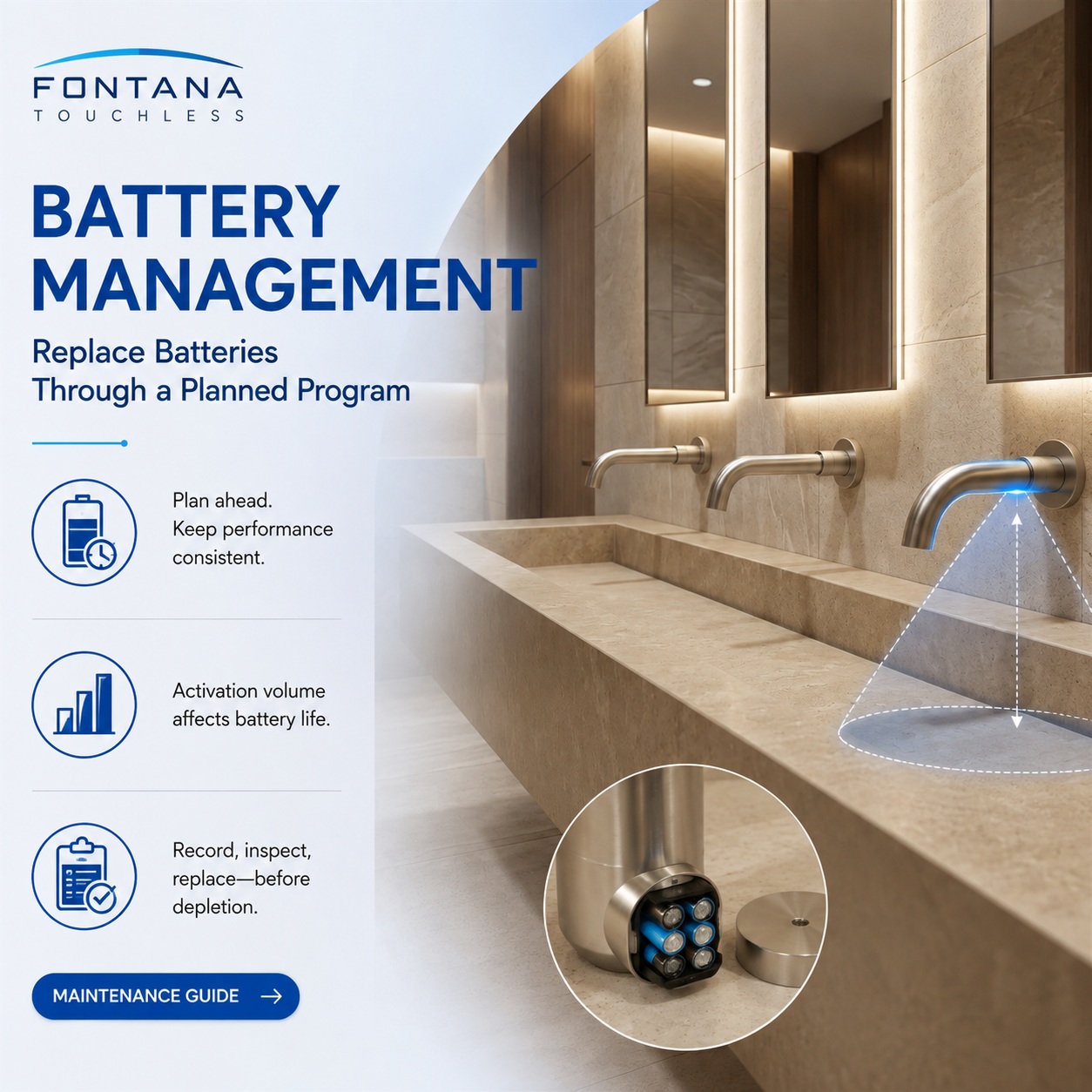
Replace Batteries Through a Planned Program
Battery life is influenced by activation frequency, battery type, sensor configuration, valve operation, environmental temperature, installation quality, and the condition of electronic components. A published activation estimate should be treated as a planning reference rather than an exact replacement date.
Commercial battery-powered systems may be rated for approximately 300,000 to 500,000 activations, depending on the selected model and operating conditions. High-traffic locations can reach these totals much sooner than low-use executive, staff, or guest restrooms.
Facility managers should record battery installation dates, use approved replacement types, inspect connectors for corrosion, replace batteries before complete depletion, and avoid mixing old and new cells in multi-battery assemblies.
MAINTENANCE GUIDANCE
SOLENOID VALVE PERFORMANCE
The Solenoid Converts the Electronic Signal into Water Flow
The solenoid valve acts as the controlled gateway between the water supply and the faucet outlet. When the control module receives a valid sensor signal, the valve opens. When the signal ends or the programmed shutoff limit is reached, the valve closes.
Commercial solenoid valves may be rated for approximately 500,000 to more than 1,000,000 operating cycles, depending on construction, water quality, pressure, usage, and the selected product. Actual service life can be reduced by scale, sediment, excessive pressure, damaged wiring, incorrect voltage, or restricted water pathways.
A valve that remains open may not always be mechanically defective. The cause can also include a continuous sensor command, incorrect wiring, trapped debris, pressure conditions, or a control-module issue. Diagnosis should follow a logical sequence.
Solenoid Service Checks
✓
Confirm correct supply pressure.
✓
Inspect strainers for debris or scale.
✓
Verify electrical connections and voltage.
✓
Test whether the sensor command ends.
✓
Check valve orientation and flow direction.
✓
Use model-approved replacement components.
✓
Document the failure mode and repair.
PROFESSIONAL TROUBLESHOOTING REFERENCE
Start with the Symptom, Then Isolate the Cause
The following table provides a general diagnostic structure. Always follow model-specific service instructions and applicable electrical and plumbing safety procedures.
|
Observed Symptom
|
Conditions to Investigate
|
Facility Response
|
|
No Activation
|
Depleted battery, interrupted power, disconnected wiring, obstructed sensor, incorrect range, damaged control module, or closed supply valve.
|
Verify power and supply first, clean the sensor, inspect connections, and test the fixture using the approved diagnostic sequence.
|
|
Water Does Not Flow
|
Closed isolation valve, blocked strainer, solenoid obstruction, low pressure, supply restriction, or incorrect valve orientation.
|
Confirm the sensor activates, then investigate the hydraulic pathway from the supply valve through the outlet.
|
|
Water Will Not Stop
|
Continuous sensor command, reflective trigger, stuck solenoid, trapped debris, damaged valve, wiring issue, or control fault.
|
Isolate the fixture if necessary, determine whether the command or valve remains active, then service the responsible component.
|
|
Intermittent Activation
|
Weak power, dirty sensor, unstable connection, range misalignment, changing light, reflective basin, or irregular hand position.
|
Record the environmental condition, clean and test the sensor, inspect power, and recalibrate if permitted.
|
|
False Activation
|
Detection range too broad, reflective surfaces, moving cleaning equipment, nearby users, pooled water, sunlight, or sensor misalignment.
|
Identify the triggering condition before changing parts. Adjust range or geometry only through the approved procedure.
|
|
Weak Water Flow
|
Low pressure, blocked aerator, restricted strainer, scale, partially closed valve, debris, or incorrect flow-control component.
|
Measure pressure, inspect restrictions, and compare performance with nearby fixtures before replacing electronic components.
|
|
Repeated Battery Failure
|
Excessive activation, incorrect batteries, poor connections, moisture, valve resistance, electrical fault, or unsuitable storage conditions.
|
Review replacement history, activation volume, battery type, enclosure condition, and current draw through qualified service personnel.
|
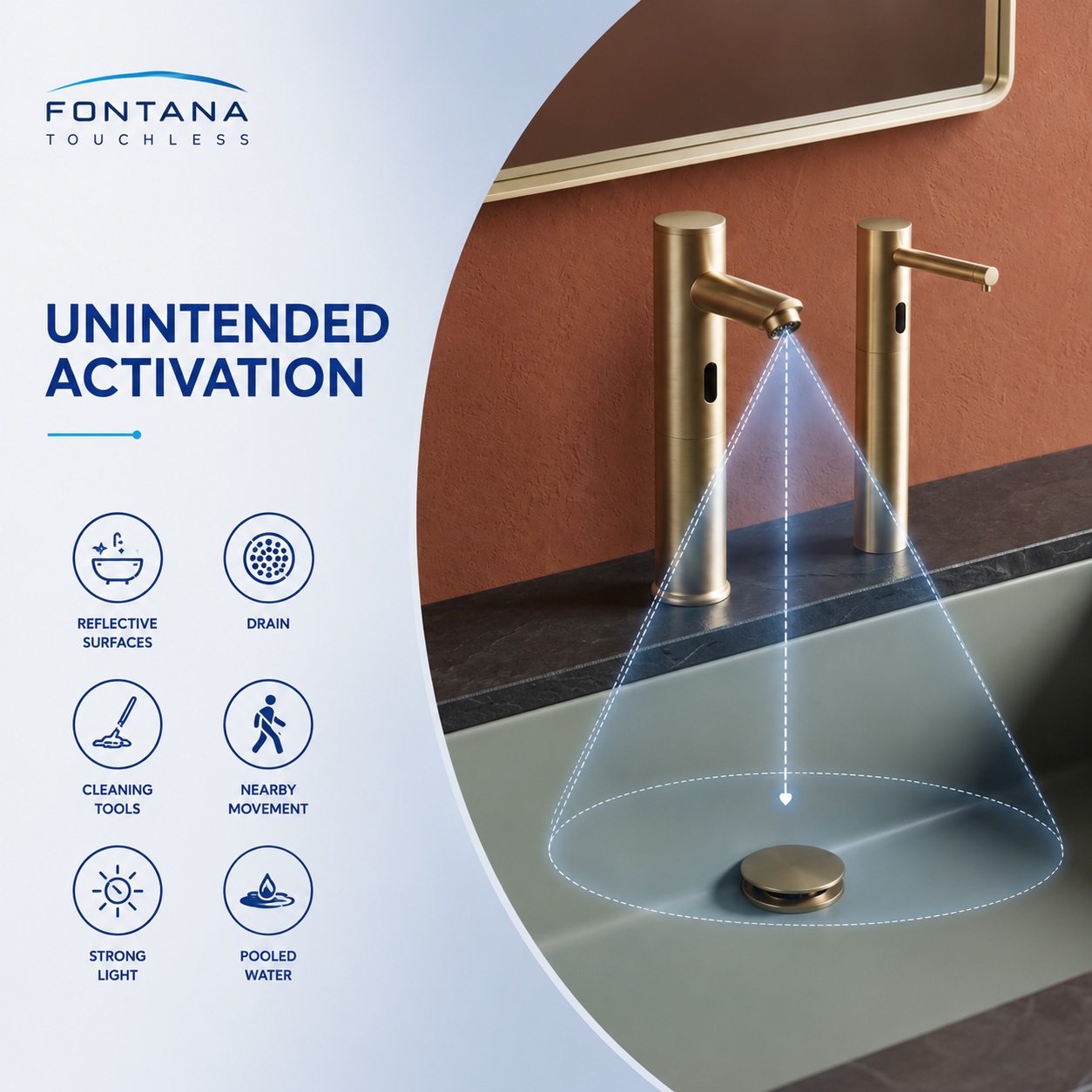
UNINTENDED ACTIVATION
Investigate the Trigger Before Replacing the Sensor
Unintended activation can occur when the sensing area includes reflective basin surfaces, the drain, moving cleaning tools, nearby traffic, pooled water, strong environmental light, or an object placed beneath the spout. Excessive sensitivity or incorrect sensor alignment can increase this risk.
Facility personnel should document when the event occurs, whether the basin is wet or dry, the lighting condition, nearby movement, cleaning activity, and whether adjacent fixtures behave similarly. This information can reveal a repeatable environmental trigger.
Replacing the sensor without correcting the installation condition may produce the same problem again. The more reliable approach is to isolate the triggering factor and then recalibrate, reposition, shield, clean, or service the appropriate component.
RELIABILITY REFERENCE
CONNECTED FACILITY SYSTEMS
Use Operational Data to Improve Maintenance Decisions
Selected connected fixtures and building systems may provide information about usage, battery status, fault conditions, water activity, maintenance requirements, and scheduled flushing.
01
Usage Data
Activation counts can help teams understand high-use locations, cleaning demand, service intervals, and restroom capacity patterns.
02
Battery Alerts
Early power notifications can support planned replacement before a fixture becomes unavailable to users.
03
Fault Reporting
Diagnostic information may help maintenance teams prioritize service calls and arrive with more appropriate tools or parts.
04
Scheduled Purging
Selected systems may support scheduled activation or flushing where required by the facility's water-management program.
CONTROLLED SERVICE PROCEDURES
Protect Technicians, Equipment, and Facility Records
Touchless faucet service can involve pressurized water, electrical connections, batteries, transformers, concealed plumbing, and restricted access beneath counters or behind walls. Facility procedures should define who is authorized to isolate, test, adjust, and replace each component.
Before service begins, the technician should identify the fixture, review the model documentation, protect surrounding finishes, isolate water or electrical power where required, and confirm that the restroom remains safe for occupants.
After service, the fixture should be tested through multiple activation cycles, checked for leakage, returned to the correct operating setting, cleaned, and documented in the asset-management system.
SENSOR AND POWER RESOURCES
Technical Information for Facility Teams
Confirm all settings, wiring, parts, power ratings, sensor procedures, and valve requirements using the documentation for the exact installed model.
CONTROL SYSTEM RELIABILITY
Accurate Diagnosis Protects Uptime and Maintenance Budgets
Sensor response, power delivery, calibration, control logic, valve operation, water pressure, debris, basin geometry, and lighting conditions all influence touchless faucet performance. Replacing parts without isolating the cause can increase cost and leave the original problem unresolved.
Facility managers who maintain accurate records and use a repeatable troubleshooting process can restore FontanaShowers™ and Fontana Touchless Faucets™ systems more efficiently while building a clearer understanding of long-term performance across the property.
TOUCHLESS SYSTEMS
SELECTION GUIDE
CONTINUED IN PART 5
Hygiene, Cleaning, Soap Delivery, and Restroom Service Standards
PROFESSIONAL FACILITY AUTHORITY
More Than Product Selection—A Complete Facility Decision Resource
A powerful facility-management resource must do more than display fixtures. It should help professionals evaluate operating requirements, compare technologies, understand maintenance responsibilities, coordinate specifications, identify applicable standards, and connect with knowledgeable project support before installation begins.
FontanaShowers™ and Fontana Touchless Faucets™ provide commercial restroom information for facility managers, architects, plumbing engineers, contractors, developers, procurement teams, and building owners. Product decisions can be reviewed in relation to traffic volume, water pressure, sensing technology, power configuration, accessibility, maintenance access, finish durability, soap delivery, and long-term component planning.
Every major facility decision should be supported by model-specific documentation, project conditions, applicable codes, and qualified professional review.
REVIEW TECHNICAL DATA
VIEW COMMERCIAL CATALOG
EXPERIENCE • EXPERTISE • AUTHORITY • TRUST
The Information Facility Professionals Need Before They Specify
Strong professional content should explain how a system performs, where it is appropriate, what must be coordinated, how it is maintained, and which documents should be reviewed before purchasing.
01
Applied Experience
Facility guidance should reflect real operating concerns: peak restroom demand, repeated activation, custodial routines, service access, spare parts, water quality, finish care, and the cost of fixture downtime.
02
Technical Expertise
Professional evaluation includes sensor range, response time, valve operation, pressure, flow rate, temperature control, power supply, installation geometry, commissioning, and maintenance procedures.
03
Documented Authority
BIM objects, Revit resources, technical data, installation information, product schedules, maintenance guidance, and project documentation strengthen informed specification and facility turnover.
04
Transparent Guidance
Trust grows when product limitations, site conditions, maintenance requirements, compliance responsibilities, and model-specific differences are explained clearly rather than hidden behind promotional claims.
PROFESSIONAL REVIEW STANDARD
Prepared for Commercial Facility Decision Makers
This resource is organized around the operating questions commonly reviewed by facility managers, architects, engineers, contractors, commissioning professionals, procurement departments, and property owners.
Technical values shown throughout this page are general commercial reference ranges. They should not be interpreted as universal specifications for every Fontana product. Final decisions must be based on the exact model cut sheet, approved submittal, installation manual, project plumbing design, and applicable authority requirements.
Facility teams should retain the approved product schedule and final construction documentation so installed equipment can be identified accurately throughout its service life.
Review Every Product Against:
✓
The selected model's technical data
✓
Expected traffic and operating cycles
✓
Available water pressure and quality
✓
Electrical and battery strategy
✓
Basin and mounting geometry
✓
Accessibility and user population
✓
Maintenance and service access
✓
Applicable codes and project standards
INDEPENDENT PROFESSIONAL REFERENCES
Connect Product Selection with Recognized Industry Guidance
Facility managers should use manufacturer documentation together with recognized industry, accessibility, water-efficiency, sustainability, plumbing, and facility-management resources. Independent references help teams understand broader project responsibilities that extend beyond the individual fixture.
Requirements vary by jurisdiction, facility type, building use, project scope, and selected product. External links are provided for professional research and do not replace project-specific engineering, legal, code, or accessibility review.
PROJECT DECISION PATH
From Initial Requirement to Long-Term Facility Operation
A clear decision process helps prevent product selections that look appropriate on a schedule but become difficult to install, commission, maintain, or replace.
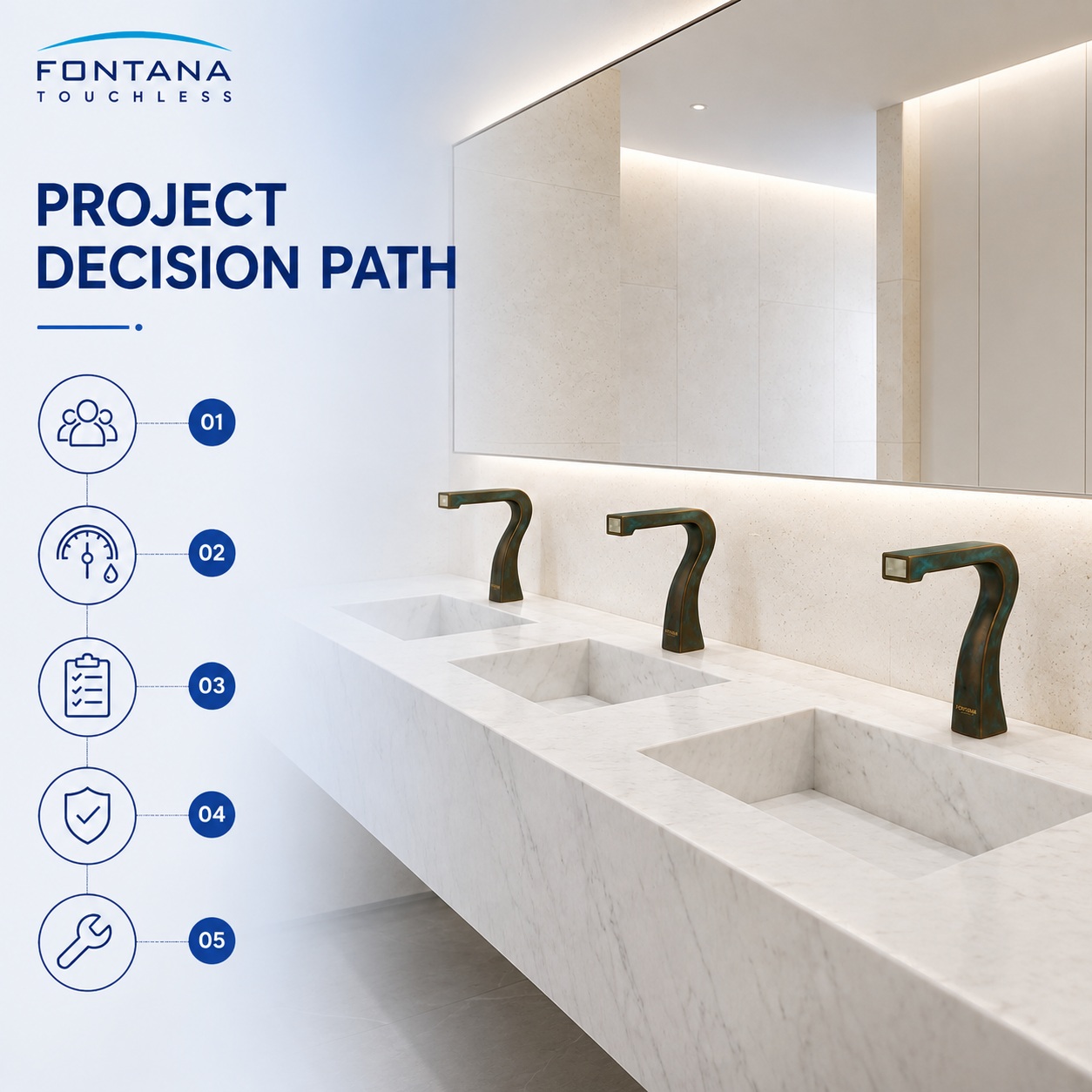
01
Define Demand
Document users, traffic, fixture count, peak demand, operating hours, and facility criticality.
02
Review Conditions
Confirm pressure, power, water quality, basin geometry, temperature control, and service access.
03
Compare Systems
Evaluate sensing, flow, materials, finish, power, valve configuration, documentation, and components.
04
Verify Compliance
Review codes, accessibility, project specifications, certifications, and authority requirements.
05
Plan Lifecycle
Prepare commissioning, training, asset records, spare parts, maintenance, and future renewal.
COMMERCIAL PROJECT SUPPORT
Bring Facility Operations into the Specification Process
Early facility involvement can identify maintenance-access conflicts, unsuitable power arrangements, difficult basin combinations, inconsistent finishes, unavailable components, and operational requirements that may not be visible during architectural selection.
Use Fontana technical resources to prepare product questions, coordinate project requirements, review commercial fixture options, and develop a more complete restroom standard for the property.
ACCESS SPEC RESOURCES
REVIEW BIM OBJECTS
DOWNLOAD BIM FILES
PREPARE FOR A PRODUCT REVIEW
Information to Collect Before Contacting a Specialist
Providing complete project information helps reduce back-and-forth communication and supports a more relevant product review.
Project Information
✓
Building type and location
✓
New construction or renovation
✓
Design and installation schedule
✓
Architect, engineer, and contractor
Fixture Requirements
✓
Required fixture quantities
✓
Faucet and soap configuration
✓
Preferred finish and mounting type
✓
Flow, power, and sensing requirements
Technical Conditions
✓
Available operating pressure
✓
Basin and counter information
✓
Electrical or battery preference
✓
Applicable project standards
FACILITY PROJECT RESOURCES
Specify with Greater Confidence
Review commercial products, technical data, maintenance guidance, BIM resources, and facility-specific planning information before standardizing fixtures across your building portfolio.
The strongest project decisions connect design quality with installation requirements, reliable operation, practical maintenance, documented compliance, and long-term component support.
EXPLORE TOUCHLESS
VIEW FAUCET & SOAP
COMMERCIAL CATALOG
TECHNICAL LIBRARY
Professional notice: Product availability, specifications, finishes, certifications, dimensions, performance values, and technical requirements may vary by model and project. Always confirm current information through the applicable FontanaShowers™ product page, approved technical documentation, project professionals, and authorities having jurisdiction before purchase or installation.
Professional Facility Management
Facility Management with FontanaShowers™
Reliable restroom and water-delivery systems help facility managers protect building performance, hygiene, accessibility, operating continuity, and the long-term value of every property.
Technical Resources
View Fixtures
BUILDING PERFORMANCE
Why Facility Management Matters
Facility management connects building operations, occupant safety, preventive maintenance, compliance, resource efficiency, and lifecycle planning. In commercial restrooms, every faucet, soap dispenser, valve, power supply, aerator, and plumbing connection influences daily reliability. A poorly selected fixture can create repeated service calls, water waste, inconsistent activation, difficult cleaning, or unavailable replacement components.
For an established brand such as FontanaShowers™ and Fontana Touchless Faucets™, product selection extends beyond appearance. Facility teams need dependable technologies supported by technical information, accessible components, appropriate flow rates, suitable power configurations, and service pathways that can be managed throughout the life of the building.
Core Facility Management Priorities
Specification-grade restroom systems should support maintenance planning, operational consistency, user accessibility, and measurable water-control objectives.

Operational Reliability
Facility managers benefit from fixtures designed for repeated daily activation, stable sensing, controlled water delivery, and practical access to serviceable components.
Review Reliability →
Hygiene Support
Touch-free activation helps reduce unnecessary contact with frequently used fixture surfaces while supporting consistent handwashing access in shared environments.
Explore Hygiene →

Water Management
Timed activation and specified flow rates can help facilities control consumption without depending entirely on users to shut off the water supply.
WaterSense Guidance →
LIFECYCLE PLANNING
From Reactive Repairs to Planned Maintenance
Effective facility management replaces emergency response with documented inspection and maintenance routines. Sensor windows should remain clean, aerators and strainers should be checked for debris, batteries should be replaced before full depletion, and shutoff valves should remain accessible. Maintenance teams should also document fixture locations, model numbers, finish selections, power sources, installation dates, and replacement-part requirements.
Fontana Touchless Faucets™ can be evaluated through technical documentation, commercial product categories, BIM resources, and maintenance guidance. This information supports better coordination between facility managers, plumbing contractors, engineers, architects, procurement teams, and building owners.
Maintenance Guidance
Facility Applications
Commercial restroom requirements vary by building type. Healthcare properties may emphasize hygiene and controlled flow, while airports, schools, offices, hospitality properties, and entertainment venues may prioritize durability, accessibility, capacity, and simplified maintenance.
Healthcare Facilities
Support hygiene-sensitive restroom planning with touchless fixtures, serviceable controls, appropriate flow selection, and documented maintenance procedures.
Healthcare Solutions →
Commercial Buildings
Coordinate restroom fixtures with architectural design, plumbing requirements, accessibility goals, expected traffic levels, finish schedules, and facility service standards.
Commercial Applications →
PROFESSIONAL DOCUMENTATION
Resources for Facility Teams
A coordinated documentation library helps reduce uncertainty during specification, installation, commissioning, and future service. Facility managers can review commercial fixture categories, BIM information, Revit resources, maintenance guidance, accessibility requirements, and industry-specific applications.
Manage Better-Performing Restroom Systems
FontanaShowers™ and Fontana Touchless Faucets™ provide facility professionals with access to commercial fixture collections, technical resources, architectural documentation, and application-focused product information for modern building programs.
Touchless Systems
Faucet & Soap
Facility Performance Reviews
Commercial Restroom Field Feedback
Reliability
|
Maintenance
|
Flow Control
Absolutely Love It!
SC
Summit Collective Architects
Facility Manager
|Chicago
As a facility manager, I selected this faucet for a university upgrade. Its CSI Division 22 specifications were easy to reference, and the solenoid performance ensures durability for continuous student use. The integrated soap dispenser system also supports efficiency, and maintenance staff reported minimal calibration adjustments over six months.
Clean Commercial Solution
ER
Emma R
Facility Manager
|Seattle, WA
Facility managers report reliable sensor performance and reduced water waste in public restrooms. The finish is easy to maintain and resists fingerprints. Overall quality is well-suited for commercial environments, with dependable electronics and solid construction. Customer service earns positive feedback for coordination, packaging, and timely delivery.
|
|
|






.png)