Fontana FS6108BDPX Commercial Touchless Faucet
A cleaner AEC-oriented product presentation for high-traffic restroom specification, balancing visible core performance data with expandable technical interpretation, service guidance, and lifecycle content.
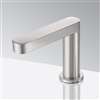
Coordinating finish option for commercial restroom projects.
Fontana Touchless Hands Free Faucet
The Fontana ToF FS6108BDPX touchless faucet is engineered for high-traffic commercial restroom environments where reliability, response speed, and maintenance control are critical. The integrated infrared sensor with an adjustable detection range of 6.2"–12.5" supports more stable activation across varied sink depths and reflective conditions. With inductive opening under 1 second and closing under 2 seconds, the faucet is designed for controlled water delivery aligned with commercial usage patterns. The dual AC/DC power configuration supports both new construction and retrofit applications, while the 0.05–0.6 MPa operating range improves compatibility across low- and high-pressure systems. The single-hole deck-mounted format supports standard U.S. plumbing layouts, and ADA-ready operation makes the unit suitable for airports, office buildings, healthcare facilities, and institutional restrooms.
Technical Specifications
- Brand Name: FontanaShowers®
- Model Number: FS6108BDPX
- Type: Touchless Bathroom Faucet
- Surface Treatment: Brushed
- Water Pressure: 0.05-0.6 MPa
- Finish: Brushed
- Faucet Mount: Single Hole
- Style: Contemporary
- Sensing: ToF Sensor
- Chrome Plating: 24/48 Hours Salt Spray Test
- Operating Temperature: 0.1-50℃
- Installation Type: Deck Mount
- Power Supply: DC & AC
- Sensing Distance: 6.2-12.5" or adjustable
- Inductive Opening Time: < 1 second
- Inductive Closing Time: < 2 second
- Usage: Commercial
- Compliance: ADA Compliant
Ideal for public restrooms, restaurants, office buildings, public facilities, and airports. Fits standard U.S. plumbing layouts.
Sensor Range
6.2"–12.5"
See Details
Adjustable sensing window supports better calibration across different basin depths and reflective conditions.
Response Time
< 1 sec
See Details
Fast hand detection supports improved user flow at busy sinks and reduces repeated user hand movement during peak traffic periods.
Auto Shutoff
< 2 sec
See Details
Controlled shutoff supports tighter water-use management after hand removal in continuous-use commercial environments.
Power Configuration
AC / DC
See Details
Flexible power planning supports both retrofit installations and more permanent commercial layouts where service continuity matters.
Specifier Summary
For architects, designers, contractors, and facility managers, the value of the FS6108BDPX is in how its listed numbers translate into real restroom operation. The adjustable sensing window supports better commissioning across different sink geometries, the sub-1-second response improves activation consistency during peak traffic, the sub-2-second shutoff supports better water control, and the 0.05–0.6 MPa operating range broadens compatibility across both retrofit and new-build systems. Combined with AC/DC power flexibility, the faucet is positioned as a practical touchless solution for commercial restroom environments where throughput, water control, and maintenance planning matter more than appearance alone.
Performance Scoring Table
This weighted comparison framework is intended to interpret which factors matter most when selecting a commercial touchless faucet for high-traffic restroom use.
| Evaluation Factor |
Weight |
What Is Measured |
Best-in-Class Commercial Benchmark |
| Sensor Accuracy |
30% |
Detection consistency, false-trigger resistance, response stability |
Precise hand detection with minimal nuisance activation in reflective and high-traffic settings |
| Durability |
25% |
Body material, valve cycle life, finish endurance, abuse resistance |
Commercial-grade body with stable finish retention and long-cycle internal performance |
| Maintenance |
20% |
Service access, filter cleaning, internal component accessibility |
Low service frequency with accessible serviceable parts |
| Installation |
15% |
Mounting simplicity, control access, power flexibility |
Single-hole compatibility with flexible AC/DC service planning |
| Operating Cost |
10% |
Water control, downtime exposure, long-term service burden |
Lower water waste risk and reduced operational interruption |
| Product Type |
Sensor Accuracy (30) |
Durability (25) |
Maintenance (20) |
Installation (15) |
Operating Cost (10) |
Total Score (100) |
| Premium Hardwired TOF Commercial Faucet |
28 |
24 |
18 |
13 |
9 |
92 |
| Hybrid IR Commercial Faucet |
25 |
22 |
17 |
14 |
9 |
87 |
| Battery IR Standard Commercial Faucet |
22 |
19 |
15 |
14 |
8 |
78 |
Failure Share and Mitigation Table
Common commercial service issues are usually influenced by sink reflectivity, commissioning quality, water conditions, and service access planning.
| Failure Category |
Share of Service Issues |
Typical Root Cause |
Engineering Interpretation |
| False Triggering |
20%–30% |
Reflective surfaces or unstable sensing window alignment |
Adjustable range and more controlled detection logic support better calibration across sink conditions |
| Activation Delay |
12%–20% |
Improper mounting geometry or basin mismatch |
Short response timing supports faster user interaction in high-traffic environments |
| Delayed Shutoff |
10%–18% |
Valve timing inconsistency or poorly tuned control logic |
Shutoff under 2 seconds supports water-control targets in continuous-use environments |
| Power Service Disruption |
15%–25% |
Missed battery replacement or limited access planning |
AC/DC configuration gives greater flexibility for new construction, retrofit work, and service continuity planning |
Environment Risk Index Table
Commercial faucet selection should reflect traffic volume, maintenance response capability, risk of misuse, and sensitivity to downtime.
| Environment |
Usage Intensity |
Main Risk |
Recommended Configuration |
Risk Index |
| Airport |
Very High |
Continuous use, nuisance activation, service interruption |
Hybrid or hardwired touchless faucet with stable sensing control |
9.5/10 |
| Healthcare |
High |
Hygiene sensitivity, low tolerance for downtime |
Low-flow commercial faucet with predictable detection zone |
9.0/10 |
| Office Building |
Medium |
Service scheduling and cost control |
Battery or hybrid commercial faucet depending maintenance staffing |
6.8/10 |
| Institutional Restroom |
High |
Misuse, repetitive cycles, maintenance burden |
Durable commercial touchless faucet with adjustable sensing range |
8.6/10 |
Lifecycle Cost / TCO Mini Model
First cost alone rarely reflects the real ownership burden in high-traffic restrooms. Power servicing, water-use control, and downtime exposure are typically more important over time.
| Cost Category |
Battery IR Faucet |
Hybrid Commercial Faucet |
Hardwired TOF Faucet |
| Initial Unit Cost |
Low |
Medium |
High |
| Installation Cost |
Low |
Medium |
Higher |
| Battery Replacement Cost |
High over time |
Low |
None |
| Water Waste Risk |
Moderate |
Lower |
Lowest |
| Downtime Exposure |
Higher |
Lower |
Lowest |
| Long-Term Maintenance Burden |
Moderate to High |
Moderate |
Low |
Technical FAQ
Why do touchless faucets fail?
Service issues usually result from reflective interference, poor commissioning, mineral buildup, or inconsistent power planning rather than from sensor technology alone.
Why does sensing range matter?
Sensing range affects how well the faucet can be calibrated to basin depth, sink angle, and reflective surfaces. More adjustability generally improves activation consistency in real restroom conditions.
What power option is better for commercial use?
Hardwired or hybrid AC/DC configurations are often preferred for higher-traffic projects because they reduce outage risk and improve maintenance planning across multiple fixtures.
Where is this model best suited?
This configuration is best suited to airports, office buildings, healthcare facilities, institutional restrooms, and other commercial environments where stable detection, fast activation, and lower service interruption are important.
Fontana Touchless Features:
|