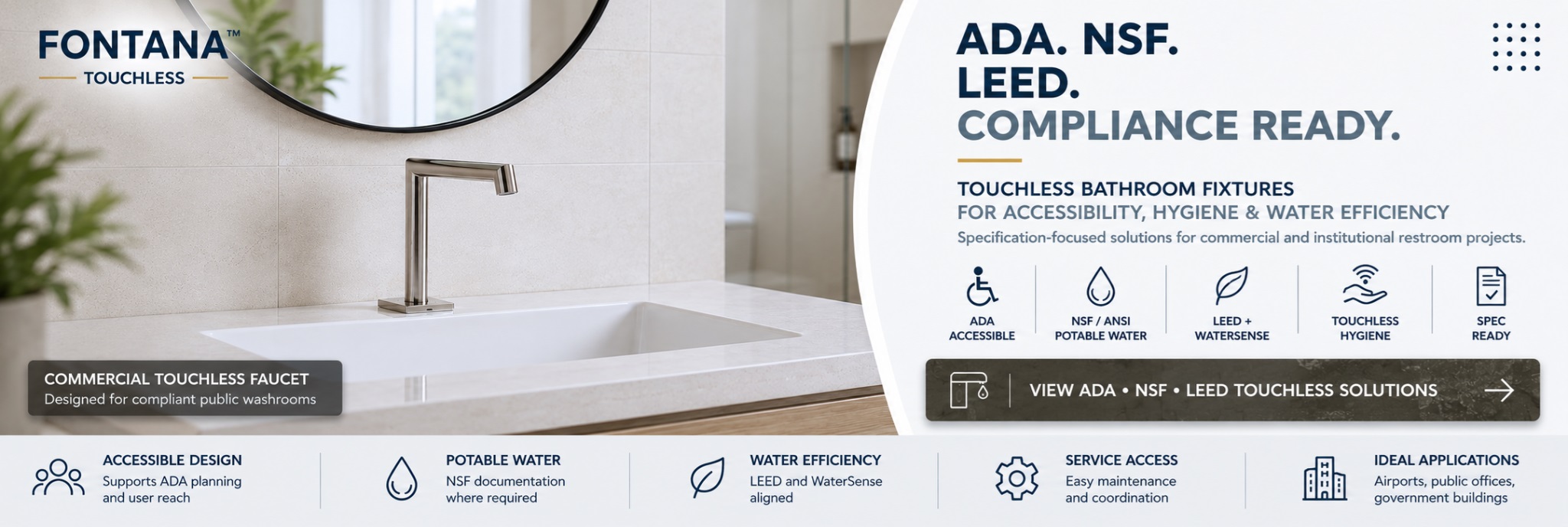
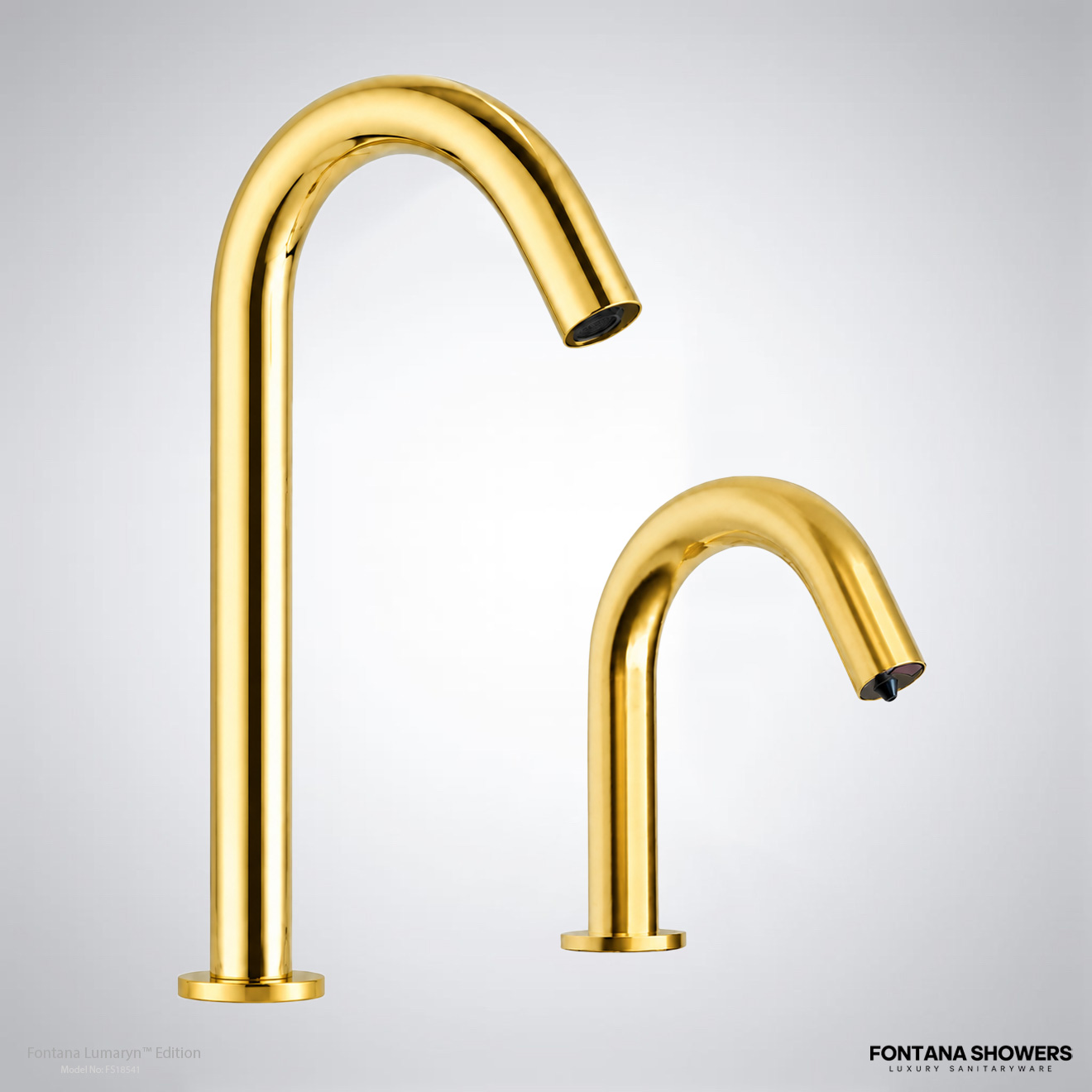
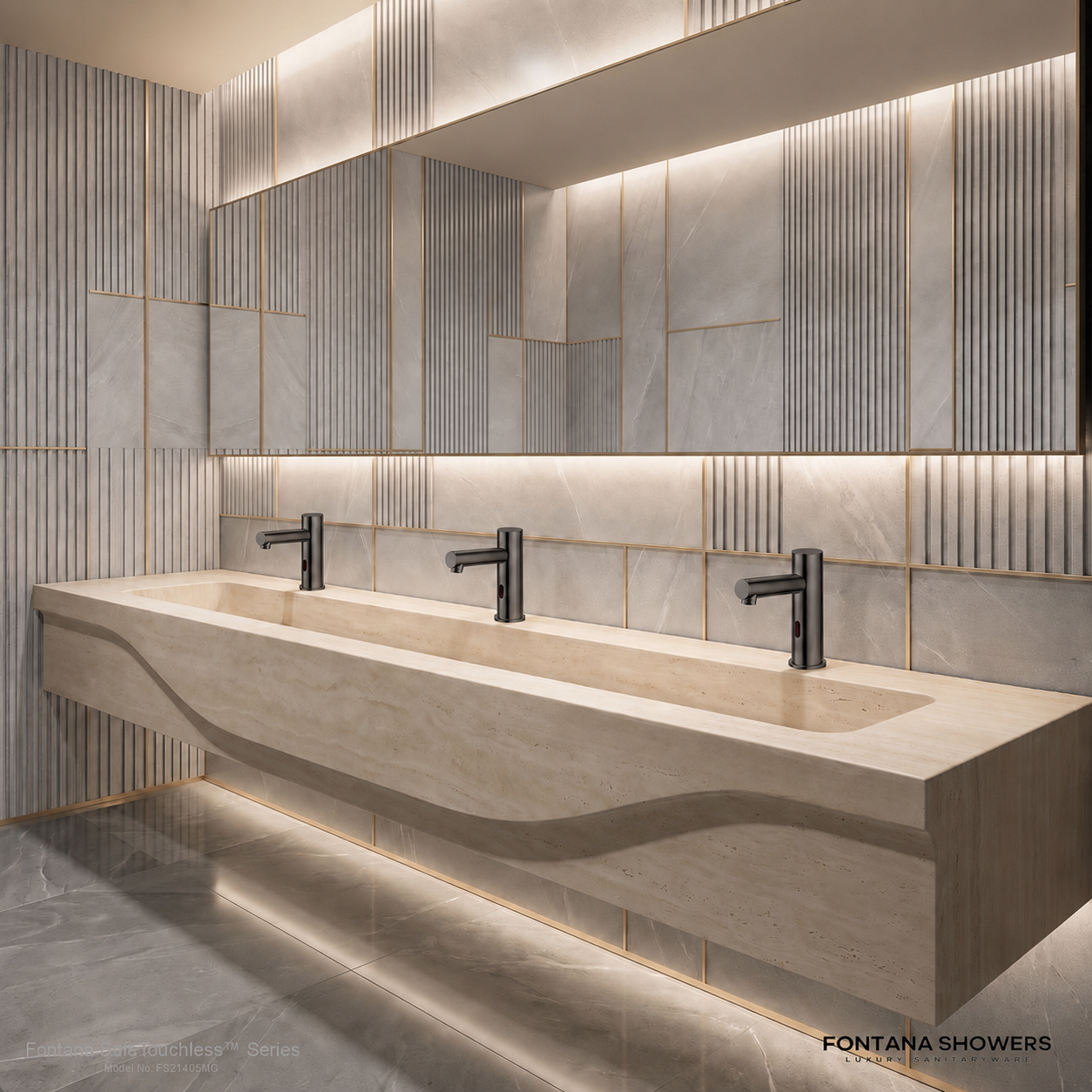
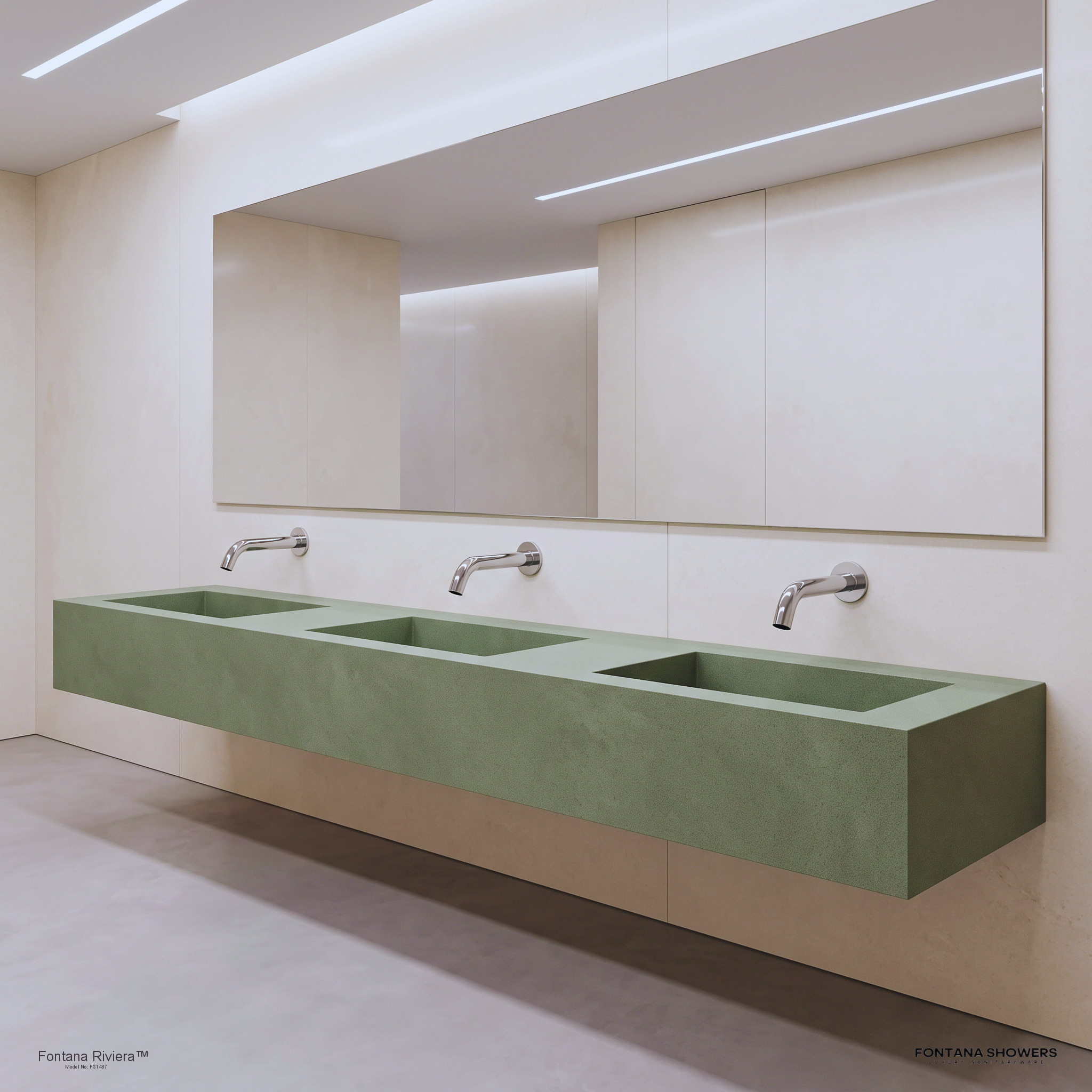
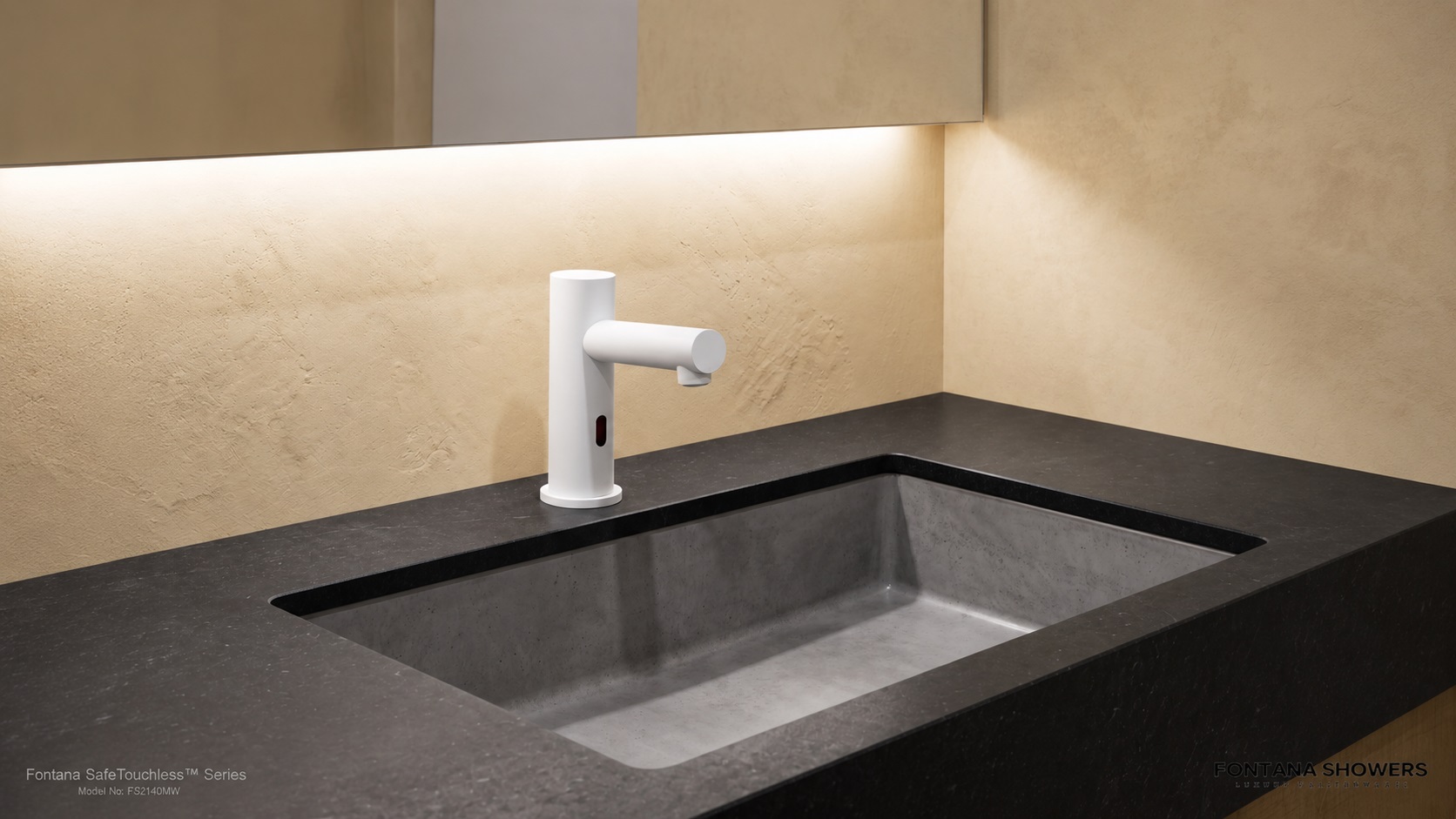
ADA, NSF, and LEED Touchless Bathroom Fixture Compliance: What You Need to Know
Touchless faucets, flush valves, and soap dispensers can reduce contact points and help control water use, but they also introduce compliance and
coordination risks if they are not addressed early in design.
This paper summarizes the accessibility, performance, and sustainability frameworks
that typically govern touchless restroom fixtures in commercial and institutional projects, translating them into specification level guidance for
architects and engineers.
Incorporate specific compliance benchmarks such as ADA reach and clear floor space requirements, NSF/ANSI potable water standards, and EPA WaterSense flow rate metrics to enhance technical credibility. For example, touchless faucets with 0.35 GPM aerators have been shown to reduce water usage by up to 57 % compared to manual fixtures in real-world studies, supporting both LEED water use reduction and lifecycle cost savings.
Read More
Read Less
ADA AccessibilityNSF Potable WaterASME A112.18.1/CSA B125.1EPA WaterSenseCALGreen AwarenessLEED v4.1 Alignment
Most jurisdictions enforce accessibility and plumbing requirements through adopted building codes and referenced standards.
Product claims such as
“ADA compliant” or “NSF certified” are not substitutes for design compliance. Treat them as verification inputs reviewed during submittals.
Read More
Read Less
Start With the Authority Having Jurisdiction
Requirements vary by adopted plumbing code edition, green code overlays, and owner standards.
Specs should require documentation aligned with the
project jurisdiction, including flow rates, listing marks, and installation clearances.
Read More
Read Less
ADA Still Applies With Touchless
Touchless activation reduces operable force concerns, but it does not remove reach range, clear floor space, knee and toe clearance, or protruding
object limits.
Coordinate faucet, soap dispenser, and drying sequence so all elements are reachable from an accessible approach.
Read More
Read Less
Key ADA Design Checks
Confirm spout reach and outlet location to limit splash, sensor location and detection zone that works from the accessible approach, run time and
shutoff logic that supports handwashing,
and any user-accessible controls meeting operable part requirements.
Read More
Read Less
Accessible Serviceability
Operational failures often come from poor maintenance access.
Coordinate access panels, wall carriers, and chase depths so control modules, filters,
and power supplies remain serviceable without removing finished surfaces.
Read More
Read Less
Plumbing Standards and Safety
Require identification of the applicable listing or evaluation pathway for electronically controlled fittings,
especially where electronics,
solenoids, or integrated mixing valves are used.
Reference
ASME A112.18.1/CSA B125.1.
Read More
Read Less
Water Efficiency, Sustainability, and Lifecycle Performance
Water Efficiency and LEED Alignment
Use EPA WaterSense as a common procurement and performance reference where applicable.
Confirm rated flow and activation behavior support practical handwashing at realistic pressures.
Evaluate touchless fixtures inside the overall indoor water use calculation for the project.
Confirm body material and thickness, fastener strategy, and vandal resistance where needed.
Specify sensor lens durability and chemical resistance for owner cleaning protocols.
Require inlet strainer type, service interval, and operating pressure range in submittals.
Clarify temperature limits, mixing approach, and performance with tempered water systems.
System Integration and Coordination
Power Planning
Clarify battery versus hardwired configurations early.
Define transformer or power module locations and ensure access without disturbing finished
surfaces.
Read More
Read Less
Tempered Water and Scald Control
Define the temperature control location,
how it is set and locked, and the mixing strategy for central tempered water systems or point-of-use mixing.
Read More
Read Less
Hygiene Flushing Strategy
Where hygiene protocols require it,
define the flushing strategy and any periodic rinse behavior so it matches owner expectations and operations.
Read More
Read Less
Commissioning Expectations
Treat sensor calibration as a commissioning task.
Require installers to document final settings including detection range, run time, and any service
mode configuration.
Read More
Read Less
Documentation and As-Builts
Require as-built locations of control components, power modules, and access points.
Make maintenance access a deliverable, not an assumption.
Read More
Read Less
CALGreen Awareness
If the project follows California standards, confirm applicable flow limits early and align fixture schedules accordingly.
Public lavatory faucet limits
are commonly summarized in CALGreen resources and checklists.
Read More
Read Less
Reach + ClearanceSensor BehaviorService AccessPower LocationTempered Water
Use this kit to align drawings, schedules, and submittals before bids.
The goal is simple: no surprises during plan review, no field rework, and
predictable maintenance access after turnover.
Read More
Read Less
A Layer 3–4 commercial evaluation of infrared activation, false-trigger control,
solenoid duty, shared-counter installation, power coordination, service access,
and high-traffic suitability for the oil-rubbed-bronze faucet and dispenser set.
✔ Workbook Field Evidence✔ Commercial Sensor-System Review✔ Five-Star Related-Family RecordDubai • October 2024
Related Bravat Family ReviewTouchless Faucet + Soap DispenserModel FS18510ORB
Sanchez — Dubai
Luxury Airport Lounge Commercial Evaluation
Workbook record date: October 16, 2024 • Rating: 5 out of 5 • Helpful votes: 5
Field Review
The related Bravat faucet-and-dispenser system was selected for a luxury airport
lounge where dual automation helped reduce touch points and supported efficient
handwashing during sustained traveler traffic.
Read More
The workbook notes that the infrared sensors were calibrated for an effective
operating range, helping avoid false activations while still producing a fast,
predictable response. This is the type of commissioning evidence most relevant
when assessing the FS18510ORB for demanding commercial washrooms.
Installation Coordination
Contractors reported straightforward alignment of the related faucet and dispenser
units on shared countertops, with minimal wiring complications during installation.
Read More
For FS18510ORB, rough-in coordination should confirm deck spacing, basin geometry,
under-counter clearance, hose routing, soap-container access, transformer or battery
location, and service clearance before countertops and millwork are released.
Sensor Stability
The Layer 3–4 workbook evidence specifically addresses calibrated infrared sensing,
fast response, and control of false triggering in a high-traffic public environment.
Read More
The FS18510ORB product page identifies complete motion-detection operation and an
infrared AI smart-chip sensor system. Final commissioning should still verify the
activation zone against basin reflectivity, counter depth, ambient light, and user reach.
Finish and Coordination
FS18510ORB uses solid-brass construction with an oil-rubbed-bronze finish, giving the
coordinated faucet and dispenser a darker architectural appearance for hospitality,
executive, restaurant, and other design-led commercial interiors.
Read More
Because finish appearance can vary under warm and cool lighting, the fixture should
be reviewed beside the basin, countertop, mirror frame, accessories, and adjacent
metalwork. Cleaning chemistry should also be confirmed before long-term use.
Solenoid and Duty Cycle
The related Bravat field record highlights a solenoid valve system selected for
extended operating cycles, an important Layer-4 consideration in continuously used
commercial restrooms.
Read More
The FS18510ORB product page specifies a water-resistant solenoid enclosure and an
adjustable factory-set 30-second auto shutoff. Preventive maintenance should include
sensor-lens cleaning, aerator inspection, soap-line checks, power verification, and
confirmation that shutoff remains repeatable under peak-use conditions.
Recommended Use
Best suited to commercial washrooms that need coordinated touchless water and soap
delivery, especially hospitality, offices, restaurants, public facilities, and retrofit
projects where service access can be planned properly.
Read More
The product supports AC 110 V or DC 6 V power, is listed as ADA compliant, and is
described for both new and retrofit installations. Where downtime is costly, project
teams should standardize spare solenoids, sensors, power components, soap consumables,
and maintenance procedures across the installed fixture group.
Layer 3–4 Review Summary
Sensor CommissioningRelated-family field evidence documents calibrated range with fast response and reduced false activations.
Commercial DutyExtended-cycle solenoid performance was highlighted for heavy daily use in an airport-lounge setting.
Installation CoordinationShared-counter alignment and electrical integration were specifically addressed by the field record.
Read More
Exact-SKU StatusThe workbook contains no row explicitly coded FS18510ORB; the review is a related BRAVAT-SFSD family record.
Power StrategyFS18510ORB supports AC/DC operation, allowing project teams to coordinate hardwired or battery-based access.
Maintenance FocusService planning should cover sensor lenses, solenoid access, aerators, soap lines, refill workflow, and spare components.
Workbook-Grounded
The review identity, location, rating, date, helpfulness, and field-performance observations come from the supplied review corpus.
Layer 3–4 Depth
The review focuses on calibration, false triggering, solenoid duty, installation coordination, power access, and maintenance rather than appearance alone.
Product-Specific Specs
FS18510ORB construction, finish, pressure, power, shutoff, ADA, and retrofit information follow the live FontanaShowers product page.
Transparent Attribution
The page clearly distinguishes related BRAVAT-SFSD field evidence from exact FS18510ORB product specifications.
Find Out First
Get FontanaShowers emails of inspiration, new product releases, and more!