Best Kitchen Faucet and Soap Dispenser Combos for Multifamily Units
Multifamily Kitchens
Kitchen Faucets
Soap Dispensers
AEC Specification
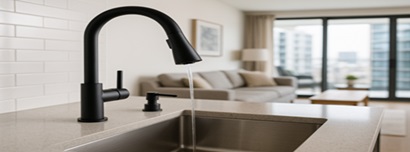
Why Faucet + Soap Dispenser Combos Matter in Multifamily
For architects, plumbing engineers, and multifamily developers, the selection of kitchen faucets and integrated soap dispensers is a seemingly minor decision with major implications at portfolio scale. These fixtures influence hot and cold water consumption, accessibility compliance, maintenance workload, resident satisfaction, and the long-term operating cost of the asset across 50, 200, or more units.
In a single-family kitchen, an owner can live with a quirky faucet or flimsy deck-mounted dispenser. In multifamily, those quirks become patterns:
- Repeated maintenance tickets for stuck pumps or loose dispenser heads
- Tenant complaints about low flow, splashing, or hard-to-use controls
- Inconsistent finishes that make units look “value engineered” instead of intentionally designed
By standardizing coordinated faucet and dispenser combinations from a single manufacturer, such as
FontanaShowers kitchen faucets,
project teams can drive:
- Operational efficiency: Durable cartridges, metal bodies, and robust pump assemblies reduce service calls and replacement cycles.
- Water and energy performance: Low-flow aerated faucets reduce domestic hot water loads while maintaining acceptable rinsing performance.
- Perceived value and leasing velocity: Matching faucet and dispenser finishes (matte black, brushed nickel, brushed gold, stainless) creates a cohesive, “designed” kitchen look.
When multiplied across an entire building, the “faucet + soap dispenser combo” becomes a strategic design decision, not just a finish selection.
Performance, Codes, and Standards that Drive Your Spec
Performance requirements and regulatory standards should shape your kitchen faucet and soap dispenser selections, especially when documenting Division 22 scope and BIM content for multifamily projects.
-
Flow rates and low-flow strategy: In the U.S., federal law caps most faucets at 2.2 gpm, with low-flow fixtures engineered below that threshold for conservation. Many multifamily teams target
1.5–1.8 gpm at 60 psi using aerators or flow restrictors to balance savings and user comfort
(
low-flow fixtures overview,
EPA WaterSense technical sheet).
In Division 22, call out maximum flow rate (gpm), test pressure, and aerator type so future changes are easy to manage.
-
Lead-free and potable water compliance: For fixtures in potable water paths, look for documentation of
NSF/ANSI/CAN 61 and NSF/ANSI/CAN 372, which support Safe Drinking Water Act “lead-free” definitions and limit total lead and leachate into drinking water
(
NSF guidance).
Require listing or test reports for both the faucet and any deck-mounted dispenser that may contact potable water or food-prep areas.
-
Accessibility and ADA reach ranges: In accessible units, faucet levers and dispenser actuators are
operable parts and must fall within forward and side reach ranges—typically 15–48 in above finished floor, with tighter limits where reach is over a counter
(
ADA reach ranges,
Access Board operable parts guide).
Controls should be operable without tight grasping or twisting—single-lever, paddle, or touch/touchless options help.
Tie these requirements directly into your notes and schedules so code reviewers, GCs, and owner’s reps can clearly see how each faucet + dispenser combo supports performance and compliance goals.
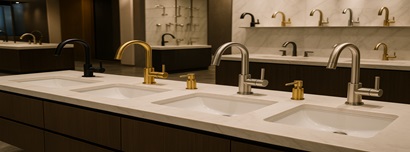
Winning Faucet + Soap Dispenser Combo Archetypes
Rather than treating every unit as a one-off, you can standardize a small set of “combo archetypes” and map them to your unit mix. For each archetype, align specific Fontana models in your kitchen fixture schedules and BIM families.
-
Standard pull-down spray faucet + deck-mounted soap dispenser:
The workhorse combo for most market-rate units. Pair a single-handle pull-down faucet (1.5–1.8 gpm, ceramic cartridge, swivel spout) from
FontanaShowers kitchen faucets
with a top-fill deck-mounted dispenser to simplify maintenance. For higher-end units, swap in an
automatic soap dispenser for kitchen sinks.
-
Touch-activated kitchen faucet + manual soap dispenser:
Touch-activated models such as the
Dax touch-activated kitchen faucet
provide “near touchless” operation without sensor complexity. Pair with a simple deck-mounted pump in the same finish for a premium yet intuitive combo.
-
Fully touchless faucet + touchless kitchen soap dispenser:
For health- and wellness-branded rentals or condos, coordinate a sensor faucet with a matching
touchless kitchen soap dispenser
or
automatic soap dispenser for kitchen sinks,
keeping sensor logic, time-outs, and power (AC or battery) coordinated.
-
Finish-forward combos for premium and penthouse units:
Use brushed gold, matte black, stainless, or brushed nickel combos—ideally with PVD or comparable high-durability finishes—to differentiate top-floor or premium units.
Collections such as Fontana’s
brushed gold kitchen soap dispensers
and
stainless steel kitchen faucets
help maintain a consistent high-end look.
These archetypes give you a repeatable playbook you can scale across typical, premium, and accessible units while keeping SKUs manageable.
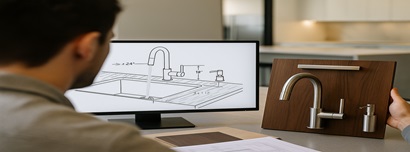
Layout, Clearances, and Coordination with Cabinets & Counters
Even the best faucet + dispenser combo will underperform if the layout is wrong. Use your drawings and BIM models to lock in hole patterns, reach ranges, and under-sink coordination early in design.
-
Hole pattern and spacing:
Decide up front whether you’re using a single-hole faucet with one additional hole for the dispenser or a 3-hole spread with an escutcheon. Keep centers close enough that both faucet and dispenser are within comfortable reach, especially in accessible units.
-
Reach and usability:
Match spout reach to bowl size to avoid hitting the back wall or causing splashing. Maintain ADA reach ranges by limiting the distance from the front edge of counter to faucet and dispenser actuators, typically under 24 in for accessible kitchens
(
ADA reach guidance at sinks).
-
Under-sink space and power:
For touchless combos, coordinate GFCI outlets, transformers, soap bottles, garbage disposals, traps, and water lines. Provide clear maintenance zones and show them in details so nothing ends up blocked.
-
Standardization across unit types:
Encode one or two “families” of faucet + dispenser combos as Revit types with consistent parameters. This supports reliable multifamily kitchen fixture schedules, smoother procurement, and easier QA in the field.
Treat the kitchen sink, faucet, dispenser, and under-cabinet services as a single assembly during coordination—this is where constructability and accessibility meet resident experience.

What to Capture in Division 22 Specs and Kitchen Fixture Schedules
A clear Division 22 section and coordinated kitchen fixture schedules help ensure that substitutions truly match design intent and that owners understand what they’re getting.
For each faucet + soap dispenser combo, document at minimum:
-
Model or collection names:
Identify the exact Fontana faucet line and a matching
automatic soap dispenser for kitchen sink
or manual pump.
-
Flow rate and operating type:
Flow (gpm) at design pressure, aerator options, and whether operation is manual single-lever, touch-activated, or sensor-operated.
-
Finish and durability:
Finish color (stainless, brushed nickel, matte black, brushed gold, etc.) and indication of PVD vs plated coatings for long-term performance.
-
Certifications and listings:
NSF/ANSI/CAN 61, NSF/ANSI/CAN 372, ASME A112.18.1/CSA B125.1, and any jurisdictional or water-efficiency requirements associated with the project.
-
Power and soap details:
Voltage and transformer location for touchless units, compatible soap type and viscosity, bottle capacity, and whether refilling is top-fill or bottom-fill.
When these parameters are embedded in BIM objects, GCs and owner’s reps can rapidly verify alternatives and maintain consistency across large multifamily buildings.

Submittals, Mockups, O&M, and Long-Term Value
On larger multifamily projects, treat the kitchen faucet + soap dispenser as a mini-system with its own submittals, mockups, and O&M strategy. This approach reduces surprises during construction and supports long-term asset performance.
-
Submittal review:
Require cut sheets for both faucet and dispenser with matching finish codes, installation diagrams showing reach distances and clearances, and confirmation of certifications and flow rates.
-
Unit mockups:
In typical-unit mockups, validate real-world use: seated reach to the dispenser, pull-down hose retract performance, and soap pump stability and priming behavior.
-
Maintenance documentation:
Request O&M manuals and recommended service intervals for cartridges, aerators, and sensor components from Fontana or your chosen manufacturer. Standardize replacement SKUs so the owner can stock a compact but effective parts inventory.
-
Lifecycle planning:
Higher-quality combos with robust cartridges and PVD finishes can extend replacement cycles over 10–15 years, often offsetting modest first-cost premiums—especially for institutional owners with long hold periods.
By standardizing on coherent, tested combinations—such as
FontanaShowers kitchen faucets
paired with purpose-built
automatic soap dispensers for kitchen sinks—you create kitchens that are easier to build, easier to maintain, and easier to lease across your multifamily portfolio.

|
|
|