Fontana Chrome Wall-Mounted Sensor Faucets™ | Architectural and Engineering Resource
Chrome Wall Mount Sensor Faucets:
Maintenance and Design Guide
This maintenance and design guide is intended to support architects,
plumbing engineers, interior designers, contractors, installers,
specifiers and facility managers coordinating Fontana chrome wall-mounted
automatic sensor faucets across commercial, hospitality, healthcare,
institutional and public washroom projects. The guide addresses design
integration, faucet placement, basin coordination, sensor environment,
service accessibility, cleaning, inspection, concealed component access,
power maintenance and long-term operational care across the available
faucet configurations within this category.
Fontana Chrome Wall-Mounted Automatic Sensor Faucets
This category includes multiple chrome wall-mounted automatic
sensor faucet configurations intended for hands-free lavatory
operation. Faucet profiles, wall flanges, concealed valves,
sensor positions, service arrangements and maintenance requirements
may vary according to the selected faucet model.
This page should be used as a category-level maintenance and
design resource rather than as a universal model-specific
maintenance manual. Final placement, concealed clearances,
sensor conditions, service procedures, power components and
replacement requirements must be verified using the approved
documentation for the selected model.
-
Category:
Chrome wall-mounted automatic sensor faucets
-
Installation:
Wall mounted
-
Operation:
Infrared touchless activation
-
Finish:
Chrome
-
Applications:
Commercial, hospitality, healthcare, institutional and public lavatories
-
Design requirements:
Model and project specific
-
Maintenance:
Periodic inspection and model-specific servicing
-
Water configuration:
Varies according to model and project requirements
-
Power configuration:
AC, battery or model-specific arrangement
-
Service access:
Required for concealed operating components
Required Maintenance and Design Review
Each faucet installation should be designed for reliable operation,
practical cleaning and future service access. The project team should
distinguish category-level design principles from model-specific
requirements and verify final placement, concealed component zones,
sensor conditions and maintenance procedures using the selected
faucet's approved documentation.
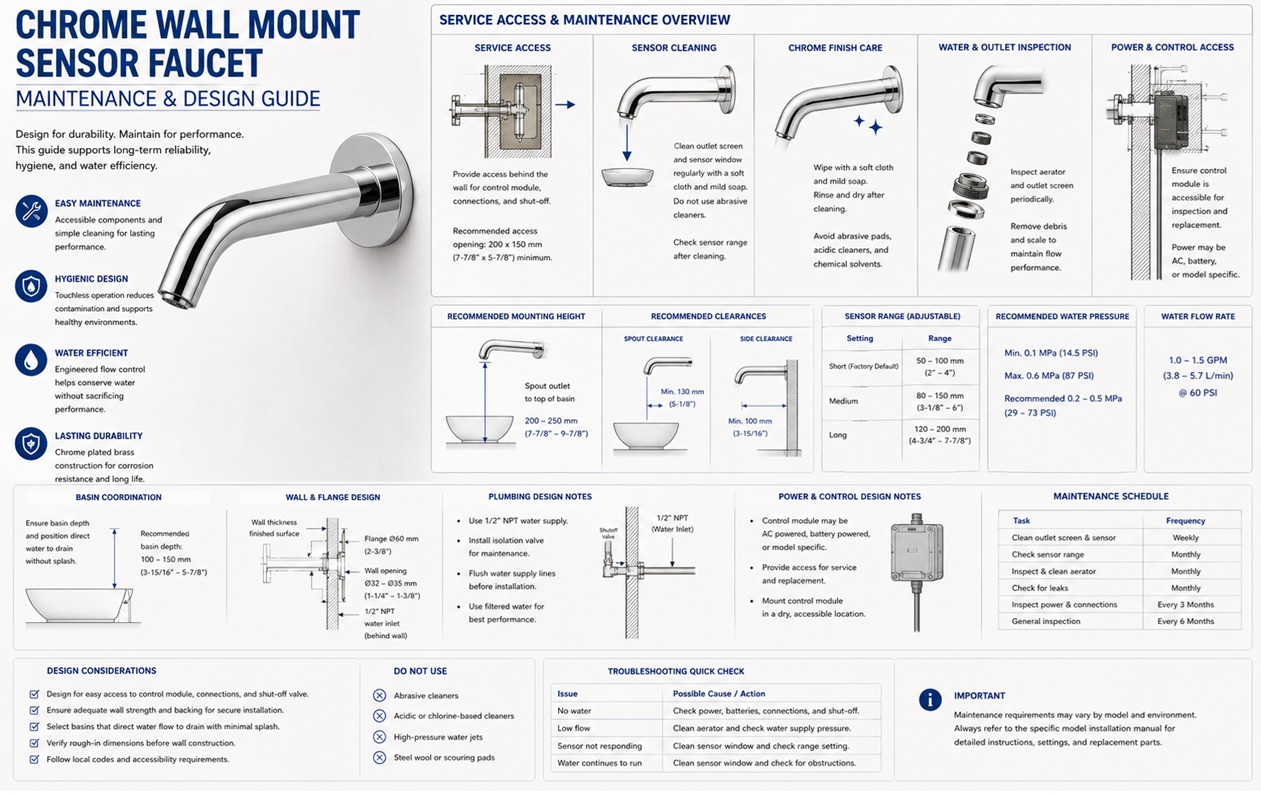
Maintenance and Design Guide
Provides an overall framework for integrating chrome wall-mounted
sensor faucets into commercial washrooms while supporting
cleaning, inspection, servicing and long-term operational access.
Faucet Selection
Select the faucet configuration according to project aesthetics,
basin geometry, sensor arrangement, power source, maintenance
strategy and intended commercial application.
Design Integration
Coordinate the faucet profile, mounting position, chrome finish,
wall construction and adjacent restroom elements as part of
the overall architectural design.
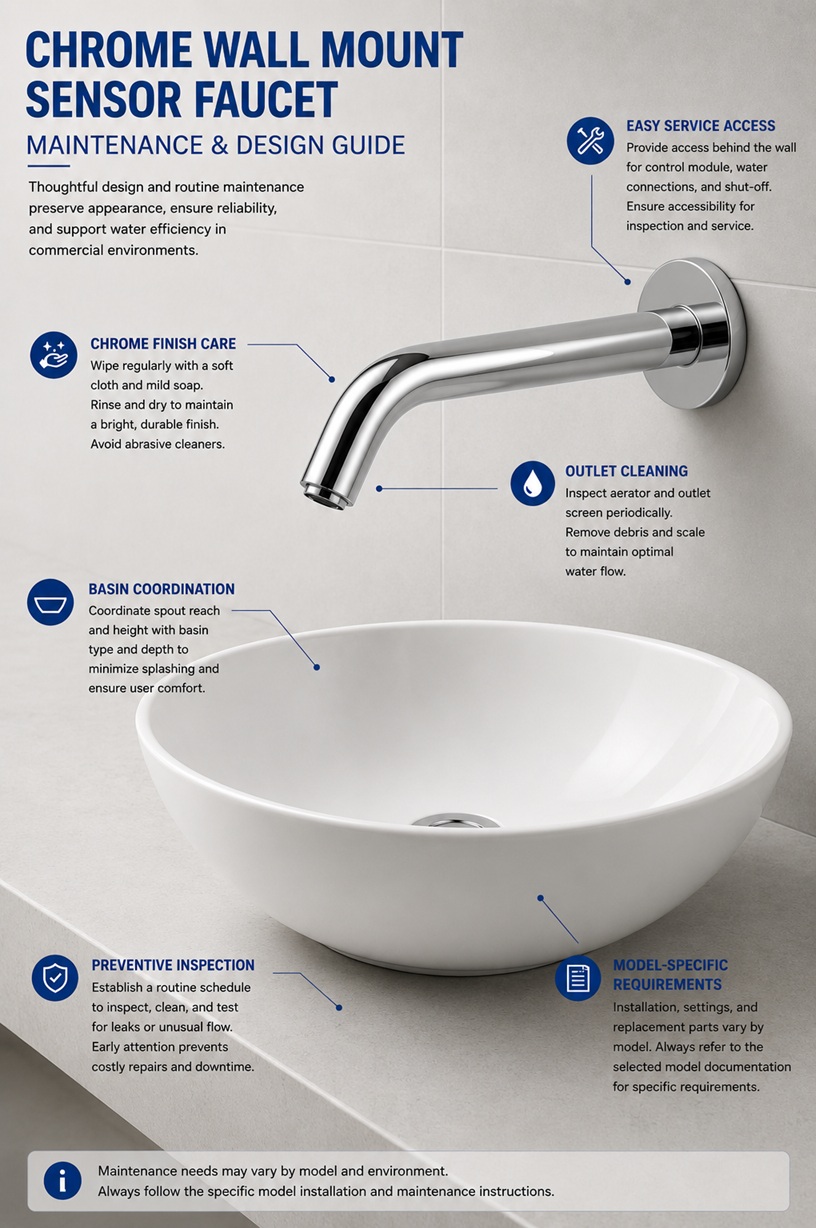
Basin Coordination
Coordinate faucet projection, outlet position, basin depth
and usable handwashing area to support practical water delivery
and comfortable hands-free use.
Sensor Environment
Review mirrors, polished surfaces, backsplashes and nearby
fixtures that may influence infrared sensing or create
unintended activation conditions.
Wall-Flange Coordination
Coordinate the exposed wall flange with tile joints, stone
panels, mirrors, backsplashes and adjacent accessories while
maintaining practical cleaning access.
Finished-Wall Design
Design the wall assembly so the faucet can be mounted securely
while preserving the required rough-in depth, finish interface
and future access to concealed components.
Mounting Support
Provide suitable backing, blocking or structural support
within the wall assembly according to the selected faucet
configuration and mounting method.
Service Access Design
Preserve practical access to valves, control boxes,
transformers, battery packs and other concealed components
without requiring removal of permanent finishes.
Cleaning Access
Maintain sufficient clearance around the faucet body,
wall flange and surrounding surfaces so routine cleaning
can be completed without obstructing the sensor area.
Chrome Finish Care
Maintain the chrome surface using cleaning methods compatible
with the selected product documentation and avoid procedures
that may damage plated or polished surfaces.
Sensor Cleaning
Keep the sensor window clean and unobstructed so dust,
residue, moisture or surface contamination does not interfere
with reliable infrared detection.
Water Outlet Inspection
Periodically inspect the faucet outlet and model-specific
aerator or flow-control components for debris, mineral buildup
or conditions that may affect water delivery.
Water Connection Inspection
Review accessible supply connections, valves and hoses for
signs of leakage, deterioration or movement according to
the selected model's service requirements.
Power System Maintenance
Inspect batteries, transformers, controllers and associated
connections according to the selected faucet's power
configuration and maintenance documentation.
Valve and Control Access
Maintain access to concealed valves and control assemblies
for inspection, adjustment, troubleshooting and replacement
without disturbing permanent architectural finishes.
Operational Inspection
Periodically test activation, water delivery and automatic
shutoff to identify changes in sensor response or operating
performance requiring maintenance.
Multi-Faucet Maintenance
In shared washbasins, inspect adjacent faucets consistently
and confirm that sensor zones, water delivery and service
access remain independent and functional.
Long-Term Verification
Confirm that mounting security, sensor condition, water
connections, power components, service access and visible
finishes remain suitable throughout the faucet's service life.
Maintenance note:
Category-level maintenance guidance does not establish universal service
intervals or procedures for every faucet within the category. Cleaning,
component inspection, battery replacement, sensor adjustment, valve
servicing and replacement procedures must be verified using the
approved technical and maintenance documentation for the selected model.
Category Maintenance and Design Workflow
Select and Coordinate
Choose the faucet according to design profile, basin geometry,
sensor arrangement, power source, maintenance strategy and
project application.
Review Documentation
Obtain the selected model's specification sheet, installation
instructions and technical documentation before finalizing
design or maintenance procedures.
Design for Access
Coordinate the wall assembly, concealed components and
service openings so future inspection and replacement can
be completed without damaging permanent finishes.
Coordinate the Basin
Confirm that faucet projection, outlet location, basin depth
and sensor zone support practical hands-free operation and
manageable splash conditions.
Inspect Routinely
Review the faucet surface, sensor window, outlet, water
connections, mounting condition and accessible operating
components during scheduled maintenance.
Check Sensor Operation
Confirm consistent touchless activation and verify that nearby
surfaces or accessories are not creating interference or
false activation.
Service Components
Service batteries, transformers, valves, controllers and
other model-specific components according to the approved
maintenance documentation.
Complete Verification
Confirm reliable operation, clean surfaces, secure mounting,
service accessibility and proper component condition after
maintenance activities are completed.
Design, Maintenance and MEP Coordination
Wall Construction
Coordinate framing, blocking, waterproofing, tile, stone
and wall panels so mounting stability and concealed service
access are maintained throughout the fixture's service life.
Plumbing Coordination
Maintain accessible supply routing, shutoff locations,
valves and serviceable plumbing connections to support
inspection and maintenance.
Electrical Coordination
Coordinate transformers, battery packs, control boxes and
cable routes so power components remain protected and
accessible for servicing.
Basin Compatibility
Verify that basin geometry supports faucet projection,
water delivery, practical cleaning and reliable sensor
operation.
Finish Coordination
Coordinate the chrome finish with mirrors, dispensers,
accessories and surrounding materials while maintaining
clear access for cleaning and inspection.
Multi-Faucet Design
In shared washbasins, maintain consistent centerlines,
appropriate fixture spacing and practical service access
while preventing overlapping sensor zones.
Chrome Wall-Mounted Faucet Maintenance Resources
Professional Design and Maintenance References
Maintenance and design verification:
This category-level maintenance and design guide does not replace
model-specific specifications, installation instructions or approved
project documentation. The architect, plumbing engineer, electrical
engineer, interior designer, contractor, licensed installer and facility
team should verify the selected faucet model, wall construction, mounting
support, basin coordination, sensor environment, water connections,
power configuration, cleaning requirements, service access, accessibility
criteria and locally adopted codes before installation and throughout
the fixture's service life.
|
|
|