FontanaShowers® | Architectural and Installation Resource
Fontana DualOrion™ Gold Widespread Basin Faucet: Hot and Cold Supply Connections
This plumbing-coordination resource helps designers, contractors and installers identify the hot and cold water routes serving the two crystal-handle valve assemblies. It addresses isolation valves, supply-line identification, flexible connection routing, valve inlets, the central spout connection, flushing, pressure testing and access for future maintenance.

Separate Supplies Feed Independent Controls
The left and right handle assemblies independently control the incoming hot and cold supplies before water is directed toward the central spout. Correct identification and organized routing help prevent reversed operation, crossed lines, hose strain and inaccessible shutoffs while supporting safe commissioning and future service.
- Hot supply: Routed to the hot-side valve inlet
- Cold supply: Routed to the cold-side valve inlet
- Isolation valves: Separate, accessible shutoffs for both services
- Valve outlets: Flexible connections leading toward the spout
- Line identification: Clear hot and cold marking before connection
- Routing: Smooth bends without crossing, twisting or pinching
- Commissioning: Flushing, pressure testing and leak inspection
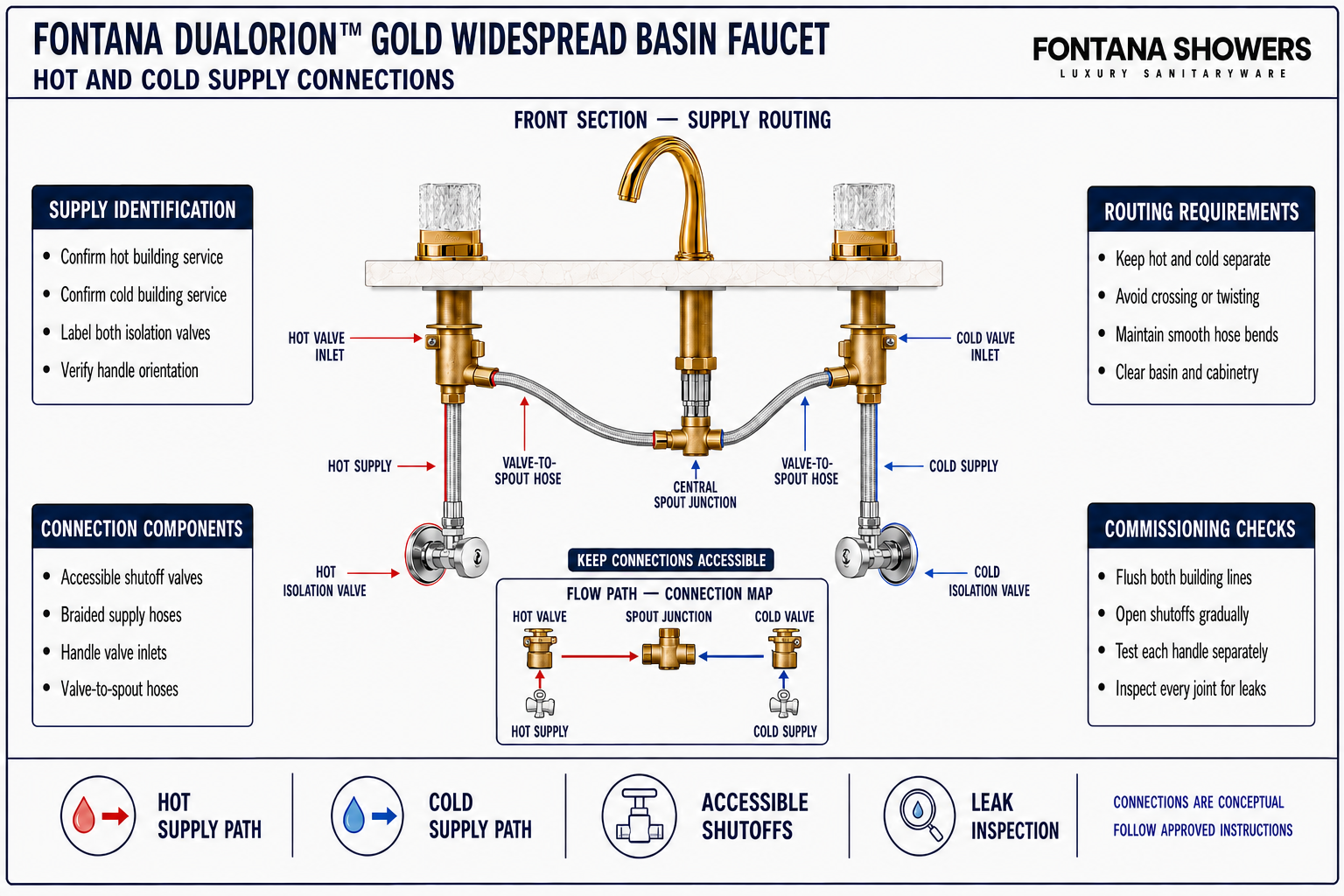
Hot and Cold Supply Routing
The enlarged section traces each building supply from its accessible isolation valve to the corresponding handle valve and then toward the central spout. The diagram establishes correct orientation and routing relationships without assigning unpublished inlet sizes or hose lengths.
Conceptual supply-routing diagram. Confirm the approved inlet connections, supplied hoses and hot/cold orientation before final tightening.
| Coordination item | Required review | What it controls | Verification |
|---|---|---|---|
| Hot building supply | Identify and route to the hot-side isolation valve | Correct hot-side control and service isolation | Line identification and flow check |
| Cold building supply | Identify and route to the cold-side isolation valve | Correct cold-side control and service isolation | Line identification and flow check |
| Handle valve inlets | Connect each supply to its corresponding valve inlet | Prevention of reversed handle operation | Orientation and leak inspection |
| Valve-to-spout hoses | Route both outlets toward the central spout connection | Balanced delivery without hose strain | Visual and tactile routing check |
| Shutoff and service access | Keep both isolation valves visible and reachable | Emergency shutoff, testing and maintenance | Installer access demonstration |
Hot and Cold Connection Process
Identify Both Supplies
Confirm which building line is hot and which is cold before connecting either isolation valve.
Install Accessible Shutoffs
Provide separate isolation valves where both can be reached for commissioning and future service.
Flush the Building Lines
Clear debris from both supplies before attaching them to the faucet valve inlets.
Connect the Hot Inlet
Route the hot supply to the hot-side valve using the approved connection and sealing method.
Connect the Cold Inlet
Route the cold supply separately to the cold-side valve without crossing or twisting the line.
Join Valves to the Spout
Connect both valve outlets toward the central spout while maintaining smooth, relaxed hose bends.
Open and Pressure-Test
Open both shutoffs gradually, operate each handle and inspect every concealed joint under pressure.
Label and Record
Leave hot and cold services identifiable and record the verified arrangement for future maintenance.
Supply-Connection Planning Considerations
Hot and Cold Identification
Verify supply temperature at the source rather than relying only on line color or assumed location.
Accessible Isolation
Position both shutoffs where they remain visible and operable after the basin and cabinetry are complete.
Separate Supply Routes
Keep incoming hot and cold lines organized, uncrossed and protected from abrasion or movement.
Approved Connections
Use the supplied or approved fittings and sealing method; do not infer connection sizes from diagrams.
Debris Protection
Flush building lines before connection to prevent installation debris from entering the valve assemblies.
Leak-Inspection Access
Keep each joint visible and reachable so pressure testing and future inspection remain practical.
Hot and Cold Supply Checklist
- Hot and cold building supplies have been positively identified before connection.
- Separate accessible isolation valves serve the hot and cold fixture inlets.
- The hot supply connects to the hot-side handle valve without crossing the cold line.
- The cold supply connects to the cold-side handle valve without twisting or pinching.
- Valve-to-spout hoses maintain smooth bends and remain clear of basin hardware.
- All specified fittings and sealing components are installed in the approved order.
- Both lines have been flushed and the handle orientation has been functionally verified.
- Every concealed joint has been pressure-tested and inspected for leakage.
Related Product and Planning Resources
Project verification: This page identifies hot and cold supply relationships but does not replace the approved product submittal or installation instructions. The plumbing engineer and licensed installer must verify inlet compatibility, supplied fittings, isolation-valve placement, line flushing, locally adopted requirements and leak-free operation before final acceptance.