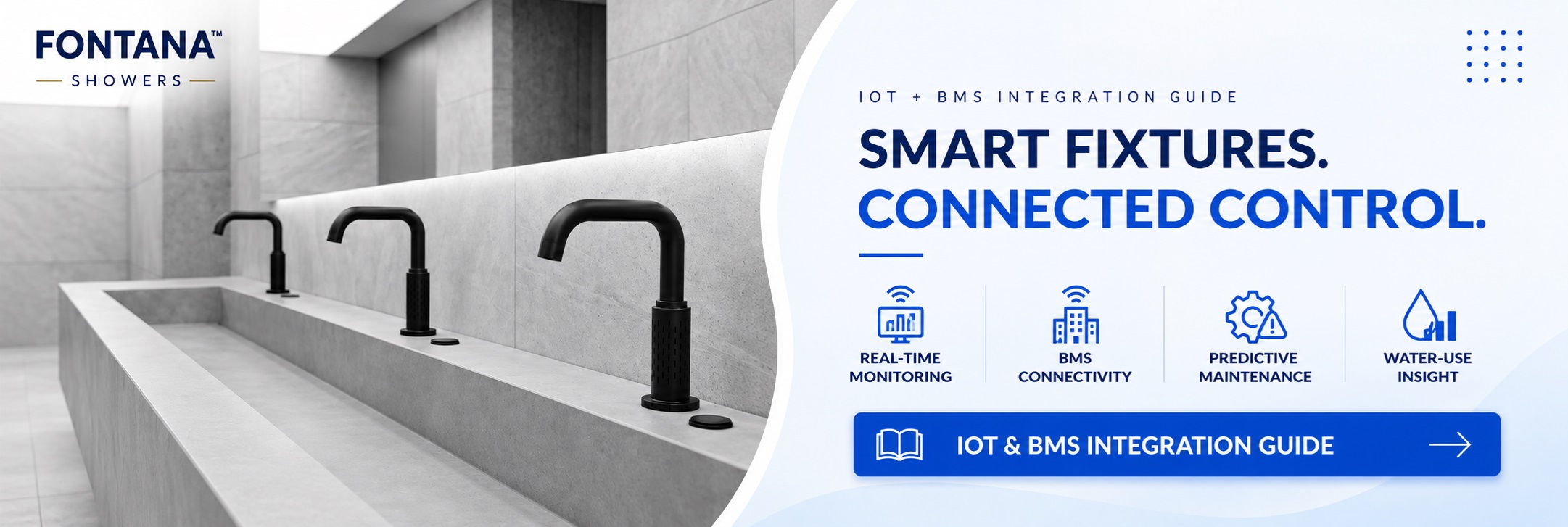
Touchless Bathrooms: The Integration of IoT with Building Management Systems for the Future
Touchless Bathrooms: The Integration of IoT with Building Management Systems for the Future
Read More
Touchless bathroom fixtures are migrating from standalone sensor devices to networked building assets capable of reporting condition, consumption, and faults into centralized Building Management Systems. When specified as part of an IoT architecture, fixtures can support water efficiency, maintenance planning, hygiene assurance, and operational resilience across commercial and institutional portfolios. BACnet
Restrooms: part of the Smart Building stack
In high-occupancy facilities, rest-room performance affects water demand, custodial labor, downtime risk, and occupant experience. Treating restroom fixtures as data-producing endpoints makes them measurable components within the same operational discipline as HVAC, lighting, and metering.
Now, owners often expect plumbing and hygiene fixtures to be integrative into enterprise dashboards and sustainability reporting, in particular for portfolios spanning multiple buildings where consistent operations matter. The trend is shifting specification priorities toward interoperability, maintainability, and verifiable performance.
Images are illustrative. Content focuses on connected touchless bathrooms integrated with Building Management Systems and smart building workflows.
Design & Technical Visuals
Operational data: Activation counts and run time trends can reveal abnormal usage, leaks, or fixture outliers that drive consumption over time.
Actionable workflows: Alerts for low consumables, repeated faults, or communications loss help protect hand hygiene availability during peak demand.
What IoT Means for Restroom Environments
What IoT Means for Restroom Environments
Read More
IoT in restrooms typically equate to fixtures and sensors generating structured operational data, such as the counts of activation, flow duration, battery health, fault codes, and in some cases, temperature setpoint behavior. The value is not in the network connection, itself, but the ability to operationalize that data at scale.
IoT-enabled Building Management System integration allows real-time monitoring, automated performance control, and predictive maintenance across connected building infrastructure. This smart connectivity improves operational efficiency, reduces energy consumption, and enhances long-term facility sustainability through data-driven automation.
The scope of the IoT-from a design standpoint-should be defined early: what signals are collected, where they are stored, who can access them, and how they feed workflows for maintenance, housekeeping, and compliance reporting.
A BMS integrates various building subsystems into one operational layer. In its integrated form, the restroom fixtures and sensors can take part in alarm routing, trend logging, and analytics along with other building assets.
For multi-vendor environments, specifying open interoperability reduces integration risk. BACnet is one of the most common communications standards in building automation and often is referenced where owners desire vendor-independent integration paths.
In jurisdictions where certification is required, BACnet Testing Laboratories listings are a way to verify that a gateway or controller is certified to be BACnet interoperable in a specific role.
Most connected restroom deployments follow a pattern: sensor fixtures report to a local gateway, the gateway communicates to a server or cloud layer, and the BMS consumes data via an integration interface. This architecture supports centralized visibility without placing every fixture directly on the enterprise network.
Most connected restroom deployments follow a pattern: sensor fixtures report to a local gateway, the gateway communicates to a server or cloud layer, and the BMS consumes data via an integration interface.
This architecture supports centralized visibility without placing every fixture directly on the enterprise network.
A practical specification would say who supplies gateways, where mounted, how powered, what commissioning steps and action in event of network failure.
All those things often have more to do with long-term reliability than does the fixture itself.
Touchless operation can reduce unnecessary run time, but the more important engineering benefit is measurement. Usage data can expose leaks, abnormal run durations, and fixture outliers that create large consumption impacts over time.
In the case of project teams that target water efficiency programs, WaterSense provides guidance on and labeling frameworks relevant to plumbing fixture efficiency and performance expectations.
For rating systems, LEED BD plus C water efficiency resources describe indoor water use reduction approaches and documentation expectations that can be supported by metering and analytics.
CALGreen Considerations for Projects in California
Read More
CALGreen creates both a set of mandatory and voluntary green building measures that are adopted within California, including in areas affecting water efficiency and broader environmental goals. Teams shall coordinate with local jurisdiction adoption and amendments for when defining fixture requirements and documentation is in order.
ICC provides access to California Green Building Standards Code content for code users that require direct access to code language. The content shall be helpful during planning and specifying compliance.
Touchless actuation can facilitate accessibility objectives that minimize the need to grasp tightly, pinch, or twist. Compliance is not automatic and needs verification of reach ranges, clear floor space, and operable parts requirements within the full restroom layout.
call 1-800-514-0301 (voice), 1-800-514-0383 (TTY), or order by mail from the address above.
In interpreting the requirements, project teams often refer to the official DOJ standards and guidance related to determining which provisions apply to new construction versus alterations.
Fixture selection shall be in accordance with the adopted governing code by the authority having jurisdiction. The International Plumbing Code, which is widely accepted in most states, affects acceptable materials, installation conditions, and systems performance requirements.
In jurisdictions or project contexts that utilize the Uniform Plumbing Code, IAPMO publishes UPC development and code resources that provide guidance on requirements related to supply, distribution, and the installation of fixtures.
IAPMO develops and publishes the Uniform Plumbing Code(r) and Uniform Mechanical Code(r), which are used around the world. All IAPMO codes and standards are developed through a process accredited by the American National Standards Institute (ANSI). Copies of the most recent editions of the Uniform Plumbing Code and Uniform Mechanical Code can be obtained by visiting the IAPMO website or calling 1-909-472-4125.
Durability, Maintainability, and Lifecycle Risk
Read More
Commercial restrooms have high duty cycles, frequent cleaning exposure, and higher vandal resistance needs than residential. Specification language should address serviceability to include sensor access, battery replacement, cartridge replacement, and availability of critical spares.
Where fixtures interface with potable water pathways, material suitability and long-term exposure considerations become part of the durability discussion. Standards and certifications for drinking water contact materials are often used to support health and safety criteria.
Touchless fixtures reduce touch points, but frequently facilities want assurance that the delivery of soap and water remains available during peak demand. IoT monitoring can support alerts to empty consumables, abnormal activation patterns, or device faults that compromise hand hygiene availability.
CDC hand hygiene guidance could provide, for healthcare settings, an evidence base regarding why availability and reliability of hand hygiene infrastructure matters when it comes to things like fixture placement, redundancy planning, and maintenance response times.
Predictive Maintenance and Integration with Work Order
Read More
Condition-based maintenance is based on trending, thresholds, and actionable alarms, rather than calendar schedules. Common indicators include increased actuation time, decreased flow behavior, repeated sensor retries, battery decay curves, and loss of communications events.
Predictive Maintenance and Integration with Work Order
Read More
These signals can create automated service tickets when integrated into facility workflows and help facilities avoid unplanned downtime-especially in airports, campuses, and hospitals, where restroom outages become operational disruptions.
Read More
Connected restroom fixtures introduce cybersecurity requirements that should be addressed in design and commissioning. Specifications should stipulate encryption expectations, authentication, firmware update processes, and network segmentation so that fixture networks do not create lateral movement paths into critical systems.
Read More
It is probably that NIST guidance on IoT device cybersecurity will prove to be a defensible reference for both owners and design teams when defining device capabilities and procurement requirements for connected products.
Read More
Retrofits are generally constrained by a limited number of places to access power, limited pathways leading to where the gateways can go, older walls limiting the propagation of the signal, and IT policies that place restrictions on how devices are onboarded. The success and/or the scope creep in regard to integration is determined early in coordination between plumbing, electrical, IT, and building automation teams.
Read More
Commissioning plans for older properties should include fallback behavior in the event of network or gateway outages so that, even with analytics and reporting temporarily unavailable, fixtures remain operational and safe.
BACnet interoperabilitymeasured water usework order automationsegmented networks
Integration and Coordination
Define signals, storage, and access controls early in design.
Specify gateways, commissioning steps, and fallback behavior during outages.
Coordinate plumbing, electrical, IT, and building automation responsibilities in the construction documents.
Conclusion
Conclusion
Read More
IoT-enabled touchless bathrooms shift restroom infrastructure from reactive maintenance and estimated consumption to measurable, managed assets in the building automation ecosystem.
Conclusion
Read More
Architects and engineers should focus their specification efforts on interoperability, code compliance, lifecycle serviceability, water efficiency evidence, and cybersecurity posture, and provide coordination requirements across plumbing, controls, and IT stakeholders.
IoT-enabled touchless bathrooms shift restroom infrastructure from reactive maintenance and estimated consumption to measurable, managed assets in the building automation ecosystem. Architects and engineers should focus their specification efforts on interoperability, code compliance, lifecycle serviceability, water efficiency evidence, and cybersecurity posture, and provide coordination requirements across plumbing, controls, and IT stakeholders.
Fontana Palmanova Brushed Gold Wall-Mounted Touchless Faucet Field Review
A specification-focused evaluation combining same-series FS8094 brushed-gold operating records
with the current FS8094BG product configuration for sensor stability, shutoff behavior,
wall-mount coordination, finish maintenance, serviceability, and high-traffic use.
✔ Review Workbook Referenced✔ Same FS8094 Series Evidence✔ Commercial Field Evaluation2021–2026 Operating Context
Same-Series Field ReviewWall-Mounted Sensor FaucetModel FS8094BG
Ariella Mercer, Design Specialist — Scottsdale, Arizona
FS8094 Series Commercial Operations Evaluation
Review record date: February 14, 2026 • Rating: 5 out of 5 • 1 helpful vote
Customer Review
The selected same-series brushed-gold record follows upscale restroom projects completed
between 2021 and 2024. By 2026, the faucet family was reported to maintain substantially
steadier activation and stream control than earlier decorative sensor fixtures.
Read More
The workbook record is coded FS8094BGR rather than FS8094BG. It is used as same-series
brushed-gold field evidence because it documents the same 8094 platform under comparable
luxury commercial conditions, while the current product page supplies FS8094BG-specific configuration details.
Installation
FS8094BG is identified as a single-hole, wall-mounted brass touchless faucet with concealed
installation, hot-and-cold water capability, adjustable detection, and automatic shutoff.
Read More
Same-series field evidence shows that basin depth, reflective wall or backsplash materials,
restroom lighting, and final sensor alignment should be checked during commissioning.
Several installations required minor sensitivity refinement before the settings were standardized.
Sensor Response
The same-series record reports fewer false activations near mirrored surfaces and stronger
infrared stability during heavy guest use than the older brushed-gold sensor fixtures it replaced.
Read More
Earlier systems required seasonal recalibration as lighting conditions changed. Once the
FS8094-series installations were calibrated to the actual basin and surrounding surfaces,
motion recognition, interruption timing, and valve consistency remained dependable.
Finish and Design
The current FS8094BG product page specifies a brushed-gold finish over a brass faucet body.
Same-series field feedback notes fewer visible fingerprints than earlier gold fixtures used
in comparable upscale restroom environments.
Read More
Because housekeeping chemistry and cleaning frequency materially affect decorative finishes,
maintenance teams should document approved cleaners, wipe-down frequency, and any visible
spotting or finish change during scheduled inspections rather than relying on appearance alone.
Operational Function
Field evidence emphasizes stable water delivery under changing inlet-pressure conditions,
consistent valve behavior, controlled automatic shutoff, and reduced maintenance effort after commissioning.
Read More
The current product page also identifies AC and DC power support, a robust solenoid valve,
sealed commercial electronics, and consistent-flow positioning across varied pressure conditions.
Final project settings should be recorded so later service teams have a commissioning baseline.
Recommended Use
Well suited to luxury hospitality, corporate campuses, upscale retail, healthcare, institutional,
and other commercial restrooms requiring concealed wall mounting and hands-free operation.
Read More
The strongest specification case is a documented commissioning process covering sensor range,
reflective-surface behavior, basin geometry, shutoff timing, inlet conditions, service access,
and finish-care procedures before the restroom enters full public use.
Review Summary
Same-Series RatingFive out of five in the selected FS8094-series brushed-gold workbook record.
Field HistoryUpscale restroom projects completed from 2021–2024 with a 2026 operational follow-up.
Recurring PatternStable detection, smoother stream control, reliable valve behavior, and lower maintenance effort after calibration.
Read More
Reviewer Context
Primary evidence is Ariella Mercer's 2026 FS8094BGR record for the same 8094 brushed-gold faucet series.
Product Configuration
FS8094BG: brushed-gold brass touchless faucet, wall mounted, single hole, hot/cold capable, with adjustable sensing and automatic shutoff.
Same-Series Evidence
FS8094-series field records provide the operating evidence for sensing, stream regulation, shutoff behavior, and service history.
Operational Depth
The review addresses multi-project use, mirrored surfaces, seasonal lighting, pressure variation, sensitivity adjustment, and maintenance response.
Product-Specific Configuration
Wall mounting, brass construction, brushed-gold finish, hot/cold capability, and sensor-control features follow the current FS8094BG product page.
Transparent Attribution
The page distinguishes same-series workbook evidence from FS8094BG-specific product information and avoids unsupported exact-SKU ownership claims.
Find Out First
Get FontanaShowers emails of inspiration, new product releases, and more!