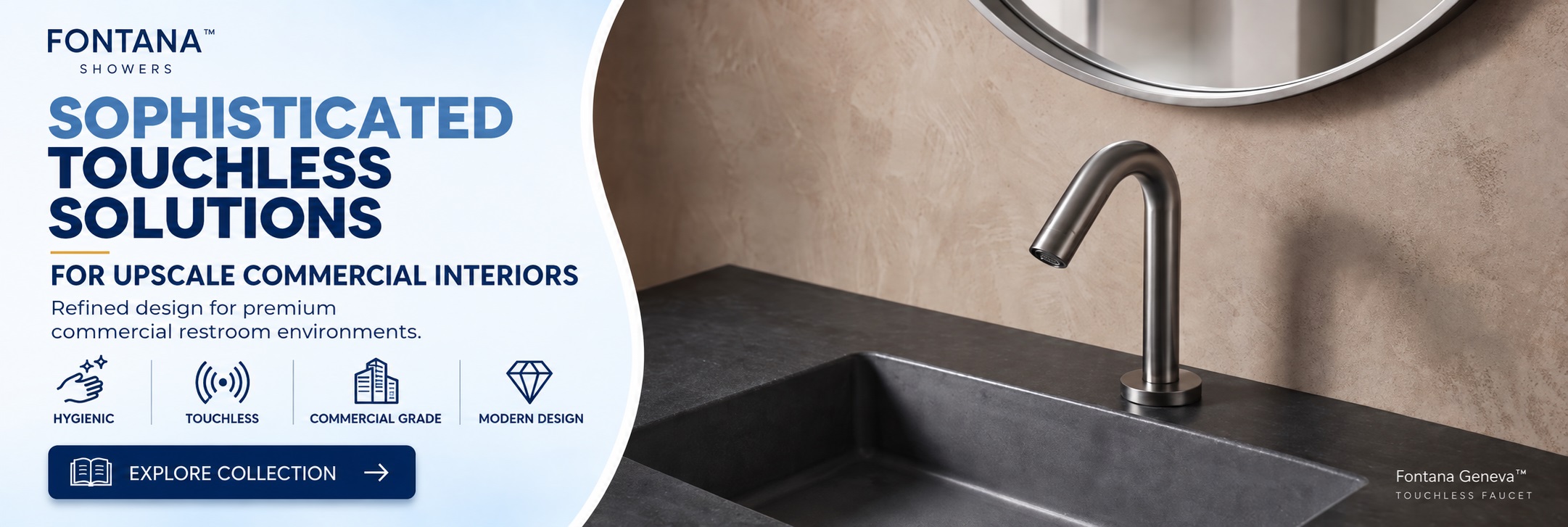
Sophisticated Touchless Solutions for Upscale Commercial Interiors
Below are some considerations for thoughtfully designed touchless solutions and how these solutions could transform the appearance of the restroom on a larger scale. We will then move on to our final section that includes the "project compilation & series format" you can adopt for your projects.
Modern touchless restroom fixtures can reduce water usage by up to 70% compared to manual faucets, while advanced sensor calibration improves hygiene performance and minimizes maintenance requirements—making them a preferred solution for high-traffic commercial and hospitality environments focused on sustainability and operational efficiency.
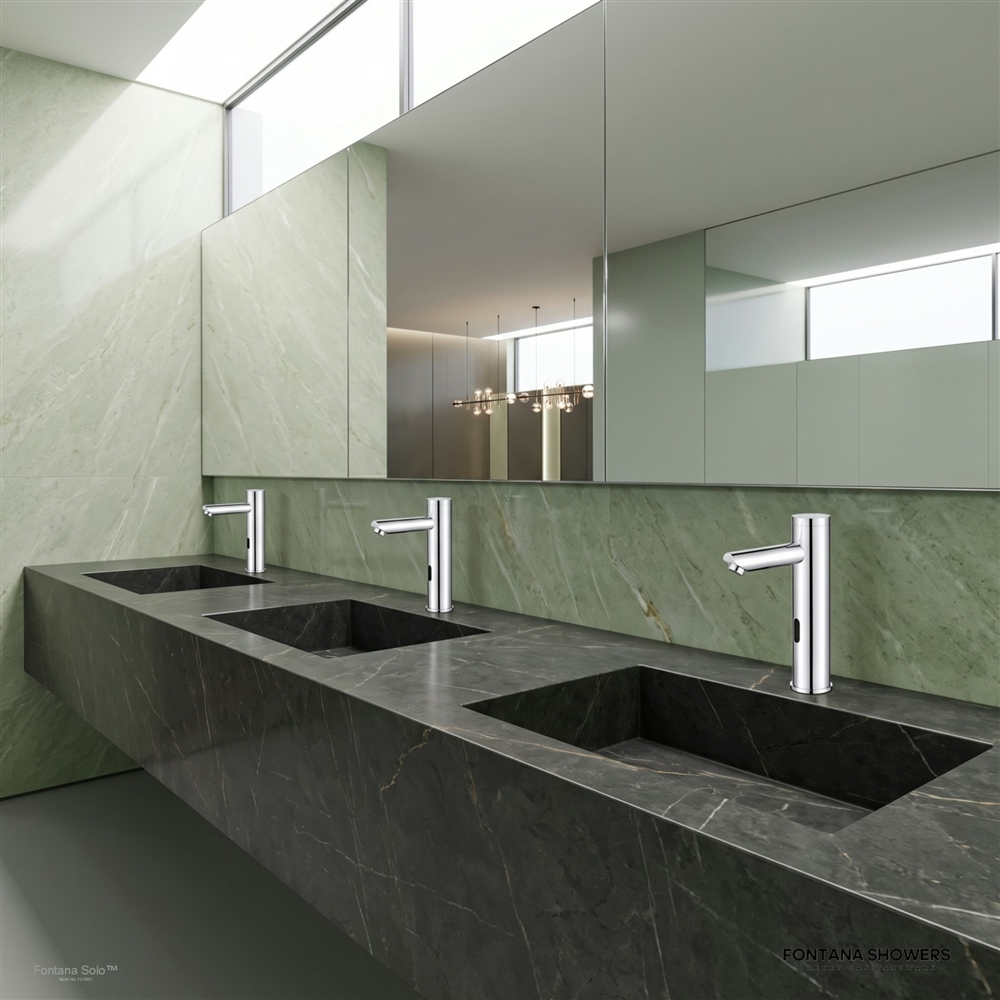
An upscale restroom is to the same ideals an upscale lobby is. Keen attention to detail creates an impression of perfection in operations, while consistency in this language corresponds to brand identity defined through geometry, finish, and light.
The Role of Restroom Aesthetics in Upscale Commercial Interiors
The key characteristics of an elegant touchless bathroom include
Touchless Faucets
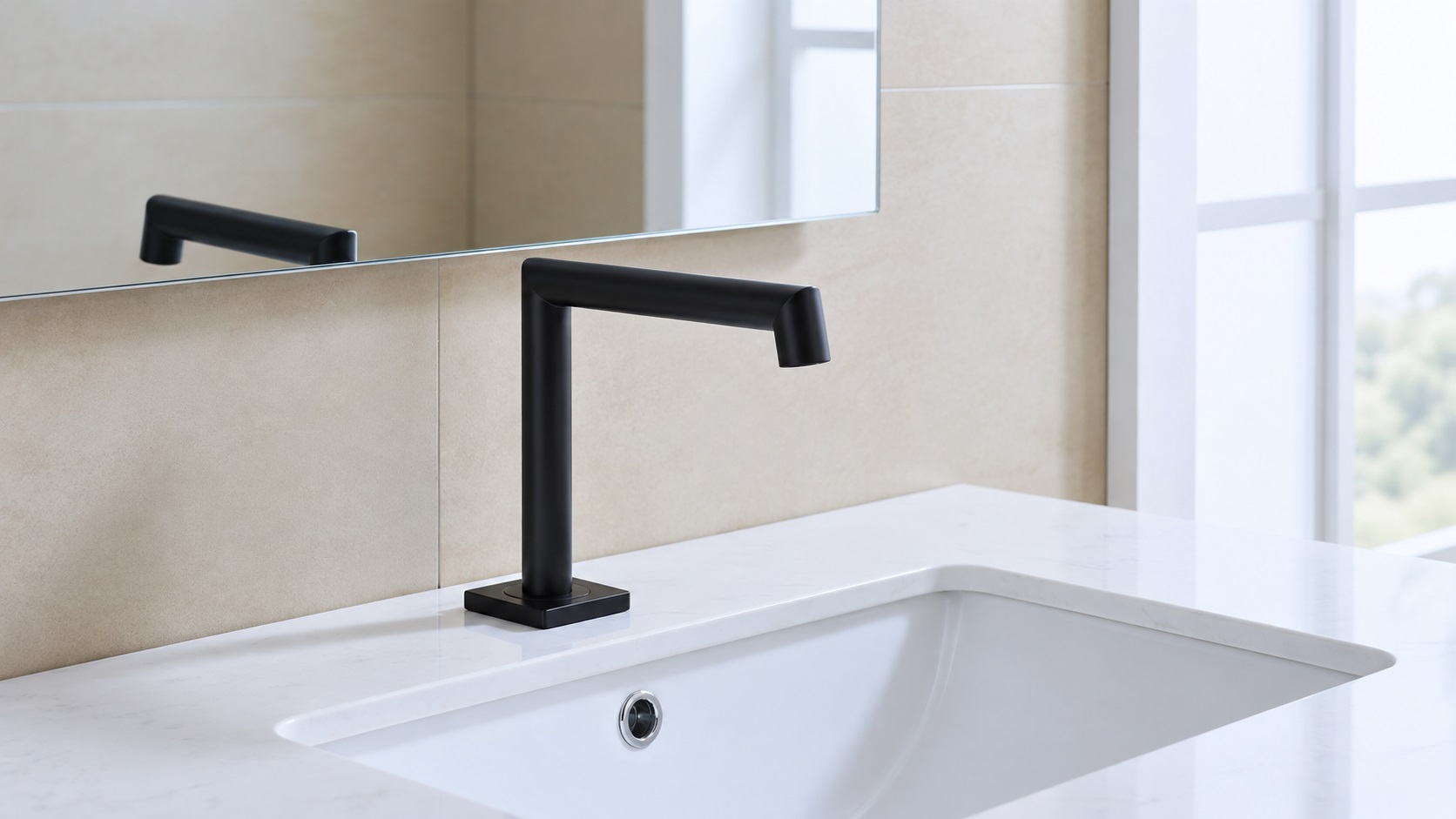
In an upscale commercial or institutional installation, touchless means much more than faucets, but the faucet is still a clear focal point. Infrared sensors, and sometimes capacitive sensing with defined detection regions, support quick, intuitive use for first-time visitors.
Co-ordinated Soap & Accessory Lines
Match form and finish so faucets, soap, and accessories read as one visual line. Refillable cartridges with front access support fast service while keeping decks and countertops clean and uncluttered.
Sensor-controlled flush valves for toilets and urinals can pair with minimalist flush plates in metal or glass. Designers often coordinate finishes with door hardware to keep the look consistent.
Doors, Access & Lighting/Specialty
Even when not fully touchless, soft-close and low-touch partitions and privacy doors can reduce contact points. Touchless hand dryers and paper dispensers also help reduce clutter and surfaces people touch.
Unified Design Language
Keep geometry consistent across faucets, dispensers, and accessories. Align fixture axes with tile grout joints, mirrors, and lighting elements to reinforce a calm, ordered layout.
INTEGRATED TECHNOLOGY AND LAMINAR FLOW
Effortlessly smart design places sensors within spouts or behind plates so the space feels modern without feeling gadget-driven. Laminar flow can reduce splashing and soften water noise.
Material Justification and Large-Scale Cleanliness
Surfaces, Partitions & Fixtures
Solid surface materials, large-format tile, and antimicrobial finishes promote easier cleaning, while no-touch technology supports infection control. For general hygiene guidance, see CDC Clean Hands.
Plumbing standards, electrical requirements, accessibility guidelines, and regional health regulations should be considered early when pursuing a streamlined design. Start with the 2010 ADA Standards and your adopted plumbing code (for example, IPC Chapter 4).
Below-the-counter and wall-hung solutions can improve knee and toe clearance and help keep floors easier to clean.
Smoothing Operation-inclusive and elegant
Well-designed touchless interfaces feel inclusive and general-purpose and do not draw attention to themselves.
Warm lighting and spa-inspired finishes can help reduce anxiety for patients, families, visitors, and staff in demanding environments.
Pre-defined parts and finishes can keep a hospitality look while meeting stricter needs for durability and cleanability.
Applications in a Large Scale Environment
Hospitality : Hotels, Resorts, and Lifestyle Properties
Good hotels often treat bathrooms as part of the guest experience. Guest-room baths may aim for a residential feel with hospitality-level durability, while public restrooms in lobbies, pools, spas, and ballrooms must perform during meeting rushes and event peaks.
Restrooms vs. guest room
Public restrooms need heavy-duty fixtures that still support signature design elements like stone features, metal inlays, and custom mirrors. The warmth of guest spaces can be paired with the endurance expected from commercial fixtures.
Corporate Headquarters and Luxury Office Buildings
Restroom design can reflect a brand’s visual DNA. Touchless systems can support water and energy goals, while data-enabled fixtures can feed dashboards that show savings and help teams plan maintenance.
Healthcare Facilities & Wellness Campuses
Smooth, easy-clean materials and no-touch operation support infection prevention. Warm lighting and spa-like finishes can help calm patients and families. Design teams often aim for a hotel-like look while prioritizing durability.
Public Transport Hubs & Venues
Airports, stadiums, and flagship retail venues need restrooms that resist vandalism and heavy wear. Touchless fixtures paired with robust partitions and vandal-resistant mounting can keep spaces looking clean while reducing manual cleaning effort between peaks.
Retail Destinations & Mixed-Use
Many retail and mixed-use restrooms use a restrained minimalism with neutral colors, aligned fixtures, and technology integrated into the background so the room feels quietly modern.
Benefits of Touchless Elegance at Scale
Hygiene & Risk Reduction
Supports infection control practices in healthcare and hospitality. A visible signal of cleanliness can matter for user confidence, not just microbial counts. Reference:
CDC guidance on handwashing.
User Flow and Crowd Management
Optimized touchless design can reduce time per user without making people feel rushed. Automatic shutoff limits lingering, and tuned sensor zones reduce false starts.
Water & Soap Efficiency
Pre-programmed run times and low-flow aerators, paired with sensor shutoff, reduce the chance of taps being left on. Metered soap doses can reduce waste and help keep counters cleaner. Reference:
EPA WaterSense bathroom faucets.
Maintenance & Lifecycle Cost
With fewer touch points and fewer wear parts, touchless fixtures can reduce handle failures and loose parts. Solid metal construction, top-access battery service, and modular components can support faster maintenance.
Upfront vs. Ongoing Cost
A higher upfront cost may be offset by savings in labor, fewer emergency repairs, improved uptime, and longer refresh cycles for finishes in large environments.
Digital Monitoring & Data
Usage tracking by fixture, plus low soap and low battery notifications, can help operators understand demand patterns and focus maintenance effort where it is needed.
Standards & Compliance
Sleek solutions still need to balance plumbing standards, electrical requirements, accessibility rules, and regional health regulations while keeping an attractive guest-facing look. Reference:
2010 ADA Standards and International Plumbing Code (IPC).
Inclusive Experience
Effective touchless design should feel mainstream and inclusive, with intuitive, low-effort operation for a wide range of users. Reference:
U.S. Access Board guide (Lavatories and Sinks).
Electrification: Power Strategies & Retrofit vs. New Build
Powered by battery: flexible and retrofit-friendly; specify long-life batteries and clear replacement guidelines.
Hardwired low voltage: stable and often preferred for heavy traffic areas; coordinate with electrical engineers early.
Hybrid methods: some systems support both and can add resilience during power interruptions.
Retrofits may involve adapters for existing rough-ins, routing low-voltage cables, and keeping key restrooms operational during construction.
For building automation context, review common BAS interoperability concepts like
BACnet.
Application Imagery and User Experience
Compilation from Projects and Series Format
Evolution From Single Projects to Portfolios
When working with a large portfolio, you are not just presenting a single restroom design, but a series of related solutions that include flagships, prototypes, roll-outs, and refreshes. This project compilation and series format helps teams communicate both the vision and the road map.
Typologies, Tiers, & Narratives
Group projects and standards by typology such as hotel, office, healthcare, retail, transit, and education, and by level such as flagship, premium, and standard. For each combination, add a short narrative that explains the design intent and the operational plan.
Visual and Technical Modules
Model numbers, finishes, power choices, and flow rates can be included on specification sheets for each project or series. This helps teams keep quality consistent across new locations while updating fixtures as technology evolves.
Series and Storytelling
The series format can also support storytelling. Show how solutions improve from one flagship property to another and what worked best in one setting versus another.
Measurable Gains
Show evidence of gains like water conservation, reduced complaints, and better user feedback. These data points can build support for continued investment in touchless technology across the portfolio.
Corresponding Early with Stakeholders
Large-scale projects benefit when design, operations, maintenance, and brand teams coordinate early. Common standards, mock-ups, and clear documentation can turn touchless design from a point solution into a scalable strategy.
Request the Architect Kit
Included
Cut Sheet (PDF) and rough-in guide for touchless faucets, dispensers, and flush valves.
Editable submittal forms that are consistent with your typology and tier standards.
BIM/CAD families for mock-ups, pilot bathrooms, and product launches.
Finishing and coordination notes on power strategies, data monitoring, and accessibility.
Utilize in mock-ups, pilots, phased rollouts, and refreshes. Include service information with standardized spare parts kits, and collect occupant feedback to improve your touchless kit of parts over time.
Customer Field Review
Fontana Solo Chrome Touchless Motion Activated Sink Faucet Field Review
A specification-focused evaluation combining exact FS-509C customer feedback
with same-family Solo FS-509 operating records for sensor response, shutoff
behavior, maintenance demand, pressure compatibility, finish care, and commercial use.
✔ Exact FS-509C Review Referenced✔ Same Solo FS-509 Family Evidence✔ Multi-Use Commercial Context2015–2026 Review Records
John P. — Los Angeles, California
Guest-Bathroom Use and Touchless Operation Review
Review record date: May 22, 2020 • Rating: 4 out of 5
Customer Review
The exact FS-509C customer record describes responsive touch-free operation,
convenient guest use, a modern chrome appearance, and water-conservation
benefits in a completed bathroom application.
Read More
John P. specifically noted the convenience of touch-free use and the cleaner
handwashing experience. The same record also calls out the chrome finish and
the faucet's role in reducing unnecessary water use.
Installation
FS-509C uses DN15 connections with a 7.87-inch faucet height and 4.13-inch
spout length, making basin geometry, stream landing, and service access important
coordination items before final installation.
Read More
The product page identifies easy installation, all-brass construction, a built-in
filter, and automatic sensing-distance adjustment. Commissioning should still verify
basin reflectivity, filter access, battery clearance, and splash behavior at the selected bowl.
Sensor Response
Same-family Solo FS-509 records add longer operating context: hotel, restaurant,
retail, healthcare, office, and multifamily installations report prompt activation,
controlled shutoff, and dependable sensing through sustained daily use.
Read More
A 2026 hotel record reports stable activation without false triggering after months
of continuous use. A multifamily record notes smooth activation and consistent shutoff
timing, while restaurant and retail records describe reliable response during changing traffic levels.
Finish and Design
The exact FS-509C review specifically praises the chrome finish, while the current
product page identifies a PVD-coated chrome tone over an all-brass body for daily
wear resistance in commercial and high-use restroom settings.
Read More
Finish condition should be reviewed under the facility's actual cleaning chemistry,
mineral exposure, and housekeeping frequency. Related Solo-family records support
frequent-cleaning use, but exact FS-509C finish wear should be tracked independently.
Operating Function
Current FS-509C specifications list DC 6V power, four AA batteries, approximately
9.84 inches of sensing distance, a 0.5-second response delay, and a 0.05–0.6 MPa
operational pressure range.
Read More
The faucet also includes a waterproof sensor, low-battery LED indication, automatic
distance adjustment, a built-in filter, and automatic power cut-off after 60 seconds
of continuous use. Verify inlet pressure, shutoff timing, and filter condition at commissioning.
Recommended Use
A strong fit for commercial and public restrooms where touch-free operation, controlled
water delivery, accessible service points, ADA-oriented use, and a polished chrome finish
are part of the fixture schedule.
Read More
The review evidence is strongest where owners document commissioning settings, monitor
nuisance activations and delayed shutoff, track battery and filter service, and compare
service-call frequency after the faucet enters normal occupancy.
Review Summary
Exact-Model RatingFour out of five in the selected FS-509C customer record.
Extended Field ContextSame-family Solo records add months of operation, peak traffic, and maintenance history.
Recurring PatternResponsive sensing, consistent shutoff, controlled water use, and reduced service demand.
Read More
Reviewer Context
Primary evidence is John P.'s exact FS-509C record, supported by later Solo FS-509 family commercial-use records.
Product Configuration
FS-509C: chrome PVD finish, all-brass body, DC 6V power, DN15 connections, infrared sensing, and built-in filter.
Exact-Model Evidence
The workbook contains multiple FS-509C customer records, including direct comments on sensing, chrome appearance, hygiene, and water conservation.
Extended Operating Context
Same-family Solo FS-509 records add continuous-use, peak-traffic, shutoff, false-trigger, and maintenance observations.
Product-Specific Specs
Dimensions, pressure range, power, sensing distance, PVD finish, filter, and cut-off details follow the current FS-509C page.
Transparent Attribution
Exact FS-509C customer feedback is separated from broader Solo-family operating evidence and product-page specifications.
Find Out First
Get FontanaShowers emails of inspiration, new product releases, and more!