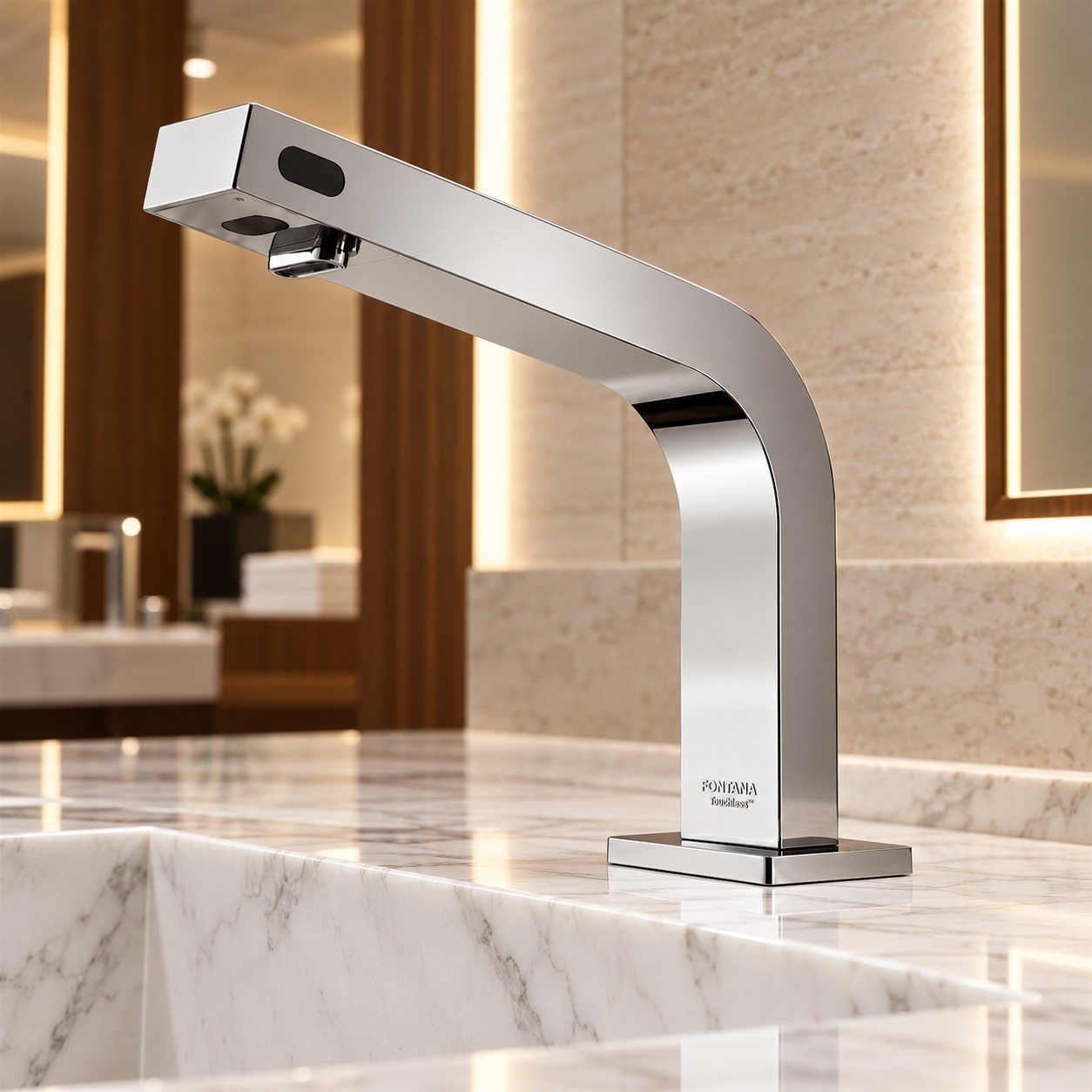
ToF vs IR Faucet Reliability Comparison
Touchless Faucet Technology · Reliability Guide
Reliability Focus
ToF vs IR
Compare activation behavior, response, environmental influences and long-term commercial service.
Commercial Sensor Technology
Reliability Comparison: ToF vs IR Touchless FaucetsCommercial Faucet Sensor Performance
Compare infrared (IR) and time-of-flight (ToF) touchless faucets across false activation, response time, environmental sensitivity and user satisfaction. Review the supplied figures alongside real-world specification criteria.
Sensor Reliability
Field Conditions
Commercial Specification
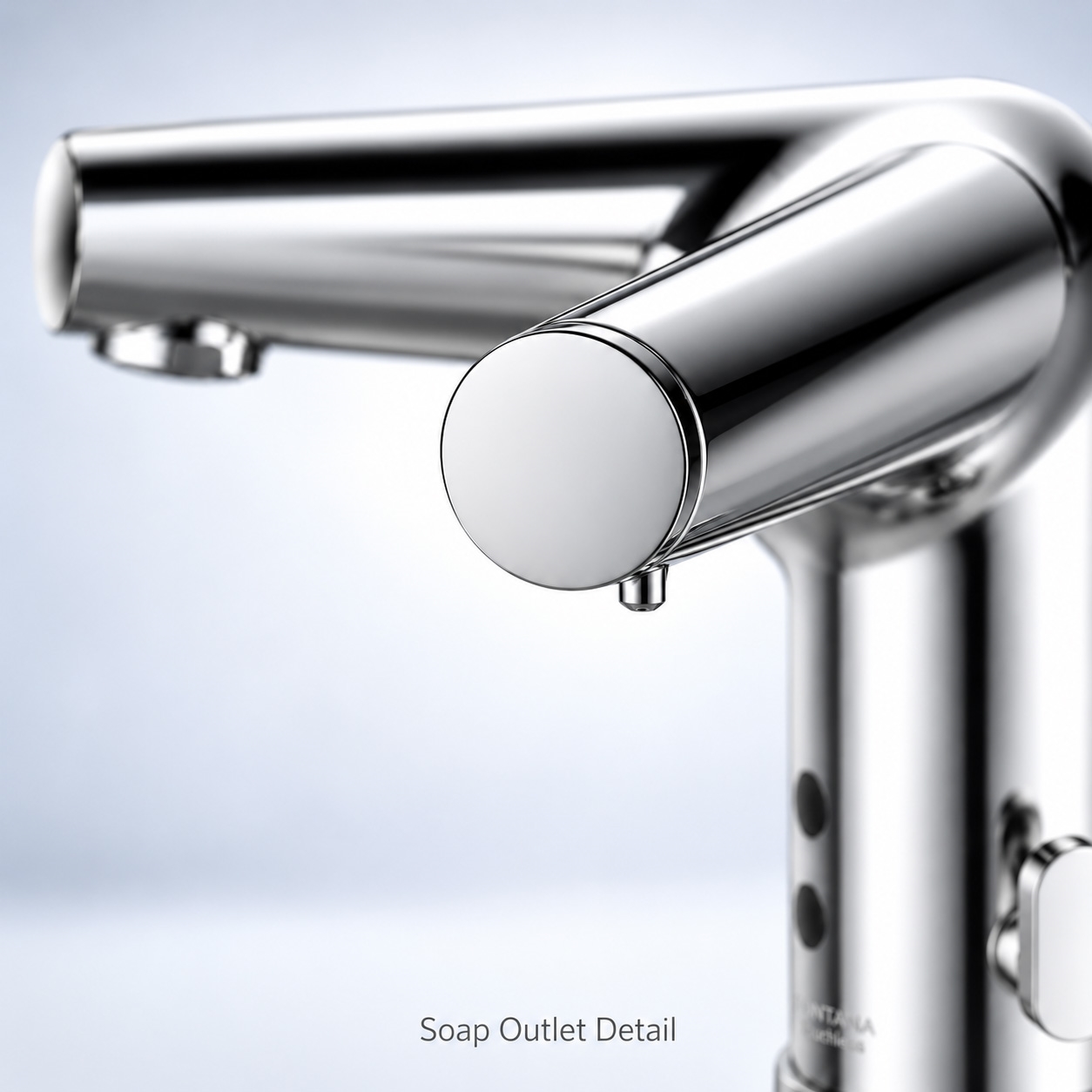
ToF vs IR Sensors
Sensor Performance
Understanding Faucet Reliability
Infrared touchless faucets typically use reflected infrared light to sense nearby hands. Time-of-flight designs estimate distance from reflected light travel time or phase. These are different detection approaches with model-dependent results.
The supplied original page compares false triggers, response speed, dirt and lighting sensitivity, and reported user satisfaction. For architects and facility managers, product-specific submittals and in-situ commissioning are needed to evaluate reliability.
Sensor technology is one factor; accurate commissioning and maintained plumbing assemblies matter equally.
Read the performance table as a comparison of claims from the supplied source, not controlled testing of specific IR and ToF faucet models.
Head-to-Head Review
ToF vs IR Reliability Comparison
The four original feature comparisons and linked references are reproduced below.
|
Feature
|
Infrared (IR) Faucets
|
Time-of-Flight (ToF) Faucets
|
|
False Activations
|
Prone to false triggers due to reflections and ambient light.
[Fontana Showers]
|
Accurately detects distance, reducing false triggers.
[Fontana Showers]
|
|
Response Time
|
Typically 0.5–2 seconds.
[Blog]
|
Under 30 milliseconds in most designs.
[Fontana Showers]
|
|
Environmental Sensitivity
|
Performance affected by light and dirt.
[Blog]
|
More stable across lighting and debris.
[Fontana Showers]
|
|
User Satisfaction
|
Mixed feedback; some frustration reported.
[Blog]
|
Higher satisfaction due to consistent performance.
[CozyNestings]
|
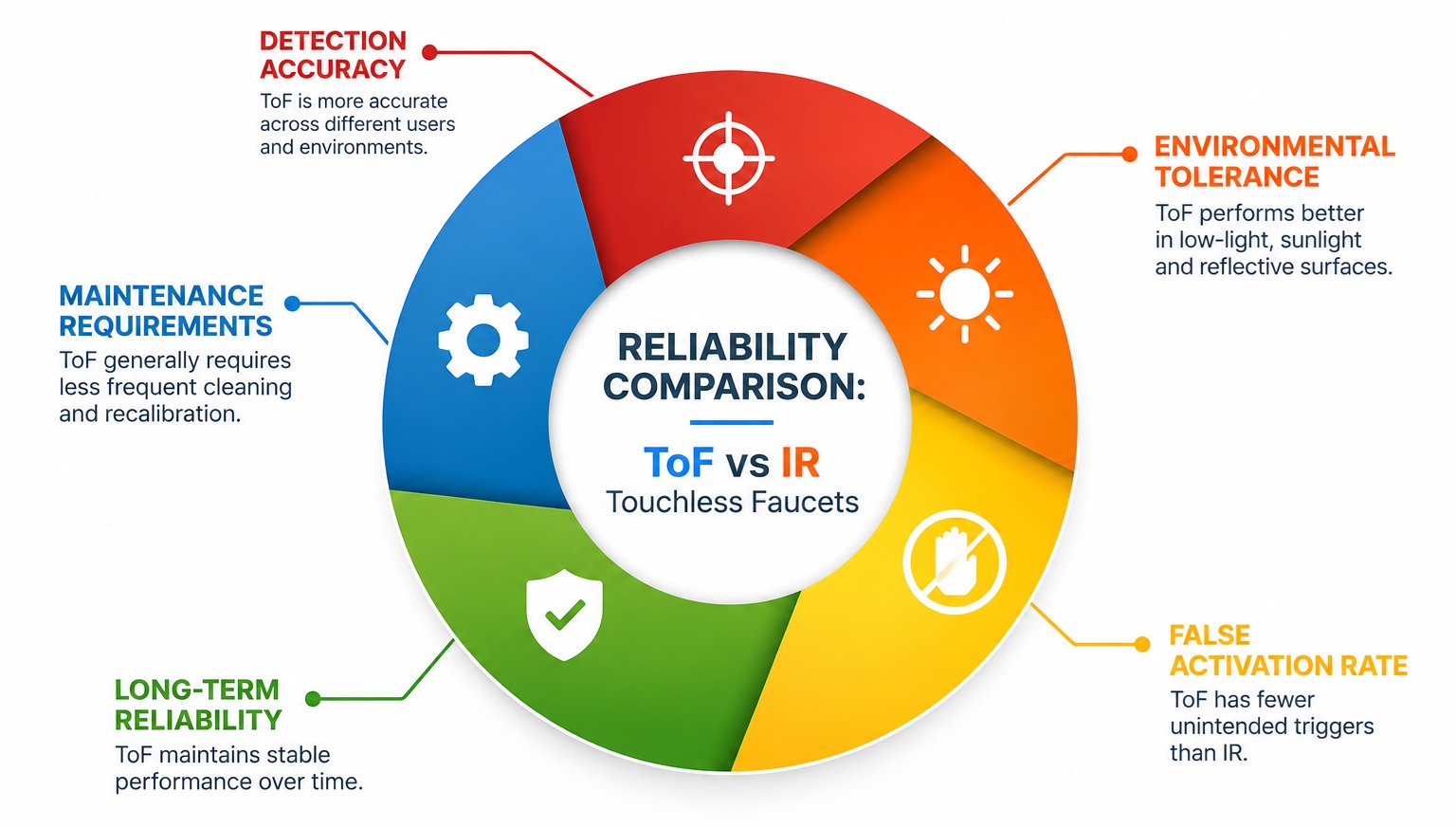
Evidence note: The response-time figures (0.5–2 seconds and under 30 milliseconds), satisfaction statements, and broad environmental-performance claims are preserved from the supplied text. They have not been established here as universal or independently verified benchmarks; verify with manufacturer test data for each model.
False Activations
Compare unwanted triggers from reflective basins, nearby objects and background activity.
Response Speed
Measure activation and shutoff timing with the specific installed sensor and controller.
Ambient Lighting
Test under the actual lighting conditions, including daylight and reflective surfaces.
Sensor Cleanliness
Assess how water spots, soap residue or debris affect sensor-window performance.
User Experience
Consider repeated handwashing cycles and the practical activation zone.
Service Reliability
Review batteries, power supplies, solenoids, filters and replacement components.
Performance Factors
Reliability Test Conditions
Comparisons should control installation geometry, calibration and operating conditions.
Detection Principles
How ToF and IR Operate
Active Infrared
An IR emitter illuminates the detection area and a receiver measures reflected energy. Typical active IR is not a heat sensor.
Time-of-Flight
A ToF system estimates target distance from the transit time or phase shift of reflected light.
False-Trigger Controls
Sensor range, filtering, light exposure, object reflectance and mounting angle affect unwanted activation.
Response Metrics
Controller settings, sampling frequency and solenoid timing contribute to observed faucet-on delay.
Use Environments
Where Reliability Matters
Verify sensing performance and serviceability for the selected installation environment.
Schools & Public Facilities
Specification Review
Confirm Model-Level Reliability
Ask suppliers for sensor-range tests, activation timing data, electrical requirements, maintenance instructions and site-condition guidance.
Sensor Type & Range
False Activation Data
Activation Latency
Ambient Light Testing
Battery / AC Supply
Sensor Window Care
Solenoid Reliability
Service Components
Technical Questions
ToF vs IR FAQs
What is the difference between ToF and active IR detection?
ToF measures distance using reflected-light timing or phase; conventional active IR typically senses the strength of reflected infrared light. Both can trigger a valve without hand contact.
Are ToF faucets always faster than IR faucets?
No. Real faucet activation depends on sensor design, electronic filtering, firmware and solenoid characteristics. The figures quoted in the supplied source are not universal product benchmarks.
Do IR faucets detect body heat?
Typically no. Commercial active-IR faucet sensors emit light and measure reflection rather than body temperature.
Can reflections cause unwanted activation?
Yes. Reflective materials and surfaces near the sensing zone can complicate detection. The severity varies by sensor design, mounting angle and calibration.
Does ToF avoid all environmental interference?
No. ToF designs may still be influenced by target reflectance, optical contamination, ambient light and installation geometry. Review the manufacturer’s limits and recommended maintenance.
Which technology uses less battery power?
Neither technology guarantees lower power use. Runtime depends on duty cycle, electronics, emitter, battery chemistry and solenoid consumption.
What should be tested before opening a commercial restroom?
Check hand-detection zones, missed activations, false triggers, shutoff delay, water pressure, cleaning sensitivity, and service access in final installed conditions.
Are touchless faucets automatically ADA-compliant?
No. Verify the complete lavatory assembly and site-specific accessibility requirements, including reach and clearance provisions, before claiming compliance.
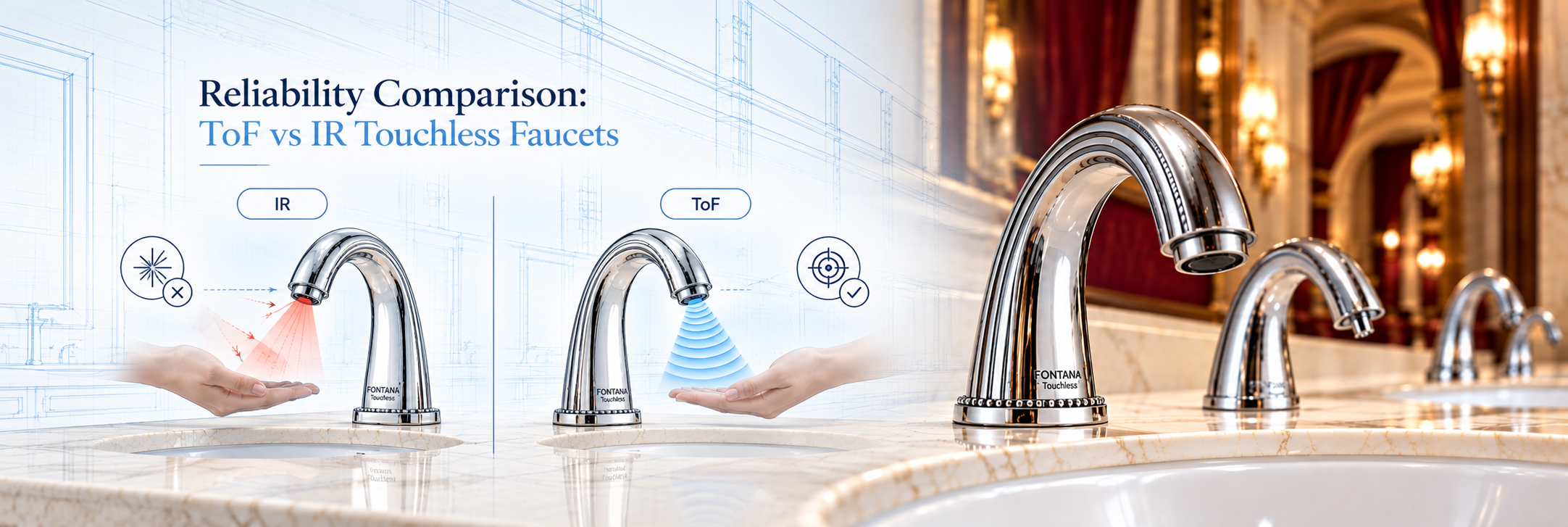
Sensor Reliability Selection
Compare Commercial Touchless Technologies
Choose a touchless faucet using product-specific reliability data, documented sensor features and long-term service requirements.
|
|
|