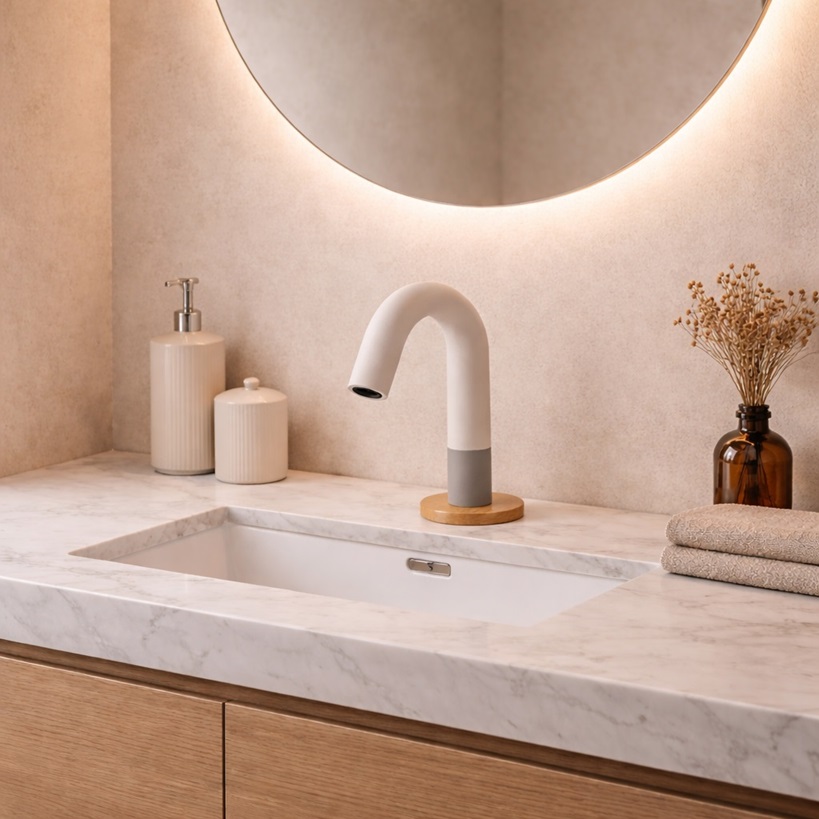
Spec-Grade · Wall-Mounted · ADA Compliant
Touchless Faucets for Wall Sink Bathroom Installations
Wall sink bathroom layouts demand precise coordination between faucet projection, sensor range, basin depth, and ADA clearances. Spec-grade touchless faucets designed for wall-mounted sinks help reduce splash, improve hygiene, and optimize space in healthcare facilities, airports, schools, and commercial restrooms. Architects and engineers can access BIM/Revit families, CSI submittals, and technical support tailored for wall sink bathroom specifications.
Wall-Mount Geometry · ToF & IR Sensors · AC/DC Power · WaterSense · ADA/UPC
|
|
Frequently Asked Questions Wall Sink Bathroom Touchless Faucet Design & Specification
What defines a wall sink bathroom?
What is a wall sink bathroom?
A wall sink bathroom uses wall-mounted lavatories and exposed or concealed plumbing to maximize floor clearance and simplify cleaning. These layouts are common in healthcare, education, and accessible restroom designs.
Why are wall-mounted faucets preferred in wall sink bathrooms?
Wall-mounted faucets allow precise control of spout reach and discharge angle, helping direct water toward the drain while maintaining ADA-required knee and toe clearance below the sink.
How does faucet selection affect wall sink performance?
Incorrect spout projection or sensor placement can cause splash or incomplete hand coverage. Faucets designed specifically for wall sink bathrooms account for basin depth and mounting height.
ADA, accessibility, and code coordination
Are wall sink bathrooms subject to ADA faucet requirements?
Yes. Faucets must comply with ADA guidelines for operability, reach range, and mounting height. Touchless activation helps eliminate grasping and twisting requirements.
How does wall-mounted faucet height impact compliance?
Mounting height must align with both sink rim elevation and ADA reach ranges. BIM coordination helps ensure compliance before construction.
Do wall sink bathrooms require UPC or ASME-listed fixtures?
Commercial installations typically require UPC-listed faucets meeting ASME A112.18.1 standards for performance and safety.
Splash control and user experience
How is splash controlled in wall sink bathroom designs?
Splash control depends on basin geometry, spout reach, discharge angle, and outlet type. Aerated or flow-conditioned outlets are often selected for comfort at low flow rates.
Does touchless activation improve hygiene in wall sink bathrooms?
Yes. Touchless faucets reduce contact points, which is especially valuable in healthcare, food service, and high-traffic commercial restrooms.
Are wall sink bathrooms suitable for high-traffic use?
When properly specified, wall sink bathrooms paired with commercial-grade touchless faucets perform reliably in high-use environments.
Engineering, rough-in, and installation considerations
What plumbing coordination is required for wall-mounted faucets?
Wall-mounted installations require accurate rough-in dimensions, in-wall mixing valves or control boxes, and service access panels.
Are AC-powered options recommended for wall sink bathrooms?
In high-traffic or institutional settings, AC or hybrid AC/DC power reduces maintenance and ensures consistent operation.
How can BIM files help reduce field conflicts?
BIM/Revit families allow designers to coordinate faucet projection, sensor zone, and basin geometry before installation.
Maintenance and lifecycle performance
Are wall-mounted touchless faucets easy to maintain?
Yes. Commercial models are designed with serviceable solenoids, accessible sensors, and vandal-resistant components.
How does wall mounting affect long-term durability?
Wall mounting protects faucets from deck impact and simplifies surface cleaning, improving longevity in commercial restrooms.
Why are wall sink bathrooms common in healthcare design?
They support infection control, ease of cleaning, and accessibility while allowing precise fixture coordination.
|
|
|