What Type of Soap in Dispenser Is Recommended for Sensor Faucets?
Sensor Faucets
Soap Dispensers
Specification
Hygiene
Why Soap Selection Matters for Sensor Faucets
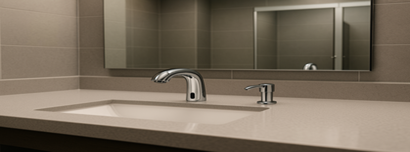
Design teams now treat the faucet and soap dispenser as a single handwashing system. When the faucet is sensor-activated, the wrong soap can cause poor performance, clogged pumps, user complaints, and even hygiene failures. For AEC professionals, “any liquid soap” is no longer an acceptable spec note.
Sensor faucets and automatic soap dispensers are calibrated systems. The infrared or ToF sensor triggers a metered pump stroke designed for a specific soap viscosity and foaming behavior
(
Berl’s Commercial Supply guide to automatic dispensers).
If the soap is too thick, contains abrasives, or separates over time, you’ll see:
- Delayed or inconsistent dosing
- Drips and “afterflow” onto deck or counter
- Premature pump and nozzle failures
- End users rubbing hands under water with no soap at all
In high-traffic commercial restrooms, this directly undermines hygiene performance that owners expect from
commercial touchless faucets
and touch-free dispensers
(
The Splash Lab).
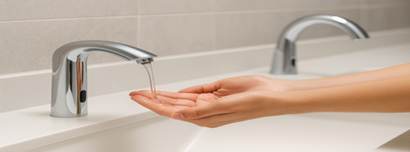
Recommended Soap Types for Sensor Faucet Systems
Below is an AEC-grade overview of what type of
soap in dispenser is recommended for sensor faucets, and how to align it with manufacturer data.
-
Plain liquid or foam soap (non-antibacterial in most projects):
Evidence from public-health agencies shows that, outside of clinical settings, plain soap is generally as effective as antibacterial soap for preventing illness when used with proper handwashing
(
CDC Hand Hygiene FAQ).
For most commercial and institutional restrooms (offices, malls, airports, education, hospitality), the recommended choice is:
- Mild, non-antibacterial liquid or foam soap
- pH close to neutral, skin-friendly
- No added abrasives, exfoliating beads, or heavy conditioners
For healthcare occupancies, follow the facility’s infection-prevention protocol; antiseptic handwash products may be required in specific clinical zones
(
CDC clinical hand hygiene guidance).
-
Viscosity within the dispenser manufacturer’s range:
Most automatic pumps are designed for a narrow viscosity window. Many commercial soaps suitable for touchless dispensers fall in a low- to medium-viscosity range, but the actual value varies by brand.
For coordinated faucet + soap packages, such as the
Fontana automatic sensor faucet and soap dispenser combo,
use the soap type and viscosity range listed on the cut sheet or O&M manual. In specs, call this out explicitly, e.g.:
Soap: Manufacturer’s standard for touch-free dispenser, compatible with pump; viscosity and rheology per dispenser manufacturer’s written recommendations.
Foaming dispensers: If your basis of design calls for foaming sensor dispensers, specify foam-specific soap (not standard liquid soap “forced through” a foam nozzle). Foam formulations are designed to:
- Produce stable foam at the dispenser’s air-mixing ratio
- Deliver perceived richness with less chemical per wash, reducing cost and environmental load
(
The Splash Lab)
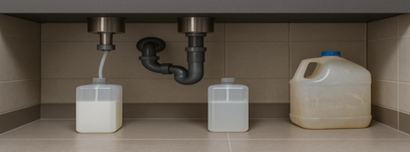
Cartridge vs Bulk: Hygiene and WELL/LEED Considerations
The dispensing format is now an ESG and rating-system issue, not just a facilities preference. The
WELL Building Standard – Hand Washing feature
notes that bulk refillable liquid soap systems are prone to bacterial contamination if not managed correctly; sealed liquid cartridges significantly reduce that risk. WELL-focused washroom guidance further recommends touch-free soap dispensers with sealed soap cartridges to support healthier handwashing environments
(
Dolphin Solutions WELL Washroom criteria).
From a LEED O+M perspective, soaps may also need to meet green cleaning criteria (for example, Green Seal or Safer Choice) when counted toward green cleaning credits
(
U.S. Green Building Council guidance).
A practical note for specifications:
Soap Concentrate: Manufacturer’s sealed cartridge, low-VOC, free of triclosan and similar banned antibacterial agents; meeting Green Seal or equivalent criteria where required.
Integration with Sensor Faucets and Full Touchless Systems
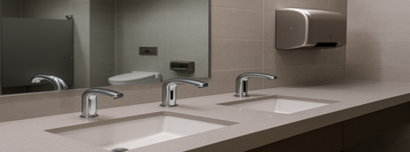
Modern restrooms are often designed as fully touchless suites: sensor faucets, automatic soap, sensor flush valves, and no-touch hand drying
(
touchless faucet case studies).
Using a coordinated family from a single manufacturer simplifies:
- Hydraulic and electrical coordination (power supplies, transformers, battery service)
- Finish consistency across
architectural touchless faucets
and soap dispensers
- Service parts, warranties, and FM training
When you select a package like
FontanaShowers touchless sensor faucets,
make the soap part of the basis of design:
- Specify the exact dispenser model and recommended soap system
- Require submittals with soap compatibility statements from the faucet/soap manufacturer
-
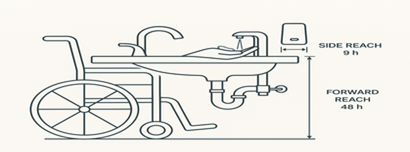
Coordinate rough-ins and clearances so that ADA reach ranges for both faucet and soap are met at the same lavatory
(
U.S. Access Board lavatories and sinks guide)
Code, Accessibility, and Reach Range Considerations
The 2010 ADA Standards for Accessible Design require that operable parts, including soap dispensers, be within specific reach ranges and usable from the accessible lavatory
(
DOJ ADA Standards).
You can reference these standards on drawings and in narrative reports, and use manufacturer templates or restroom planning guides to verify that:
- Soap outlet is within the side or forward reach limits from a seated position
- Sensor window and actuation zone are usable from the same approach as the faucet
- Dispenser body does not encroach into required knee/toe clearances or maneuvering clearances
A good practice is to treat the lavatory, sensor faucet, soap dispenser, and towel/dryer as one handwashing assembly in your accessibility review, not four independent components
(
Alberta Health Services sink and faucet selection guideline).
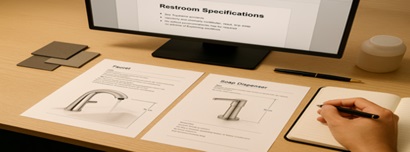
Suggested Spec Language for “Soap in Dispenser” with Sensor Faucets
You can adapt the following to your Division 10 or 22 section to shift “soap in dispenser” from a vague note to a performance-backed, standards-aligned design decision:
-
Soap Type: Manufacturer’s standard for automatic touch-free dispensers; plain or foam soap, non-antibacterial unless required by project infection-control program.
-
Compatibility: Viscosity and chemistry compatible with dispenser and pump as recommended in manufacturer’s written instructions; no abrasive or exfoliating additives.
-
Dispensing Format: Sealed cartridges, keyed to dispenser body; no open bulk refilling permitted in WELL-aligned areas.
-
Sustainability: Soap to comply with project green cleaning policy (for example, Green Seal, Safer Choice, or equivalent) where LEED O+M or similar framework is pursued.
-
Basis of Design: Soap and dispenser coordinated with specified sensor faucet set from same manufacturer to provide a fully touchless handwashing assembly.

|
|
|