3. How Fontana Should Explain mmWave to Architects, Engineers, and Facility Owners
The strongest Fontana explanation should begin with a familiar problem: commercial restrooms are difficult environments for sensor fixtures. They are wet, reflective, crowded, and unpredictable. Users move quickly. Children wave hands differently than adults. Bags, sleeves, phones, and cleaning tools can enter the sensing zone. Water splashes across chrome surfaces. Mirrors and glossy tile can create reflective conditions. A faucet that performs well in a showroom may behave differently in a busy airport terminal or university restroom.
That is why the mmWave trend is important. It gives manufacturers and specifiers a language for discussing more advanced detection. A future mmWave faucet can be described as a fixture that detects the handwashing event with better contextual awareness. It may distinguish a user intentionally placing hands under the spout from someone passing near the basin. It may provide stronger sensing consistency in environments where lighting, reflection, and surface contamination affect other sensor types. It may also support a more natural user experience because the user does not have to find an exact sensor window or wave repeatedly.
For Fontana, this should be connected to commercial-grade restroom outcomes. AEC professionals care about reducing callbacks. Facility managers care about fewer complaints. Owners care about lower water waste and a better restroom impression. Cleaning teams care about fixtures that do not cause excessive splash, residue, or unnecessary activation. Designers care about finishes, profile, proportions, and whether the fixture supports the overall restroom design concept. A mmWave-ready product story can bring all of these priorities together under one specification theme: intelligent hands-free performance.
4. Recommended Fontana Product Architecture
Fontana can organize its future touchless faucet strategy into three commercial tiers. This makes the technology easy for contractors, architects, engineers, and purchasing teams to understand.
Tier 1: Core Commercial Touchless
This tier includes standard commercial touchless faucets, deck-mounted sensor faucets, wall-mounted touchless faucets, and automatic bathroom faucets for restrooms where cost control, hygiene, and dependable sensor operation are the main priorities. These products should emphasize hands-free operation, water discipline, durable brass construction where applicable, AC/DC power options where applicable, and compatibility with high-traffic commercial use.
This category is ideal for office restrooms, restaurants, retail spaces, schools, small healthcare offices, and general commercial properties. The key message is practical reliability: touchless operation that reduces surface contact and supports cleaner restroom workflows without overcomplicating the specification.
Tier 2: Integrated Hygiene Systems
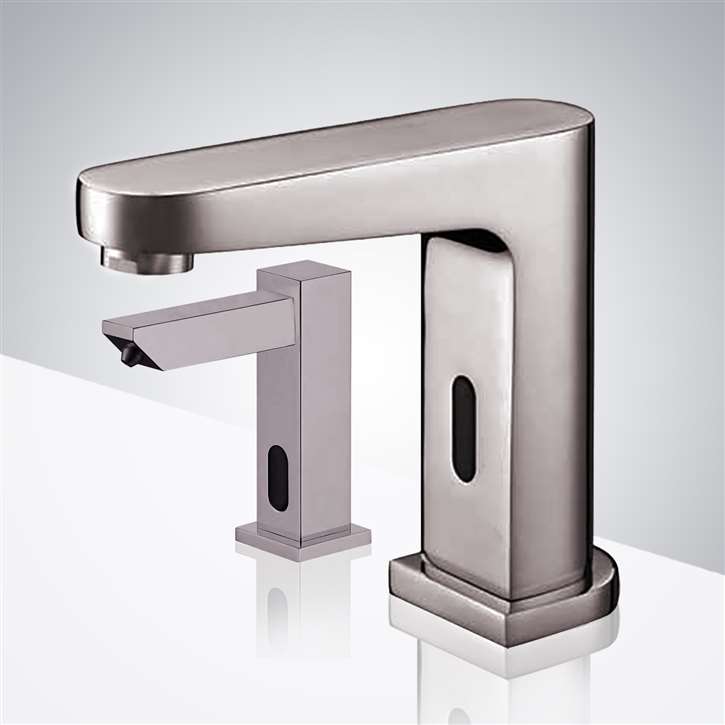
This tier includes faucet-and-soap-dispenser sets, coordinated automatic soap dispensers, and integrated faucet systems. Products like Fontana FS10225 and FS10254 fit the strategic direction because they combine water and soap activation into a more complete handwashing experience. This is important because the restroom is not only a faucet zone; it is a hygiene sequence. The user approaches the basin, activates soap, washes hands, rinses, and dries. Every touch point in that sequence matters.
For AEC specification, this tier should emphasize coordinated finish selection, matching fixture aesthetics, consistent sensor experience, reduced counter clutter, maintenance planning, and better alignment between faucet and soap placement. It is especially relevant for high-traffic commercial restrooms, corporate offices, airports, public facilities, and hospitality developments.
Tier 3: Smart Restroom / mmWave-Ready Platform
This is the premium future-facing tier. It should be framed around advanced detection logic, intent-aware activation, future smart-building integration, and next-generation restroom intelligence. Even before every product uses mmWave hardware, Fontana can develop the category language now. The messaging can describe the design direction: more accurate sensing, fewer false activations, better user presence recognition, and stronger performance in demanding public restroom conditions.
This tier should be targeted toward airports, healthcare systems, convention centers, stadiums, high-rise office buildings, large universities, transit hubs, and 5-star hospitality developments. These projects justify premium sensing because usage volume and maintenance consequences are much higher.
5. Fontana AEC Spec Language for mmWave-Ready Faucet Pages
Fontana product pages and specification landing pages should use language that feels technical without making unsupported claims. The wording should be confident but careful. Instead of saying “all Fontana faucets use mmWave,” the better wording is: “Fontana’s commercial touchless faucet platform is aligned with the next generation of smart restroom sensing, including mmWave-ready design concepts focused on motion intelligence, user intent, false-trigger reduction, and high-traffic restroom reliability.”
This type of wording protects product accuracy while still capturing the trend. It lets Fontana rank for mmWave faucet search demand, educate AEC buyers, and connect existing products to the future of smart restroom technology.
Recommended phrases include: “intent-aware touchless activation,” “next-generation sensor faucet strategy,” “smart restroom sensing,” “mmWave-ready commercial restroom planning,” “high-traffic sensor reliability,” “advanced hands-free hygiene,” “faucet and soap dispenser synchronization,” “commercial restroom lifecycle efficiency,” “automatic shutoff water discipline,” “sensor-controlled user experience,” and “future-ready AEC specification.”
6. How mmWave Supports Water Conservation Strategy
Water discipline is one of the most practical ways to explain advanced sensing. In a commercial restroom, a faucet does not need to run longer than the handwashing event. Traditional touchless faucets already help reduce water waste by shutting off automatically when hands leave the sensor range. mmWave can strengthen this concept by improving how the faucet interprets presence and departure.
A future mmWave faucet could help identify whether the user is still actively washing, whether hands have left the basin, or whether an object is merely passing through the zone. That creates a more intelligent run-time profile. For large commercial buildings, small improvements in run-time control can multiply across hundreds or thousands of daily uses. This is especially relevant for airports, schools, sports facilities, and office towers where fixture cycles are repeated constantly.
Fontana should connect this directly to sustainability-oriented project language. The faucet should be described as part of a broader restroom water management strategy, not only a stylish fixture. When paired with automatic soap dispensers, commercial-grade valves, controlled flow, and durable construction, the faucet becomes part of lifecycle performance planning.
7. Hygiene and Infection-Control Positioning
Hygiene is the most obvious benefit of touchless faucets, but the mmWave angle makes the hygiene story more sophisticated. In public restrooms, users want the fixture to respond quickly and naturally. When a faucet fails to activate, users wave, touch surrounding surfaces, move to another basin, or leave with a poor impression. When the faucet activates accidentally, it wastes water and creates unnecessary wet surfaces.
Better sensing can reduce friction in the handwashing sequence. For Fontana, the message should be that advanced sensor logic supports a cleaner, more predictable, hands-free experience. The goal is not only “no-touch.” The goal is reliable no-touch operation that encourages proper handwashing behavior.
This is highly relevant for hospitals, outpatient facilities, laboratories, schools, universities, airports, and food-service environments. In these settings, touchless fixtures are not merely design upgrades. They support infection-control planning and reduce repeated contact with shared restroom surfaces.
8. Maintenance and Facility Management Benefits
Facility managers judge a faucet by performance after installation. A good specification must reduce complaints, minimize service calls, simplify replacement parts, and keep restrooms operating under heavy use. mmWave-ready positioning should address this practical side.
Fontana can explain that smarter detection helps reduce nuisance activations and user complaints. A faucet that turns on at the wrong time creates wet counters and cleaning burden. A faucet that does not turn on quickly creates frustration. A faucet that runs too long wastes water. A faucet that activates from passing traffic or reflective conditions increases unnecessary cycling. Advanced sensing is valuable because it can reduce these operational problems.
The maintenance story should also include power and access. Commercial touchless faucets should be specified with clear power options, serviceable components, accessible installation documentation, and coordinated fixture placement. Fontana product pages can support this with BIM references, specification sheets, installation instructions, maintenance guides, and product detail brochures when available.
9. Recommended AEC Specification Copy
Use the following paragraph on Fontana category pages, product pages, and AEC-focused content:
Fontana commercial touchless faucets are designed for high-traffic restrooms where reliable hands-free activation, water discipline, durable construction, and architectural finish coordination are essential. As restroom technology evolves toward mmWave-ready sensing and smarter user-intent detection, Fontana provides a practical specification platform for today’s automatic faucet requirements while supporting the future direction of intelligent commercial restroom systems.
10. How Fontana Should Use This Trend for SEO
The mmWave faucet trend is an excellent SEO opportunity because it combines technical novelty with commercial buyer intent. Most buyers may not yet know exactly what mmWave means in a faucet context, but architects, engineers, smart-building consultants, and facility managers are increasingly searching for advanced restroom technologies. Fontana can capture this traffic by creating educational pages that explain the trend and then guide readers toward existing touchless faucet product categories.
Important SEO keyword clusters include: mmWave faucet, millimeter wave faucet, smart restroom faucet, commercial touchless faucet, automatic sensor faucet, touchless bathroom faucet, hands-free faucet, sensor faucet for public restrooms, smart building restroom fixtures, AEC faucet specification, automatic soap dispenser, touchless faucet and soap dispenser, wall mount sensor faucet, and high-traffic commercial restroom faucet.
The page should not overuse keywords unnaturally. Instead, it should build authority by explaining the technology, comparing it with infrared sensing, discussing AEC use cases, and linking to Fontana’s relevant product collections. This approach gives Google both topical depth and commercial relevance.