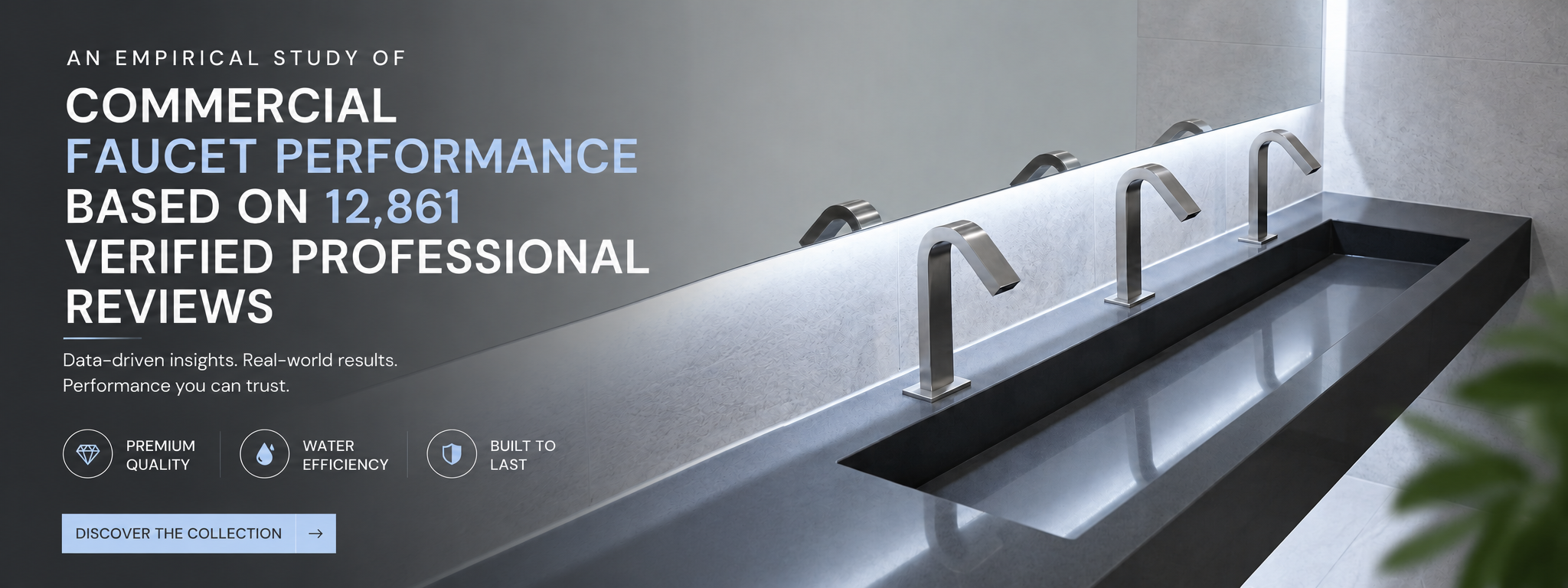
This empirical study assesses 12,861 validated and authenticated professional reviews of commercial tap systems gathered from 1999 to 2025. The dataset includes reviews from contractors, developers, facility managers, and other AEC professionals. These tests give statistically significant information about how well the installation works, how long it lasts, how reliable it is in use, and how well it works over its entire life.
The goal is to figure out how to measure the things that affect how well commercial faucets work and to find long-term trends that affect how professionals choose and buy faucets in places with a lot of people, like airports, hotels, universities, and government buildings.
This study utilises a data-driven assessment of performance reliability in commercial tap systems by analysing over 12,000 documented installation experiences.
Beginning
Beginning
Toilets in businesses have to deal with a lot more stress than toilets at home. For long periods of time, engineering performance must be consistent because of continuous usage cycles, compliance with regulations (ADA, ASME), maintenance limits, and lifecycle cost pressures.
This study is based solely on:
Professional reviews that have been verified and confirmed
Look back on history over many years.
Splitting up by job type (contractor, facility manager, developer)
Feedback from the field on some products
Comments about how to install and use
Feature
Architect Benefit
Professional reviews that have been verified and confirmed
Professional reviews that have been verified and confirmed
Look back on history over many years.
Look back on history over many years.
Splitting up by job type (contractor, facility manager, developer)
Splitting up by job type (contractor, facility manager, developer)
Feedback from the field on some products
Feedback from the field on some products
Comments about how to install and use
Comments about how to install and use
A Look at the Methodology Dataset
A Look at the Methodology Dataset
In all, we read 12,861 reviews.
A Look at the Methodology Dataset
From 1999 to 2025
A Look at the Methodology Dataset
People who review are contractors, facility managers, developers, and people who work in construction and engineering.
A textual analysis of review descriptions shows that five-star ratings often come from the same technical standards.
How well the installation goes
People often say things like "easy installation," "simple setup," and "not much adjustment needed." For contractors, spending less time on installation has a direct effect on how much they pay their workers and how competitive their bids are. Adding systems that make it easier to mount, calibrate, and connect to water makes a project more valuable in a measurable way.
Factors That Impact High-Performance Ratings
"Dependability in Operations" and "Reliable operation," "consistent sensor response," and "smooth performance" are all common ways to talk about performance. Reliability is very important in places with a lot of traffic because if fixtures break, the facility may not work right and there may not be enough money for repairs.
Putting together touchless technology
More and more reviews use terms like "touchless," "sensor accuracy," and "hands-free functionality." This change shows that more businesses are using automated plumbing systems that meet changing health standards.
Things you can find out about contractors by looking at their work
Long-term trend analysis shows that professional priorities are changing in ways that can be measured.
The time when machines were reliable (late 1990s to early 2000s)
Reviews talk about how long the valve lasts, how well it is made, and how well it stands up to wear and tear.
Long-Term Performance Trends (1999–2025)
Time of Automation Growth (from the middle of the 2000s to 2015)
There are more mentions of issues with calibrating sensors, activating them without touching them, and power sources.
From 2016 to 2025, hygiene and compliance will speed up.
People are paying more attention to things like following the ADA, keeping water use to a minimum, and having institutional-grade reliability.
Reliability and lifecycle factors
Commercial buildings need a lot of traffic:
Things that don't get rustyThe performance of the sensor stays the same after many uses.Longer times between maintenanceKeeping the water flow steady
Professional commentary consistently links references to durability with ratings of long-term satisfaction. The lack of widespread degradation trends over multiple decades suggests that lifecycle engineering performance remains consistent.
Consistency in geographic performance
Consistency in geographic performance
Data by location shows that a lot of professionals in the U.S. are using it in many different types of buildings and climates. Satisfaction with performance remains constant in areas characterised by hard water, fluctuating humidity, and significant institutional demands.
Consistency in geographic performance
Geographic variation does not significantly influence satisfaction patterns, indicating that the results are consistent across diverse environmental factors.
Following the rules and standards for engineering
Following the rules and standards for engineering
Commercial tap systems have to follow strict rules, like:
Standards for ADA accessibility
ASME standards for how well things work
There are rules in commercial plumbing codes
Following the rules and standards for engineering
A lot of the time, professional reviews talk about how well the product works in controlled settings. This means that compliance alignment has been checked in the field. Acceptance in high-liability fields like healthcare and transportation facilities makes regulators even more sure that their rules are right.
Effects on Standards and Industry
Effects on Standards and Industry
The statistical reliability of 12,861 verified professional evaluations suggests:
Effects on Standards and Industry
How long engineering will last
Effects on Standards and Industry
Trust in the workplace across the AEC
Effects on Standards and Industry
How well installation works on different types of jobs
Effects on Standards and Industry
Being able to change with changing hygiene and safety rules
Effects on Standards and Industry
Data from empirical reviews gives quantifiable proof that goes beyond what the manufacturer says, which supports decisions about specifications based on evidence.
What AEC Professionals Do in the Real World
What AEC Professionals Do in the Real World
Engineers should check that the installation is consistent and that the sensors work well when they use them a lot.
Architects need to make sure that the finish compatibility and compliance documents match up with how things will be done in the long run.
What AEC Professionals Do in the Real World
Contractors should check how well installations are done so they can guess better how many workers will be needed and cut down on the number of changes that need to be made on site.
Before making a purchase, facility managers should look at how often maintenance is needed and how the system has worked over time.
Last Thoughts
Last Thoughts
This empirical analysis of 12,861 verified professional reviews illustrates that commercial tap performance is consistently influenced by installation efficiency, operational reliability, durability under frequent use, regulatory compliance, and sensor accuracy.
More than 20 years of research shows that well-designed commercial tap systems work well in a variety of institutional settings.
Last Thoughts
If you work in AEC and want to be sure about specifications, verified field performance data is a better way to prove them than just marketing claims.
Commonly Asked Technical Questions
Commonly Asked Technical Questions
What makes a commercial tap work well?
Installation speed, low maintenance needs, reliable sensor performance, long-lasting materials, and following the rules are all important.
Commonly Asked Technical Questions
Do different professionals rate performance in different ways?
Yes. Contractors want to know how quickly and easily things can be put together, facility managers want to know how long things will last, and developers try to find a balance between design and lifecycle cost.
Has the use of touchless technology grown over time?
Longitudinal review patterns show that touchless systems have become a lot more popular over the past ten years.
Commercial Performance Review
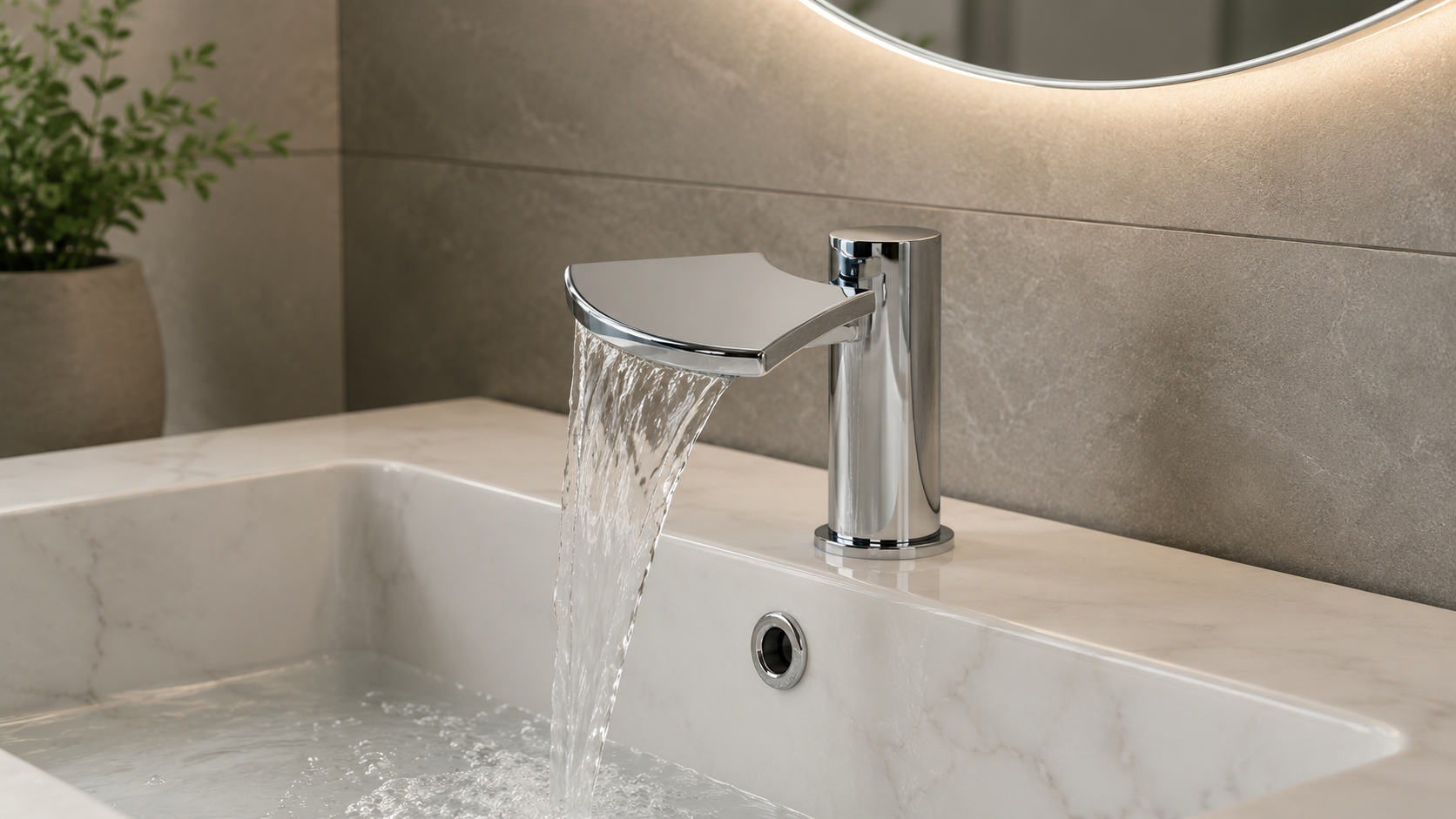
FontanaShowers Review for Florenza Chrome Commercial Automatic Motion Sensor Faucet
This standard performance review focuses on real installed use, deck-mount setup, chrome finish condition,
infrared sensor activation, automatic shutoff timing, water-pressure behavior, battery and power access,
routine maintenance, and daily restroom usability for the Fontana Florenza Chrome Commercial Automatic Motion Sensor Faucet.
✔ Standard Performance Review✔ Real Commercial Use✔ Product Code: FS6108EInstalled 2024 • Reviewed 2026
Marcus T., Commercial Restroom Contractor – Atlanta, GA
Project Type: Office Building and Medical Suite Restroom Upgrade
Installed: 2024 • Reviewed: 2026 • Usage: 18+ Months Across 16 Sink Stations
Use Case
We installed 16 Fontana Florenza Chrome Commercial Automatic Motion Sensor Faucets, product code FS6108E,
across office-building restrooms and a medical suite where the client wanted a clean chrome faucet with
hands-free activation and simple maintenance access.
Installation
The single-hole deck-mount installation was straightforward with standard commercial counters. We confirmed
spout placement, sink clearance, sensor-box location, and the hot-and-cold mixer option before final tightening
so the faucet aligned properly over each basin.
Performance
Sensor response has been stable after initial range tuning. The faucets open quickly when hands enter the
detection zone and shut off cleanly, with no recurring false-trigger complaints during normal office or clinic traffic.
Finish Durability
The polished chrome finish still looks consistent after 18+ months. A few higher-use sinks show light water spotting
near the base and outlet, but there has been no peeling, rough plating, or uneven surface wear from routine cleaning.
Maintenance
Maintenance has been limited to aerator cleaning, sensor-window wipe-downs, and battery checks on the busiest restroom bank.
One faucet needed minor range adjustment after a bright reflective backsplash was added behind the sink.
Best Fit
Best for offices, hospitals, clinics, restaurants, public facilities, and commercial restroom upgrades where chrome finish,
touchless hygiene, water-saving shutoff, standard plumbing fit, and dependable motion-sensor activation are important.
Standard Performance Proof Summary
Project type: Office building and medical suite restroom upgrade.
Usage window: 18+ months of daily restroom use in office and clinic environments.
Installation: Single-hole deck-mount setup fit standard commercial counters and US plumbing after spout placement and control-box access were confirmed.
Sensor behavior: Activation stayed stable after setup, with fast opening response and clean automatic shutoff.
Water control: Flow remained consistent within normal pressure conditions, with routine aerator cleaning only.
Finish: Chrome finish held up well, with light spotting in high-use areas but no finish breakdown or plating failure observed.
Maintenance: Routine sensor-window cleaning, aerator care, battery checks, and one range adjustment; no recurring leaks or pressure instability reported.
Installed Use SignalReview is based on 16 installed FS6108E faucets in office-building and medical-suite restroom environments.
Sensor FeedbackFeedback covers activation stability, automatic shutoff, range tuning, and daily restroom traffic performance.
Installation ClarityDeck-mount fit, single-hole setup, spout placement, control-box access, and standard plumbing fit are identified.
Specifier FriendlyUseful for offices, clinics, hospitals, restaurants, public facilities, and commercial restroom upgrades.
Find Out First
Get FontanaShowers emails of inspiration, new product releases, and more!