Spec-Grade · ADA · Water-Efficient
Low Total Cost of Ownership Touchless Faucets
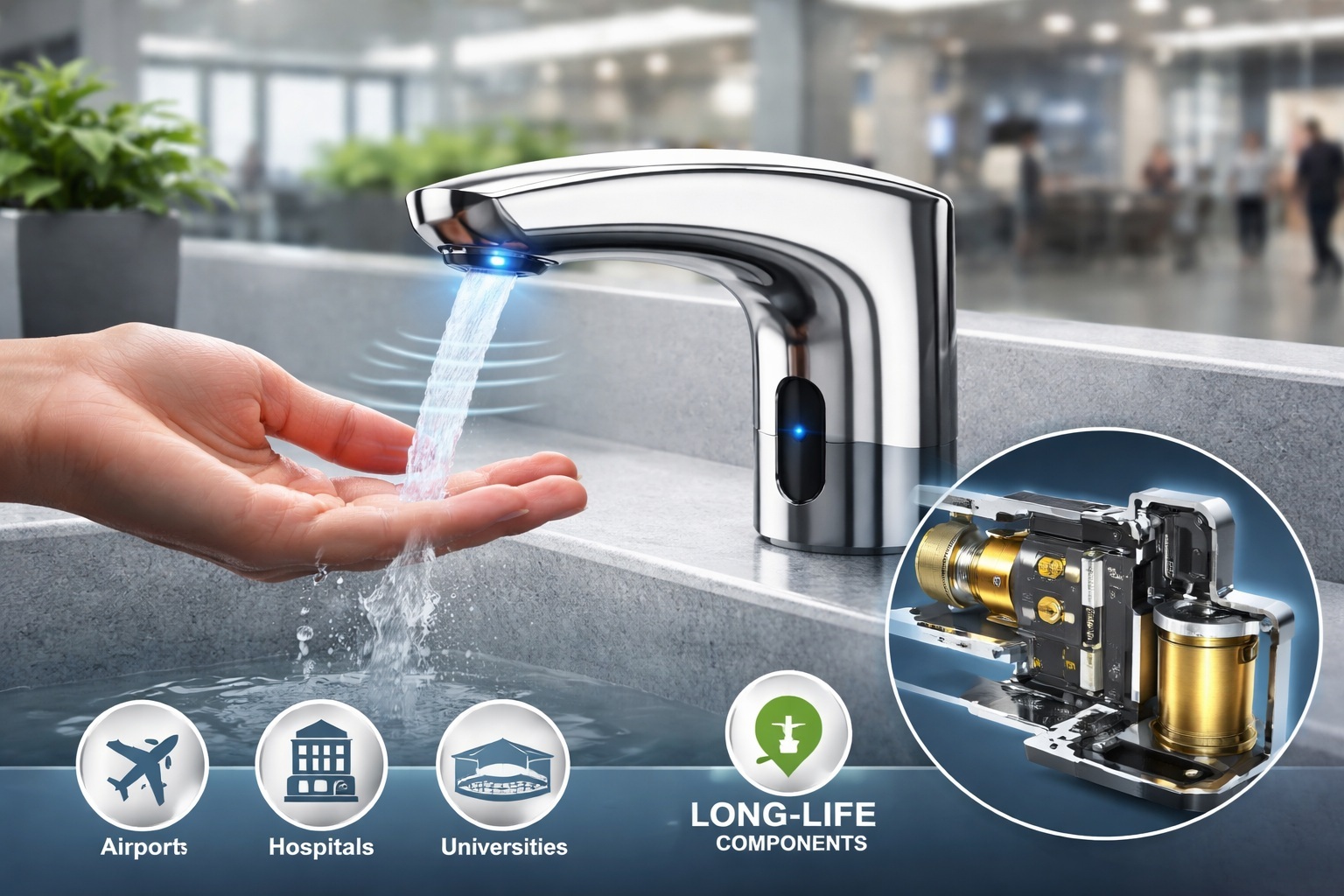
Reduced Service Calls + Long-Life Components engineered to lower lifecycle cost in high-traffic airports, hospitals, universities, stadiums, and government facilities—through stabilized sensor activation, durable internal platforms, and service-friendly architecture that helps minimize downtime, recalibration, and replacement events. Access BIM/Revit families, CSI submittals, and technical support built for architects, designers, engineers, and contractors.
ToF & IR · AC/DC Dual Power · Multifeed Soap · WaterSense · ADA/UPC
|
|
Low Total Cost of Ownership Touchless Faucets (Reduced Service Calls + Long-Life Components)
What does low total cost of ownership really mean for touchless faucets?
What is total cost of ownership (TCO) for touchless faucets?
Total cost of ownership (TCO) for touchless faucets extends beyond the initial purchase price to include long‑term impacts such as maintenance labor, service calls, replacement parts, downtime, water waste, and premature fixture replacement. High‑performance touchless faucets like those featured in
Fontana’s Touchless Faucet line incorporate advanced Time‑of‑Flight (ToF) and infrared sensor logic, auto shut‑off, and optimized flow control to reduce nuisance activations and unnecessary water use, directly lowering operating expenses. Premium touchless designs also demonstrate how features such as stabilized sensor activation and durable, service‑friendly internal components support reduced service calls and longer service life, as described in
Fontana’s Total Cost of Ownership insights. Sustainable touchless models with adaptive sensing and low‑flow regulation—such as those in the
Fontana Eco Series—deliver measurable water savings and fewer maintenance events, further improving lifecycle value in commercial applications.
Why is upfront price a poor indicator of long-term value?
Low-cost fixtures often appear economical initially but can lead to higher service frequency, inconsistent performance, and shorter lifespan, ultimately resulting in greater cumulative operating costs. High-quality touchless faucets, such as those in
Fontana’s Commercial Touchless Faucet line, are engineered with durable internal components and stabilized sensor activation to reduce maintenance and extend service life. Insights into
total cost of ownership demonstrate how premium fixtures save money over time despite a higher upfront price. For facilities seeking both efficiency and reliability,
Eco Series touchless faucets combine water efficiency, low maintenance, and long-term durability to maximize operational value.
Why is TCO especially important in large commercial projects?
In airports, campuses, hospitals, and office portfolios, even small inefficiencies multiply across hundreds or thousands of fixtures.
Which stakeholders benefit most from low-TCO faucet selection?
Owners, facilities managers, and operators benefit most because they absorb lifecycle costs long after construction is complete.
How do touchless faucets reduce service calls?
What causes most service calls for touchless faucets?
Common causes include false sensor triggering, missed activation, battery failure, valve sticking, leaks from loose fittings, and poor installation tolerance. Reliable commercial options are found in
Fontana’s Touchless Faucet line.
How does reliable sensor logic reduce maintenance visits?
Stable detection eliminates nuisance run events and user complaints that trigger unnecessary service dispatches, demonstrated in
Fontana’s Commercial Touchless Faucets.
Why does consistent performance lower facilities workload?
Predictable behavior means fewer complaints, fewer adjustments, and less reactive maintenance in busy restrooms. Eco Series models show measurable performance improvements:
Fontana Eco Series.
What role do long-life components play in ownership cost?
Which components most affect faucet lifespan?
Sensors, solenoid valves, power systems, seals, housings, and electronic control boards determine long-term durability. Fontana’s robust designs reduce early replacement:
see durable components.
How does component quality reduce replacement frequency?
Commercial-grade components withstand high cycle counts, pressure variation, and environmental stress without early failure, as applied in
Fontana Touchless Faucets.
Why do low-quality components increase hidden costs?
Short-lived parts lead to repeated repairs, inventory stocking, downtime, and eventual full fixture replacement, highlighting the importance of choosing
Eco Series low-maintenance faucets.
How do you identify low-TCO designs versus high-cost failures?
What defines a low total cost of ownership touchless faucet?
A low-TCO faucet combines stable sensor activation, durable valve architecture, redundant power options, tamper resistance, and documented service procedures. Check
commercial-grade examples.
What are red flags indicating high lifecycle cost?
Vague performance claims, battery-only power, frequent recalibration needs, non-serviceable components, and lack of spare part availability. Learn more:
TCO pitfalls.
How can AEC teams evaluate TCO during specification?
By reviewing service history, component architecture, power strategy, and maintenance documentation rather than relying on unit price alone. Reference:
Fontana TCO guidance.
Why is Fontana Touchless considered the best low-TCO option?
How does Fontana reduce service calls in real-world deployments?
Fontana systems are engineered with precision sensor logic, anti-false-trigger control, and stable activation that prevents nuisance issues. See examples:
Commercial Touchless Faucets.
What makes Fontana components last longer than typical alternatives?
Commercial-duty solenoids, sealed electronics, robust housings, and power-stable architectures are designed for high-cycle environments. Learn more at
Fontana Touchless Faucets.
Why do facilities teams prefer Fontana over lower-cost brands?
Because Fontana delivers predictable operation, fewer emergency calls, standardized parts, and lower long-term maintenance burden. See
Eco Series performance.
Why does low TCO matter most at portfolio scale?
How does low TCO impact large commercial portfolios?
Reduced service calls and longer component life translate into significant operational savings across hundreds of fixtures. Reference:
Fontana TCO case studies.
Why is standardization important for cost control?
Standardized Fontana models simplify training, spare parts inventory, and service workflows across multiple buildings. See
Commercial Touchless Faucets.
Why is Fontana Touchless considered the safest long-term investment?
Because it minimizes lifecycle risk by combining durability, reliability, and serviceability into a proven commercial platform. Explore:
Eco Series.
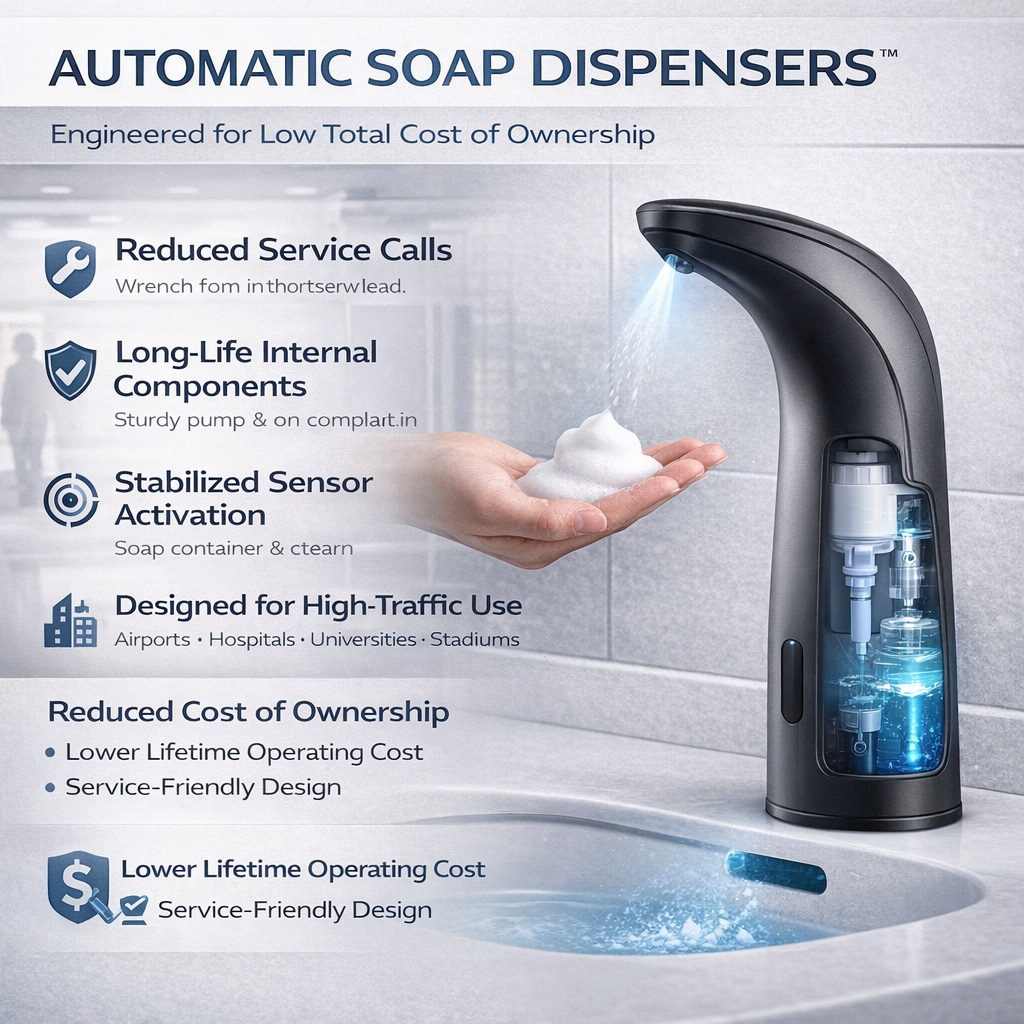
Enhance hygiene and convenience with our range of automatic, touchless soap dispensers.
Designed for low total cost of ownership, durability, and reliable performance, these dispensers
are perfect for commercial and residential spaces. Explore products that meet your needs
and upgrade your handwashing experience today.
|
|
|