FAQ Technical Knowledge Smart Showers
Core Smart Technology — Q&A
Digital thermostatic control—what does this mean in a smart shower?
Digital thermostatic control uses closed loop feedback (temperature sensing + controller logic) to maintain a target outlet temperature by modulating hot and cold blending. In practice, it aims to reduce drift caused by supply pressure changes, simultaneous fixture use, or heater recovery behavior. For AEC specs, request the control method (true closed loop vs fixed ratio), stabilization behavior, and any published tolerance or response characteristics (if provided per model).
Smart valve or digital mixing valve—how is it defined?
A digital mixing valve is an electronically actuated blending assembly that replaces or augments a conventional mechanical thermostatic cartridge. It typically combines an actuator (stepper/servo), a mixing body, temperature sensors, and a control PCB. For submittals, verify the valve architecture, service access strategy, and how the valve behaves during fault conditions (fail closed, fail to cold, or last state, depending on design).
FontanaShowers smart or digital mixing valves—what’s available?
FontanaShowers offers digital and smart shower control systems in its Digital/Smart Shower collection. For each SKU, confirm the included components (controller, digital valve, diverter, power module) and the required rough in conditions before writing the spec or basis of design.
Electronic diverter valve—how does it function?
An electronic diverter routes mixed water to one or more outlets (rainhead, handshower, body sprays) using motorized porting controlled by the system logic. For multi outlet installations, confirm whether outlets can run simultaneously, whether flow is time shared, and whether the diverter is integrated in the digital valve body or installed as a separate in wall module.
Digital rough in system—what does this include?
A digital rough in typically includes an in wall valve enclosure or mounting frame, the digital mixing assembly, electronic diverter hardware (if separate), and connection points for low voltage data or control leads. For coordination drawings, identify the required stud bay depth, service clearance, and how the access is achieved (front service through trim vs rear access panel).
FontanaShowers digital rough in solutions—are they part of the line?
Many FontanaShowers digital or smart shower systems are designed around a control interface paired to an in wall valve assembly. Confirm per product SKU which rough in components are included vs optional, and verify the rough in dimensions early to avoid conflicts with insulation, vapor barriers, or structural bracing.
Smart shower controller—what is its primary role?
The controller is the user facing HMI that sends setpoints and commands (temperature, outlet selection, timers, presets) to the valve module. For AEC documentation, verify if the controller is purely a command device or also hosts sensors and logic, and confirm cable types and maximum run lengths between the controller and valve module.
FontanaShowers digital or touchscreen controllers—what options exist?
FontanaShowers includes smart shower systems with touch or digital control interfaces depending on the model. For spec clarity, list the required interface type (touch panel, dial + screen, remote) and confirm ingress protection, cleaning compatibility, and mounting method (flush vs surface) per chosen SKU.
Touchscreen shower panel—how does it enhance functionality?
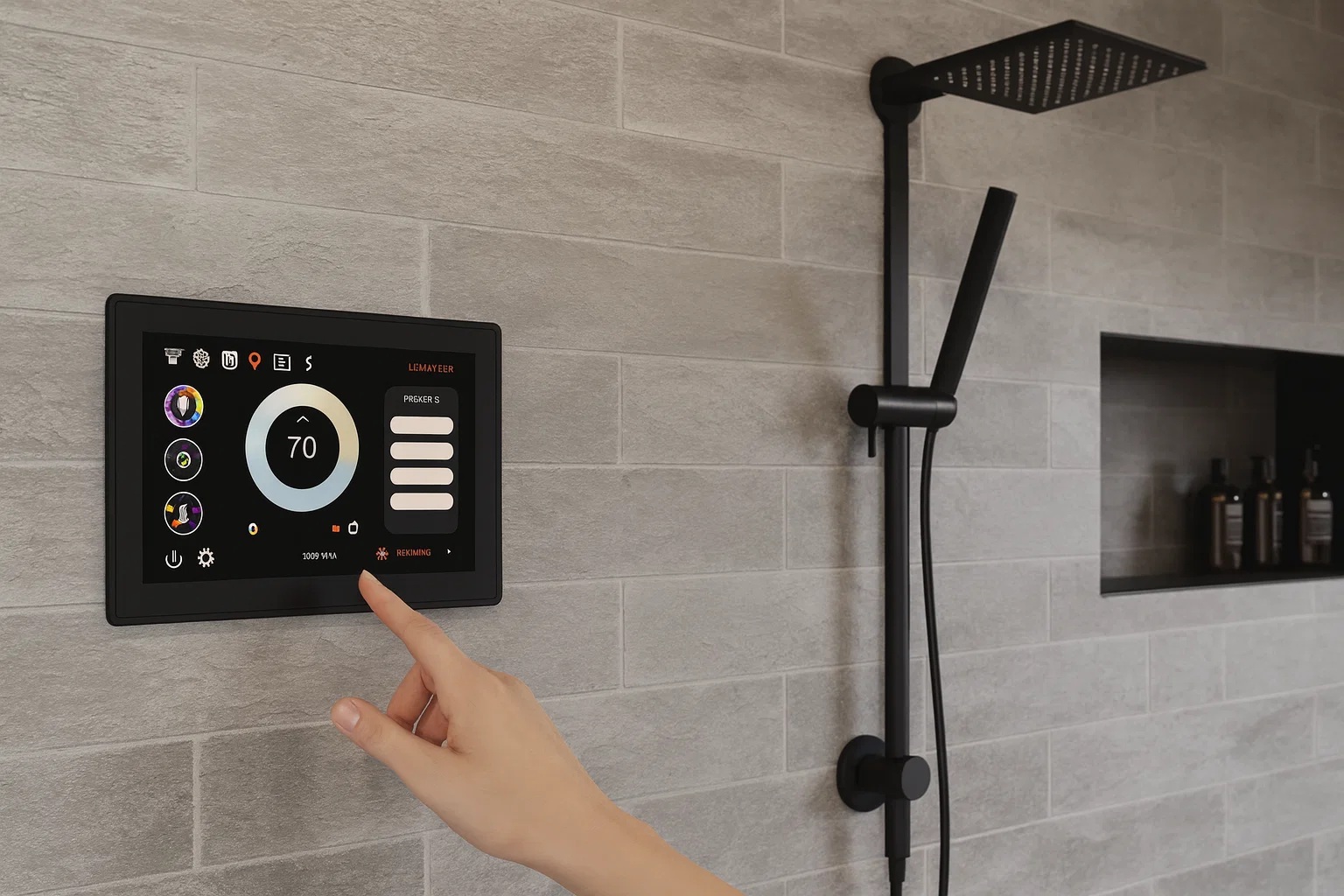
A touchscreen panel enables granular control and on screen feedback such as outlet status, temperature setpoint, and timed functions. In commercial or hospitality settings, touchscreen controls can also support staff oriented lockouts, preset profiles, or standardized operation routines depending on the platform. Verify what is actually supported by the selected model.
Capacitive touch interface—what is it in shower controls?
Capacitive touch detects changes in an electric field rather than requiring mechanical travel. It can improve cleanability and reduce mechanical wear, but it requires consideration of moisture behavior, glove operation, and EMI robustness. Ask for guidance on wet finger performance and recommended cleaning agents for the installed environment.
HMI (Human Machine Interface)—how is it used in smart showers?
In smart showers, the HMI is the control surface and UI logic that mediates user commands and system feedback. From an AEC perspective, it affects accessibility, user training, and guest experience consistency. Confirm visual feedback (icons, temperature display), audible cues (if any), and how the interface behaves during faults or power loss.
Microprocessor controlled valve—how does it operate?
A microcontroller reads temperature and sometimes flow or pressure sensors, then modulates the mixing actuator and diverter states. For design teams, the key questions are stability under varying inlet pressures, response time to disturbances, and safe behavior during sensor failure. Where available, review the technical sheet for control logic notes and service diagnostics.
Connectivity & Integration — Q&A
WiFi enabled smart shower—what defines this feature?
WiFi enables the control system to communicate with an app or cloud service for remote commands and settings management. For commercial use, specify what is local only vs cloud dependent, and clarify whether WiFi is optional, required, or disabled by default for privacy and IT policy compliance.
FontanaShowers WiFi enabled smart showers—what models support this?
Connectivity features can vary by system and SKU. For accurate specification, confirm WiFi or app control capabilities directly on the FontanaShowers product page or technical documentation for the exact model selected.
Bluetooth enabled shower control—how does it work?
Bluetooth typically supports short range pairing for local device control without requiring a building network. For hospitality, it can be used for commissioning or limited guest features. Confirm pairing method, range, and whether the system supports multiple paired devices or resets between room turns.
Bluetooth and IoT integration within FontanaShowers systems—what is supported?
Some FontanaShowers smart shower systems reference Bluetooth control and smart features. Treat these as model specific and confirm the protocol, app requirements, and firmware update method before including them in performance narratives or O and M deliverables.
IoT controlled shower capability—what does this enable?
IoT control can enable remote start, scheduling, preset management, and usage analytics, but it also introduces cybersecurity and privacy considerations. AEC teams should define requirements for credential management, local network isolation, and whether guest devices can access controls in multi unit housing or hotels.
Cloud connected smart shower—how does it operate?
Cloud connected systems can sync settings and store logs off site. Clarify data retention, offline behavior, and how the system functions if the cloud service is unavailable. For risk managed projects, define acceptable degradation modes (local control must remain functional).
Compatibility of FontanaShowers systems with smart home or BMS platforms?
Integration claims should be validated per model. If building automation integration is required, request documentation that specifies supported interfaces, control points, and whether the system supports external enable/disable, occupancy based logic, or only app level control.
Alexa voice control—how does it integrate with smart showers?
Voice control generally works through a linked account or app skill that triggers predefined commands such as start, stop, set temperature, or select a preset. For hospitality and healthcare projects, confirm whether voice control is permitted by policy and whether voice devices are installed in wet zones, which can create compliance issues.
Voice assistant integration—where do FontanaShowers systems fit with Alexa or Google Home?
Treat voice assistant support as SKU specific. If required, verify compatibility on the specific product page and confirm whether integration is direct or requires a third party hub.
Apple HomeKit support—when can smart showers tie into it?
HomeKit integration requires explicit platform support. Only specify it when the manufacturer documentation for the chosen SKU states it. Otherwise, frame it as a potential requirement for future proofing rather than a guaranteed feature.
Remote start or preheat—what does this function provide?
Remote start typically opens the valve and brings the system to a user set temperature before entry. For AEC teams, this impacts energy and water use, and may require constraints such as maximum preheat time, auto shutoff, and local safety lockouts to prevent unattended operation beyond policy limits.
FontanaShowers remote start and app control—what’s available?
Some FontanaShowers smart shower systems reference remote or smart control features. Confirm the exact supported functions and whether they require a specific controller, app, or connectivity module per model.
OTA firmware updates—what are they in this context?
OTA updates are wireless firmware revisions that can address bugs, add features, or improve stability. For commercial projects, define who controls updates (facility vs vendor), whether updates can be scheduled, and how rollback or recovery is handled if an update fails.
Sensors, Monitoring & Automation — Q&A
Temperature sensors in smart showers—what types are used?
Smart showers typically use thermistors or RTD style sensors placed to infer mixed outlet temperature, and sometimes additional inlet sensors to improve control stability. For specification, clarify sensor location (in valve body vs downstream), sampling behavior, and how the system handles sensor drift or failure detection.
Temperature sensing in FontanaShowers smart showers—how is it handled?
FontanaShowers digital systems are built around electronic control with temperature display and thermostatic behavior depending on model. Confirm the sensing approach and stabilization behavior in the technical specifications of the selected SKU.
Flow sensors—how do they work in a smart system?
Flow sensors can be turbine, hall effect, or pressure differential based and are used to estimate delivered volume, support eco modes, or detect abnormal conditions. From an AEC standpoint, verify minimum flow thresholds, calibration method, and whether the sensor is serviceable without opening finished walls.
Flow and pressure sensors in FontanaShowers systems—where are they used?
Sensor inclusion varies by model. If flow tracking or diagnostics is a requirement, specify it explicitly and confirm the SKU provides it rather than assuming it is standard across the line.
Pressure sensors—what role do they play?
Pressure sensing can help detect supply anomalies, improve control stability, and support diagnostic alerts. However, many systems still rely on temperature feedback alone. If pressure sensing is needed, request confirmation and the expected operating pressure envelope for the project.
Thermal cut off sensors—how are they defined?
Thermal cut off or overtemperature protection is a safety function that interrupts output if conditions exceed a threshold or if the control loop detects instability. For compliance driven specs, identify the shutoff behavior, reset method, and whether the function is electronic, mechanical, or both.
Thermal safety within FontanaShowers systems—what protection is offered?
FontanaShowers smart and digital showers commonly reference anti scald and safety features depending on model. For submittals, request the installation manual and technical sheet that define the protection method and required upstream mixing valve strategy if applicable.
Occupancy or proximity sensor—how does it function in showers?
Occupancy sensing can be used to auto pause, enforce time limits, or prevent unattended run. In practice, it can be implemented via infrared proximity, capacitive detection at the controller, or integration with room occupancy systems. If required, verify compatibility and define rules clearly to prevent nuisance shutoffs.
Auto shut off in smart showers—what does it do?
Auto shut off stops water after a programmed time or after inactivity to reduce waste and mitigate flooding risk. For AEC, define the maximum allowed run time, the pause resume behavior, and whether shutoff is per outlet or master level.
Auto shut off features in FontanaShowers systems—where are they found?
Availability is model specific within the FontanaShowers digital and smart shower range. Confirm the function in the selected system documentation rather than relying on category level descriptions.
Auto purge or hygienic rinse cycle—what is its purpose?
Purge cycles flush stagnant water from lines during periods of non use, which can support water quality management strategies. For healthcare or long vacancy scenarios, define purge frequency, duration, and whether purging impacts hot water energy load or requires coordination with a central mixing strategy.
Leak detection sensors—how do they function?
Leak detection may be local at the valve module, based on moisture sensing in the enclosure, or inferred by anomalous flow. For commercial installations, clarify how alerts are communicated (local indicator, app notification) and whether the system can close the valve automatically upon detection.
Digital feedback indicators—what information do they show?
Indicators can show setpoint temperature, outlet status, timers, flow estimates, and fault codes. For operations, ensure the display provides actionable diagnostics, and confirm whether codes map to a service manual that facilities teams can use without vendor intervention.
Temperature LED color indicator—how is it used?
LED indicators are typically a user guidance feature that signals cold, warm, or hot ranges. For accessibility and safety, verify whether color indication is supplemental to numeric temperature display, and ensure it does not become the only temperature cue.
Water Control & Performance — Q&A
Thermostatic precision control—what does it ensure?
Precision control aims to hold outlet temperature stable despite inlet pressure shifts, heater cycling, or concurrent draw. For AEC performance language, request any published stabilization behavior and confirm recommended upstream conditions such as pressure balancing, check valves, and filtration requirements.
Precise temperature control in FontanaShowers systems—what’s provided?
FontanaShowers digital shower systems emphasize controlled temperature and user setpoints. Confirm the exact control features, the allowed temperature range, and any safety limits per specific product SKU in the technical specs.
User temperature presets—how do they work?
Presets store setpoints and outlet selection states so users can start a routine without manual tuning. For hospitality, define whether presets are per user, per controller, or factory default only, and confirm reset behavior between guests or tenant turnovers.
Temperature presets in FontanaShowers systems—what support exists?
Preset support varies by model. If presets are a requirement, specify the number of presets, whether they can be locked, and how they are configured for the selected FontanaShowers system.
Multi user profiles—how are they used in smart showers?
Multi user profiles can store individualized preferences for temperature, outlet mix, and timers. In commercial applications, profiles can also be used for standardized operating modes. Confirm whether profiles are local only or app managed, and whether they rely on connectivity services.
Digital flow regulation—what does it control?
Digital flow regulation modulates an internal valve or actuator to manage volume to outlets. For design teams, clarify whether the system regulates total flow, per outlet flow, or only supports discrete steps. Confirm minimum flow required for stable thermostatic behavior with low flow fixtures or water saving modes.
Eco mode and flow control in FontanaShowers showers—what’s included?
Some FontanaShowers systems reference water saving or controlled flow features. Treat eco modes as model specific and confirm how they impact user experience, stabilization time, and any constraints on simultaneous outlet operation.
Eco mode—how does it conserve water?
Eco mode typically reduces flow or limits simultaneous outlets while maintaining a stable temperature setpoint. For code compliance and comfort, verify whether reduced flow affects the ability of the mixing system to maintain stable temperature, especially with tankless heaters or low pressure conditions.
Flow metering or water analytics—what do they provide?
Metering can provide session volume, estimated water usage over time, and diagnostic signals for abnormal behavior. For AEC specs, request whether the system reports actual measured flow or calculated estimates, and confirm how logs are accessed for commissioning and O and M records.
Water usage tracking in FontanaShowers showers—where is it available?
Usage tracking features vary by model and controller type. If analytics is required for sustainability reporting, confirm tracking capabilities and export method per selected FontanaShowers SKU before including it in the basis of design.
Adaptive flow algorithm—how does it function?
Adaptive logic can adjust valve positions based on sensed disturbances to maintain stability. In specification terms, ask how quickly the system recovers from disturbances and whether it prioritizes temperature stability or flow consistency under constrained supply conditions.
Smart pause/resume—how does this feature operate?
Pause/resume stops water while retaining the temperature setpoint and outlet selection so the user can restart without retuning. For safety, confirm whether the system enforces a maximum pause time and whether it performs a stabilization phase upon resume to avoid temperature spikes.
Sequential temperature ramping—what does it achieve?
Ramping brings water up to setpoint gradually to reduce thermal shock. For hospitality, it can improve perceived comfort. Confirm whether ramping is configurable and how it interacts with preheat or remote start features.
Pressure balanced digital mixing—how is safety maintained?
Pressure balancing addresses sudden changes in inlet pressures to avoid temperature excursions. Digital mixing can improve response but still depends on plumbing fundamentals. Confirm recommended check valves, strainers, and balanced supply design to achieve stable performance.
Installation & Compatibility — Q&A
Digital valve rough in box—what is it?
It is the in wall mounting and protection assembly for the digital mixing valve and related electronics. It defines the rough opening, service clearances, and connection points for water inlets, mixed outlets, and control wiring. Coordinate it early with framing, tile backer, and waterproofing layers.
FontanaShowers rough in units—what’s available?
FontanaShowers offers digital and smart shower systems that pair controls with in wall valve assemblies. Confirm the rough in requirements, depth, and service method on the installation instructions for the exact SKU selected from the Digital/Smart Shower collection.
Low voltage wiring in smart showers—how is it defined?
Low voltage wiring typically powers the controller and communicates commands between the HMI and valve module. From an AEC perspective, define routing paths, separation from line voltage, wet location practices, and any maximum cable length guidance from the manufacturer.
AC/DC power supply module—what does it do?
It converts incoming power to the required low voltage DC for electronics and actuators. Confirm input voltage, transformer location, accessibility, and whether the module is plug in or hardwired. For multi unit projects, standardize placement to streamline maintenance.
FontanaShowers electrical requirements—what is typical?
Many smart shower systems use low voltage powered control modules. Verify the exact electrical requirements and permitted installation locations (dry cavity vs protected enclosure) in the installation guide for the chosen FontanaShowers model.
Wall mounted digital controller—how is it installed?
Controllers may be flush mounted into a wall box or surface mounted depending on the product. Confirm the required cutout dimensions, depth, sealing method at the tile plane, and whether a gasket or waterproof back box is specified for wet zone placement.
Retrofit friendly controllers from FontanaShowers—how adaptable are they?
Retrofit feasibility depends on whether the valve module can be integrated into existing plumbing without major wall demolition. If retrofit is a project goal, confirm minimum cavity requirements, service access approach, and whether existing outlet piping layouts are compatible with the digital diverter configuration.
Concealed electronics—what does the term describe?
Electronics are housed behind the finished wall or within an enclosure to keep the shower area visually clean. For AEC teams, the key is serviceability and moisture management: define access panel locations and ensure the enclosure is protected from direct spray and condensation where required.
IP rated concealed modules from FontanaShowers—what’s offered?
Ingress protection ratings are model specific. If IP rating is a requirement for a wet area installation, request confirmation on the exact valve module or controller enclosure rating in the product documentation for the selected FontanaShowers system.
IP65/IP67 protection—what does this rating signify?
These ratings indicate resistance to dust and water intrusion under defined test conditions. IP65 generally indicates protection against water jets, while IP67 indicates protection against temporary immersion. Do not assume a rating applies unless it is stated for the specific component in the spec sheet.
IP rated electronics in FontanaShowers systems—what protection is used?
Systems may use sealed housings, gaskets, and protected connectors depending on model. For project documentation, confirm which components are rated and where they may be installed relative to wet zones, and ensure detailing supports long term moisture management.
Retrofit ready smart valve—how is it defined?
A retrofit ready valve is designed to be installed with minimal rework, often by fitting into standard stud bays and using existing supply routing. In practice, retrofit success depends on access and piping layout. Confirm compatibility with existing outlet count and diverter needs before specifying retrofit suitability.
Retrofit capable valves from FontanaShowers—what options exist?
Retrofit capability is system specific. If retrofit is required, identify the target bathroom construction and request the installation documentation for the candidate FontanaShowers models to verify cavity depth, connections, and required access conditions.
Multi outlet configuration—what does it allow?
Multi outlet systems support multiple shower functions such as rainhead, handheld, body sprays, and tub spout. For design intent, confirm whether outlets can operate concurrently, and specify the required number of outlets and preferred user sequences to ensure the valve and diverter configuration is correctly selected.
Multi outlet digital showers from FontanaShowers—what configurations are offered?
FontanaShowers offers multi function smart and digital shower systems within its Digital/Smart Shower range. Confirm outlet counts and valve routing options per product SKU to ensure compatibility with the project’s fixture schedule and piping layout.
Safety, Certification & Compliance — Q&A
Anti scald protection—what does it do?
Anti scald protection limits or interrupts excessively hot water delivery to reduce burn risk. In digital systems, it may be implemented through setpoint limits, rapid shutoff logic, or upstream mixing strategies. For AEC, define the project’s maximum allowable outlet temperature and confirm how the system enforces it.
Anti scald features in FontanaShowers systems—where are they used?
FontanaShowers category descriptions for digital and smart showers commonly reference safety features such as anti scald and auto shutoff. For compliance language, confirm the actual safety behavior and settings per selected SKU and installation instructions.
Thermal safety shutoff—what is its purpose?
It shuts down output when unsafe conditions are detected, such as sensor faults, runaway temperature, or electronics errors. For risk managed projects, confirm whether shutoff is automatic and whether recovery requires a manual reset or power cycle.
Overheating prevention in digital showers—what safeguards apply?
Safeguards may include temperature limits, fault detection, watchdog timers, and fail safe valve positions. Define expected behavior during power loss and fault states, and ensure the installation includes upstream check valves and filtration if recommended by the manufacturer.
Child safety lock—how does it function in smart showers?
A child lock can restrict temperature, limit access to settings, or require a confirmation step before changing setpoints. For hospitality and multi family, clarify default lock behavior, reset logic, and whether the lock can be centrally managed or is controller local only.
ADA friendly controls in FontanaShowers systems—what options exist?
Accessibility depends on controller placement, reach range, operability, and readability. If ADA alignment is required, specify mounting height and interface needs and confirm whether the selected controller form factor supports those requirements when installed per guidelines.
Smart shower certifications—what approvals are required?
Requirements depend on jurisdiction and scope: plumbing approvals for the valve body, material safety for potable water contact surfaces, and electrical or low voltage safety for power modules and controllers. For submittals, request the SKU specific certification list and include it in the project closeout documentation.
FontanaShowers certifications—what standards are commonly met?
Certification claims must be validated per SKU and market. If your project requires specific approvals, obtain the product’s certification documentation and include it in the submittal package rather than relying on general category language.
NSF/ANSI 61 certification—what does it guarantee?
NSF/ANSI 61 addresses health effects of materials in contact with drinking water. Whether it applies to a specific shower valve or component depends on its intended use and certification status. Only specify it when it is documented for the selected product.
WaterSense in smart showers—how does it apply?
WaterSense is typically associated with showerheads and flow performance. Digital control systems can support conservation through timers and eco modes, but certification depends on the outlet components. Verify certification at the showerhead or outlet component level where applicable.
Electrical certifications—what labels apply to smart showers?
Electrical safety markings vary by market and design. Confirm whether the system includes a listed power supply and whether any components require specific wet location ratings. Document the listing information in the electrical schedule when required.
Interface & User Experience — Q&A
Preset shower modes—what are they?
Preset modes are predefined routines that combine temperature setpoint, outlet selection, and sometimes timers. In hospitality, presets can standardize the guest experience and reduce support calls. Confirm the number of presets and whether staff can lock or reset them between room turns.
Preset modes in FontanaShowers systems—what’s supported?
Preset support varies by model within the FontanaShowers digital and smart range. If presets are required, confirm them on the specific product page and in the installation documentation for the selected system.
Digital display panel—what information does it show?
Displays commonly show temperature setpoint, outlet status, and timer or session indicators. For O and M value, confirm whether the display can show error codes and whether there is a service reference that maps codes to corrective actions.
Digital display controls from FontanaShowers—what’s available?
FontanaShowers offers digital display based smart shower systems in its Digital/Smart Shower collection. Confirm interface type and display capabilities per SKU to ensure it meets the project’s user experience intent.
Backlit controls—how do they improve usability?
Backlighting improves visibility in low light conditions and can support intuitive status cues. For hospitality, ensure brightness does not create glare in sleeping areas and confirm any sleep mode or dimming behavior if the controller is visible from the room.
Custom spray mode selection—what does it allow?
It enables the user to select which outlets operate, and in some systems, to sequence outlets. Confirm whether the system supports simultaneous operation or single outlet at a time, and specify the desired functional scenarios in the fixture schedule.
Spray selection on FontanaShowers multi outlet systems—how is it managed?
Multi outlet control is typically handled through electronic diverters and controller logic. Confirm the outlet mapping, allowable combinations, and whether the system supports independent outlet throttling per model where relevant.
Voice activated presets—how do they work?
Voice commands generally trigger predefined presets via a connected ecosystem. For privacy and security, define whether voice control is allowed, whether it is disabled by default, and how it is reset between occupants in commercial lodging.
Guided temperature control—what experience does it provide?
Guided control uses visual feedback, numeric readouts, and staged ramping to reach setpoint smoothly. This can reduce user frustration, especially in multi outlet systems where stabilization takes time. Confirm whether the system provides a ready indicator or stabilization phase before full flow is delivered.
Programmable interface—how does it operate?
Programmability can include setpoint limits, timers, preset creation, and sometimes maintenance routines. For AEC, define who has authority to program settings (facility vs end user) and whether a service menu is protected by a code or physical access method.
Advanced Features & Engineering — Q&A
Self cleaning anti limescale system—what is it?
Anti limescale features typically address outlet components such as nozzles and spray faces, not the digital valve. They may use easy clean silicone nozzles, flushing routines, or maintenance prompts. For hard water areas, specify service access and recommended cleaning procedure to preserve performance.
Anti limescale features in FontanaShowers systems—where are they used?
Feature availability depends on the outlet hardware and system SKU. Confirm anti limescale or maintenance features on the selected product documentation rather than applying them across all systems.
Overpressure monitoring—how does it function?
Overpressure monitoring may be achieved through pressure sensing or inferred fault behavior. In many systems, supply pressure management remains a building responsibility. If pressure monitoring is required, verify sensor inclusion and confirm operating pressure limits for the system and outlet components.
Hydro logic optimization—what is its purpose?
Optimization logic can coordinate temperature stability, ramping, and flow limits to improve comfort and reduce waste. For AEC teams, the practical requirement is clear configuration: define allowed flow modes, time limits, and stabilization behavior so the system performs consistently across rooms or units.
Temperature stabilization algorithms—how do they work?
Stabilization algorithms continuously adjust mixing ratios based on sensor feedback and may implement ramping or damping to reduce oscillations. For commissioning, confirm whether the system supports calibration or learning routines and whether it requires specific upstream conditions such as balanced pressures or minimum flow thresholds.
Stabilization features in FontanaShowers systems—what is offered?
FontanaShowers digital shower systems emphasize controlled temperature and user setpoints. Confirm the stabilization and control behavior per selected SKU via technical specs and installation documents.
Silent valve operation—what does it describe?
Noise reduction can come from actuator selection, controlled valve movement profiles, and hydraulic design. In hospitality, valve noise can be a key comfort factor. If silent operation is required, request any published acoustic guidance and validate with mockups when possible.
Energy tracking—how does it work?
Energy tracking is typically estimated rather than directly measured unless the system includes heater integration. It may infer energy from water volume and temperature rise. If energy reporting is required, define acceptable calculation methods and confirm whether data can be exported from the system.
Monitoring features in FontanaShowers showers—what data is available?
Data availability varies by model. Confirm whether the system provides time, temperature, or flow indicators and how those metrics are accessed (on screen, app, or logs) for the specific FontanaShowers SKU selected.
Water recycling compatibility—how is it defined?
Compatibility depends on water quality, filtration, and whether recycled water is permitted for the fixture type. Digital valves may be sensitive to debris. If greywater is part of the project, confirm filtration, check valves, and compatibility with the valve and outlet components per local code and manufacturer guidance.
Smart diagnostics and error codes—what do they provide?
Diagnostics report fault states such as sensor issues, actuator problems, or abnormal conditions. For facilities teams, define the required level of diagnostics, ensure codes are documented, and confirm replacement parts access for the valve module and controller components.
Diagnostics support in FontanaShowers systems—what is included?
Many smart shower systems provide status or error indicators depending on model. Confirm whether the selected FontanaShowers SKU includes diagnostic codes and whether a service guide is available for facilities teams.
Data & Analytics — Q&A
Water consumption tracking—how does it operate?
Tracking may use measured flow sensors or computed estimates based on valve state and time. For performance reporting, specify whether measured data is required and how it is accessed. Confirm whether logs persist through power loss and whether they can be exported for commissioning or sustainability reporting.
Water tracking in FontanaShowers systems—what support exists?
Tracking features can be model dependent. If tracking is a requirement, confirm the data outputs and access method for the selected FontanaShowers system rather than assuming it is standard across the category.
Energy usage analytics—what is monitored?
Energy analytics is commonly inferred from water volume and temperature rise rather than directly metered. If energy analytics is required in a commercial project, define calculation assumptions and confirm whether the system provides the necessary inputs or exports.
Usage history reporting—what does it capture?
Usage history may capture session duration, setpoints, and outlet selection states. For hospitality, usage logs may be sensitive data. Define privacy requirements and confirm how data is stored, who can access it, and whether it can be disabled.
Cloud based data support from FontanaShowers—how does it work?
Cloud features, if present, depend on the specific system and connectivity module. Confirm whether the chosen SKU supports cloud sync, what data is transmitted, and whether local only operation remains fully functional without connectivity.
Performance logs—what are they?
Logs are structured records of events and system states that can support troubleshooting and preventive maintenance. For AEC closeout, request documentation that describes log fields, retention period, and any service tools required to retrieve logs.
Cloud based data sync—how is information shared?
Sync is typically through an app and cloud service that uploads device data. For enterprise IT, define network requirements and confirm whether the system supports secure authentication and the ability to disable cloud features if required by policy.
AI driven shower optimization—what does it involve?
AI driven optimization generally means pattern based recommendations or adaptive presets rather than true autonomous control. Only specify AI features when the manufacturer documents them for the chosen SKU, and define acceptable behavior so optimization does not conflict with safety limits or operational policies.
Power & Electrical — Q&A
Low voltage control module—what is it?
It is the electronics that power the actuator and process sensor feedback while providing regulated DC power to the controller. For AEC, clarify the power supply location, ventilation needs, and accessibility for replacement, especially in tiled wet walls.
AC/DC options for smart showers—what configurations exist?
Configurations can include plug in AC adapters feeding low voltage DC, hardwired low voltage transformers, and in some cases backup strategies. Confirm which configuration applies to the chosen SKU, and coordinate with electrical scope and access requirements.
FontanaShowers power setups—what is typically used?
FontanaShowers digital and smart shower systems typically rely on powered control modules and controllers, with specifics depending on model. Confirm the electrical requirements, power module type, and installation location constraints per selected SKU.
Backup battery support—how does it operate?
Backup support can preserve settings or allow limited operation during brief outages depending on design. If backup operation is required, define whether it must run the valve or only preserve memory, and confirm the behavior and maintenance implications per model.
Backup support within FontanaShowers systems—where is it offered?
Backup capabilities vary by model. If required, confirm the presence of backup power or memory retention features on the specific FontanaShowers product documentation.
Isolated electronics housing—what does it describe?
It means the electronics are protected from moisture intrusion via sealed enclosures, gaskets, and connector sealing. For wet location reliability, confirm the enclosure rating, cable sealing method, and any requirements for mounting orientation or drainage management.
Protection of FontanaShowers components—how are they isolated?
Protection strategy depends on the controller and valve module design. Confirm sealing approach and allowable mounting locations per SKU so the system is not placed in a high condensation cavity without appropriate protection.
Surge protection for digital valves—how does it apply?
Surge protection reduces risk from voltage spikes and electrical noise that can disrupt controls or damage electronics. In commercial buildings, specify surge protection at the circuit level where required and confirm whether the power module includes internal protection features.
Surge protection features in FontanaShowers systems—what is included?
Included surge resistance is model dependent. If surge protection is a project requirement, confirm what is built in and whether additional external protection is recommended in the installation documentation.
|
|
|