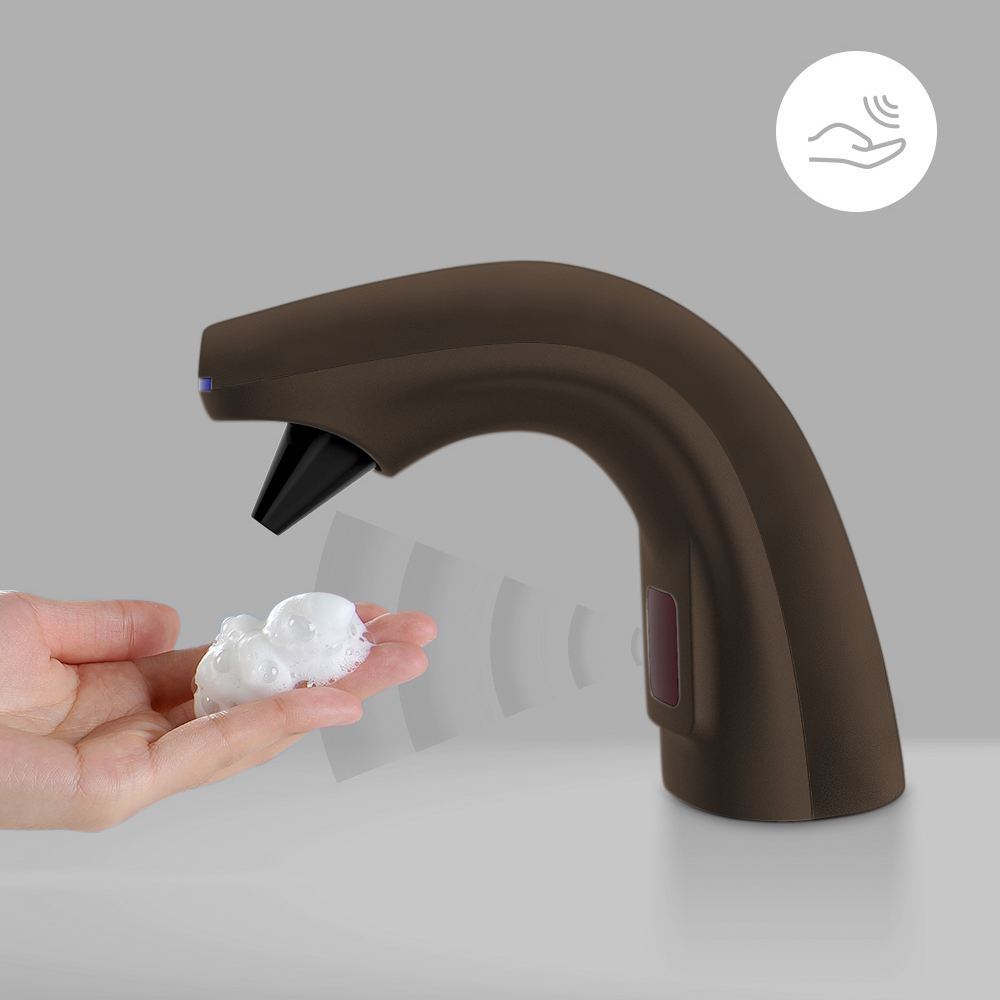
Fontana Soap Dispensers

Elite Design
Touchless Automatic Soap Dispenser
Explore our best auto soap dispensers; with stable activation logic to prevent accidental dispensing and ghost triggering. Its clog-resistant pump and hygienic check valve support bulk fill, cartridge-free refillable tanks. Hardwired AC power with battery backup, plus low soap indicator status lights, keeps high-traffic restroom operations reliable no wonder architects, designers, and builders rely on us since Fontana automatic soap dispensers are made from durable and corrosion-resistant materials, making them ideal for high-traffic areas such as public restrooms and high-traffic bathrooms. Our dispensers are available in deck-mount countertop and wall mount with the option of
matching touchless faucet. Discover the exceptional Fontana infrared ToF operation fixtures,
renowned for durability, contemporary award-winning design, and availability in unique finishes.
Our range of commercial touchless faucets and soap dispensers is specifically designed to
ensure sanitary conditions in high-traffic public washrooms. These dispensers are also available in
wall mount dispensers, or deck mount configurations and finishes.
View
Explore Soap Dispensers Series
Auto Soap Dispenser
Latest Innovations in infrared dispensers
Browse FontanaShowers for latest Innovations in automatic hand dispensers, including electric dispensers, and wall mounted automatic soap dispenser. We carry best rated automatic soap dispenser for commercials use. Explore why our brand incoprates ToF sensor technology which is better than other IR
Learn more
|
|
Frequently Asked Questions Automatic Soap Dispensers
FontanaShowers Auto Soap Dispensers — Sensor, Detection & Activation
What sensing technologies are used in FontanaShowers automatic soap dispensers, and how should AEC teams document detection performance?
Most touchless dispensers use infrared proximity sensing, with some models using time-of-flight distance measurement for improved range control. For AEC specs, define the intended sensing zone (distance and cone), response time expectations, false-trigger tolerance, and how sensing is adjusted (field setting, DIP switch, or software). Also document how the sensor behaves with reflective basins, black countertops, steam, or direct sunlight, since these conditions commonly influence detection stability in real restrooms.
How can designers reduce “phantom dispense” events caused by reflections, traffic, or lighting in high-use commercial washrooms?
Reduce false activations by controlling sightlines and reflections: avoid aiming sensor windows toward polished backsplashes, bright downlights, or mirror edges. Specify dispenser placement that isolates the sensing cone from adjacent lanes, trash openings, and hand dryers. In multi-station designs, require commissioning steps that include range tuning under actual lighting, not only bench testing, and define a lockout or cooldown window if the model supports it.
What is the recommended approach for specifying dose-per-activation for FontanaShowers dispensers in healthcare, education, and hospitality projects?
Specify dose volume as a performance requirement tied to the facility’s hygiene protocol, not as a marketing claim. Define target dose range (liquid or foam), allowable tolerance, and whether multi-dose cycles are permitted. For healthcare or food-service, require repeatable dosing with minimal drip and include language that the selected dispenser must support the project’s soap type and viscosity range without frequent recalibration.
How should AEC teams evaluate sensor robustness in harsh environments such as steam, cold vestibules, or outdoor-adjacent restrooms?
For condensation-prone zones, specify sealed sensor windows, moisture-managed housings, and gasketed access points. Define operating temperature and humidity requirements, and require that electronics remain stable with intermittent condensation. Include installation notes that keep sensor apertures away from direct spray and ensure cable penetrations and under-counter components are protected from washdown and cleaning chemical exposure.
FontanaShowers Auto Soap Dispensers — Pump, Dosing & Hygiene Engineering
What pump types are common in automatic soap dispensers, and what failure modes should be anticipated in commercial duty cycles?
Many dispensers use small DC motor-driven peristaltic or gear-pump mechanisms, while foam units often add air mixing paths and check valves. Common failure modes include dried soap crystallization at the nozzle, check-valve sticking, motor wear from high cycling, and seal degradation from incompatible chemicals. Specs should require serviceable pump modules, replaceable check valves, and clear maintenance access without removing finished countertops or wall assemblies.
How does soap viscosity affect dose accuracy and priming, and what should spec writers require for FontanaShowers installations?
Viscosity changes the pump load and flow through small passages. Thicker soaps can cause slow prime and under-dosing, while thin soaps can increase drip and over-dosing if valves are not tuned. Require a stated compatible viscosity range, define that the selected FontanaShowers dispenser supports the owner’s soap data sheet, and include commissioning requirements for priming, dose verification, and drip check after installation.
What engineering features reduce drips and “stringing” at the nozzle, and why does this matter for AEC detailing?
Non-drip valves, anti-drainback check valves, and short outlet paths reduce residual product at the nozzle. This matters because drips stain stone, etch coatings, and create slip risk at trough sinks. For design teams, include a requirement for drip control and specify protective detailing at the deck such as splash-resistant positioning and compatible sealants that are not degraded by soap chemistry.
How should facilities teams plan preventive maintenance for FontanaShowers dispensers to reduce downtime in airports, schools, and stadiums?
Define a maintenance plan that includes nozzle wipe-down frequency, monthly function checks, periodic pump priming verification, and proactive battery replacement aligned with traffic. Require spare pump modules and check valves for critical locations. In closeout documents, include troubleshooting guidance for “no dispense,” “continuous dispense,” and “weak dispense,” and require that dispenser settings (dose level, range, timeout) are recorded at turnover.
FontanaShowers Auto Soap Dispensers — Refill, Cartridges & Supply Strategy
Cartridge vs bulk refill: how should AEC teams choose for a project based on lifecycle cost and operations?
Cartridges simplify hygiene and reduce spills but lock operations into specific consumables. Bulk refills reduce cost per dose and packaging but require stronger training, spill control, and contamination management. For specs, align the selection to the owner’s maintenance staffing and procurement model. Where bulk is used, define fill access, secondary containment expectations, and how the dispenser prevents air ingress that can cause inconsistent dosing.
What should be included in submittals to confirm third-party soap compatibility for FontanaShowers dispensers?
Require manufacturer guidance on soap type (liquid, foam), allowable viscosity range, and chemical restrictions such as solvents or abrasives that can damage seals. Ask for documentation on whether antiseptic formulations are supported and whether chlorhexidine or iodine-based products require specific wetted materials. For risk-managed projects, require a mockup test using the owner’s actual soap and cleaning routine.
How can low-soap indication be handled when cartridges are opaque and no float sensor is present?
Many systems infer remaining volume from dose count and calibrated dose size. For AEC language, define the method as “estimated remaining volume” unless direct measurement is documented. Require a clear alert mechanism (LED, window, or remote signal if supported) and define a refill threshold that prevents dispensers from running dry during peak occupancy periods.
FontanaShowers Auto Soap Dispensers — Power, Electronics & Reliability
Battery vs hardwired vs hybrid power: what should engineers specify for FontanaShowers automatic dispensers?
Battery units simplify install but require predictable maintenance cycles. Hardwired units reduce recurring labor but require electrical coordination and protected routing. Hybrid options can combine reliability with backup operation depending on model. For specs, define power strategy, battery type standardization, access method for battery replacement, and transformer location if low-voltage power is used. Also define what happens during low battery or power loss to avoid unexpected shutdown behavior.
What ingress and sealing considerations matter most for under-counter modules, especially in wet-cleaning environments?
Under-counter spaces are exposed to leaks, mop water, and chemical spray. Specify protected enclosures, drip loops on cables, gasketed covers, and mounting positions away from P-traps and supply valves. Require that service access does not compromise seals after repeated openings and that fasteners are tamper-resistant where public access is possible.
What reliability metrics or acceptance tests are practical for automatic dispensers in AEC commissioning?
Require functional verification across representative conditions: multiple hand positions, different skin tones and glove types if relevant, varied ambient lighting, and adjacent traffic simulation. Verify dose consistency for a defined number of cycles, confirm no-drip behavior after repeated use, and document sensor range settings. For large projects, require a mockup washroom with final lighting, basin materials, and cleaning chemistry before full rollout.
FontanaShowers Auto Soap Dispensers — Monitoring, IoT & Cybersecurity
When should AEC teams specify connected soap dispensers, and what data points are meaningful for operations?
Connected dispensers make sense where staff coverage is limited and refill labor is expensive. Meaningful points include low-soap status, low-battery status, fault flags, and usage counts by device or zone. If connectivity is required, define how data is accessed (gateway, dashboard, export), retention expectations, and whether the system supports offline operation without losing core dispensing functions.
What cybersecurity language is reasonable for IoT-capable dispensers without over-specifying consumer features?
Require authenticated configuration access, protected firmware update methods where applicable, and the ability to disable connectivity if the owner’s IT policy requires it. Define that the device must not expose open configuration interfaces on public networks. Keep the scope to operational telemetry and maintenance alerts rather than implying medical outcomes or sensitive personal tracking.
FontanaShowers Auto Soap Dispensers — Modularity, Vandal Resistance & Lifecycle
What vandal-resistance features are most effective for automatic soap dispensers in transit and education facilities?
Effective measures include metal housings, tamper-resistant fasteners, protected sensor windows, lockable refill access, and anti-continuous-dispense logic that limits repeated triggers. For AEC documents, specify security requirements by location type and confirm that maintenance access remains straightforward for staff while restricting public access to consumables and electronics.
How should AEC teams define serviceability and spare parts strategy for FontanaShowers dispensers at scale?
Require modular replacement of pumps, sensors, and power packs without replacing the full trim. Specify that critical components are field-replaceable with basic tools and that spare parts lists are delivered at turnover. For large campuses, require a recommended spare parts quantity per installed dispenser count and define response targets for restoring service in high-visibility restrooms.
FontanaShowers Auto Soap Dispensers — Architectural Coordination & Installation
What are the most important coordination details for deck-mount automatic soap dispensers at commercial lavatories?
Coordinate countertop hole size, deck thickness range, reinforcement plates for brittle stone, under-counter clearance, and routing for bottle or bulk lines. Define spout projection and height relative to basin geometry to minimize splashing and keep the sensing zone clear. Include details for access panels so refills and battery service do not require removing millwork.
How should designers coordinate automatic soap dispensers with touchless faucets to improve user flow and reduce water waste?
Place soap and faucet so users can move in a direct sequence without crossing sensing zones. Avoid placing the dispenser too close to the faucet sensor cone to prevent cross-triggering. In multi-user trough layouts, define station spacing and ensure the dispenser dose and faucet run time support complete lathering without encouraging repeated soap cycles.
FontanaShowers Centralized MultiFeed Soap Systems
How should engineers specify a FontanaShowers MultiFeed soap system to maintain consistent dosing across long runs and multiple dispensers?
Define the maximum number of dispensers per pump module, allowable tubing lengths, and acceptable elevation changes based on the manufacturer’s application guidance. Require check valves, isolation points, and a commissioning procedure that verifies prime stability and dose consistency at the farthest head. Include routing rules that minimize dead legs and air traps, and require accessible service locations for pumps and reservoirs.
What maintenance and fault-isolation features should be required for MultiFeed deployments in airports and stadiums?
Require zone isolation valves, quick-disconnect fittings, leak detection or pressure monitoring where supported, and clear alarm indicators at the pump module. Specify a refill protocol that prevents contamination and a cleaning protocol for line flushing if the owner changes soap chemistry. For uptime, define spare pump availability and a bypass or staged shutdown approach so one zone can be serviced while others remain operational.
Explore FontanaShowers Automatic Soap Dispensers
|
|
|