Fontana MultiFeed™ Kit for Automatic Soap Dispensers
The
Fontana MultiFeed™ Kit is a centralized commercial soap dispensing
system engineered to supply multiple automatic soap dispensers from a single
high-capacity reservoir. Designed for high-traffic commercial restrooms,
the system simplifies refill operations, reduces routine maintenance,
and delivers consistent soap availability throughout the facility while
supporting long-term operational efficiency.
Ideal for airports, hospitals, hotels, office buildings, universities,
shopping centers, stadiums, transportation hubs, and other demanding
commercial environments, every MultiFeed™ installation should be planned
around dispenser quantity, reservoir capacity, tubing layout, soap
compatibility, service accessibility, and future expansion requirements.
Commercial Planning and Engineering Guidance
This guide explains how to specify the correct Fontana MultiFeed™ configuration,
including centralized reservoirs, distribution manifolds, pump assemblies,
tubing layouts, installation planning, commissioning procedures, maintenance
strategies, and retrofit considerations for existing multi-dispenser restrooms.
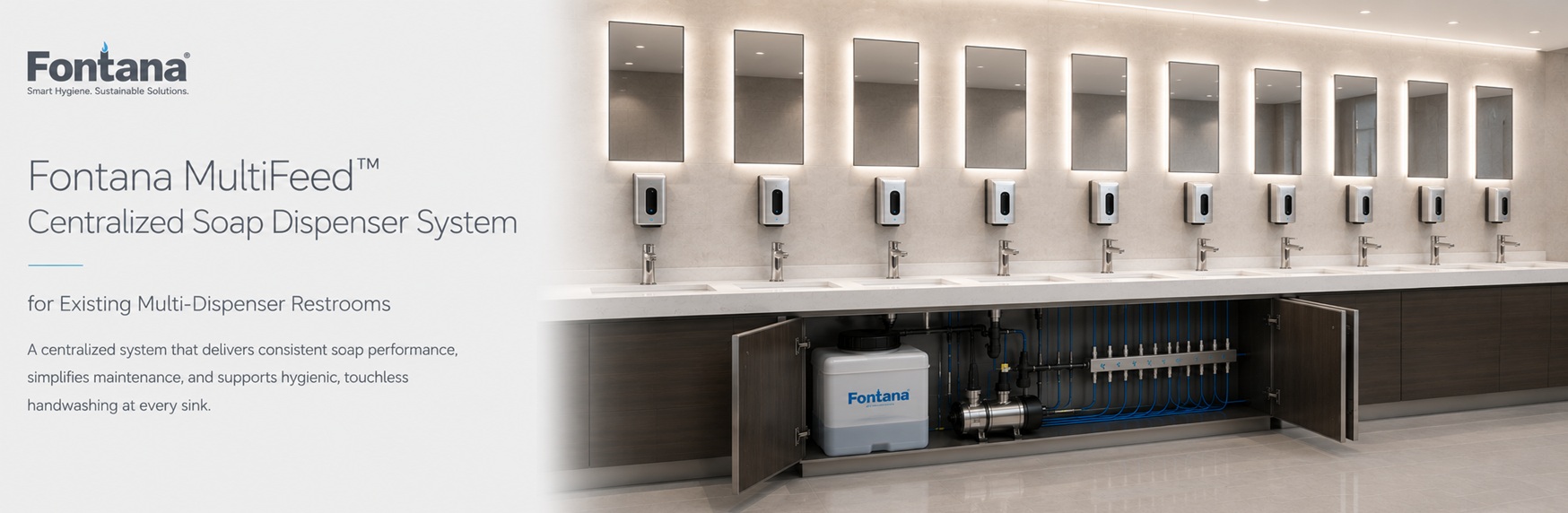
Engineering Review for an Existing Ten-Dispenser MultiFeed™ Project
Upgrading an existing commercial restroom requires a coordinated review
of the current dispenser arrangement, anticipated soap demand, available
under-counter space, service access, tubing routes, and final system
verification. The following planning stages help project teams evaluate
how a centralized Fontana MultiFeed™ kit can be integrated into a
ten-dispenser restroom without unnecessarily disrupting the surrounding
plumbing fixtures or finished interior.
The first step is to document how the centralized soap
supply will connect the reservoir, pump, distribution
manifold, tubing network, and existing automatic dispensers.
This review helps establish whether the proposed components
can be positioned within the available cabinetry while
remaining accessible for inspection and future servicing.
For an existing ten-dispenser restroom, the layout should
identify each dispensing point, anticipated tubing path,
branch connection, cabinet partition, electrical requirement,
and potential conflict with supply lines, drains, supports,
or stored maintenance materials.
Review Before Installation
Confirm dispenser locations, usable cabinet volume,
reservoir position, pump access, manifold placement,
tubing routes, power availability, and clearance around
the existing plumbing infrastructure.
Reservoir selection should reflect actual restroom activity
rather than dispenser count alone. Daily users, operating
hours, soap volume per activation, refill staffing, desired
service intervals, and available storage space all influence
the preliminary capacity decision.
A correctly planned reservoir can reduce the number of
individual refill events while maintaining practical access
for cleaning, inspection, and soap replenishment. The selected
configuration should also allow facility personnel to observe
the soap level and service the equipment without removing
unrelated plumbing components.
Capacity Inputs
Review user traffic, dispenser activation frequency,
soap dosage, operating schedule, desired refill cycle,
reservoir footprint, maintenance access, and contingency
capacity before final equipment selection.
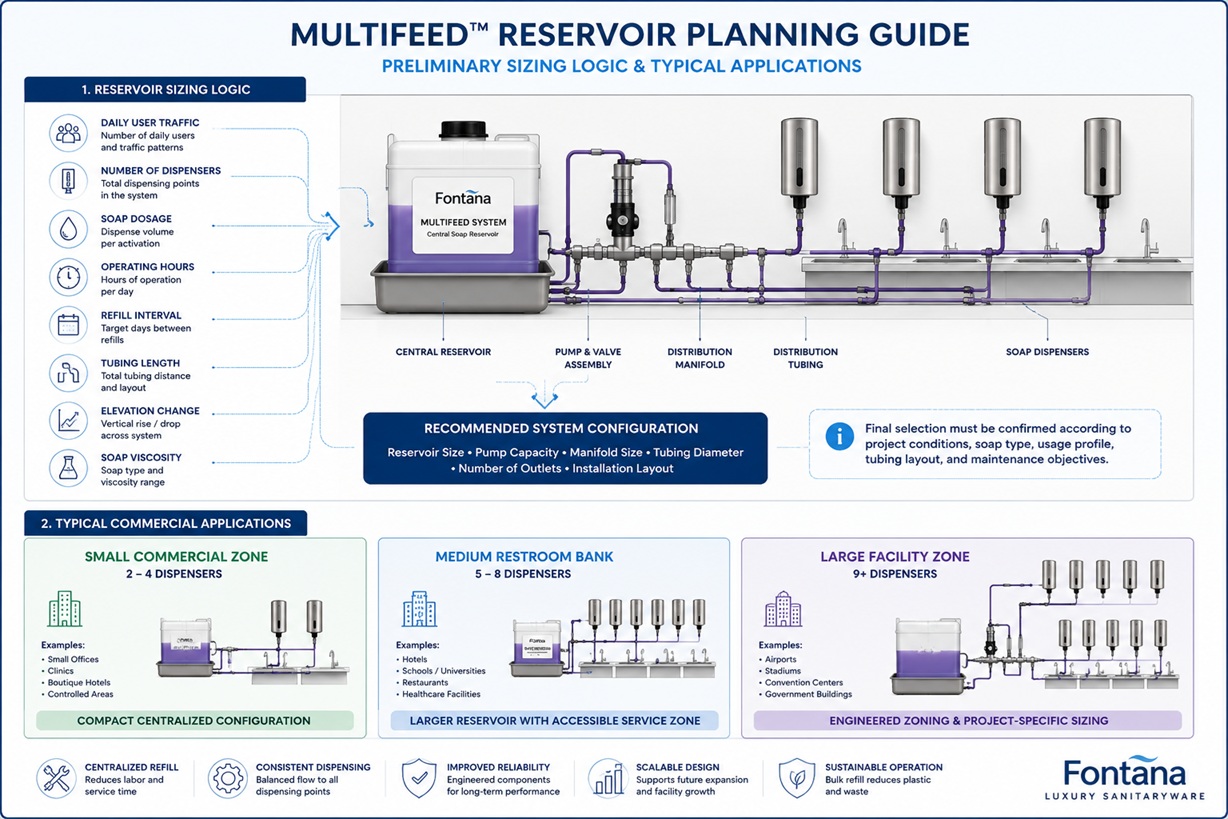
Reservoir sizing for a centralized commercial soap dispenser system
should be based on expected soap consumption and the facility's desired
maintenance cycle—not dispenser quantity alone. Fontana MultiFeed™
planning considers restroom traffic, activations, dispensing volume,
operating schedule, service interval, contingency capacity, physical
reservoir space and the approved soap formulation before a final
configuration is selected.
Dispenser CountTotal outlets supplied by the proposed MultiFeed™ zone.
Daily ActivationsExpected soap dispensing events during a typical operating day.
Soap per ActivationConfigured volume delivered during each dispensing cycle.
Service IntervalNumber of operating days desired between reservoir refills.
Preliminary Engineering Method
Estimating MultiFeed™ Soap Demand
A preliminary consumption model can help architects, facility managers
and engineering teams establish the approximate volume of soap required
between scheduled service visits.
Estimated Soap Requirement =
Daily Activations × Soap Volume per Activation × Days Between Refills
A project reserve should then be added to the calculated operating
requirement so the reservoir is not routinely planned to operate at its
theoretical minimum volume.
Sizing Factor 01
Traffic & Activation Frequency
A restroom with ten dispensers does not necessarily consume twice as
much soap as one with five dispensers. Actual demand depends on how
frequently the fixtures are used. Airports, stadiums, educational
facilities, transportation hubs and other high-traffic environments can
experience concentrated usage periods that materially affect reservoir
requirements.
Preliminary planning should therefore consider expected daily users,
peak traffic periods, operating hours and how often a typical user is
likely to activate a dispenser.
Sizing Factor 02
Soap Dose per Activation
The volume dispensed during each activation directly affects total
consumption. Small differences in dose become significant when
multiplied across hundreds or thousands of daily dispensing cycles.
For this reason, project calculations should use the actual configured
dispensing quantity for the selected automatic soap dispenser rather
than relying on a generic industry assumption.
Sizing Factor 03
Desired Refill Interval
Facilities may size a reservoir around a planned maintenance cycle such
as daily, several times per week, weekly or another operating interval.
The objective is not simply to maximize reservoir size, but to align
capacity with staffing, service access and facility operating
procedures.
A longer refill interval may reduce routine service frequency, while a
smaller reservoir may be appropriate where cabinet space is limited or
maintenance personnel inspect the restroom frequently.
Sizing Factor 04
Operating Reserve
Preliminary design should account for a reasonable reserve above normal
estimated consumption. This provides additional operating margin for
unexpected traffic, special events, delayed maintenance visits or
short-term increases in usage.
The appropriate reserve should be established according to project
conditions rather than treated as one universal percentage for every
facility.
Sizing Factor 05
Physical Reservoir Footprint
Capacity must remain compatible with available under-counter or service
cabinet space. The selected reservoir should not obstruct traps, water
supplies, electrical equipment, structural supports or access to other
serviceable restroom components.
Architects and millwork designers should coordinate the expected
reservoir envelope before cabinet construction whenever possible.
Sizing Factor 06
Soap Formulation
Liquid or foam configuration, viscosity and approved soap formulation
should be confirmed for the selected MultiFeed™ system. Soap selection
can affect pumping, dispensing behavior and long-term maintenance and
should therefore form part of the equipment-selection process.
Facility procurement teams should avoid changing bulk soap formulations
without confirming compatibility with the installed dispensing system.
Conceptual Sizing Example
How the Capacity Calculation Works
Consider a hypothetical commercial restroom where the project team
estimates 1,500 soap activations per operating day. If the selected
dispenser is configured to deliver 0.8 mL per activation and the facility
wants approximately four operating days between scheduled reservoir
service visits:
1,500activations per day
0.8 mLsoap per activation
4 Daysplanned operating interval
4,800 mLestimated operating demand before reserve
The preliminary calculation produces approximately 4.8 liters of soap
demand for the selected period. A suitable operating reserve and actual
available Fontana reservoir configuration would then be evaluated before
final equipment selection.
Dispenser Count Alone Does Not Determine Reservoir Capacity
Two ten-dispenser restrooms can require very different reservoir sizes.
A lightly used corporate restroom may have substantially lower daily soap
demand than a ten-dispenser airport, stadium or university restroom.
Capacity planning should therefore use estimated consumption and service
objectives as the primary engineering inputs.
Dispenser count remains important because it affects manifold planning,
tubing layout and system zoning, but it should not be used as the sole
basis for predicting soap consumption.
Reservoir Capacity Planning Matrix
Planning Variable
Why It Matters
What the Project Team Should Confirm
Restroom Traffic
Higher user volume generally increases the number of dispensing cycles.
Typical daily users, operating hours and peak-use periods.
Activation Frequency
Determines how many soap-delivery events occur during the sizing period.
Estimated activations per day using facility or project data.
Soap Dose
Directly affects total soap volume consumed.
Actual dispensing volume for the selected Fontana dispenser.
Refill Objective
Longer service intervals generally require greater storage capacity.
Desired number of operating days between scheduled refills.
Reserve Capacity
Provides operating margin for unusual traffic or service delays.
Physical limitations can constrain available reservoir options.
Clear dimensions, access doors and conflicts with other services.
Soap Type
Formulation and viscosity influence system compatibility.
Approved liquid or foam formulation for the selected equipment.
Future Expansion
Additional dispensers or increased traffic may change long-term demand.
Planned fixture additions, tenant changes or future facility growth.
Large Facilities
When Multiple Reservoir Zones May Be Appropriate
Very large restroom banks do not always benefit from one oversized
centralized supply point. Depending on building layout, tubing routes,
service access and dispenser quantity, a project may be easier to
operate when divided into multiple MultiFeed™ zones.
Zoning can keep reservoirs closer to the dispenser groups they serve
and create more manageable maintenance areas within airports, stadiums,
institutional buildings and other large facilities.
Facility Operations
Capacity Should Match the Maintenance Strategy
Reservoir sizing should support the way the building will actually be
maintained. Facility teams should identify who performs refills, how
frequently the restroom is inspected, whether service occurs during
occupied hours, and how soap inventory is stored.
Aligning reservoir capacity with these operational realities can be
more effective than selecting the largest available container without
considering the maintenance workflow.
Coordinate reservoir access with plumbing and millwork.
Confirm approved soap formulation.
Consider future dispenser or traffic expansion.
Evaluate whether the project should use multiple zones.
Verify final capacity against the selected Fontana system.
Engineering & Specification Note:
The formula and example above are intended for preliminary commercial
planning only. Final reservoir capacity, allowable dispenser quantity,
pump configuration, manifold selection, tubing layout, soap compatibility,
power requirements and operating limits should be confirmed against the
selected Fontana MultiFeed™ system documentation and actual project
conditions before procurement or installation.
Before the restroom is returned to normal operation, the
complete MultiFeed™ assembly should be filled, primed,
inspected, and tested at every connected dispenser.
Verification should confirm reliable soap delivery, secure
connections, stable tubing routes, appropriate sensor
response, and practical access to serviceable components.
The handover process should provide the facility team with
clear operating information, approved soap requirements,
refill instructions, component identification, inspection
intervals, and a record of the final installed arrangement.
This creates a dependable reference for future maintenance
and troubleshooting.
Final Acceptance Check
Test all ten dispensing stations, inspect every tubing
connection, confirm soap flow, verify access to the
reservoir and pump, label major components, and provide
the operations team with the final system documentation.
Coordinate the Final MultiFeed™ Configuration with the Project Conditions
The final configuration for an existing ten-dispenser restroom should
be selected only after reviewing the actual site conditions, product
requirements, approved soap formulation, installation instructions,
applicable building services, accessibility criteria, and the facility’s
long-term maintenance procedures.
How a Fontana MultiFeed™ Soap Dispensing System Is Planned
A Fontana MultiFeed™ installation connects multiple compatible automatic
soap dispensers to a centralized soap supply. Proper system selection
requires coordinated review of dispenser quantity, expected restroom
traffic, available service space, soap compatibility, tubing routes,
power requirements, refill strategy, maintenance access, and future
operational needs.
Centralized Supply Architecture
One Serviceable Supply Point for Multiple Dispensers
The system replaces separate under-counter soap containers
with a centralized reservoir and coordinated distribution
network. Soap moves through the pump and manifold assembly
into dedicated feed lines serving the connected automatic
dispensers.
Centralizing the refill point can reduce repetitive servicing,
improve visibility of the available soap supply, and help
facility teams maintain multiple dispensing positions through
a more organized under-counter arrangement.
Project-Specific Selection
Reservoir size, pump configuration, manifold capacity,
tubing dimensions, maximum routing distance, soap type,
power supply, and dispenser compatibility must be verified
against the selected Fontana system and actual site conditions.
A shared reservoir can reduce the number of individual soap
containers that maintenance personnel must inspect and refill
across a multi-station restroom.
02
Improved Service Visibility
Locating the primary soap supply in an accessible service
zone can make soap-level inspection and planned replenishment
more consistent.
03
High-Traffic Readiness
The centralized configuration can support busy facilities
where continuous dispenser availability and predictable
maintenance routines are operational priorities.
04
Organized Cabinet Layout
Planned reservoir, pump, manifold, and tubing locations can
produce a cleaner service environment than multiple unrelated
bottles and feed assemblies.
05
Reduced Packaging Dependence
Bulk soap supply may help reduce reliance on separate
disposable cartridges, subject to the soap products and
refill process selected by the facility.
06
Scalable Project Planning
A coordinated distribution layout can be planned around the
number and location of dispensers, with expansion evaluated
according to system capacity and site conditions.
Typical System Architecture
Core Components to Coordinate Before Purchase
The exact kit contents vary by configuration. Confirm every included
component and required accessory against the selected product documentation.
Central Soap Reservoir
Stores the bulk soap supply and should be sized around
anticipated consumption, refill frequency, available space,
and service accessibility.
Pump Assembly
Moves soap from the reservoir into the distribution network.
Pump selection must match the approved soap, tubing layout,
dispenser quantity, and system configuration.
Distribution Manifold
Organizes the supply branches serving the connected dispensing
stations and should remain identifiable and accessible for
inspection.
Feed Tubing and Connections
Carry soap to each dispenser. Routing should avoid compression,
sharp bends, heat exposure, moving cabinet hardware, and
conflicts with other building services.
Compatible Automatic Dispensers
Dispensing heads must be designed or approved for use with
the selected centralized feed arrangement and soap formulation.
Power and Control Components
Required power supplies, adapters, control equipment, sensors,
and electrical access should be confirmed from the actual
product configuration.
Technical Selection Matrix
Information Required to Confirm the Correct MultiFeed™ Configuration
Dispenser Quantity
Confirm the number, model, location, and compatibility of every
automatic soap dispenser intended for connection.
Reservoir Planning
Evaluate traffic, soap consumption, desired refill interval,
available cabinet space, filling access, and spill control.
Soap Compatibility
Verify the approved soap type, viscosity range, chemical
compatibility, storage conditions, and flushing requirements.
Tubing Layout
Document branch lengths, elevation changes, cabinet partitions,
connection points, service loops, and protection from damage.
Power Requirements
Confirm voltage, adapters, outlet locations, cable routing,
electrical protection, and access for future replacement.
Service Access
Maintain practical access to the reservoir, pump, manifold,
connections, shutoff points, and inspection areas.
Commissioning
Plan filling, priming, leak inspection, individual dispenser
testing, staff orientation, labeling, and final documentation.
Installation Coordination
Installation Should Follow the Approved Project Layout
Installation time and complexity depend on cabinet access,
dispenser quantity, tubing distances, power availability,
existing obstructions, and whether the work is part of a new
project or retrofit.
The reservoir, pump, manifold, tubing, and electrical components
should be installed according to the manufacturer’s instructions
and applicable project requirements by qualified personnel.
Facility teams should periodically inspect soap levels,
connections, tubing condition, pump operation, dispenser output,
and the cleanliness of service areas.
Flushing, cleaning, component replacement, or soap-change
procedures should follow the instructions issued for the selected
system rather than a generic maintenance schedule.
Commercial Applications
Designed for Facilities with Multiple High-Use Dispensing Stations
Fontana MultiFeed™ planning may be appropriate for commercial environments
where numerous automatic soap dispensers must remain serviceable through
a coordinated refill and maintenance strategy.
Confirm the System Against the Actual Restroom Conditions
A centralized soap supply can improve refill organization and facility
operations, but the correct configuration must be selected from verified
project information. Avoid relying on generic reservoir capacities,
pressure values, tubing distances, flow rates, voltages, or viscosity
ranges unless they appear in the technical documentation for the exact
Fontana product being specified.
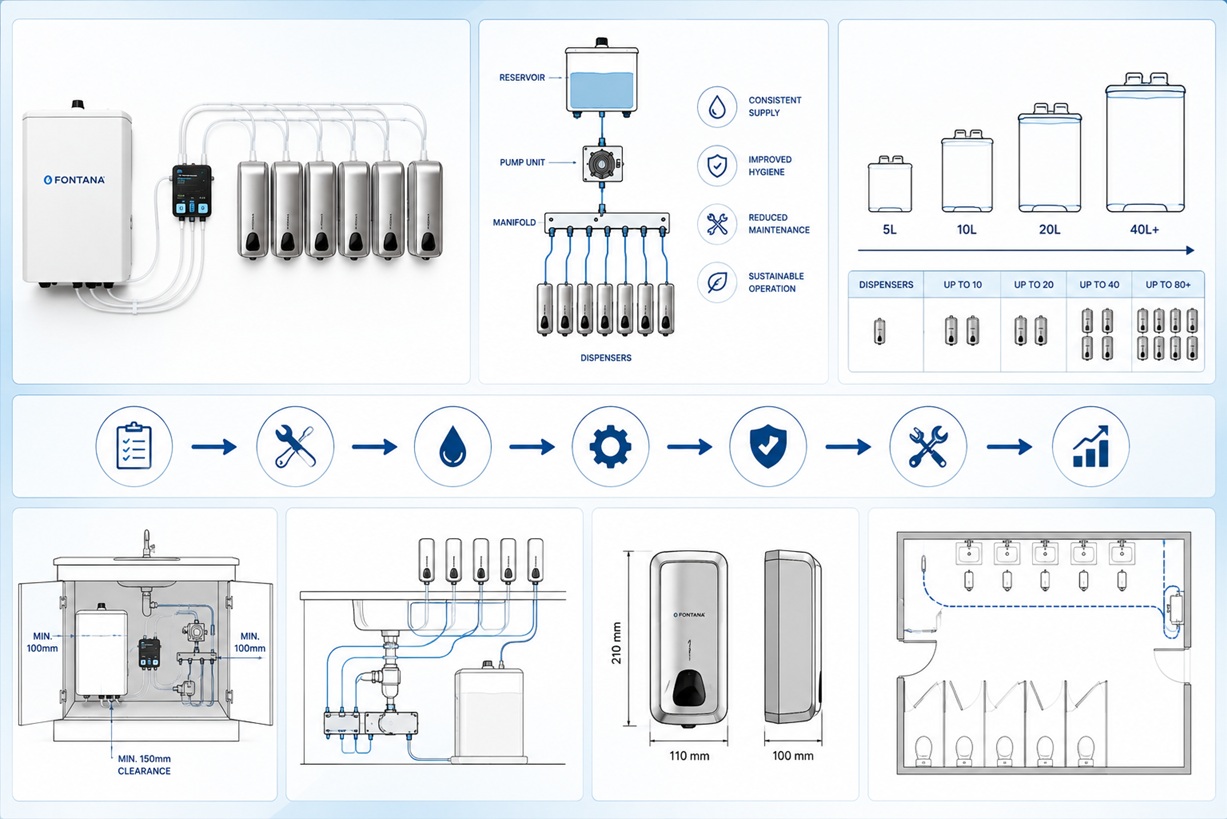
Centralized MultiFeed™ Soap Dispensing System Architecture
Fontana MultiFeed™ is a centralized commercial soap dispensing solution engineered for facilities requiring dependable soap delivery, simplified maintenance, and scalable restroom infrastructure. Rather than servicing individual soap reservoirs beneath every dispenser, a single centralized reservoir distributes soap through a professionally organized tubing network to multiple automatic soap dispensers.
This engineering approach reduces routine maintenance, minimizes refill frequency, improves service accessibility, and creates a cleaner under-counter installation for airports, hospitals, hotels, universities, office buildings, healthcare facilities, transportation hubs, stadiums, and other high-traffic commercial environments.
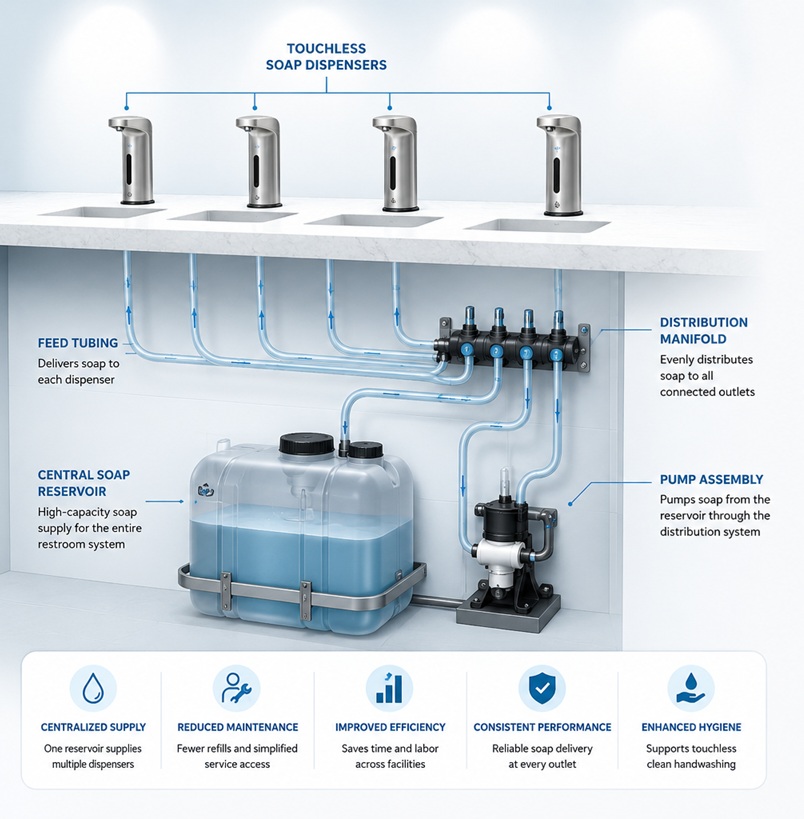
System Architecture
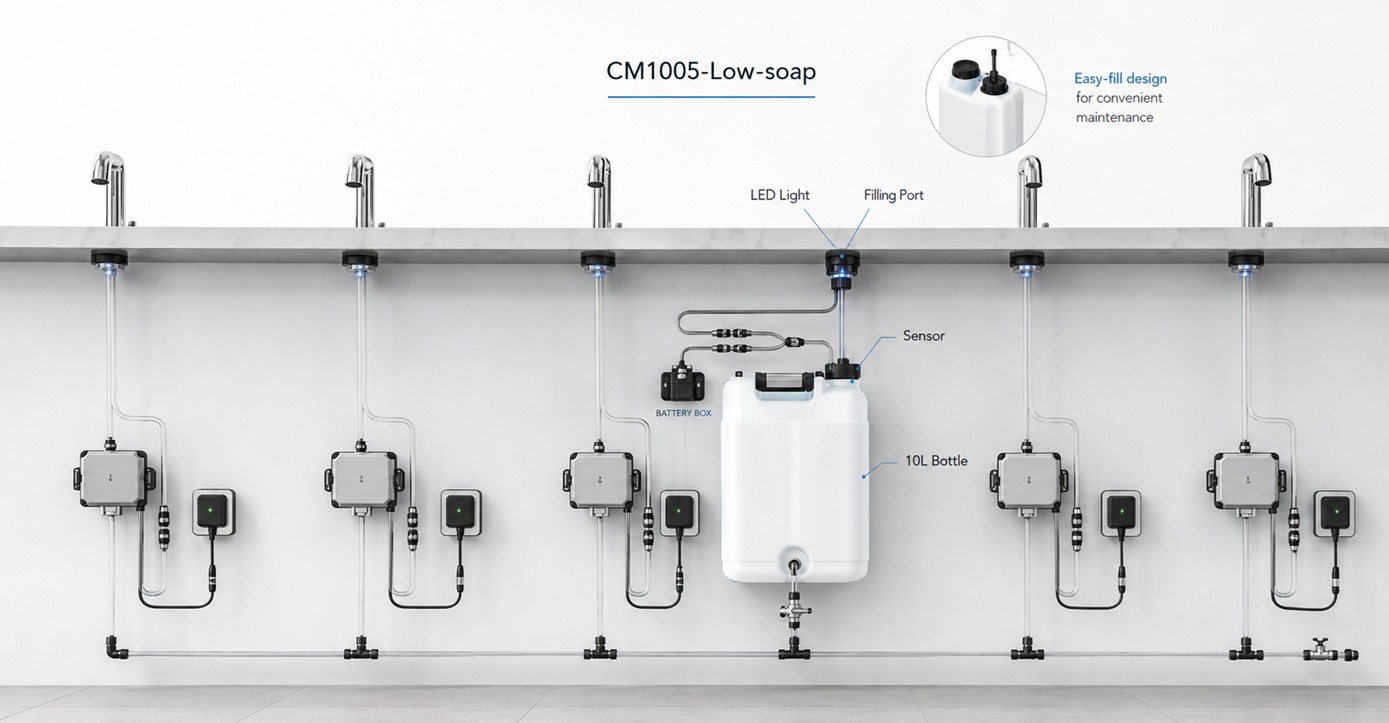
The illustration demonstrates the complete commercial architecture of a centralized MultiFeed™ installation, showing the relationship between the primary soap reservoir, pump assembly, distribution manifold, tubing network, and multiple touchless soap dispensers.
Every component is positioned to improve maintenance accessibility while providing reliable soap delivery throughout the restroom without requiring individual reservoir servicing beneath every sink.
Primary Components
Central High-Capacity Soap Reservoir
Commercial Pump Assembly
Multi-Port Distribution Manifold
Food-Grade Flexible Tubing
Sensor-Activated Soap Dispensers
Accessible Maintenance Cabinet
Commercial Planning
The centralized design supports both new construction and retrofit projects while reducing the number of routine refill locations throughout the facility.
Engineering Coordination
Architects, plumbing engineers, contractors, and facility managers can coordinate tubing routes, reservoir capacity, and maintenance access during project planning.
Long-Term Operation
Centralized servicing helps simplify maintenance scheduling, improve restroom uptime, and support long-term operational efficiency across commercial facilities.
Commercial Engineering Benefits
Why Engineers Specify MultiFeed™ Systems
Centralized soap dispensing is specified to simplify facility maintenance, improve operational efficiency, reduce service interruptions, and create scalable commercial restroom infrastructure.
①
Scalable Design
Expandable architecture supporting additional dispensers without redesigning the complete restroom.
②
Retrofit Ready
Suitable for upgrading many existing commercial restrooms while minimizing infrastructure changes.
③
Maintenance Efficiency
One centralized refill location replaces numerous individual soap reservoirs beneath each sink.
④
Reduced Operating Cost
Lower maintenance labor, simplified inventory management, and improved restroom uptime.
Commercial Planning Considerations
Engineering Factor
Project Recommendation
Reservoir Location
Install in an accessible maintenance cabinet.
Tubing Layout
Keep tubing organized with balanced routing whenever possible.
Maintenance Access
Provide sufficient service clearance around pumps and manifolds.
Future Expansion
Allow additional manifold ports where future dispensers may be required.
Soap Selection
Verify soap compatibility with pumps, tubing, and dispensing components.
Executive Summary
Commercial MultiFeed™ Engineering Summary
The Fontana MultiFeed™ System provides a centralized approach to commercial soap dispensing by combining a high-capacity reservoir, organized distribution network, and multiple touchless dispensers into one coordinated engineering solution. This architecture reduces maintenance labor, simplifies servicing, improves restroom uptime, and supports scalable facility planning for healthcare, hospitality, education, transportation, and other high-traffic commercial environments.
The Fontana MultiFeed™ System centralizes soap distribution through a single high-capacity reservoir, organized tubing network, and multiple touchless dispensers. This engineering approach simplifies maintenance, reduces refill labor, improves restroom uptime, and provides a scalable solution for high-traffic commercial facilities.
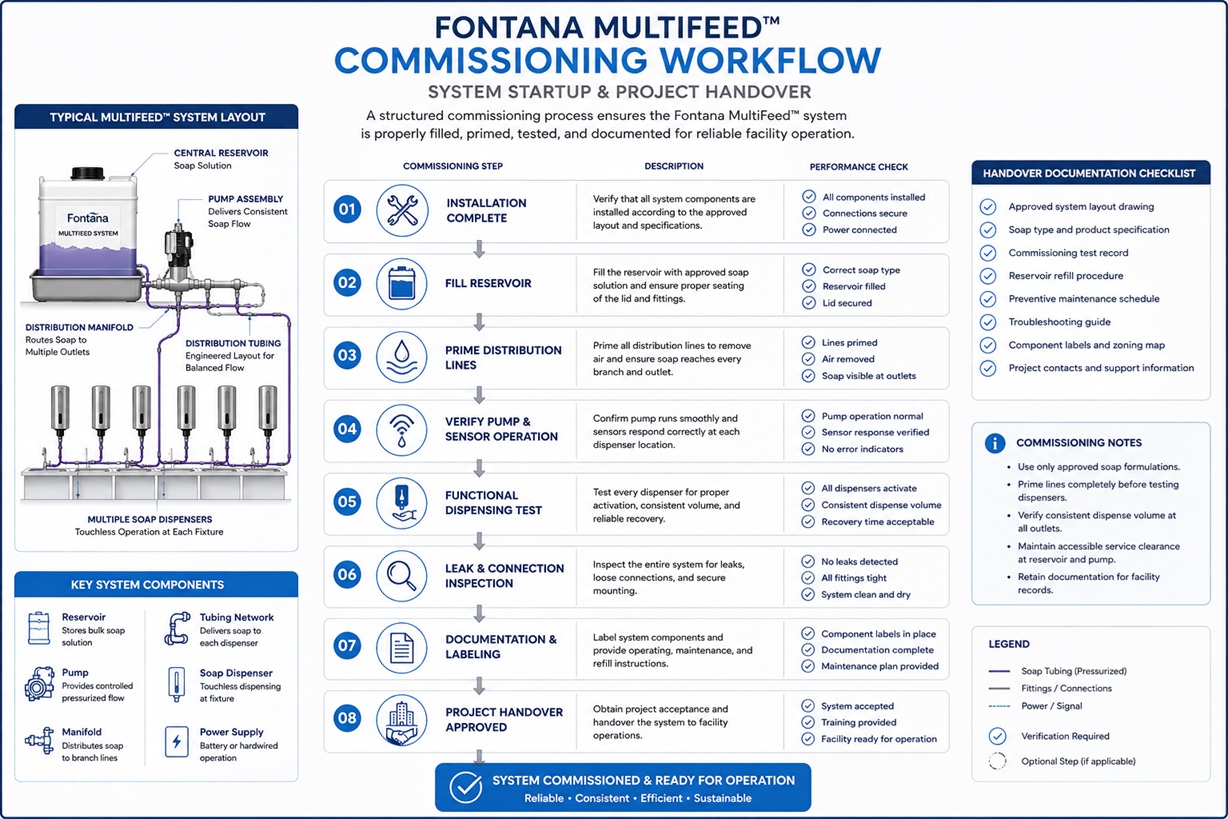
A reliable centralized soap dispensing system begins with coordinated reservoir placement, accessible tubing routes, compatible soap selection, secure connections, and complete commissioning before the restroom is placed into service.
01
Confirm System Requirements
Confirm the number of connected dispensers, expected restroom traffic, reservoir capacity, soap formulation, available power, and required service intervals before installation begins.
02
Select an Accessible Reservoir Location
Position the central reservoir in a protected and serviceable location with adequate clearance for inspection, soap replenishment, tubing connections, and future maintenance.
03
Plan the Tubing Network
Route feed tubing using smooth, protected paths. Avoid sharp bends, excessive tubing length, compression points, heat exposure, and locations where service personnel cannot reach the connections.
04
Connect the Manifold and Dispensers
Install the manifold and connect each dispenser using secure fittings. Verify that every connection is fully seated, properly supported, and clearly identified for future service.
05
Prime the Soap Delivery Lines
Fill the reservoir with an approved soap formulation and prime the distribution lines until soap reaches each dispenser without visible air pockets or interrupted delivery.
06
Test, Balance and Document
Activate every dispenser, inspect the tubing and fittings, verify consistent delivery, correct any flow irregularities, and record the final reservoir, tubing, and dispenser configuration.
Commissioning Checklist
Complete these checks before handing the system over to the facility operations team.
✓Reservoir is stable, accessible, and properly identified.
✓All tubing routes are protected and free from kinks.
✓Fittings and manifold connections show no visible leakage.
✓Every connected dispenser activates and delivers soap.
✓Soap formulation and service instructions are documented.
✓Facility personnel understand refill and inspection procedures.
Commercial Installation Best Practices
Keep the reservoir accessible for routine servicing.
Use only compatible soap and tubing materials.
Label every dispenser connection at the manifold.
Test the complete network before final enclosure.
Technical note:
The final installation layout should be reviewed for dispenser quantity, tubing distance, elevation changes, soap viscosity, power requirements, service access, and manufacturer-specific component limitations before installation.
Engineering Visual Reference
MultiFeed™ System Architecture, Sizing and Handover
Use the following engineering references to understand the complete centralized soap-delivery sequence, review preliminary reservoir planning, and coordinate commissioning before the restroom is released for normal operation.
System Blueprint
From Central Reservoir to Every Dispenser
The complete supply path should identify the reservoir, pump, manifold, branch tubing, dispenser connections, power components, and accessible service points as one coordinated system.
Every connected dispenser should be primed and tested. Tubing, fittings, reservoir stability, soap delivery, sensor response, labeling, maintenance access, and final documentation should be reviewed before handover.
Traditional Soap Dispensers vs. Fontana® MultiFeed™
Centralized soap distribution simplifies maintenance by replacing dozens of individual refill points with one service location. The comparison below illustrates the operational differences commonly considered during commercial restroom planning.
Comparison
Individual Dispensers
Fontana MultiFeed™
Soap Refilling
Each dispenser individually
One centralized reservoir
Maintenance Time
Higher labor requirement
Reduced routine servicing
Service Access
Multiple locations
Single maintenance point
Inventory Management
Numerous cartridges or bottles
Bulk soap management
Expansion
Additional standalone units
Designed for scalable layouts
Suitable Applications
Small installations
High-traffic commercial facilities
Operational Efficiency
Conventional servicing
Centralized maintenance workflow
1
Central Reservoir
One accessible refill location supports multiple automatic dispensers.
↓
Reduced Service Visits
Maintenance personnel refill one reservoir instead of servicing every dispenser individually.
✓
Commercial Ready
Suitable for airports, hospitals, universities, hotels, office buildings, and other high-use facilities.
Lifecycle Performance
MultiFeed™ Lifecycle Performance Dashboard
Commercial facilities evaluate centralized soap systems using operational efficiency, maintenance effort, service continuity, sustainability, and total lifecycle value rather than dispenser hardware alone.
70–90%
Less Refill Labor
Centralized refilling substantially reduces routine servicing across multiple dispensers.
99%+
System Availability
Planned maintenance and centralized supply help maintain consistent dispenser operation.
30–50%
Operating Savings
Bulk soap management may reduce operational costs compared with servicing numerous individual units.
8–12+
Years Service Life
Expected lifecycle with scheduled maintenance and appropriate operating conditions.
Operational Efficiency
Centralized maintenance workflow
Reduced technician travel between fixtures
Simplified refill scheduling
Improved inventory management
Fewer routine maintenance interruptions
Hygiene Performance
Touchless dispensing operation
Consistent soap availability
Controlled soap delivery
Central monitoring of refill status
Reduced service interruptions
Sustainability Benefits
Bulk soap reduces packaging waste
Lower transportation requirements
Reduced storage space
Fewer disposable containers
Supports sustainable facility operation
Executive Summary
A centralized MultiFeed™ architecture replaces repetitive dispenser-by-dispenser maintenance with one coordinated servicing strategy. For airports, healthcare facilities, hotels, universities, office buildings, and other high-use environments, this approach can simplify maintenance planning, improve soap availability, reduce routine labor, and support long-term operational efficiency.
Video Resource Center
Learn More About the Fontana® MultiFeed System
Watch installation demonstrations, refill procedures, and commercial system overviews designed for architects, plumbing engineers, contractors, facility managers, and maintenance teams.
MultiFeed™ System Overview
Discover how a centralized soap reservoir supplies multiple automatic dispensers while simplifying maintenance and improving operational efficiency.
Central Reservoir Refill Procedure
Follow the recommended refill process and see how scheduled centralized servicing replaces repetitive dispenser-by-dispenser refilling.
Automatic Soap Dispenser Installation
Review dispenser installation fundamentals before integrating each fixture into a centralized MultiFeed soap distribution system.
Recommended Viewing Sequence
Start with the complete system overview, continue with the centralized refill procedure, and finish with dispenser installation. Together these videos provide a complete understanding of planning, installing, commissioning, and maintaining a commercial Fontana MultiFeed™ soap dispensing system.
Compare traditional dispenser maintenance with a centralized Fontana MultiFeed™ system by entering your facility information below.
Facility Information
Estimated Results
--
Labor Hours Saved
--
Annual Savings
--
Estimated Payback
--
Total Cost Reduction
Engineering Note
Actual operating costs depend on dispenser quantity, refill frequency, labor rates, maintenance procedures, facility occupancy, and soap consumption patterns. A detailed project evaluation should be completed before estimating lifecycle savings.
The following example illustrates how a centralized Fontana MultiFeed™ Soap Dispenser System can be planned for a large commercial restroom. It is provided for conceptual planning purposes only and should not be interpreted as a project-specific engineering design.
30
Soap Dispensers
1
Central Reservoir
3
Distribution Zones
1
Maintenance Location
Planning Objectives
Reduce individual dispenser refill points.
Centralize maintenance access.
Improve service efficiency for maintenance teams.
Simplify future restroom expansion.
Support consistent soap availability across all fixtures.
Improve long-term facility management planning.
Engineering Note
Every Fontana MultiFeed™ installation should be engineered according to fixture quantity, tubing layout, reservoir capacity, maintenance accessibility, building configuration, local plumbing requirements, and project-specific operating conditions. This planning scenario is presented for conceptual illustration only.
AEC Professional Review: Sensor Accuracy & Specification Coordination | Review Date: March 23, 2024 | Reviewer: D. Harper | Company: Precision MEP | Profession: MEP / Plumbing Engineering | Industry: Healthcare & Commercial Building Systems | Product Category: Automatic Soap Dispensers | Application: High-Traffic Commercial Restrooms | Location: Phoenix, AZ | Rating: ★★★★★
From an MEP and plumbing specification perspective, automatic soap dispensers perform best when sensor accuracy, controlled dosage, service access, and deck-mount coordination are addressed early in the restroom design. Precise hands-free activation without false triggering helps maintain reliable operation in high-traffic environments, while consistent soap volume supports cleaner countertops and more predictable consumable usage. Accessible refill components and finishes capable of tolerating routine commercial cleaning also simplify ongoing facility maintenance. For AEC teams planning healthcare and other demanding commercial washrooms, these characteristics support efficient installation, dependable hygiene performance, and practical large-scale restroom upgrades.
Planning a Commercial MultiFeed™ Soap Dispensing Project?
Fontana supports architects, plumbing engineers, contractors, facility managers, owners, and specification teams with centralized soap dispensing system planning, product coordination, technical documentation, and commercial project assistance.
Reservoir Sizing
Determine a suitable preliminary reservoir capacity based on dispenser quantity, expected usage, refill strategy, and maintenance access.
Tubing Layout Review
Review preliminary tubing routes, system zones, connection points, manifold planning, and accessible service locations.
Specification Review
Coordinate product requirements, dispenser quantities, system components, finish selections, and project specification needs.
CAD & BIM Assistance
Request available technical drawings, installation diagrams, BIM resources, and project coordination documentation.
Commissioning Support
Support startup planning, system priming, operational verification, dispenser testing, and project handover preparation.
Commercial Quotations
Receive product recommendations, preliminary system configurations, finish coordination, and commercial project pricing.
Start Your MultiFeed™ Project Review
Share the estimated dispenser quantity, facility type, reservoir location, project phase, finish requirements, and available drawings so the commercial support team can review the proposed application.
Final system configuration should be reviewed according to dispenser quantity, soap compatibility, tubing distances, reservoir capacity, service access, installation conditions, and applicable project requirements.
Find Out First
Get FontanaShowers emails of inspiration, new product releases, and more!