|
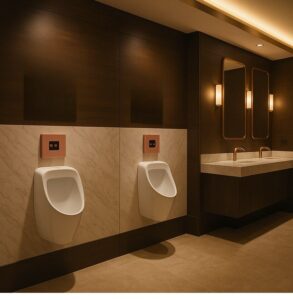
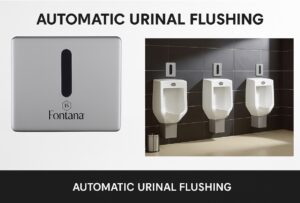
Explore Fontana urinal and flush valve models engineered for architectural excellence — merging intelligent automation, timeless finishes, and reliability trusted in high-traffic commercial and luxury projects worldwide.
|
Product Name
|
Code
|
Description
|
Client Review
|
|
Fontana Pure Modica Sensor Urinal
|
FS9000WH
|
Modern white Modica model offering a seamless sensor system for superior sanitation.
|
Project Engineer: “Reliable, sleek, and requires zero manual resets after power cycles.”
|
|
Fontana Lift Ardea Matte Black Urinal
|
FS9010MB
|
Matte black Ardea urinal with precision contours enhancing both hygiene and design flair.
|
Architect: “This became our design centerpiece in boutique hospitality washrooms.”
|
|
Fontana AutoCore Chiva Urinal Flush Valve
|
FS8978SN
|
Stainless unit featuring intelligent auto-sense core for continuous water management efficiency.
|
Contractor: “Quick installation, immediate calibration—reduced commissioning time noticeably.”
|
|
Fontana SenseLink Sensor Urinal Flush Valve
|
FS8099WH
|
Smart connectivity-enabled flush valve integrates smoothly into automated facility systems.
|
Systems Engineer: “Perfect for BMS integration—live diagnostics save maintenance calls.”
|
|
Fontana Aura Silver Urinal Modern Sanitary Fixture
|
FS8994SL
|
Refined silver design delivering reliable operation and contemporary aesthetic presence.
|
Developer: “Easiest premium model to specify—consistent lead times and client praise.”
|
|
Fontana HydroIntel Sensor Urinal Flush Valve
|
FS8113WH
|
Adaptive sensor valve adjusting automatically to lighting and user distance conditions.
|
Facility Planner: “The most dependable flush response among our latest installations.”
|
|
Fontana FusionFlow Elite Warm Taupe Bronze Pure
|
FS10520WTB
|
Bronze-finished automatic fixture blending elegance and energy-efficient water use technology.
|
Design Consultant: “Visually rich finish—ideal for upscale mixed-material restroom palettes.”
|
Specifier Decision Framework
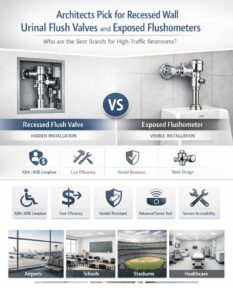
Recessed Wall Urinal Flush Valves vs Exposed Flushometers
For high-traffic restrooms, the “best” flush architecture is the one that aligns with your protection level, service access workflow,
wall/rough-in constraints, sensor behavior requirements, and documentation for plan review. This guide gives architects, engineers, and facility teams
a practical way to select between recessed and exposed flushometer approaches—without relying on generic rules of thumb.
High-Traffic Restrooms
Anti-Vandal Strategy
Service Access
ADA / ASSE Readiness
Sensor Logic
Why the Architecture Decision Matters
A recessed wall flush valve system typically shifts risk away from exposed components by placing sensitive elements behind the wall plane,
while an exposed flushometer simplifies access and retrofit speed by keeping service points visible and reachable. The “best” outcome depends on how
your project scores in five non-negotiable areas: (1) protection level and tamper risk, (2) service access workflow and staffing, (3) wall depth and rough-in constraints,
(4) sensor behavior requirements and water waste control, and (5) compliance and documentation readiness.
For deeper performance notes and series navigation, reference the
Commercial Flush Systems Hub.
Fast Decision Tree
-
If vandal/tamper risk is high (schools, transit hubs, stadiums): start with Recessed.
(See anti-vandal planning.)
Anti-vandal guide
-
If retrofit speed and open access are priority (fast renovation windows): start with Exposed.
-
If wall depth/rough-in is limited or in-wall coordination is risky: bias toward Exposed,
or select recessed only when wall cavity and carriers are confirmed early.
-
If facilities have lean service staff and you must reduce downtime events: consider Recessed + low-maintenance planning.
Downtime reduction
-
If sensor tuning and water waste control are critical (green programs, tight budgets): evaluate sensor logic and cycle controls for either architecture.
Water waste article
-
If compliance submittals must be clean and fast: align with documented guidance early.
ADA/ASSE guide
and
Specifier submittals.
Still unsure? Compare total cost and service frequency across power modes:
Battery vs hardwired comparison.
Specifier Score Matrix
| Criteria |
Recessed Wall Valves |
Exposed Flushometers |
What to Validate |
| Vandal / Tamper Risk |
Typically stronger (components protected behind wall plane) |
Can be strong, but exposed hardware is reachable |
Housing, fasteners, sensor shield design, access points.
Guide
|
| Service Access Workflow |
Planned access route; can reduce accidental damage |
Fast access; simpler “open” service pattern |
Who maintains it, how often, and what the access policy is.
Downtime
|
| Wall / Rough-In Constraints |
Requires early coordination; wall depth and carriers matter |
More forgiving for retrofits |
In-wall space, routing, and access panels.
Install notes
|
| Sensor Behavior & Water Waste |
Excellent when sensor logic is tuned; protection can stabilize operation |
Excellent when tuned; environment may influence sensor behavior |
Detection window, flush timing, and occupancy behavior.
Sensor tech
|
| Power Strategy |
Battery or hardwired; choose based on access and maintenance cadence |
Battery or hardwired; often easier service access to power module |
Battery cycles vs hardwired reliability and labor cost.
Compare
|
| Compliance & Documentation |
Strong with complete submittals and guide-aligned install |
Strong with complete submittals and guide-aligned install |
ADA/ASSE alignment, plan review docs, submittal completeness.
Guide
|
Submittals
|
Tip: Use the matrix as a pre-submittal checklist so procurement aligns with how the building will actually be maintained.
Field Service Reality Check
In high-traffic facilities, the real differentiator is not the first month of performance—it’s how the system behaves at scale after repeated usage cycles,
occasional misuse, and maintenance turnover. Before you finalize recessed or exposed, validate service steps for common events
(mis-detection, continuous flush, low flush performance, power interruptions). Keep this field guide accessible to teams:
Commercial troubleshooting guide.
Download: Recessed vs Exposed Specifier Checklist (PDF)
Turn this article into a plan-review-ready checklist for architects and facility managers. Includes selection criteria, coordination notes,
and a one-page scoring worksheet.
|
|