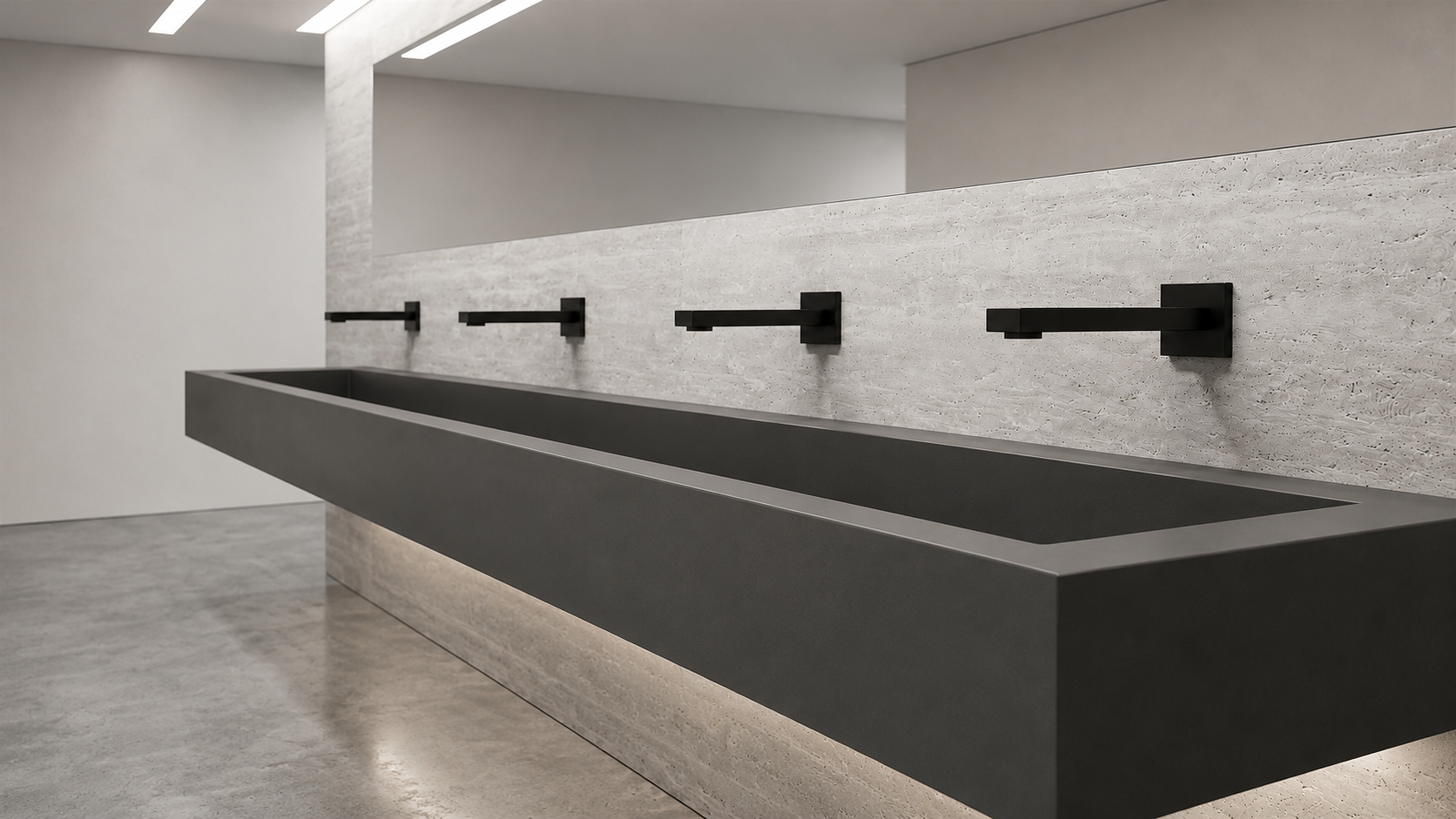
Black matte bathroom faucets have moved from being a purely aesthetic selection to a legitimate specification choice in commercial and institutional environments.
In airports, healthcare, education, corporate, and civic projects, the finish is often selected for its ability to reduce visible water spotting and fingerprints while supporting a contemporary fixture palette.
However, matte black introduces real performance questions for architects, engineers, and specifiers: coating durability, cleanability, chemical resistance, compatibility with sensor controls,
and long-term appearance under high-frequency use.
This technical guide outlines how to evaluate matte black bathroom faucets as part of an AEC-grade restroom system, with attention to regulatory alignment,
lifecycle performance, and integration into plumbing and facility operations. For product families and configuration examples, browse the dedicated category:
Matte Black Bathroom Faucets.
Matte black bathroom faucets are engineered with advanced protective coatings that improve resistance to corrosion, fingerprints, and mineral buildup. Studies show matte finishes can reduce visible water spots by up to 70%, supporting long-term performance in both residential and commercial bathroom applications.
Finish Engineering: What “Matte Black” Really Means in the Field
Coating System Types
In the built environment, “matte black” is not one material. It is usually a coating system applied over a base metal
(commonly brass or stainless steel). Performance is driven more by the coating method and surface preparation than by color alone.
For durability documentation language, many AEC teams align submittals with performance expectations in widely used plumbing code references
(e.g.,
ICC Code Library
and local AHJ requirements).
PVD variants (often strong against abrasion when correctly applied)
Electroplated or chemically deposited systems with topcoats
Powder-coated finishes (good thickness, but edge impacts can reveal substrate)
Commercial Risk Areas
Matte black fixtures are frequently touched at the spout base, handle, and aerator interface. Typical failure modes include edge wear,
micro-scratching from repeated wiping, and finish hazing from incompatible disinfectants.
For facilities running aggressive cleaning protocols, coordinate finish selection with the owner’s chemical list and custodial process.
Matte surfaces can conceal spotting but may show polish trails if cleaned with abrasive pads.
Documentation to Request
From a specification standpoint, matte black requires the same rigor applied to any architectural finish:
request coating method documentation where possible, and evaluate how the manufacturer addresses adhesion, edge wear,
and cleaning-chemical compatibility.
Start by reviewing category-level options and narrowing to service-friendly models in the
Matte Black Faucets
collection.
Lifecycle First
In commercial environments, the faucet is a maintainable component, not a decorative endpoint. If service access requires removing the entire faucet body,
maintenance cost rises quickly. Many facility specs also align fixture selections to government-maintained best practice purchasing and performance guidance such as:
GSA Sustainable Purchasing.
Institutional restrooms often experience misuse (over-torquing handles, impacts, or intentional damage).
Where abuse risk is likely, pairing matte black with sensor activation can reduce handle wear and limit user-applied force.
Matte black is often selected to unify mixed device families visually, but the engineering work is in the coordination:
hole patterns, deck thickness allowances, service clearance, and power requirements.
Durability and Lifecycle Planning in High-Traffic Restrooms
Specification Parameters That Matter More Than Finish
When matte black is used in high-traffic environments, focus on mechanical and operational features that control lifecycle cost.
Plan service access early, and verify parts availability before submittals.
Cartridge replacement approach and parts standardization
Mounting method and anti-rotation stability
Aerator tool access and clog-resistance strategy
Recommended spares list aligned to facilities operations
Cleaning Protocol Coordination
Finish performance is strongly tied to custodial behavior. Matte black often performs well when cleaned correctly,
but it can degrade quickly if staff use abrasive pads or harsh chemicals not recommended by the manufacturer.
A practical baseline reference for cleaning and hygiene planning is available here:
CDC Cleaning Guidance.
Include a custodial care sheet in O&M manuals, and align the finish choice to the owner’s chemical list and wipe-down frequency.
Applications in Commercial and Institutional Projects
Airports & Transit
High duty-cycle reliability and rapid cleanability support facility uptime. Matte black can reduce the appearance of spotting in visible public zones,
but must be paired with durable service access and chemical-compatible care.
Healthcare
Touchless activation can reduce contact variability and limit finish wear at handles. Sensor tuning should match basin geometry to prevent splashing
and repeated activations that increase maintenance calls.
Education & Civic
Where misuse risk is higher, prioritize maintainable cartridges, robust mounting, and consider touchless operation to reduce handle torque and wear.
Corporate & Class A Offices
Matte black supports a contemporary palette and can unify countertop devices. Engineering coordination should include deck-hole patterns,
service clearances, and power strategy for sensor models.
Retail & Mixed-Use
Select configurations that simplify maintenance in high-volume environments. Avoid assemblies that require complete removal for routine service tasks.
Hospitality
Finish consistency matters across guestrooms and public restrooms. Align the owner’s housekeeping protocol to the finish limitations to preserve appearance
over turnover cycles.
Water Efficiency, CALGreen Context, ADA Usability, and Standards Referencing
Water Efficiency Baseline
Use WaterSense as a practical performance reference point and documentation anchor for efficient lavatory faucet evaluation.
Program overview:
EPA WaterSense Program.
Flow Rate Strategy
Flow rate is a design decision, not a checkbox. Consider rinse effectiveness, user experience, and temperature stability.
Achieve stable performance at an efficient baseline rather than chasing the lowest possible flow.
Reference efficiency model language:
FEMP Water Management (DOE).
CALGreen Alignment
Treat CALGreen as a system requirement. Coordinate fixture schedules and documentation early, and verify the adopted code cycle and project targets.
Official resources:
CALGreen (California DGS)
and reference presentation structure via ICC:
CALGreen 2025 Appendix A5.303 (ICC).
ADA and Controls
ADA compliance is about reach ranges, operable parts, clearances, and usability consistency.
Primary reference:
ADA Accessibility Standards (U.S. Access Board).
Matte black does not change ADA requirements,
but projects adopting matte black often also choose touchless activation and control strategies that influence accessibility outcomes.
Overview:
ADA-Compliant, Water-Efficient Touchless Faucets.
Standards + Code Context
Confirm which standards are enforced by the local AHJ and align the fixture schedule and submittal requirements to the adopted plumbing code year.
California reference portal:
California Plumbing Code (IAPMO ePubs).
For broader code reference libraries commonly used in AEC workflows:
ICC Code Library.
Sensor Integration
For institutional projects, touchless faucets can reduce interaction variability, but require correct tuning:
activation distance, runtime, and shutoff behavior should match basin geometry to avoid splashing and repeated activations.
System overview:
Touchless Faucet Systems (Commercial/Institutional).
Matte Black FinishHigh-TrafficChemical List CheckService AccessSensor Tuning
For AEC teams, align finish selection with the owner’s cleaning protocol, then confirm water efficiency and usability targets early.
Use WaterSense as a performance baseline reference:
EPA WaterSense Program,
and coordinate CALGreen documentation strategy where applicable:
CALGreen (California DGS).
Customer Field Review
Fontana Geneva Dark Oil Rubbed Bronze Commercial Sensor Faucet Field Review
A specification-focused evaluation of exact FS1226 customer and facility records
covering sensor stability, reflective-surface behavior, shutoff timing, inlet-pressure
variation, commissioning, maintenance demand, finish coordination, and long-term commercial use.
✔ Exact FS1226 Records Referenced✔ Multi-Year Field History✔ Commercial Facility Context2021–2026 Review Records
Exact-Model Field ReviewCommercial Sensor FaucetModel FS1226
Finley Whitmore, Infrastructure Advisor — Spokane, Washington
Transportation and Municipal Retrofit Evaluation
Review record date: March 30, 2026 • Rating: 5 out of 5
Customer Review
The selected exact-model field record compares FS1226 with older touchless fixtures
used in transportation and municipal restroom retrofits and reports noticeably steadier
performance across projects completed from 2022 through 2025.
Read More
Finley Whitmore specifically cites fewer complaints involving false triggering,
delayed shutoff, and interrupted stream behavior after replacement. The same record
notes fewer interruption-related service requests once the faucets entered regular use.
Installation
FS1226 is identified as a commercial, deck-mounted, single-hole faucet with a ceramic
valve core and dark oil rubbed bronze finish. Exact-model review records also report
clean coordination with standard deck-mount rough-ins.
Read More
A. Reynolds' FS1226 record notes that the installation aligned cleanly with standard
rough-ins and reduced contractor coordination time. D. Chen's exact-model record adds
that commissioning proceeded without sensor recalibration on that project.
Sensor Response
The deepest FS1226 records describe stable activation under changing ambient lighting,
reflective wall materials, fluctuating inlet pressure, and continuous public use, with
only localized sensitivity adjustment required on one compact sink configuration.
Read More
A separate exact-model office record reports no lag or false activation during peak
usage. Transportation-hub feedback also notes responsive sensing under changing lighting,
while the 2026 record documents long-term infrared and valve stability after setup.
Finish and Design
The current FS1226 product page specifies a dark oil rubbed bronze finish and contemporary
commercial styling. An exact-model 2021 customer record also describes the finish as giving
the bathroom a more refined, high-end appearance.
Read More
Finish condition should still be tracked against the facility's actual cleaning chemistry,
mineral exposure, and housekeeping frequency. Long-term finish wear is a separate maintenance
metric from the sensor and valve performance documented in the field records.
Operating Function
Exact FS1226 records repeatedly reference immediate or consistent automatic shutoff,
controlled flow without splashing, quiet internal valve operation, moisture-protected
internal components, and straightforward maintenance access.
Read More
Healthcare feedback highlights well-sealed internal components and service access for
continuous-operation environments. Corporate-campus feedback adds quiet valve operation
and low maintenance demand, while the 2026 record documents fewer interruption-related calls.
Recommended Use
The review evidence is strongest for offices, healthcare projects, transportation hubs,
municipal restrooms, and other commercial facilities where sensor stability, controlled
shutoff, service access, and repeatable commissioning matter.
Read More
Project teams should document basin reflectivity, nearby wall materials, ambient-lighting
conditions, inlet-pressure behavior, and any sensitivity adjustment during commissioning so
later maintenance teams have a clear performance baseline.
Review Summary
Primary RatingFive out of five in the selected 2026 exact-model field record.
Operating HistoryTransportation and municipal retrofit history extends across projects from 2022 through 2025.
Recurring PatternStable sensing, controlled shutoff, fewer nuisance events, and reduced service demand.
Read More
Reviewer Context
Evidence combines multiple exact FS1226 customer, MEP, facility, healthcare, and infrastructure records.
Product Configuration
FS1226: deck-mounted, single-hole commercial sensor faucet with ceramic valve core and dark oil rubbed bronze finish.
Exact-Model Evidence
Seven FS1226 records support the page, including infrastructure, MEP, healthcare, facility, and end-user observations.
Extended Operating Context
The strongest record tracks retrofit performance from 2022 through 2025 and reports fewer nuisance events and service calls.
Product-Specific Specs
Mounting, valve-core, finish, style, and commercial-use details follow the current FS1226 product page.
Transparent Attribution
Customer and facility observations are kept separate from product-page specifications and commissioning recommendations.
Find Out First
Get FontanaShowers emails of inspiration, new product releases, and more!