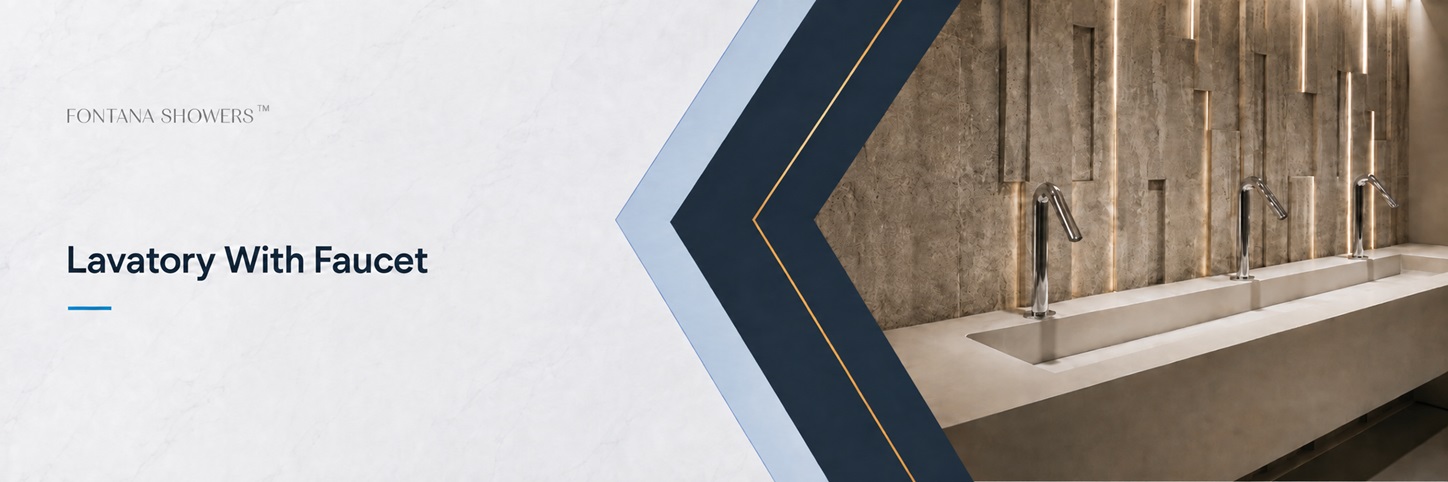
Lavatory & Faucet Specifications for Commercial Projects
A lavatory with faucet is seldom a simple fixture selection in commercial work. In healthcare, education, transportation,
hospitality, and public assembly buildings, the lavatory and faucet operate as a system that needs to meet accessibility,
water efficiency, durability, maintainability, and infection control objectives while coordinating with rough in conditions,
wall construction, and operations and maintenance workflows. This article summarizes technical considerations architects and
engineers commonly document in drawings and schedules, along with code and standard references where they meaningfully
influence specification decisions.
ADA Operable PartsWaterSense and Flow TargetsCALGreen AwarenessASME A112.18.1 and CSA B125.1
The driving basis for the technical baseline is typically public use versus private use. This classification affects expected abuse loads,
duty cycle, hygiene strategy, and likely water use targets.
Duty Cycle and Abuse Loads
Read More
The same lavatory geometry can serve staff restrooms, public toilet rooms, patient rooms, classroom corridors, locker rooms,
and transportation facilities. The expected frequency of use and misuse should guide the control strategy and materials selection.
Standardization Strategy
Read More
For multi fixture projects, standardization is often more valuable than customization. One rough in template, one trim family,
and one spare parts strategy can reduce coordination risk and long term maintenance cost.
High Traffic Public Restrooms
Read More
Common selection drivers include
hands free activation, automatic shutoff that limits run time, reduced touch points, vandal resistance,
and serviceability without wall demolition.
Hygiene and Touch Reduction
Read More
In high use spaces,
fewer touch points and predictable shutoff behavior support infection control objectives and reduce the burden on
custodial staff.
Reality
Read More
Selection should align with access constraints, staffing, and parts strategy. A well documented service plan can be more important than
optional features.
Accessibility Considerations under ADA
Operable Parts and Access Conditions
Operable parts: Faucet controls should be usable without tight grasping, pinching, or twisting.
Operating force: Controls should function with limited operating force consistent with accessibility intent.
Approach condition: For lavatories, the approach condition affects the practical location of controls and spout reach.
How Design Teams Document Strategy
State faucet control type in the plumbing schedule: single lever, metering, or sensor operated.
Coordinate spout reach and mounting height with bowl geometry to limit splash and reduce user over reaching.
Check clearances relative to soap dispensers, mirrors, hand dryers, grab bars, and partitions since adjacent items often drive placement.
Water Efficiency and Regulatory Drivers
WaterSense Applicability
Read More
WaterSense publishes a high efficiency lavatory faucet specification that is commonly referenced in public sector and institutional projects.
Classification matters because private use versus public use conditions can affect applicability.
CALGreen Awareness
Read More
CALGreen and jurisdictions adopting similar requirements can impose more prescriptive lavatory faucet flow limits in nonresidential and public use spaces.
Use the adopted code edition for the project jurisdiction.
Flow Rate and Basis of Test
Read More
Confirm that specified flow rates are stated at the correct reference pressure and that aerator or laminar devices align with local water quality
and maintenance practices.
Infection Control and Rinse Behavior
Read More
Flow and spray characteristics can influence splash and user behavior. Coordinate faucet selection with basin geometry rather than treating the faucet
as a standalone item.
Owner Targets and Reporting
Read More
Many owners set
water reduction targets that go beyond code minimums. Schedules should document the intended flow rate and control type to prevent
substitutions that change performance.
Compliance, Durability, and Coordination Checklist
Accessibility (ADA)
Document control type, operable parts intent, approach condition, and coordination clearances around the lavatory zone.
Water Efficiency
Identify flow rate and basis of test. Confirm WaterSense and jurisdictional requirements where applicable.
Compliance Standards
Require conformance to ASME A112.18.1 and CSA B125.1 where applicable for plumbing supply fittings and submittal review.
Durability
Define base material expectations, wear parts strategy, corrosion resistance intent, and finish performance relative to cleaning protocols.
Vandal Resistance
For public restrooms, consider tamper resistant aerators, concealed fasteners, heavy duty escutcheons, and impact resistant sensor windows.
Rough In Coordination
Document deck hole patterns, spout reach and height, under counter clearance, and any accessory or power module requirements.
Sensor Power and Controls
Specify power type, access needs, default run time and shutoff delay, and whether hygiene flush or line purge is required and who commissions it.
Closeout Deliverables
Require O and M manuals,
settings verification checklists, recommended and prohibited cleaning agents, and a spare parts list aligned with standard assemblies.
Common Documentation Items for Plumbing Schedules
Mount TypeHole PatternFlow Rate and Test BasisControl TypeFinish RequirementsService Access
Closeout Notes that Protect Long Term Performance
Include operations and maintenance manuals and any startup and settings verification checklist for sensor faucets.
Provide recommended and prohibited cleaning agents and any disinfectant compatibility notes required by the owner.
Align spare parts lists with standardized assemblies to reduce downtime and avoid mismatched replacements.
System Integration and Coordination
Lavatory and Faucet as One System
Read More
Treating the lavatory and faucet as an integrated system improves cleanability, reduces splash, and supports consistent user experience across high traffic facilities.
Rough In and Wall Constraints
Read More
Rough in dimensions, wall construction, and access panels often drive feasible options. Document controlling dimensions and access expectations on drawings.
Coordination Around the Lavatory Zone
Read More
Soap dispensers, mirrors, hand dryers, grab bars, and partitions frequently dictate real world placement and service access requirements.
Vandal and Misuse Mitigation
Read More
Public restrooms may require tamper resistant components and robust trim protection. Specs should define these measures clearly rather than rely on vague descriptors.
Serviceability without Demolition
Read More
Where possible, require access for diagnostics and component replacement that does not require wall demolition. This matters most for
sensor powered assemblies.
Commissioning and Settings Control
Read More
If run time, shutoff delay, or hygiene flush features exist, the spec should assign who sets them, who verifies them, and what documentation is included at closeout.
Specification and Closeout Best Practices
What to Put in the Plumbing Schedule
Type of mount and deck hole pattern
Flow rate and basis of test
Control type and intended use classification
Required compliance standards
Finish requirements and cleaning compatibility expectations
A lavatory with faucet may be a small scope item, but it has a measurable impact on accessibility compliance, water use, and maintenance burden
in commercial and institutional buildings. Align selections with ADA operable part intent, correctly apply WaterSense and CALGreen where they govern,
and document conformance to ASME A112.18.1 and CSA B125.1 where applicable. Treating the lavatory and faucet as an integrated system reduces risk and
improves long term performance.
Reta P. — Baltimore, Maryland
Installation and Site-Round Evaluation
Review record date: February 17, 2023 • Rating: 5 out of 5
Customer Review
I saw the faucet installed during site rounds, and it was working properly
right away. The sensor picked up consistently, and nothing unusual came up
during the initial testing.
Read MoreShow Less
What stood out to me was the matte white finish. It looked clean and modern
in the restroom without feeling too decorative. During commissioning, the
faucet felt secure at the counter and the hands-free response was easy to use.
Installation
The faucet sat cleanly on the countertop and remained stable during the site
inspection and operating checks.
Read MoreShow Less
Mounting hardware and supply hoses are listed with the faucet. The control box
can be configured for hardwired or battery operation, so power access, basin
alignment, and concealed service space should be confirmed before final rough-in.
Sensor Response
Hands-free activation was consistent during repeated commissioning checks,
with prompt water delivery and predictable shutoff after hands were removed.
Read MoreShow Less
I did not notice delayed starts or random activation during the walkthrough.
For project setup, the FS20165MW product information also lists an adjustable
sensor range and an optional remote for sensing-distance adjustment or on/off control.
Finish and Design
The matte white finish gave the faucet a crisp, understated appearance and worked
well with the clean lines of a contemporary restroom.
Read MoreShow Less
The finish is a useful option where bright chrome would create too much contrast.
Because this was an initial site-round review, long-term finish wear and cleaning
performance were not evaluated and should be followed through normal maintenance cycles.
Initial Function
Water delivery remained steady during testing, and no leaks, loose movement,
irregular flow, or immediate operating concerns were observed on site.
Read MoreShow Less
The product uses solid-brass construction and supports aerator flow options from
0.5 to 1.5 GPM. It also lists an adjustable 30-second auto-shutoff, giving specifiers
flexibility to balance user comfort, water conservation, and project requirements.
Recommended Use
A strong fit for hotels, offices, restaurants, airports, malls, and other commercial
restrooms that need hands-free operation with a clean matte-white visual profile.
Read MoreShow Less
The faucet is especially convincing where white fixtures, light solid-surface
counters, pale stone, or minimal interiors are already part of the design language.
Adjustable sensing and dual power options also make it practical for commercial coordination.
Review Summary
Customer RatingFive out of five in the supplied customer record.
Site TestingConsistent sensor pickup with no unusual issues during commissioning.
First ImpressionStable installation, dependable operation, and a clean contemporary finish.
Read MoreShow Less
Reviewer Context
Observation was made during site rounds rather than after a long ownership period.
Product Configuration
Solid-brass matte-white faucet with automatic infrared sensing and AC/DC control options.
Long-Term Follow-Up
Finish wear, sensor calibration, battery service, and component history require later field review.
Customer-Grounded
Reviewer identity, location, rating, date, helpfulness, and observation context come from the supplied customer record.
Scope-Aware
The review addresses installation and commissioning without inventing unsupported long-term ownership history.
Product-Specific
Finish, construction, sensing, flow, pressure, power, and mounting information follow the FS20165MW product page.
Transparent Attribution
The page distinguishes the original customer record from the editorial FS20165MW product adaptation.
Find Out First
Get FontanaShowers emails of inspiration, new product releases, and more!