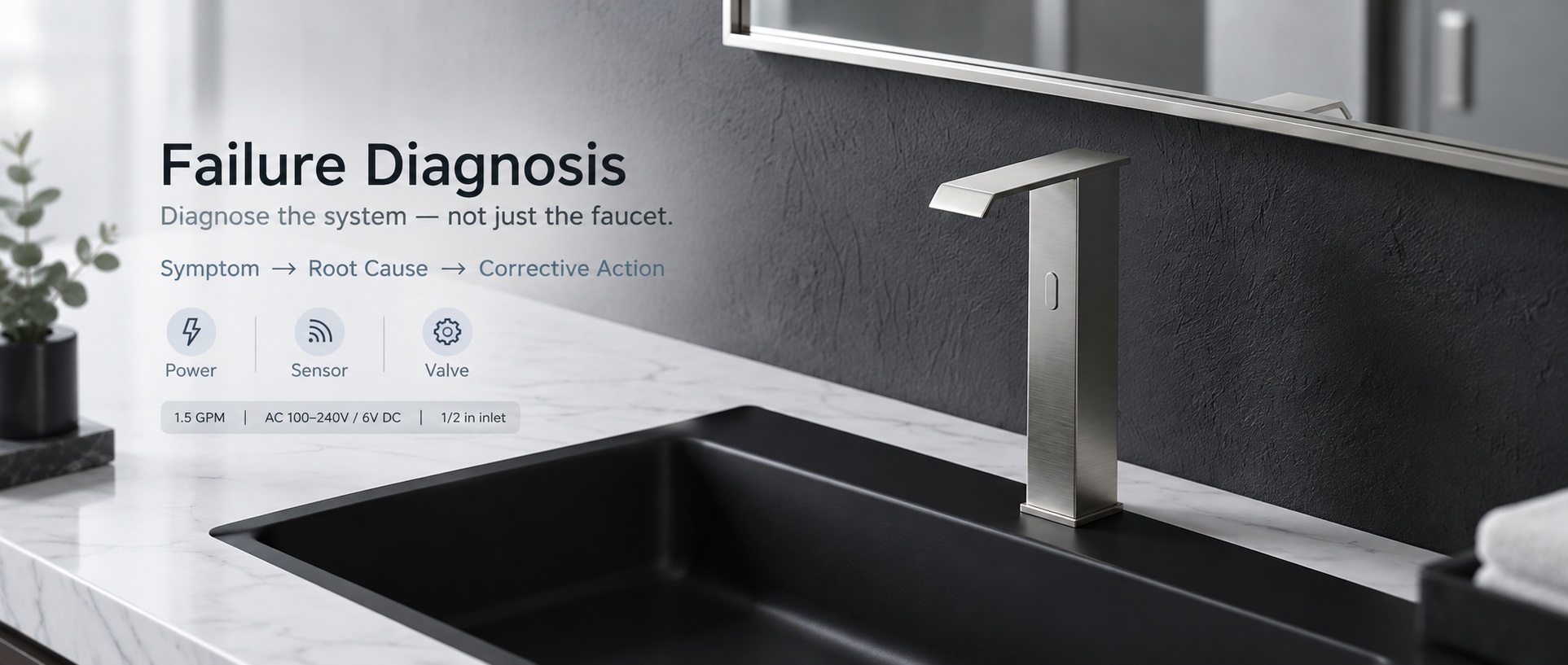
Why Touchless Faucets Fail in Commercial Restrooms:
Common Mistakes Facility Managers Can Prevent
Most commercial touchless faucet problems are not caused by the concept of
touchless operation itself. They develop when sensor conditions,
water quality, power, solenoid valves, installation, basin geometry,
maintenance access and service procedures are treated as unrelated issues.
In high-traffic buildings, small weaknesses can become recurring maintenance events
multiplied across dozens, hundreds or even thousands of fixtures.
Facility-management principle:
the cheapest faucet on bid day is not necessarily the lowest-cost faucet
over the life of the building. Commercial reliability depends on how quickly
the system can be diagnosed, serviced and returned to operation.
SENSOR RELIABILITYActivation consistency, calibration, environmental interference and user detection.
VALVE UPTIMESolenoids, filters, pressure conditions, debris protection and isolation.
POWER CONTINUITYBattery condition, AC/DC architecture, connectors and backup strategy.
SERVICEABILITYAccess, replacement components, technician time and lifecycle planning.
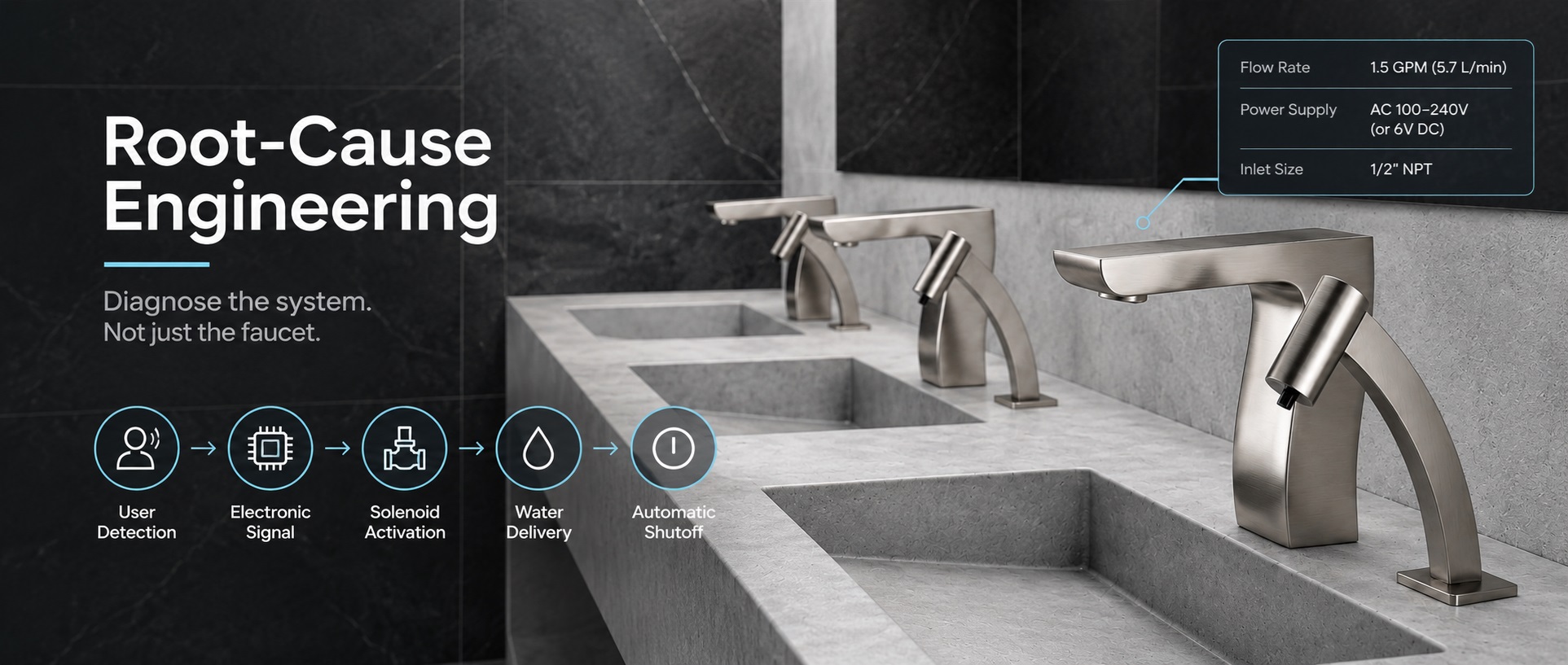
Root-Cause Engineering
“The Faucet Failed” Is Usually Not a Complete Diagnosis
When a user reports that a touchless faucet does not work, the visible symptom
may have several possible causes. A no-flow complaint can originate with the
sensor, power supply, wiring, solenoid, supply stop, clogged filter, debris,
pressure condition or installation error.
Effective facility maintenance therefore starts by diagnosing the
system rather than immediately replacing the faucet body.
The Commercial Touchless Failure Chain
User Detection
Electronic Signal
Solenoid Activation
Water Delivery
Automatic Shutoff
A problem anywhere along this chain may appear to the occupant as exactly
the same complaint: “the faucet doesn't work.”
That is why facilities teams benefit from standardized diagnostic procedures.
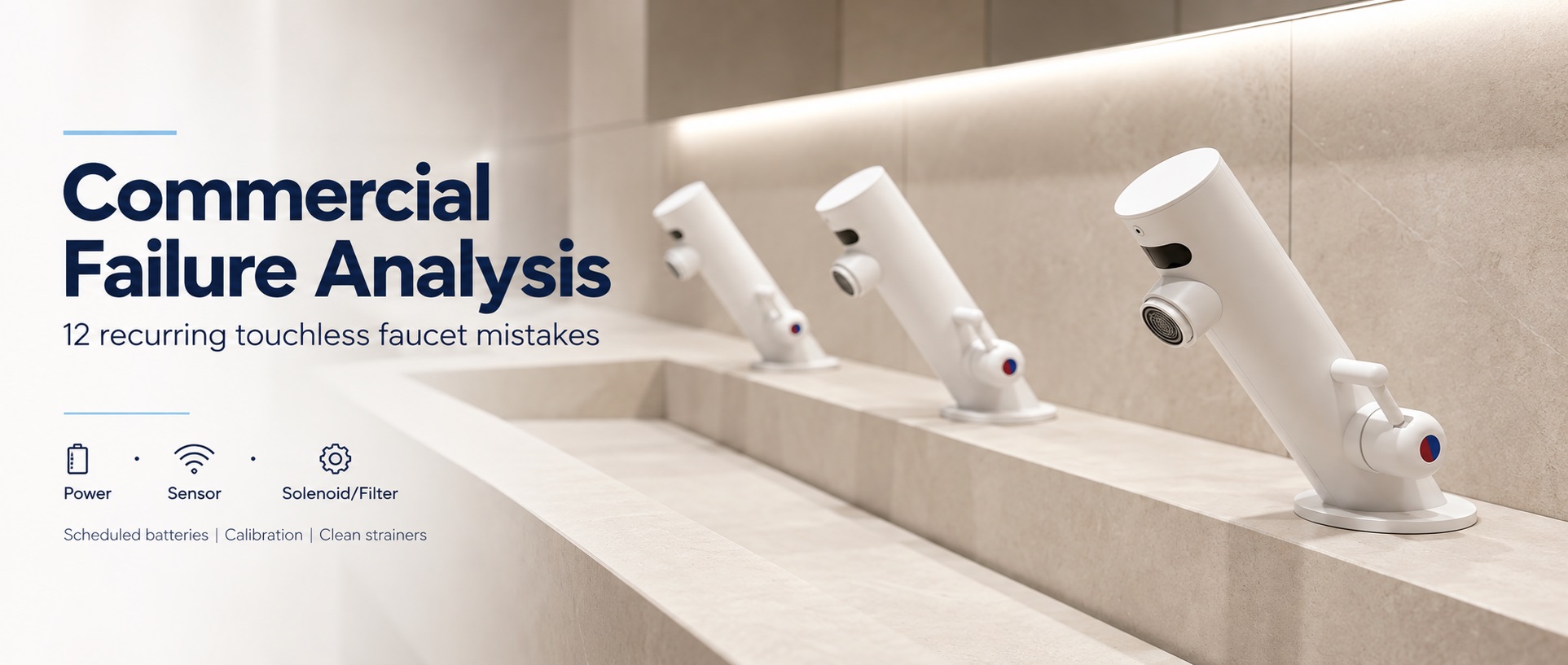
Commercial Failure Analysis
Common Mistakes That Create Recurring Touchless Faucet Problems
These failure modes should be reviewed by facility managers, building owners,
maintenance supervisors, plumbing contractors and project teams responsible
for commercial restroom uptime.
Waiting for Complete Battery Failure
Battery-powered sensor faucets often become a reactive maintenance item.
Instead of servicing batteries according to an organized facility schedule,
maintenance teams respond only after an occupant reports a nonfunctioning fixture.
Typical symptom: delayed activation, intermittent operation or complete loss of function.
Root cause: batteries are treated as emergency replacements rather than planned consumables.
Prevention: establish documented battery replacement intervals based on actual traffic, fixture type and manufacturer requirements.
Ignoring Sensor Calibration and Detection Conditions
Sensor performance can be affected by installation geometry, objects within
the detection area, reflective surfaces and commissioning conditions.
Some systems perform automatic calibration after power is connected.
The basin and sensor area should remain clear during the calibration procedure
according to the exact fixture instructions.
Typical symptom: faucet activates too early, too late, continuously or inconsistently.
Prevention: document commissioning and recalibration procedures for each fixture family.
Allowing Debris to Reach the Solenoid Valve
Construction debris, sediment or material released from supply piping can
interfere with filters, strainers and solenoid components.
Supply lines should be flushed according to installation instructions
before final connection and commissioning.
Typical symptom: reduced flow, no flow, inconsistent shutoff or a valve that appears defective.
Root cause: inadequate flushing or neglected strainer maintenance.
Prevention: include filter inspection and cleaning in preventive maintenance procedures.
Installing Control Boxes Where Technicians Cannot Reach Them
An electronic control box may require future battery replacement,
wiring inspection, valve access or troubleshooting.
Hiding it behind fixed millwork or congested plumbing increases every
future service event.
Typical symptom: a five-minute service task becomes a lengthy maintenance intervention.
Prevention: require accessible control locations during design and verify access during turnover.
Misdiagnosing Solenoid Problems as Sensor Problems
A sensor may correctly detect the user while the valve fails to deliver
the expected water response. Replacing electronic components without
isolating the actual failure point increases parts cost and technician time.
Typical symptom: sensor indication appears normal but water does not start or stop correctly.
Prevention: use a diagnostic sequence that separates sensor, power, valve and hydraulic causes.
Ignoring Water Pressure and Flow Conditions
A properly functioning sensor and solenoid cannot compensate for every hydraulic
condition in the building. Supply pressure, partially closed stops, blocked filters,
piping conditions and aerator restrictions can all affect perceived faucet performance.
Typical symptom: weak stream, uneven flow or complaints that one fixture performs differently from adjacent fixtures.
Prevention: include basic pressure and flow checks before replacing electronic components.
Incorrect Flexible-Hose Routing
Flexible connections should not be sharply bent, kinked or twisted.
Poor routing can restrict flow and can create unnecessary stress on the connection.
Typical symptom: unexplained low flow even when the sensor and valve appear operational.
Prevention: inspect hose routing during installation, commissioning and troubleshooting.
Mixing Old and New Batteries or Using the Wrong Battery Type
Facility technicians sometimes replace only one or two cells or mix battery
ages and brands. That practice can lead to inconsistent power performance
and make troubleshooting unnecessarily difficult.
Typical symptom: intermittent sensor operation shortly after a “battery replacement.”
Prevention: replace required batteries as a complete matched set and follow model-specific manufacturer instructions.
Cleaning the Fixture Without Considering the Sensor
Cleaning procedures influence electronic fixtures differently from conventional
manual faucets. Residue, objects left in the detection field, aggressive chemicals
or improper cleaning practices may contribute to false activation or surface damage.
Typical symptom: problems appear after custodial service rather than during normal occupancy.
Prevention: provide model-appropriate cleaning instructions to custodial teams—not only plumbing technicians.
Operating Without Standard Spare Parts
Large facilities should not wait until a critical fixture is out of service
to discover that a battery carrier, solenoid, aerator, control module,
connector or other service component must be ordered.
Typical symptom: a simple repair results in prolonged fixture downtime.
Prevention: create a project-specific spare-parts schedule during turnover.
Using Too Many Unrelated Faucet Platforms
A building containing numerous sensor technologies, battery types,
solenoids, controllers and proprietary service parts can create
unnecessary operational complexity.
Typical symptom: technicians need different procedures and inventories for nearly identical restrooms.
Prevention: where practical, standardize fixture platforms across the facility or portfolio.
Measuring Purchase Price Instead of Lifecycle Cost
A lower-cost faucet can become expensive when multiplied by technician visits,
batteries, service parts, repeat troubleshooting and fixture downtime.
Typical symptom: the lowest initial fixture bid produces the highest maintenance burden.
Prevention: evaluate commercial touchless faucets using total cost of ownership, maintainability and component availability—not fixture price alone.
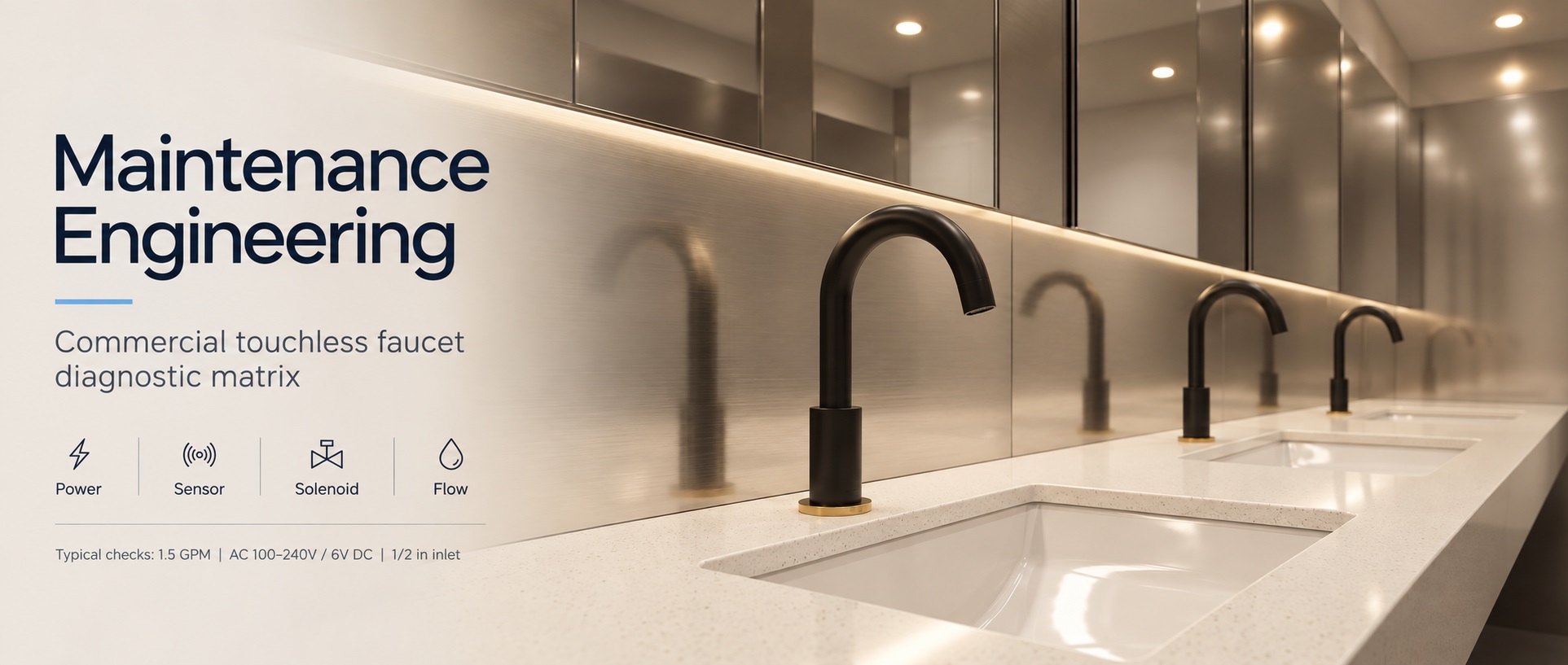
Maintenance Engineering
Commercial Touchless Faucet Diagnostic Matrix
Before replacing components, facility technicians should move logically
from the observable symptom toward the most likely electrical, sensing,
hydraulic or mechanical causes.
Observed Condition
First Areas to Inspect
Possible Cause
Observed Condition: No activation / no water
First Areas to Inspect: Power, battery condition, cable connections, supply stop
Possible Cause: Loss of power, disconnected sensor, closed supply or valve issue
Observed Condition: Sensor responds but no flow
First Areas to Inspect: Solenoid, filter, supply pressure, hose routing
Possible Cause: Blocked strainer, hydraulic restriction or valve problem
Observed Condition: Water will not shut off
First Areas to Inspect: Sensor field, solenoid, debris, calibration
Possible Cause: Continuous detection, valve obstruction or calibration condition
Observed Condition: Intermittent activation
First Areas to Inspect: Battery voltage, sensor field, connectors
Possible Cause: Weak power, unstable connection or environmental interference
Observed Condition: Weak water stream
First Areas to Inspect: Aerator, strainer, stop valve, pressure, hose
Possible Cause: Restriction, kink, debris or hydraulic condition
Observed Condition: False activation
First Areas to Inspect: Detection zone, basin contents, reflections, calibration
Possible Cause: Object or surface influencing sensor field
Observed Condition: One faucet differs from adjacent units
First Areas to Inspect: Local supply, filter, battery and installation
Possible Cause: Fixture-specific maintenance or hydraulic issue
Observed Condition: Repeated failures in multiple fixtures
First Areas to Inspect: System design, commissioning, water quality, power strategy
Possible Cause: Portfolio-level rather than isolated component issue
Critical Facility Insight
Replacing Parts Without Finding the Root Cause Is Not Preventive Maintenance
Repeatedly replacing batteries, sensors or solenoids may temporarily restore
operation while leaving the underlying cause unresolved.
For example, repeated valve issues may actually originate with debris or filtration;
repeated activation complaints may originate with basin geometry or commissioning;
and repeated low-flow complaints may originate upstream of the electronic system.
In commercial facilities, total cost of ownership is influenced by far more
than the fixture invoice. The effect becomes increasingly important as the
number of installed faucets grows.
Technician Time
Travel, diagnosis, access, repair, testing and documentation.
Consumables
Batteries and routine replacement components accumulated over years.
Spare Inventory
Solenoids, aerators, filters, controllers and service components.
Fixture Downtime
Unavailable lavatories, occupant complaints and repeat service requests.
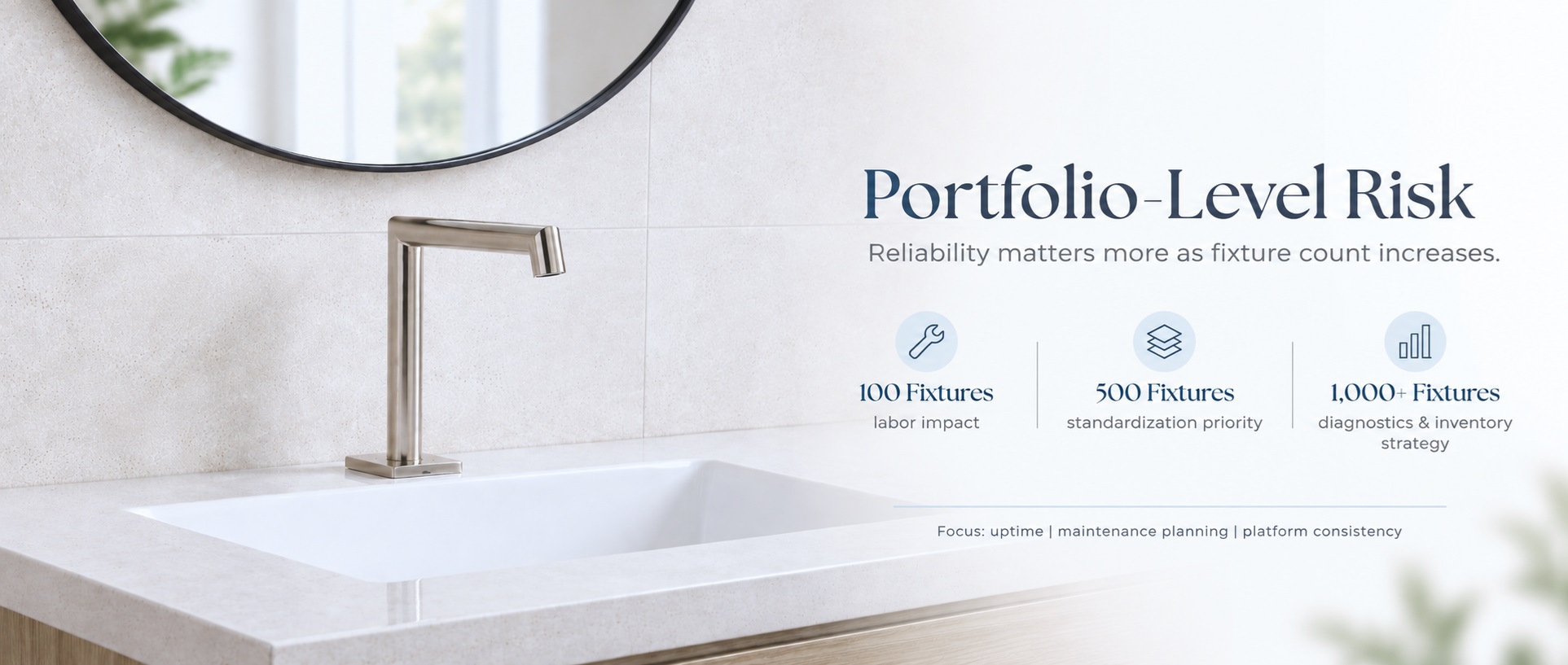
Portfolio-Level Risk
Why Reliability Matters More as Fixture Count Increases
A maintenance procedure that requires only several additional minutes may seem
insignificant at one faucet. Across hundreds of fixtures and repeated annual
service cycles, that same inefficiency becomes a measurable labor burden.
100 Fixtures
Small maintenance inefficiencies begin to affect annual labor planning.
500 Fixtures
Parts standardization and preventive maintenance become operational priorities.
1,000+ Fixtures
Power architecture, inventory, diagnostics and platform consistency become
facility-management strategy.
Maintain Spare Components
Keep appropriate high-use service parts available for critical buildings.
Document Root Causes
Track recurring problems by fixture model, restroom and failure type.
Train Custodial Teams
Ensure cleaning procedures account for sensor location and fixture finish.
Verify Service Access
Keep control boxes, shutoffs, filters and connections reachable.
Review Failure Trends
Repeated failures across several fixtures may indicate a system-level problem.
Installation → Maintenance
Many “Maintenance Problems” Actually Begin During Installation
Installation decisions determine how easily a touchless faucet can be serviced
years later. Control-box location, line flushing, hose routing, cable connections,
supply isolation and initial sensor calibration all influence subsequent reliability.
FontanaShowers® installation documentation specifically addresses line flushing,
control-box positioning, flexible connection routing, sensor calibration and
power connections—items worth incorporating into project commissioning procedures.
Facility Managers Inherit Decisions Made Years Before Occupancy
Maintenance teams frequently inherit systems they did not select.
If a project was designed without adequate service access, replacement-parts
planning, sensor coordination or suitable power architecture, facility management
may spend years compensating for an early design decision.
That is why facility professionals should be involved in fixture review on
major projects before the specification is finalized.
Understand the design-stage mistakes involving sensors, basin geometry,
power, mixing, accessibility and serviceability that can create
operational problems after turnover.
Move from failure prevention into procurement strategy.
Learn how to compare commercial touchless systems for airports,
stadiums, hospitality, institutional and high-traffic buildings.
Common causes can include depleted power, disconnected wiring,
sensor conditions, blocked filters, supply restrictions, solenoid issues,
installation problems or hydraulic conditions. Diagnosis should isolate
each subsystem rather than assuming the entire faucet has failed.
What is the first thing a facility technician should check?
Start with the observable symptom, then confirm power, supply conditions,
connections and sensor behavior before replacing components.
The exact diagnostic sequence should follow the model-specific documentation.
Can debris cause a touchless faucet to malfunction?
Yes. Sediment or construction debris can restrict filters and interfere
with internal water-control components. Proper line flushing and routine
filter inspection can reduce this type of problem.
Why does a sensor faucet sometimes run continuously?
Continuous flow may require investigation of the detection field,
objects near the sensor, calibration conditions, the solenoid or debris.
Technicians should isolate the cause according to the specific faucet system.
Should facilities replace touchless faucet batteries on a schedule?
In larger buildings, planned battery maintenance can be more efficient
than waiting for individual failures. Actual intervals should reflect
fixture technology, traffic and manufacturer requirements.
Why is control-box accessibility important?
Batteries, wiring, valves and electronic components may require inspection
during the life of the fixture. Accessible placement can substantially
reduce maintenance labor.
Should a facility standardize one touchless faucet platform?
Standardization can simplify technician training, spare-parts inventory,
battery management and troubleshooting. The best strategy depends on
project requirements and the building portfolio.
How should lifecycle cost be evaluated?
Consider purchase and installation cost together with technician labor,
batteries, replacement components, preventive maintenance,
expected service life and fixture downtime.
When a Touchless Faucet Fails, Diagnose the System — Not Just the Faucet
Commercial touchless faucet failures are often blamed immediately on the
sensor or faucet body. In practice, the visible symptom may originate from
power, hydraulic conditions, debris, valve components, sensor environment,
installation, basin geometry, temperature control or maintenance.
For architects, MEP engineers, contractors and facility managers, the more
useful question is therefore not simply “What part failed?”
but “What system condition produced the failure?”
Root-cause principle:
replacing a component may restore operation without correcting the condition
that caused the problem. Repeated failures should trigger a review of the
complete installation—including power, sensing, hydraulics, commissioning
and maintenance history.
The same visible symptom can have several possible causes. Troubleshooting
should proceed systematically rather than replacing components by assumption.
Observed Problem
Possible Causes
Diagnostic Action
Prevention / Design Response
Observed Problem: Touchless faucet does not turn on
Possible Causes: Power loss, depleted battery, disconnected wiring, closed supply, obstructed filter, sensor condition or valve issue.
Diagnostic Action: Verify water supply and power first; then inspect sensor, connections, filtration and valve operation.
Prevention / Design Response: Document power architecture, accessible shutoffs and service procedures.
Observed Problem: Faucet activates by itself
Possible Causes: Excessive detection range, reflective surfaces, nearby movement, basin interaction or incorrect sensor positioning.
Diagnostic Action: Observe the installation under normal lighting and operating conditions; verify sensor range and surrounding surfaces.
Prevention / Design Response: Coordinate sensor field, basin geometry and backsplash during specification.
Observed Problem: Faucet keeps running
Possible Causes: Persistent detection, valve contamination, solenoid condition, sensor obstruction or commissioning problem.
Diagnostic Action: Determine whether the controller continues requesting flow or whether the valve remains mechanically open.
Prevention / Design Response: Use standardized commissioning and facility failure records.
Root-Cause Classification
Most Failures Fall Into Common System Categories
Sensing
Sensor & Detection Environment
Detection range, mounting angle, reflective surfaces, basin geometry, nearby objects and environmental conditions can influence activation.
Power
Electrical & Battery Architecture
Battery condition, wiring, power supplies, voltage requirements and connections should be verified before electronic components are replaced.
Hydraulics
Water Supply & Flow Path
Pressure, supply stops, debris, filters, aerators and valve components can create symptoms incorrectly attributed to sensing electronics.
Installation
Installation & Commissioning
Improper rough-in, unflushed lines, poor component placement and skipped commissioning can create failures immediately after turnover.
Geometry
Faucet + Basin Coordination
Spout projection, basin depth, stream landing and sensor field should function as one coordinated lavatory assembly.
Maintenance
Service & Lifecycle Conditions
Inaccessible components, inconsistent preventive maintenance and undocumented repairs can turn simple service events into recurring failures.
Failure Prevention at Turnover
Commission the Installed Faucet Under Real Conditions
A faucet that powers on is not necessarily a commissioned faucet.
Before turnover, contractors and project teams should verify the complete
operating sequence under the actual installed conditions.
Flush water lines before final operation.
Confirm supply stops are fully configured.
Verify power and electrical connections.
Test activation from natural hand positions.
Check for unintended or false activation.
Observe performance with actual basin surfaces.
Verify water stream landing and splash.
Confirm automatic shutoff behavior.
Verify intended temperature-control operation.
Confirm controllers and valves remain serviceable.
Record model numbers and configuration settings.
Transfer maintenance documentation to facility staff.
Facility Management Feedback Loop
One Failed Faucet Is a Service Event. Repeated Failures Are Data.
Facility managers should avoid treating every repair as an isolated work
order. When failure information is recorded consistently, recurring
patterns can reveal specification, installation, environmental or
maintenance problems affecting an entire fixture population.
Location
Building / restroom / fixture
Model
Faucet and controller
Symptom
Exact observed behavior
Date
Failure occurrence
Root Cause
Confirmed diagnosis
Part Replaced
Actual component changed
Labor
Technician service time
Recurrence
Repeat failure history
Facility-management principle:
if the same symptom repeatedly appears across multiple faucets,
investigate the shared condition before continuing fixture-by-fixture
component replacement.
Important Diagnostic Distinction
Sometimes the Faucet Is Working Correctly — the Installation Is Not
A sensor faucet can operate according to its design and still perform poorly
within an incorrectly coordinated restroom. Excessive splash may originate
from basin geometry. False activation may originate from the installed
sensor environment. Low flow may originate upstream. Repeated power service
may indicate that the selected power architecture does not match traffic.
This distinction matters because replacing a correctly functioning faucet
will not correct an incompatible basin, poor electrical design,
contaminated supply line or inaccessible service layout.
FontanaShowers® Failure Prevention Resources
Diagnose the Cause, Then Use the Correct Technical Resource
Continue troubleshooting and failure-prevention research through these
related commercial touchless engineering, installation and specification resources.
In high-traffic commercial restrooms, reliable touchless operation begins
before the first maintenance call. Sensor architecture, power,
valve accessibility, filtration, installation quality, replacement-parts
strategy and preventive maintenance all contribute to lifecycle performance.
FontanaShowers® commercial touchless systems are developed for demanding
applications including hospitality, healthcare, corporate buildings,
aviation, education, government facilities and other high-use environments.