ENGINEERING • SPECIFICATION • COMMISSIONING
TECHNICAL REFERENCE
How to Use This Technical Reference
This reference supports commercial planning, submittal review, commissioning, and maintenance. Values are typical engineering targets and must be confirmed against the latest model-specific cut sheet, wiring diagram, BIM file, approved submittal, and local code.
Do not treat a planning range as a universal certification claim.
Core Commercial Planning Values
1.2–10 in.Adjustable sensor range
<300 msResponse target
0.35–0.5 GPMPublic-lavatory flow
10–100 PSIOperating pressure
500K–1M+Solenoid cycles
300K–500KBattery activations
TECHNICAL REFERENCE
1. What flow rate is appropriate for a public commercial lavatory?
A maximum of
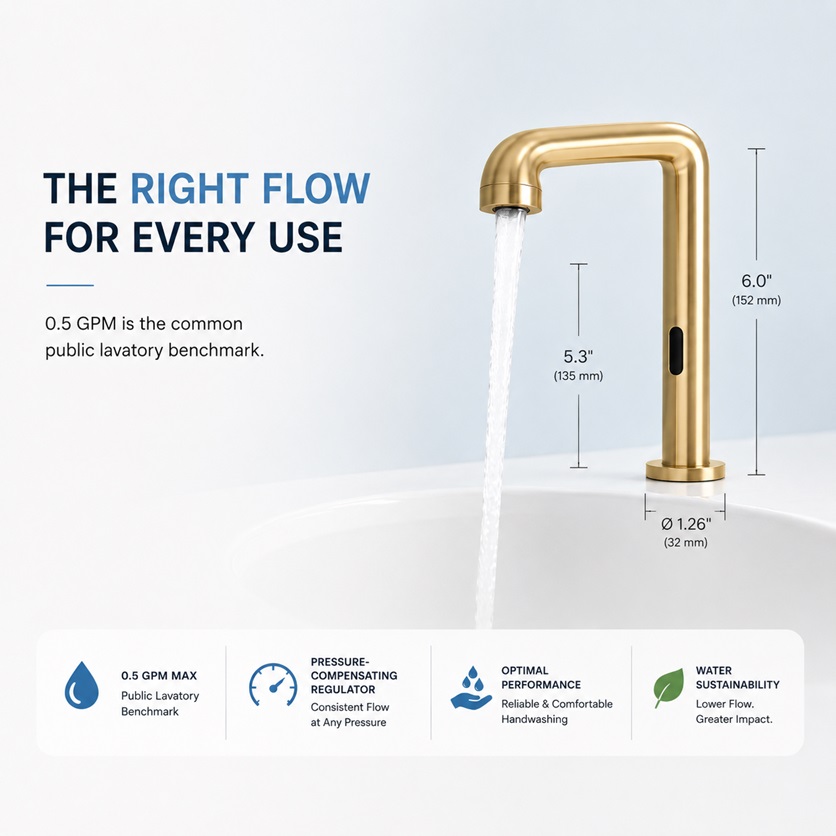
0.5 GPM is the common U.S. public-lavatory benchmark. Specify a pressure-compensating regulator and verify the rated flow at the test pressure shown on the cut sheet. Lower 0.35 GPM options may be used where permitted and where handwashing performance remains acceptable.
TECHNICAL REFERENCE
2. What sensor response time should a commercial faucet target?
A practical commissioning target is
100–300 milliseconds from valid hand detection to valve command. Excessive filtering may create lag; insufficient filtering may increase false activation. Measure response repeatedly under normal lighting, reflective-countertop, and adjacent-fixture conditions.
TECHNICAL REFERENCE
3. How wide should the detection range be?
Commercial models commonly provide an adjustable range of approximately
1.2–10 inches. Set the final range only far enough to detect the user's hands inside the intended wash zone. Overextended range can detect basin edges, mirrors, clothing, or movement at adjacent stations.
TECHNICAL REFERENCE
4. What operating pressure should be verified during commissioning?
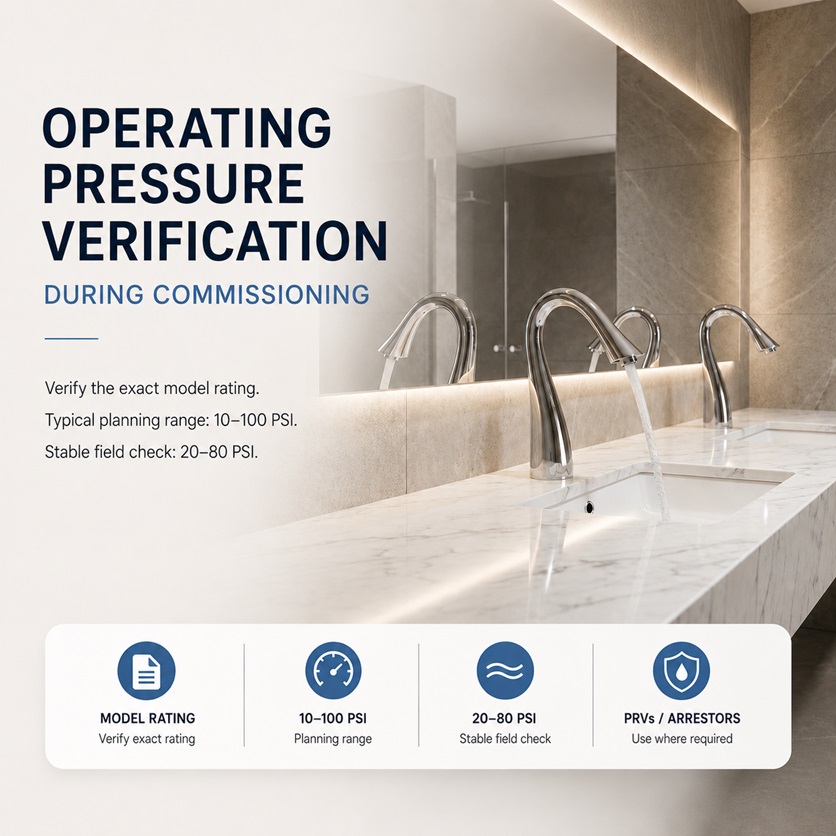
Use the exact model rating. A common commercial planning range is
10–100 PSI, while stable field performance is often checked near 20–80 PSI. Investigate pressure below the minimum, static pressure above the rating, and water-hammer events. Add pressure-reducing valves or arrestors where required.
TECHNICAL REFERENCE
5. How long should a commercial solenoid last?
A robust commercial design target is
500,000 to more than 1,000,000 operating cycles. This is not a universal guaranteed life: debris, pressure spikes, scale, coil temperature, seat contamination, and duty cycle can reduce service life. Request the model's cycle-test report or declared endurance value.
TECHNICAL REFERENCE
6. How many activations should a battery-powered faucet provide?
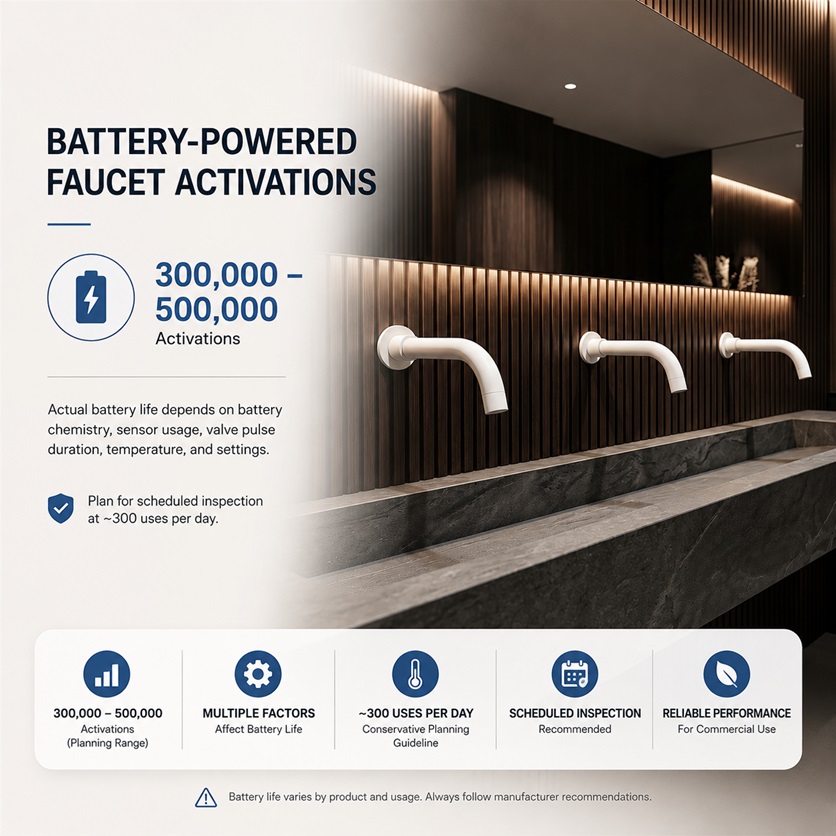
Commercial planning values are commonly
300,000–500,000 activations, but actual life depends on battery chemistry, standby current, sensor sampling, valve pulse duration, ambient temperature, and hygiene-flush programming. At 300 uses per day, a conservative battery plan should include scheduled inspection rather than relying only on a theoretical activation count.
TECHNICAL REFERENCE
7. When should AC or AC/DC hybrid power be specified?
Use hardwired or hybrid power for airports, hospitals, stadiums, and other high-use locations. For shared
12 VDC supplies, calculate connected peak load and add 20–30% capacity headroom. Keep design voltage drop at or below 5%, use star wiring, and avoid daisy-chaining fixture banks unless the manufacturer specifically permits it.
TECHNICAL REFERENCE
8. What maximum run time helps control abuse or obstruction?
A typical project setting is
15–30 seconds maximum continuous run, followed by an obstruction lockout of approximately 30–90 seconds. Final programming must match the intended use, accessibility needs, water-management plan, and manufacturer controls.
TECHNICAL REFERENCE
9. How should faucet and dispenser sensors be spaced?
A useful starting layout is
6–10 inches center-to-center, followed by live cross-trigger testing. Highly reflective basins, polished backsplashes, close fixture spacing, and opposing optical paths may require greater separation or reduced sensor gain.
TECHNICAL REFERENCE
10. What water temperature protection should be used?
For tempered-water lavatories, use a listed point-of-use temperature-limiting device where required.
ASSE 1070 addresses devices intended to limit outlet temperature at fixtures such as sinks and lavatories. Verify the final outlet temperature with a calibrated thermometer and follow the project plumbing design.
TECHNICAL REFERENCE
11. What IP rating is appropriate for electronic faucet components?
Where the model is tested and marked accordingly,
IP65–IP67 is a useful commercial target for exposed sensor or control enclosures. IP ratings must come from a model-specific test declaration under IEC 60529; do not infer the enclosure rating from the faucet's appearance.
TECHNICAL REFERENCE
12. What finish testing can be requested for commercial projects?
Request the coating system, substrate, test method, duration, and acceptance criteria. ISO 9227 defines neutral, acetic-acid, and copper-accelerated salt-spray procedures, but it does
not assign a universal exposure duration or pass/fail threshold. A stated 72-hour or longer target is meaningful only when tied to a specific method and evaluation criterion.
TECHNICAL REFERENCE
13. How should soap viscosity and dose be specified?
Verify the pump's approved chemistry range. Planning values may span approximately
1–3,000 cP for compatible liquid soap, with a typical liquid dose of 0.8–1.5 mL and foam concentrate delivery near 0.4–0.6 mL. Foam requires a dedicated air-mixing pump; do not treat liquid and foam modules as interchangeable.
TECHNICAL REFERENCE
14. What accessibility values directly affect faucet selection?
ADA operable parts must be usable with one hand without tight grasping, pinching, or wrist twisting, and manual controls are limited to
5 lbf maximum activation force. Manual metering faucets must remain open for at least 10 seconds; motion-activated faucets are not subject to that minimum run time.
TECHNICAL REFERENCE
15. What commissioning sample should be documented?
For each fixture bank, record model/SKU, supply pressure, measured flow, detection range, response behavior, max-run setting, outlet temperature, power-source voltage, battery installation date, sensor cross-trigger test, leak test, strainer condition, and final basin landing point. Retain the approved settings with the O&M package.
TECHNICAL REFERENCE
Related Fontana Technical Resources
Use these internal Fontana pages alongside exact product cut sheets and project submittals.
Testing, Code, and Regulatory Authorities
ASME — plumbing supply fitting performance.
CSA Group — harmonized plumbing standards.
NSF International — drinking-water health and lead-content standards.
ASSE International — temperature-limiting and mixing-device standards.
EPA WaterSense — water-efficiency criteria.
U.S. Access Board — ADA accessibility requirements.
ICC — plumbing and accessibility codes.
IAPMO — UPC and product certification.
UL Solutions — electrical safety evaluation.
Intertek / ETL — electrical product certification.
IEC — ingress-protection and electrical standards.
ISO — corrosion and quality-management test methods.
ASTM International — materials and coating test methods.
ASHRAE — building systems and water-management guidance.
CDC — healthcare and water-management guidance.
TEMPORARY IMAGE PLACEMENTS
Technical Installation and Specification Gallery
Replace each repeated image with model photography, installation diagrams, test documentation, or project-specific technical graphics.

Installation Detail Placeholder
Use this position for a deck-mount installation diagram, below-counter valve assembly, power supply arrangement, or basin landing-point illustration.
Sensor Calibration Placeholder
Replace this image with a sensor detection-zone graphic, reflective-surface test, range calibration sequence, or commissioning photograph.
Model-Specific Verification Required
Confirm the exact SKU, finish, power configuration, flow regulator, certifications, wiring, pressure range, and installation details before approval.
For technical support, use the approved Fontana documentation and project submittal package.
|
|










 TOUCHLESS SENSOR FAUCETS