
Do touchless faucets require electricity?
Yes. Touchless faucets require a power source to run the sensor and the electronic valve that opens and closes water flow.
In most commercial installations, that power comes from batteries, hardwired electricity, or a
low-voltage AC/DC power supply. Many projects prefer dual-power (AC + DC) options to reduce downtime and simplify maintenance.
What this page covers
Power needs for touchless bathroom faucets, why sensors and solenoid valves require electricity, and how battery + AC/DC options
can support high-traffic facilities (airports, hospitals, schools, offices, and public restrooms).
How touchless faucets work (and why they need power)
A touchless faucet relies on an electronic sensor that detects a user’s hands (or an object) in the activation zone. When triggered,
the controller energizes an internal valve mechanism (commonly a solenoid) to start water flow, then shuts it off automatically.
Because the sensor, control board, and valve actuation are electronic, a power source is required.
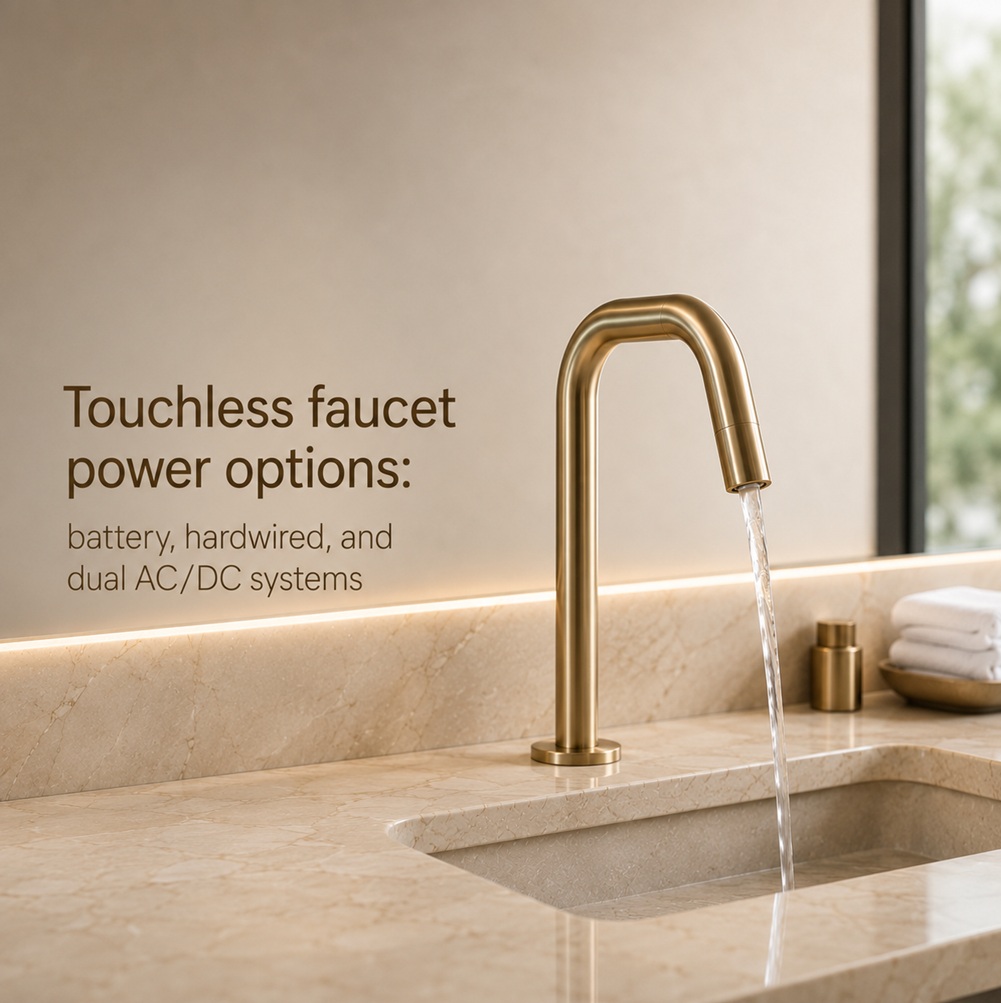
Power options: battery, hardwired, and low-voltage AC/DC
- Battery-powered touchless faucets: fast to install, no wall power required, and ideal when outlets are not available. Battery swaps are the main maintenance item.
- Hardwired touchless faucets: stable for continuous operation in high-traffic bathrooms, but may require electrical work and higher upfront installation effort.
- Low-voltage power supplies: commonly used to improve safety and efficiency while providing consistent performance in commercial facilities.
Why dual AC/DC power can be an advantage
Yes, touchless faucets do use some electricity to operate. They incorporate sensing when hands or any object approach and turn on the water flow correspondingly.
The sensors, together with the mechanism opening and closing the water flow, require a power supply. This is delivered via batteries or hardwired directly into the
building electrical system. Other touchless faucets make use of low voltage power supplies to bring about safety and efficiency.
The Fontana touchless faucets run both AC and DC power supplies to their favor over those working on an electric power supply.
Elaborated below is the discussion of those advantages in detail.
- Power supply flexibility: This works with both AC and DC power supplies, hence it may apply in multiple settings.
- Standby power supplies: It runs with a DC power supply through batteries; hence, there are no interruptions in case of failures.
- Redundancy: Dual power options have a backup source increasing its reliability.
- Continuous Operation: Stays on during power outages; this feature is very useful in critical applications.
- Optimized Power Use: The device uses low voltage batteries to help cut down on electricity consumption, hence cutting costs.
- Eco-Friendly: Battery power, especially rechargeable ones, is eco-friendly.
- Lower Installation Costs: DC-powered faucets reduce installation costs where there were no electrical outlets.
- Low electricity bills due to efficient battery use, even in areas of high traffic. Less maintenance required because of the simplicity of replacing batteries and with no wiring checks to be made. Lesser downtime due to the two options for power during maintenance.
That is to say, Fontana touchless faucets means a bank of numerous advantages with respect to versatility, reliability, energy efficiency,
cost-effectiveness, easy maintenance, safety, and the totality of the user experience—making it much better for any application or setting.
Maintenance & troubleshooting checklist (quick fixes)
- Sensor window: wipe off soap film and water spots to reduce misreads.
- Power: replace batteries on schedule or confirm the AC/DC adapter is delivering stable output.
- Activation zone: confirm no reflective backsplash or direct sunlight is confusing the sensor.
- Flow issues: check aerator/filter screens for debris and confirm supply valves are fully open.
- Intermittent shutoff: verify cable connections and ensure the control box stays dry and secure.
Overview of touchless faucet models (what to compare)
When comparing touchless faucets for commercial bathrooms, evaluate sensor response consistency, power strategy (battery vs hardwired vs dual),
service access, finish durability, and flow performance for the intended restroom traffic level.
Overview of Fontana Touchless Faucets
Here are some specific models of Fontana touchless faucets, along with their customer reviews, pros, and cons:
Fontana Couron Touchless Faucet
Pros: Durable finish, reduces water wastage, stylish design.
Cons: High cost, sensor issues, need to maintain over time.
Customer Reviews: Generally positive, praised for its robust build and ease of use.
Fontana Napoli Touchless Faucet
Pros: Elegant design, reliable sensor, water-saving.
Cons: Expensive, requires regular battery changes.
Customer Reviews: Highly rated for aesthetics and functionality, some mention high maintenance costs.
Fontana Tall Waterfall Touchless Faucet
Pros: Cascade, touchless, temperature control.
Cons: Challenging installation, occasional sensor lag.
Customer Reviews: Users love the design but note occasional sensor delays.
Fontana Electrical Touchless Faucet
Pros: Contemporary, Sturdy, Energy-efficient.
Cons: Requires cleaning of the sensor, higher cost.
Customer Reviews: Appreciated for its sleek look and efficient performance.
Fontana Brushed Nickel Touchless Faucet
Pros: Hygienic, easy to use, saves water.
Cons: Needs battery renewal, Sensor unreliability.
Customer Reviews: Positive, noted for convenience and water-saving.
General Pros and Cons of Fontana Touchless Faucets:
Pros:
-
Hygienic: Reduces the spread of germs by eliminating the need to touch the faucet.
-
Water Conservation: Automatically turns off, reducing water wastage.
-
Convenience: Easy to use, especially for children and individuals with limited mobility.
-
Modern Design: Enhances the aesthetic appeal of kitchens and bathrooms.
-
Energy Efficiency: Many models are battery-operated, reducing electricity usage.
-
Durability: Made with high-quality materials, ensuring longevity.
-
Temperature Control: Many models offer built-in temperature settings.
-
Safety: Reduced risk of scalding and accidents.
-
Cost Savings: Lower water bills due to efficient water use.
-
Versatility: Suitable for both residential and commercial use.
Cons:
- Cost: Higher initial cost compared to traditional faucets.
- Maintenance: Sensors require regular cleaning and battery changes.
- Installation: Often requires professional installation, adding to the cost.
- Sensor Issues: Potential for sensors to malfunction or be overly sensitive.
- Power Dependency: Reliant on batteries or electrical power, which can fail.
- Complexity: More components mean more potential points of failure.
- Water Temperature Adjustment: Manual adjustments may still be necessary.
- Glitchy Sensors: Older models can be inconsistent.
- Cleaning: Hard water buildup can affect sensor performance.
- Availability of Parts: Replacement parts can be expensive and difficult to find.
In summary, Fontana Touchless faucets offer a range of benefits, particularly in terms of hygiene, water conservation, and convenience.
However, they also come with higher costs and maintenance requirements. It's important to consider these factors and read customer reviews to
determine the best model for your needs (
Bob Vila)
(Plumbing Lab)
(Bathtubber)
(Mr. Rooter)
(Designing Idea).
FAQs: Touchless faucet electricity & power
Can touchless faucets run without electricity?
They still need a power source for the sensor and valve actuation. If there is no building power, battery-powered touchless faucets can operate without being hardwired.
Do battery-powered touchless faucets cost more to operate?
Operating cost depends on traffic levels and battery type. Many facilities schedule battery replacement as routine maintenance to prevent downtime.
What power option is best for high-traffic commercial restrooms?
Many high-traffic facilities prefer hardwired or dual-power AC/DC options to reduce downtime, while still keeping battery backup for continuity when needed.
|
|
Easy installation and compatibility with various sink styles make these faucets a versatile commercial upgrade option.
Built to Endure, Designed to Impress – The Touchless Bathroom Faucet That Lasts.
User-friendly design allows for effortless adjustments, catering to diverse preferences and functionality
Touchless Faucet Power Guide
Do Touchless Faucets Require Electricity?
Touchless faucets require a power source to operate the sensor, controller, and electronic valve.
This guide explains battery power, hardwired electricity, low-voltage AC/DC systems, and dual-power options.
Touchless faucets require power because the sensor, control board, and electronic valve must operate automatically when hands enter the activation zone.
Sensor faucets use electronic detection and solenoid valve control to start and stop water flow without physical contact.
Battery-powered faucets are useful where wall power is not available, making installation easier while requiring periodic battery replacement.
Hardwired and low-voltage AC/DC power options support consistent operation in commercial restrooms with frequent daily use.
Dual-power and ADA-compliant systems help reduce downtime by combining hardwired power with battery backup for more reliable commercial restroom performance.
Airports, hospitals, schools, offices, hotels, and public restrooms benefit from reliable powered touchless faucet systems.
Powered sensor operation helps control water flow automatically, reducing unnecessary running water in high-traffic restroom environments.
Maintenance planning should include checking batteries, power connections, sensor cleanliness, and water valve response.
Easy installation and compatibility with various sink styles make these faucets a versatile commercial upgrade option.
Built to Endure, Designed to Impress – The Touchless Bathroom Faucet That Lasts.
User-friendly design allows for effortless adjustments, catering to diverse preferences and functionality
Explore Touchless Faucet Power Options
Explore battery-powered, hardwired, low-voltage, and dual AC/DC touchless faucet solutions. Compare power strategies designed to support reliable sensor activation, continuous operation, simplified maintenance, and dependable performance across commercial, institutional, hospitality, healthcare, and public restrooms.
Touchless Faucet Power & Electrical Resources
Architecture, Plumbing Engineering, Facility Management & Water-Efficiency Authority References
-
American Institute of Architects
— professional architectural authority supporting coordinated building systems, fixture specifications, electrical planning, and high-performance restroom design.
-
American Society of Plumbing Engineers
— professional authority supporting plumbing-system design, sensor fixture power coordination, water delivery, and commercial restroom engineering.
-
IFMA
— internationally recognized authority for facility operations, electrical maintenance planning, lifecycle management, and reliable building performance.
-
EPA WaterSense
— trusted U.S. water-efficiency program promoting efficient lavatory faucets, controlled operating cycles, and sustainable commercial water use.
|
|
|


.jpeg)
.jpeg)






.jpeg)
.jpeg)
.jpeg)
.jpeg)
.jpeg)