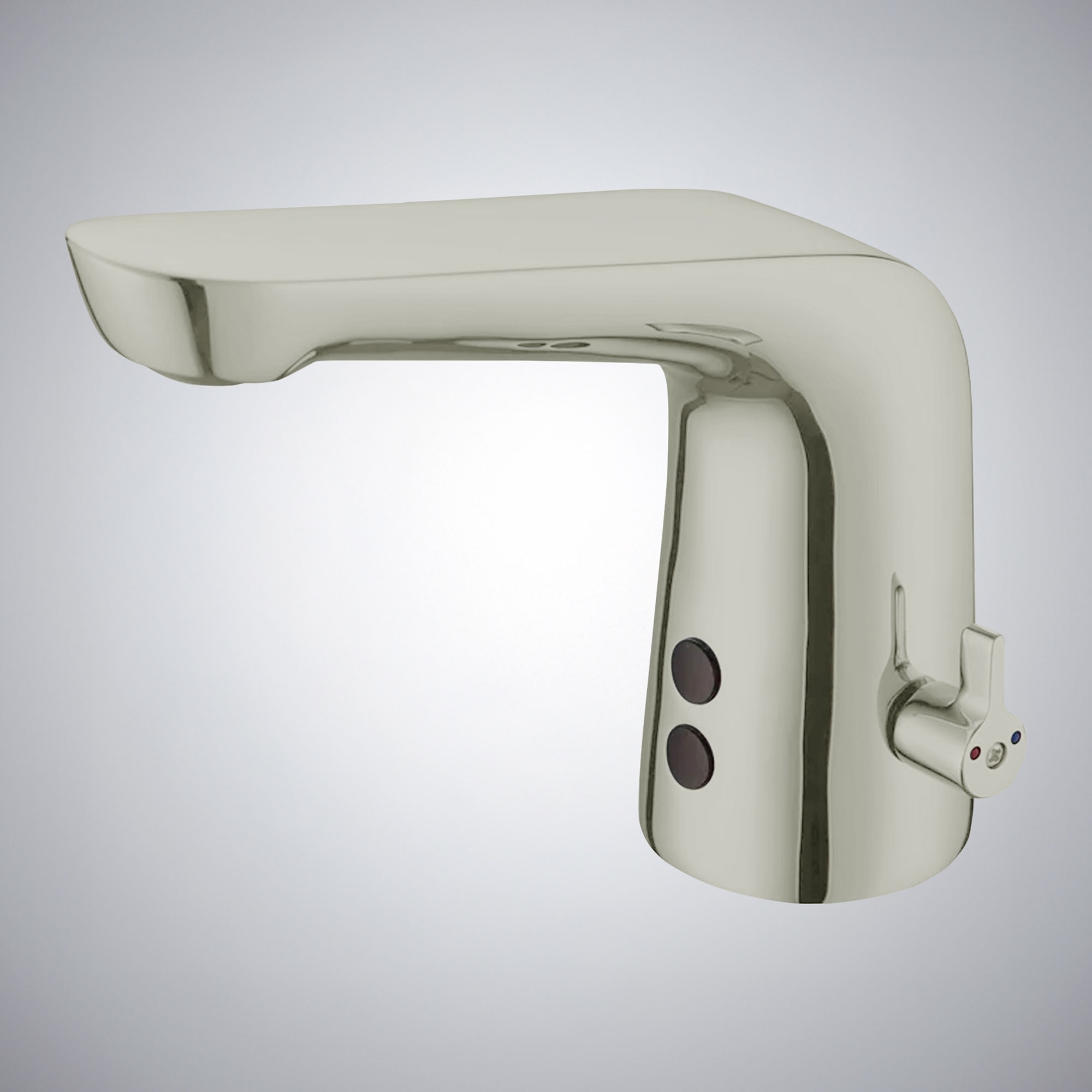
Fontana Castano Brushed Nickel Touchless Faucet combines new design with state-of-the-art performance, perfect as a high-end option for new construction. For high-use applications, it has an infrared sensor that offers the hands-free advantage without the cost. Brushed nickel finish offers a modern appearance and heavy-duty resistance and corrosion resistance, fingerprint resistance and offers a long-lasting appearance.
Designed in single-hole deck-mounted style, the faucet features a sleek, clean finish ideal for traffic environments. Designed economically, the faucet works within a wide range of water pressure and consumes minimal power while providing reliable performance. Its long-lasting construction and precise engineering make it a functional and stylish addition to any modern bathroom. The Fontana Castano Touchless Faucet reinvents convenience as it combines technology and modern design, bringing luxury and functionality in a single innovative piece of hardware. Commercial Anti-Vandal Faucet Series; Professional series offering tamper resistance, ADA compliance, water-saving flow, and reliable sensor performance.
Fontana Castano Brushed Nickel Touchless Faucet FAQ
Inductive Response Timing, Ultra-Low Power Control & Nickel Surface Durability
The Fontana Castano Brushed Nickel Touchless Faucet combines infrared sensing, temperature control, and AC/DC operation for reliable hands-free performance in commercial washrooms.
How should the 1-second opening and 2-second closing response be evaluated during sensor commissioning?
The faucet specifies an inductive opening time of approximately 1 second and closing time of approximately 2 seconds. Technicians should perform repeated hand-entry and withdrawal cycles after the basin and surrounding finishes are installed, confirming that activation remains consistent throughout the adjustable sensing field. Delayed response beyond the expected timing should prompt inspection of power condition, sensor alignment, electrical connections, and valve operation before recalibrating the detection range.
What is the significance of the faucet's 0.5 mW working power consumption for commercial installations?
The specified 0.5 mW working power consumption minimizes the electrical demand of the sensing and control system, which is particularly beneficial where numerous touchless fixtures operate continuously throughout a facility. During commissioning, technicians should still verify stable supply voltage under the selected AC or DC configuration. Intermittent activation should be investigated as a power-quality, connection, or battery-condition issue rather than assuming that the low nominal consumption eliminates electrical troubleshooting requirements.
How should the adjustable 6.2–12.5-inch sensing distance be coordinated with basin geometry?
The sensing distance should position the active detection zone around the natural hand-washing area without extending unnecessarily toward the basin floor or surrounding surfaces. Deeper bowls can accommodate a broader detection field, while shallow or highly reflective basins may require a shorter range. After adjustment, technicians should test several approach angles and idle conditions to verify intentional activation without false triggering from the countertop, backsplash, or standing water.
Why is the specified 24/48-hour salt-spray performance relevant to the brushed nickel finish?
Salt-spray testing provides a controlled method for evaluating the corrosion resistance of the plated surface under accelerated exposure conditions. For commercial facilities, this supports assessment of finish durability where fixtures experience frequent moisture, handling, and cleaning. The rating does not make the surface immune to chemical damage, so maintenance teams should avoid abrasive materials and aggressive cleaners that can degrade the protective nickel layer and alter the appearance of the brushed finish.


 Tuning Pays Off