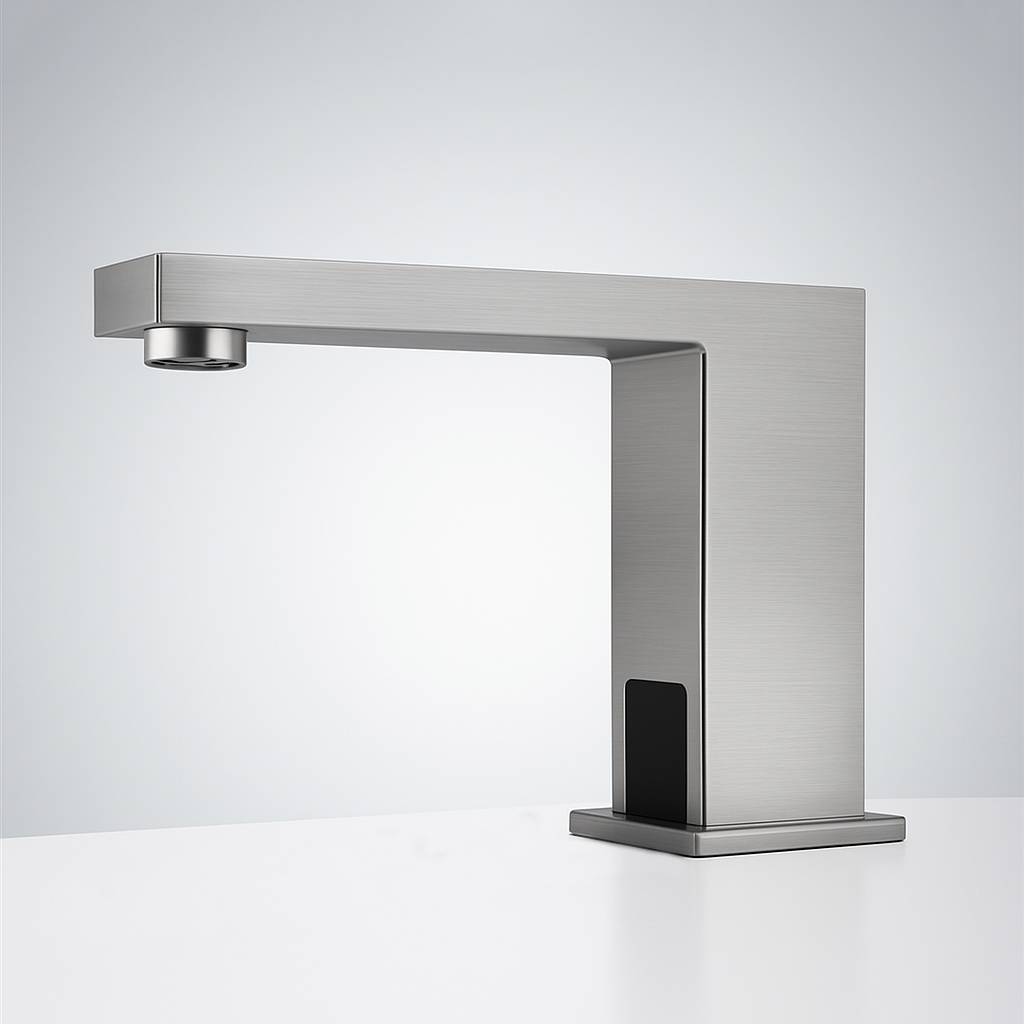
FontanaClearFlow™ Brushed Nickel Edition defies common thought about the standard of the restroom. It is a single-hole deck fixture with all the latest modern technologies and designs. The style arises from the synonymous geometry of a whole host of spheres, straight lines, and cardinals. Operation through motion activation gave instant water flow free of contact, which improves hygiene and prevents unnecessary wastage.
As it mixes both hot and cold, it performs different functions suitable for different areas such as offices, hotels, malls, or healthcare facilities. The induction-control system makes operating the tap smooth and effortless, while both AC and DC power supply modes offer flexible installation options. Popular treatment on the surface ensures that it is fingerprint-resistant and able to keep its appearance even after rough usage. Featuring some degree of technical innovation in practical usage, this tap comes as an excellent choice that strikes a balance between design and performance for commercial interiors. In essence, it is a clean-tech way of styling that beckons a solution to busy intersections looking for a bit of ease. Engineered for large-scale deployments where uniform behavior across hundreds of fixtures is required.
FontanaClearFlow™ Brushed Nickel Edition
Infrared Detection Logic, Hydraulic Flow Regulation & Electronic Valve Cycle Engineering
Engineered for touch-free basin operation, this brushed nickel faucet integrates infrared sensing with automatic water control for efficient, repeatable washroom performance.
How does sensor-field geometry influence activation reliability at the basin?
The infrared transmitter and receiver establish an optical detection envelope beneath the spout. Faucet setback, bowl depth, countertop reflectivity, and hand approach angle influence returned infrared energy, so final commissioning should verify reliable user detection without allowing the basin surface to sustain an unintended activation signal.
How does inlet-pressure variation affect automatic faucet discharge stability?
Changes in dynamic supply pressure alter the hydraulic energy available across the internal valve and outlet. During peak building demand, excessive upstream pressure loss can weaken discharge, while unusually high pressure can increase velocity and splash potential. Pressure should therefore be evaluated with representative fixtures operating simultaneously.
Why is repeatable solenoid seating critical in high-cycle touchless operation?
Every sensor cycle requires the solenoid to open and then reseat accurately against its sealing interface. Sediment or scale at this interface can prevent complete closure, so clean upstream waterways and periodic filter inspection are important for maintaining positive shutoff through repeated operating cycles.
What diagnostic checks should be performed if sensor response becomes intermittent?
Technicians should inspect the sensor window for contamination, verify the electrical power source, confirm unobstructed supply flow, and test repeated hand-entry cycles. If detection remains inconsistent, basin reflections and sensor alignment should be evaluated before servicing the electronic controller or solenoid assembly.


 Confidence Strengthened


 Reduced Maintenance Interruptions