WELL Commercial Restroom Solutions FontanaShowers
Commercial restrooms have become measurable components of occupant health, accessibility, water performance, facility resilience and overall building quality. For architects, plumbing engineers, sustainability consultants, specification writers, contractors and facility managers, lavatory fixtures can no longer be specified based on looks or first cost alone. These need to be coordinated as integrated systems that support hygiene, efficient water delivery, inclusive use, maintainability and long-term operational performance.
FontanaShowers WELL Commercial Restroom Solutions blends these priorities with commercial touchless faucets, automatic soap dispensers, flush systems, coordinated accessories and architectural bathroom fixtures created for offices, healthcare facilities, hotels, airports, universities, retail developments, public buildings and mixed-use properties.
Read MoreShow Less
The approach is wellness-aligned, not based on a single product claim. WELL certification applies to projects and operational strategies—not automatically to an individual tap or dispenser. International WELL Building Institute’s WELL v2 is based on ten concepts, including Water, Materials, Movement, Mind and Community. Restroom design can support several of these concepts through accessible layouts, the right material choices, dependable handwashing infrastructure, responsible water management and positive occupant experiences.


Restrooms as a Part of a WELL-Aligned Building Strategy
WELL Water concept highlights water quality, accessibility, treatment, testing and responsible management in buildings. Although the concept primarily focuses on drinking-water quality, its broader goal advocates for well-managed plumbing systems and dependable water access.
A WELL-aligned commercial loo should then be considered in its entirety as a user journey:
Read MoreShow Less
- Entry and transit should accommodate varied mobility requirements.
- Lavatories must have accessible knee and toe clearance.
- Faucets and soap dispensers must be operated in a predictable way.
- Water shall be discharged to the effective capture area of the basin.
- Soap and water activation areas must not interfere with each other.
- Surfaces must be durable and easy to clean.
- Maintenance personnel should have adequate access to batteries, transformers, valves, reservoirs and control modules.
- Fixture flow rates should conform to applicable plumbing codes and project water budgets.
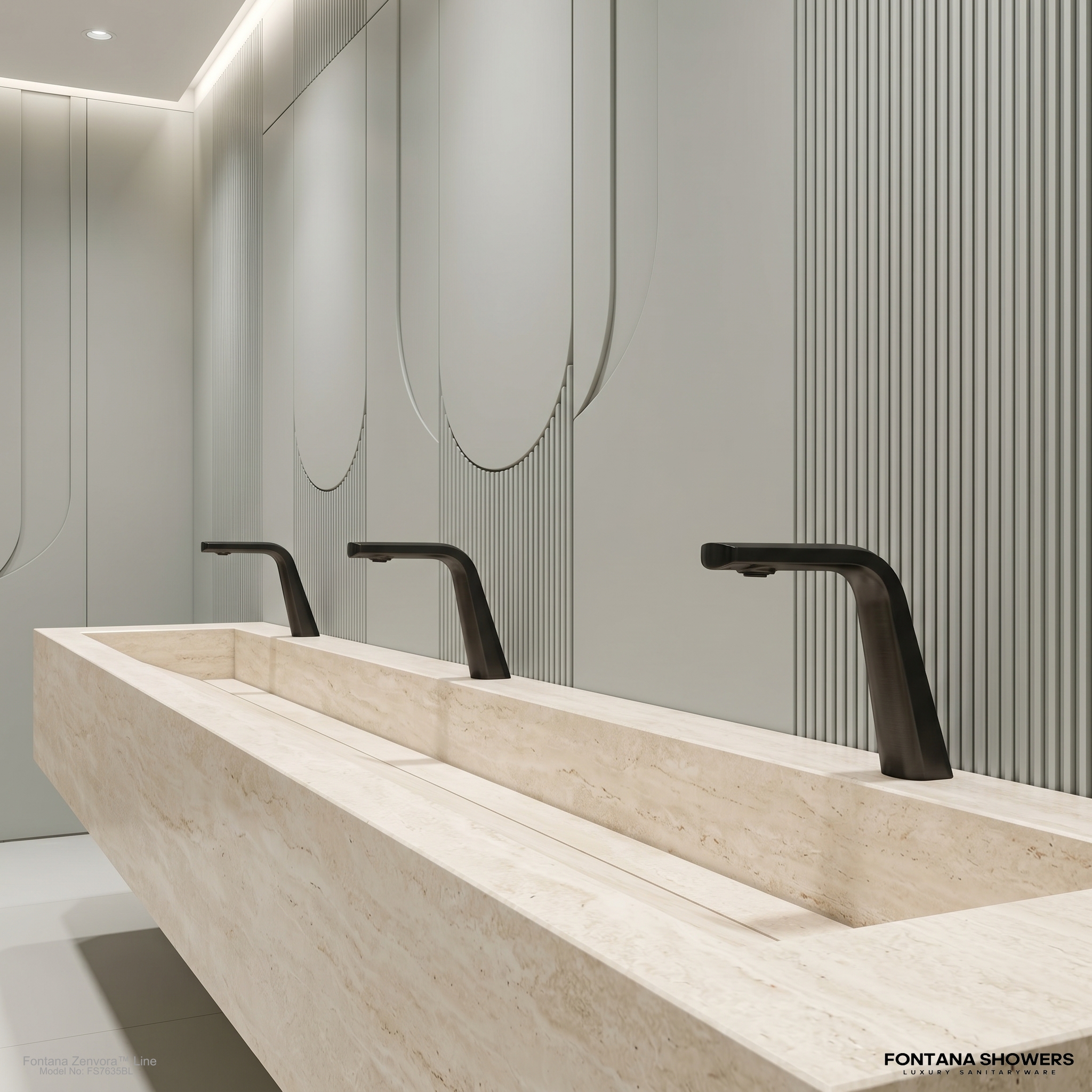
FontanaShowers offers commercial touchless sensor faucets for high traffic restrooms and are available in configurations that fit well with architectural and MEP coordination. Available in deck-mounted and wall-mounted arrangements, multiple finish options, battery and hardwired power configurations, and coordinated faucet-and-dispenser systems. Always check the model-specific documentation before using the fixture in the construction documents.


Touchless Handwashing & User Experience
With touchless operation, you never have to grasp or turn conventional tap handles as part of a typical handwashing sequence. This may facilitate operation in high occupancy environments and decrease unnecessary contact with shared controls, as well as provide a consistent shutoff sequence.
The best system is not necessarily the one with the largest sensor range. False activation can be caused by excess range from reflective surfaces, nearby movement, basin geometry or adjacent dispensers. On the other hand, a narrow activation zone may frustrate users and result in more maintenance complaints.
Read MoreShow Less
Commercial Automatic Sensor Faucets: AEC teams should coordinate when specifying.
- Sensor detection range and field of view tuning
- Basin depth, drain location and backsplash reflectivity.
- Spout reach vs catching area of bowl.
- Maximum run time and automatic shutoff operation.
- Tempered or mixing valve water requirements.
- AC, battery or hybrid power.
- Access to isolation stops and solenoid valves, strainers and control boxes.
- Compatibility of aerators with flow controls and the pressure range selected
Integrated touchless tap and soap-dispenser systems can provide consistent spacing, finish, sensor behaviour and maintenance procedures across the lavatory counter in multi-user washrooms.


Access and coordination of restrooms
Touchless activation may make for easier operation, but it does not make a loo ADA compliant. Accessibility depends on the entire installation including clear floor area, approach, reach, mounting height, knee clearance, toe clearance, counter height, pipe protection, mirror location and placement of accessories.
Read MoreShow Less
According to the U.S. Access Board, accessible lavatories generally require a forward approach and knee and toe clearance beneath the fixture. Clearances required shall be adequate at the controls of faucets, soap dispensers, and other usable elements. Objects such as waste receptacles, cabinetry, piping or poorly located accessories shall not interfere with the required clear floor space.
The 2010 ADA Standards set the minimum requirements for new construction and alterations to commercial facilities and public accommodations to ensure their accessibility. Project teams must also review the adopted building code, plumbing code, ICC A117.1 edition, owner standards and local amendments that apply to the jurisdiction.
A coordinated lavatory detail should show the tap, soap outlet, basin edge, counter thickness, support framing, piping enclosure, sensor components, electrical connection and accessible clearances in a single drawing rather than showing each piece on its own.
Water Efficiency and Flow Control Strategy
Water performance is not only about the flow rate but about the flow rate, activation time, usage frequency, leakage risk and commissioning.
Read MoreShow Less
EPA WaterSense labelled products are certified by an independent third party to meet all of the applicable performance requirements, and they use at least 20 percent less water than standard products. However, public lavatory faucets are not recognised as an eligible product category for WaterSense at this time by the EPA. Therefore, specifications should not make a generic WaterSense claim for all commercial sensor faucets without checking the specific product category and current certification record.
For public lavatories, the teams should find the code-required flow limit and require third-party proof for the selected model instead. Flow controls shall be tamper resistant and serviceable without requiring complete tap assembly to be replaced.


Comparison for Water-Demand Illustration
The following design exercise shows the impact of flow rate of the tap on the estimated consumption. It is an engineering example, not a prediction of actual savings.
| Design input Conventional fixtureCommercial fixture, efficient |
|---|
| Number of handwashing events per day 600 600 |
| Assumed water-on time 15 sec 15 seconds |
| Example flow rate – 2.2 gpm – 0.5 gpm |
| Average daily use at faucet 330 gallons 75 gallons |
| Annual demand estimate 120,450 gallons 27,375 gallons |
Read MoreShow Less
Under these same operating assumptions, the lower-flow fixture uses approximately 77 percent less tap water. Actual performance will vary depending on user behaviour, sensor timing, pressure, maintenance condition, aerator selection and occupancy. This type of calculation should be included in the project water model, not as a guaranteed product savings.
Materials Submittal Review Certifications
Commercial plumbing specifications should specify performance, not appearance or marketing terminology. ASME A112.18.1/CSA B125.1 covers plumbing supply fittings and accessories from the supply stop to the terminal fitting. Faucets subject to the provisions herein shall be evaluated to the edition adopted by the authority having jurisdiction.
Products in contact with potable water shall also be evaluated for appropriate health effects and low-lead requirements. NSF states that faucets and plumbing products that will contact drinking-water should be tested and certified to NSF/ANSI/CAN 61. Project teams typically will coordinate NSF/ANSI/CAN 372 requirements for lead content, as applicable.
The complete submittal package shall include:
Read MoreShow Less
- Product information and model identification.
- Record of flow rates.
- Third party certification lists, where applicable.
- Information on material and finish.
- rough-in sizes.
- Electrical properties
- Sensor calibration instructions.
- Installation diagrams
- Schedules of spare parts.
- Limitations of cleaning.
- Warranty details.
- Operations and maintenance manuals.
The specification should require verification of equivalency claims instead of assuming all finishes, power options or model variations have the same certification.
Project Reference: Commercial
FontanaShowers maintains a commercial lavatory project portfolio for AEC precedent research in hospitality, office, healthcare, public infrastructure and mixed-use applications. The company has over 126 referenced commercial projects in these sectors.
Read MoreShow Less
One published airport reference lists 247 commercial sensor faucets installed in Dubai International Airport Terminal 3. “The installation included adjustable infrared sensing, reinforced mounting, vandal-resistant components and centralised commercial maintenance planning,” FontanaShowers says. The reported water-reduction figures are based on case studies from manufacturers and should be considered project references and not independently verified universal results.
The bigger lesson for AEC teams is that high-traffic projects need repeatable fixture schedules, spare parts planning, accessible isolation points, documented commissioning procedures and standardised sensor settings. The choice of products cannot make up for the absence of coordination or planning for inadequate maintenance.


.jpg)
FontanaShowers WELL Commercial Bathroom Solutions Spec
A successful specification for wellness-oriented restrooms balances fixture performance with the intended occupancy of the building, the cleaning program, accessibility obligations, plumbing infrastructure, sustainability targets, and design language.
FontanaShowers offers commercial bathroom fixtures and touchless restroom products along with commercial restroom accessories for coordinated AEC schedules. Architects and engineers should use these resources as starting points and review the technical documentation for each scheduled model.
The best commercial lavatory solution isn't just touchless, decorative or low-flow. It is coordinated, testable, accessible, maintainable, code aware, and suitable for the actual operating conditions of the facility. By addressing these priorities together, FontanaShowers WELL Commercial Restroom Solutions can help provide healthier user experiences, stronger water-management strategies, cleaner architectural integration and more resilient building operations.