FontanaShowers WELL Healthcare Bathroom Fixtures | Infection Control Solutions
Healthcare bathroom design is where architecture, plumbing engineering, environmental services, accessibility, water management and infection prevention meet. A tap may be a small element in a hospital or ambulatory-care project but its sensing method, outlet position, flow characteristics, serviceability, basin relationship and surrounding surfaces can impact how well the entire handwashing station performs.
So, for AEC teams looking for WELL-aligned healthcare bathroom fixtures, the goal should be more than just choosing a touchless tap. The handwashing station has to be a system that works together.”
Read MoreShow Less
FontanaShowers Commercial Touchless Sensor Faucets for Healthcare and Institutional Projects Supporting BIM, Specification, Installation and Maintenance Resources. Each product should be reviewed in light of the specific infection-control requirements of the project, plumbing codes, facility water-management programs, and applicable healthcare design criteria.
Importantly, bathroom fixtures themselves should not be described as 'WELL certified'. WELL certification applies to qualifying projects and organisations. However, well-selected fixtures can help project strategies related to sanitary handwashing, access, water quality, maintenance, and health of the occupants.


Healthcare Handwashing is a Systems Design Problem
Touchless activation eliminates the need for users to physically touch traditional tap handles before or after washing. The reduction in touch points can help a facility’s hand-hygiene strategy, but automatic activation alone does not make an infection-control solution.
CDC healthcare water guidance indicates that sinks and drains can serve as reservoirs for opportunistic premise-plumbing pathogens, and contaminated drain biofilms can pose a risk if splashing distributes droplets to nearby surfaces, equipment, patients, or staff.
Read MoreShow Less
CDC guidance, therefore, supports consideration of basin depth, faucet orientation, drain location, water pressure, and splash control when sinks are installed or modified.
This makes faucet-to-basin coordination a health-care engineering problem, not merely an interior-design decision.
Check the elevation of the discharge stream and design so that the water does not hit the drain directly. Appropriately sized flow characteristics and adequate basin depth can reduce excessive splash under maximum operating conditions.
WELL ALIGNED HANDWASHING DESIGN
The WELL framework is dedicated to offering accessible and sanitary handwashing facilities to promote hygiene and reduce pathogen transmission pathways. WELL guidance also includes access to appropriate handwashing facilities, supplies, and other hygiene factors.
This implies several practical coordination priorities for architects and plumbing engineers:
Read MoreShow Less
- Fixtures that can be operated hygienically, handsfree or otherwise.
- Usable handwashing clearance and correct basin sizes.
- Consistent soap delivery.
- Simple fixture placement.
- Surfaces around easy to clean.
- Water delivery is controlled.
- Non-disruptive demolition for maintenance access.
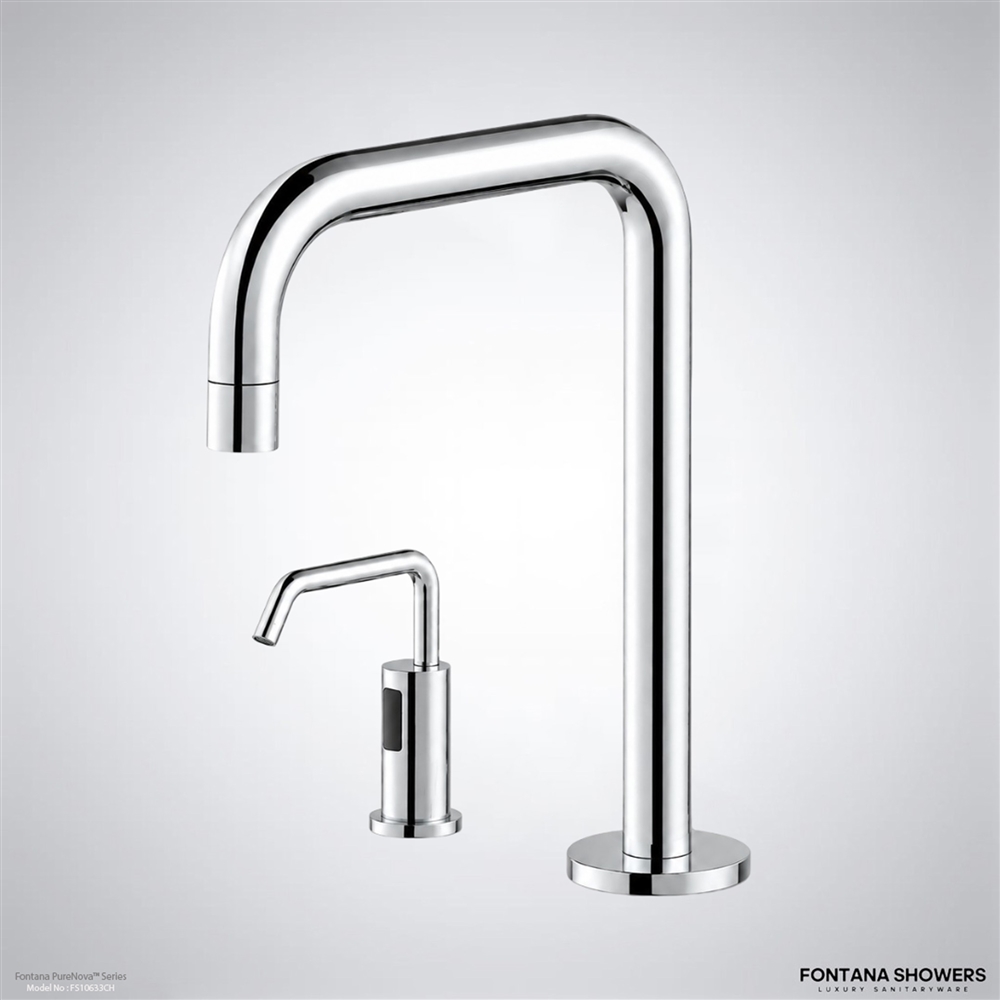
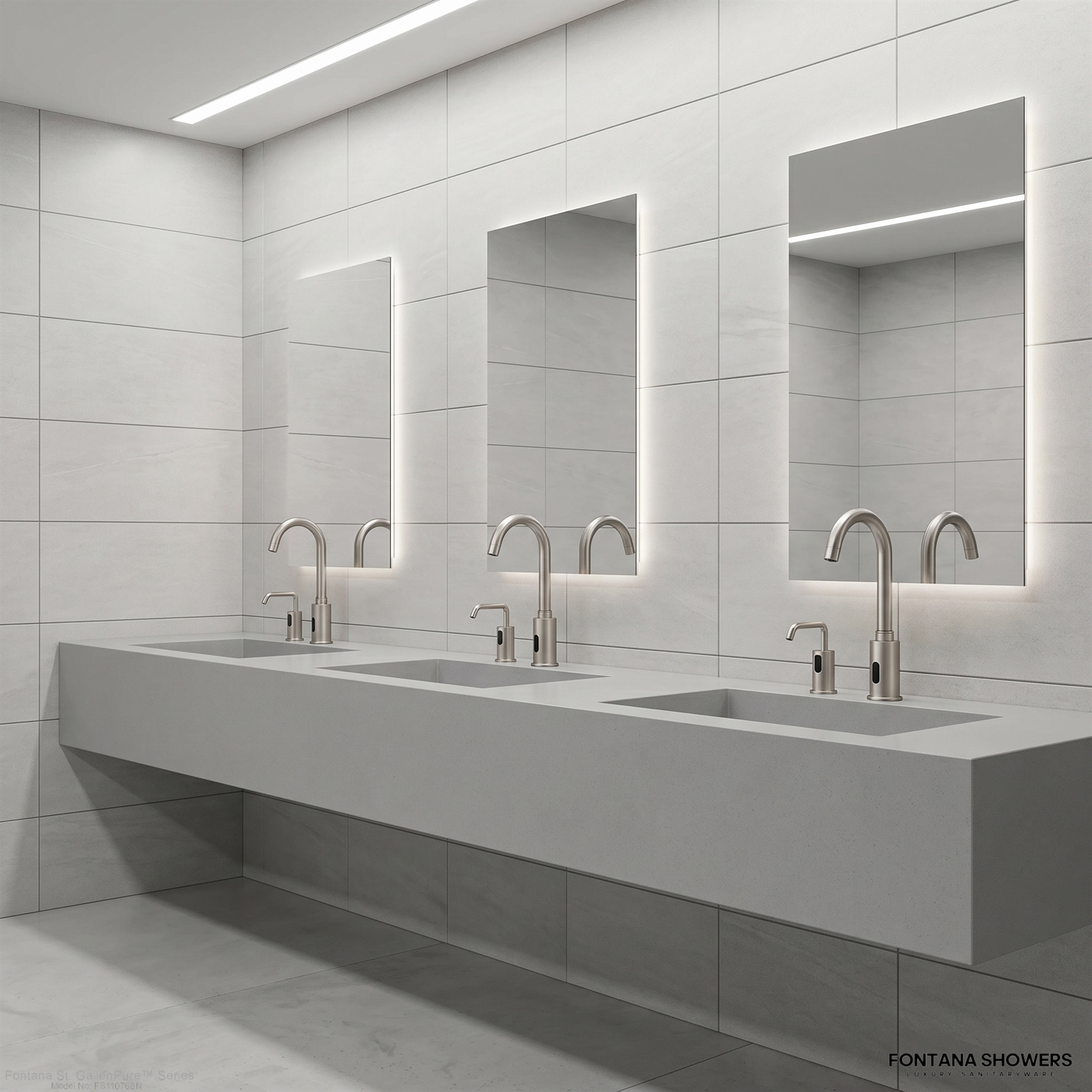
Instead of choosing each component separately, a coordinated package may include architectural touchless bathroom faucets with automatic soap dispensing and lavatories of a suitable size.


Splash Control: One of the Most Important Health Care Details
In a typical commercial restroom, selection of faucets may be largely based on appearance, flow, accessibility and durability over their life. Healthcare projects need an additional level of assessment, the association between water discharge and waste outlet.
Healthcare guidance recommends that newly installed or modified sinks should be of sufficient depth, and that the faucet be located so that the jet of water does not cross the drain. You should also check the water pressure to avoid accidental splashing.
Read MoreShow Less
Thus, for the AEC team, the submittal should confirm the full relationship:
Spout reach → discharge location → basin shape → drain location → operating pressure .
A fixture that looks appropriate based on appearance or mounting style alone may be poor from an infection-control planning standpoint if its discharge stream strikes the drain directly or causes excessive splash.
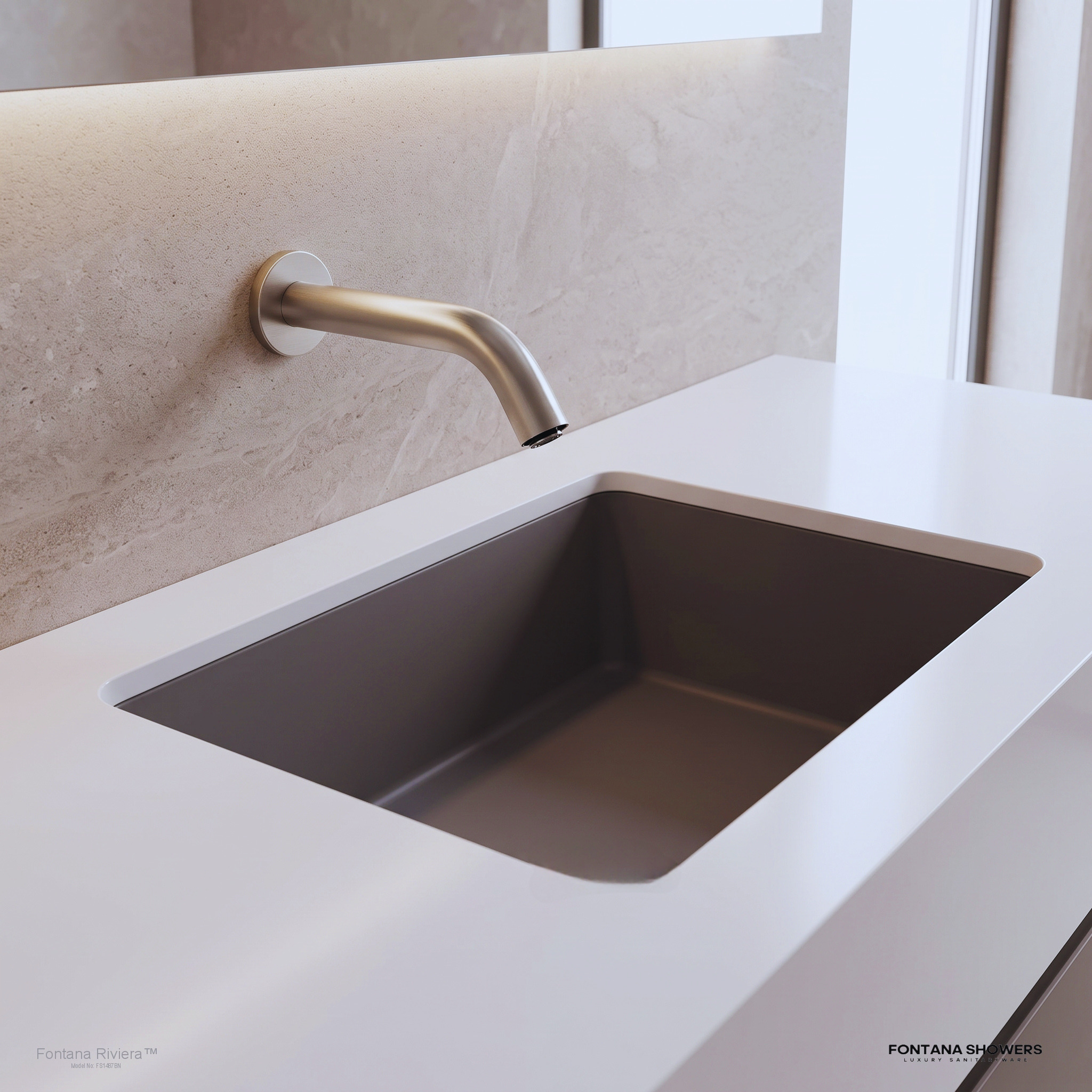
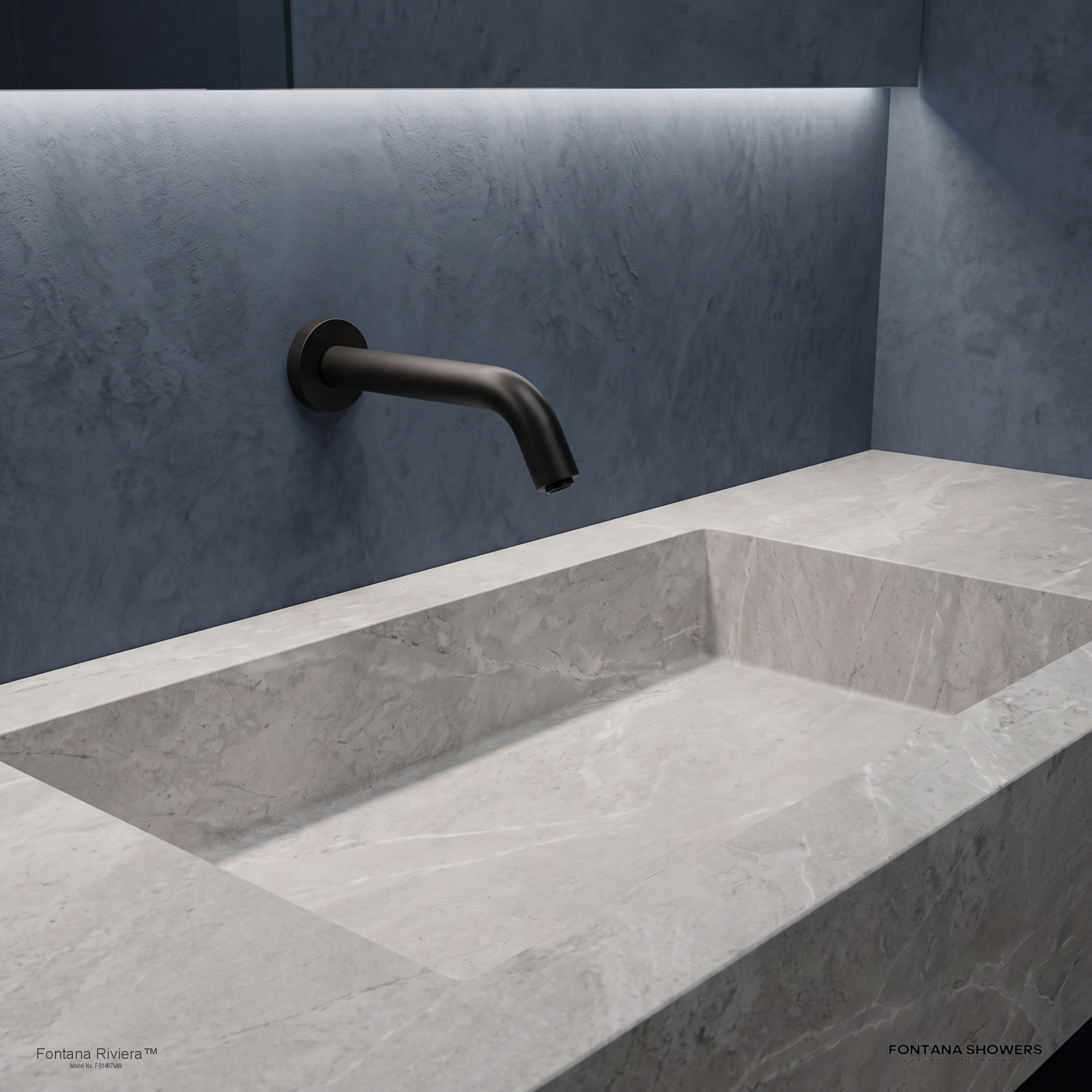
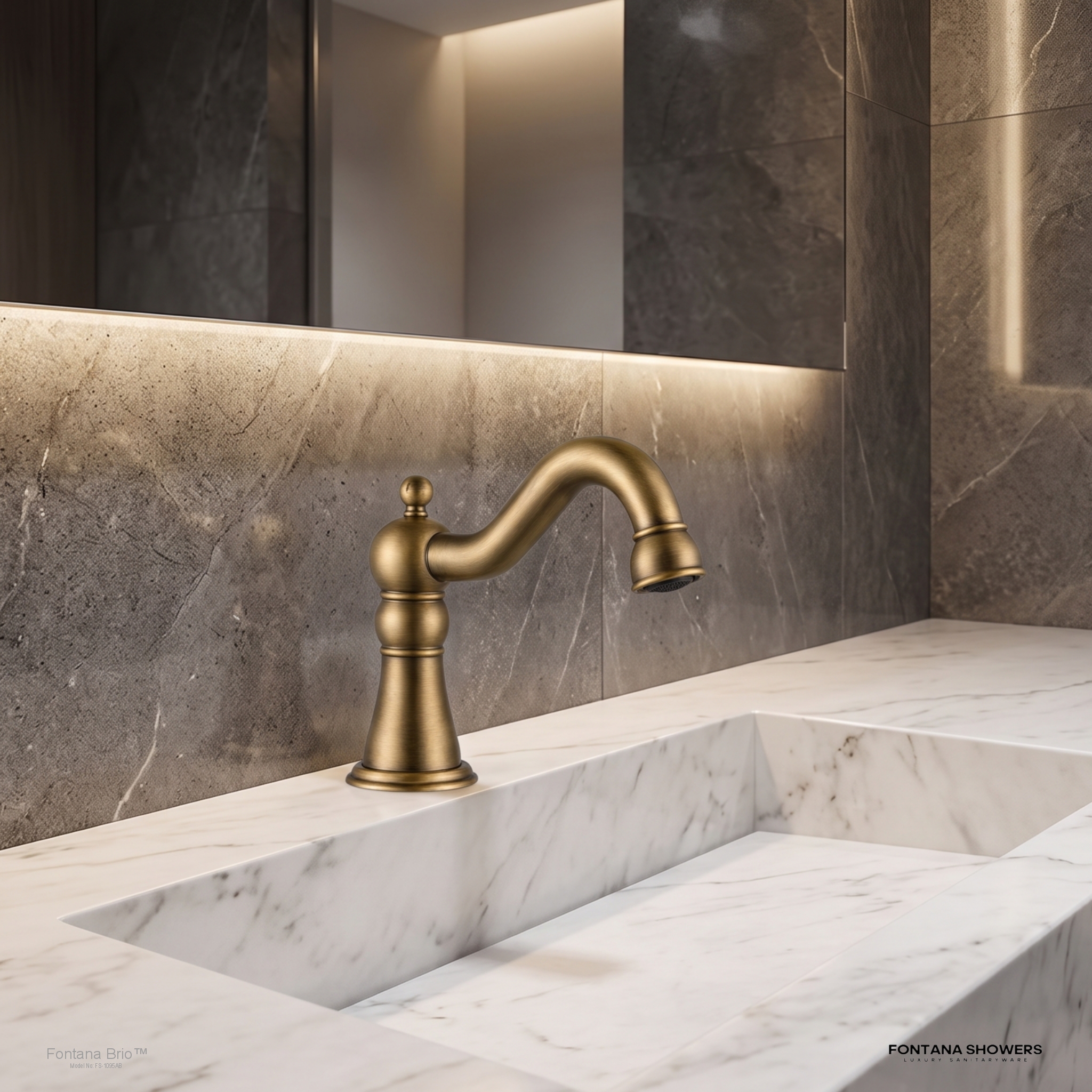
Wall-mounted applications can be especially helpful when the design team wants to minimise deck penetrations and make counter cleaning easier. Deck-mounted fixtures remain a good choice when existing infrastructure or standard lavatory assemblies make traditional rough-ins more convenient.
.jpg)

Flow rate is a healthcare judgement call.
Commercial lavatory faucets are often specified at low flow rates to support water efficiency goals. But low-flow criteria should not be employed in health care settings without looking at the clinical and operational function of each handwashing site.
Design requirements could vary for public toilets, staff areas, patient rooms, examination spaces, clinical handwashing stations, and utility areas.
Read MoreShow Less
For this reason, the plumbing engineer should differentiate between fixture applications rather than assign a uniform flow requirement to an entire healthcare campus.
Flow rate should also be coordinated with supply pressure and basin shape. However, reducing nominal flow does not necessarily eliminate splash if outlet geometry, stream characteristics or drain alignment are poorly coordinated.
Engineers may also evaluate the outlet configuration, including laminar-flow devices, depending on the project requirements, if the infection-control standards of the healthcare facility require it.
AEC Healthcare Handwashing Coordination Matrix
Read MoreShow Less
| Design Variable : Faucet Activation | Infection-Control Relevance: Reduces routine touch of tap controls | AEC Coordination Priority: High |
| Design Variable: Spout-to-drain alignment | Infection-Control Relevance: Helpful in limiting impact splash from drain | AEC Coordination Critical Priority: |
| Design Variable: Depth of Basin | Splash containment relevance to infection control | AEC Coordination Priority: High |
| Design Variable: flow, pressure | Infection-Control Relevance: High velocity may increase splashing | Priority: High - AEC Coordination |
| Design Variable: Outlet Arrangement | Infection-Control Relevance: Can affect stream characteristics and project-specific healthcare requirements | AEC Coordination Priority: High |
| Design Variable: Soap dispenser. | Infection-Control Relevance: Enables the complete handwashing workflow | Priority: High AEC Coordination |
| Design Variable: Power architecture | Infection-Control Relevance : Affects the continuity of the touchless operation | Priority for AEC Coordination: Medium-High |
| Design Variable: Access to service | Infection Control Relevance: Helps with inspection and replacement of parts | Priority for AEC Coordination: High |
| Design Parameter Water temperature | Infection-Control Relevance: Needs coordination of system and scald protection | AEC Coordination Priority: High |
| Design Variable: Environment and Drain | Infection-Control Relevance : Demands environmental-services and splash-control planning | AEC Coordination Priority: High |
This coordination matrix is most useful during schematic design, design development, specification writing, and submittal review—not after the plumbing rough-in has already been done.
Water Management and the Risk of Legionella
The healthcare plumbing specifications need to be coordinated with the facility’s building water-management program.
ANSI/ASHRAE Standard 188 sets forth requirements for managing the risk of legionellosis associated with building water systems and covers design, construction, commissioning, operation, maintenance, repair, and replacement.
Read MoreShow Less
Selection of fixtures cannot be a standalone control of Legionella risk.
Engineers should consider the entire domestic-water system: temperature management, potential for stagnation, branch configuration, water age, commissioning procedures, flushing protocols and ongoing maintenance.
Thus, documented operating requirements, clear maintenance instructions, serviceable valves, and accessible strainers are all useful components of the healthcare fixture specification.
For sensor faucets, consider access to the solenoid valve, controller, power source, filter or strainer, supply connections and sensing components before finalising walls, millwork or access panels.


Example Healthcare Case: Retrofit of Handwashing in Outpatient
For example, an outpatient facility may be replacing manual faucets during a washroom renovation.
The first idea is to replace the current basins with automatic taps. However, during plumbing coordination, the design team learns that the proposed spout projects directly over the waste fitting.
Read MoreShow Less
The project team considers the entire handwashing assembly rather than as a like-for-like replacement of the fixture.
The redesign moves the tap discharge away from the drain.
Spout reach and basin depth are verified.
Splash control. Operating pressure review.
The outlet configuration is checked for the facility requirements.
Accessibility sensor activation confirmed.
The electrical components and solenoid are still available for service.
Cleaning requirements are coordinated with the facility operations and environmental services personnel.
The design improvement should not be promoted as a quantified reduction in healthcare associated infections without project specific clinical evidence.
Instead it is a more defensible, infection-control-oriented configuration of plumbing based on accepted principles of splash control, serviceability, hygienic operation and healthcare water management.



Specification, BIM and Submittal Coordination
Detailed fixture documentation early in design development benefits healthcare projects.
AEC teams must align touchless tap BIM and Revit resources with architectural plans, plumbing drawings, lavatory schedules, accessibility clearances, power requirements, and millwork details.
Read MoreShow Less
BIM coordination can identify conflicts with spout projection, basin location, supply routing, control boxes, electrical connections, access panels and surrounding casework prior to installation.
Also, the specification documents need to contain the precise performance requirements for each selected fixture, not just generic product descriptions.
The AEC team may be required to check requirements related to: Depending on the project jurisdiction and product configuration,
- ASME A112.18.1/CSA B125.
- NSF/ANSI/CAN 61.
- NSF/ANSI/CAN 372.
- ADA 2010 Standards for Accessible Design
- ICC A117.1 Accessibility Requirements
- Plumbing code, as applicable.
- Flow rate requirements.
- Needs for temperature control.
- Power supply requirements.
- Pressure restrictions.
- Operating range of the sensor.
- Growing demands.
- Solenoid and control box access.
- Cleaning of strainers or filters.
- Applicable health care facility standards.
Please confirm these requirements on a per SKU and per project basis – do not assume that all fixture configurations have the same listings or certifications.
Designing Healthcare Fixtures for Risk, Not Features
The strongest healthcare bathroom specification doesn’t start with a finish, a tap shape or a sensor feature.
The first is the clinical and operational context.
Design and Construction Considerations. The total tap, basin, drainage, pressure, temperature, power, accessibility, cleaning protocol, service access and building water-management strategy should be evaluated as an integrated assembly by architects, MEP engineers, infection-prevention teams, contractors, environmental-services personnel and facility managers.
Specification-grade, touchless bathroom fixtures, when properly integrated into the overall architecture and plumbing design, can support sanitary handwashing and lower-contact operation for WELL-aligned healthcare environments.
It's not simply about creating a "touchless bathroom."
It is to design a healthcare handwashing environment around controlled water delivery, reduced touch points, splash management, accessibility, maintainability, appropriate water-management practices and long-term plumbing-system performance.
The most defensible approach for AEC teams specifying FontanaShowers healthcare bathroom fixtures is performance-based: verify each product against the basin, plumbing system, accessibility requirements, healthcare protocols, applicable standards and facility maintenance strategy before the final specification.
Related Healthcare, Infection Control & AEC Resources
Selected healthcare, infection-control, plumbing, accessibility, BIM, facility-operations and FontanaShowers references relevant to healthcare handwashing-system coordination, touchless fixture specification, water management, maintenance and project documentation.
Reference links are provided for healthcare design research, specification coordination and facility planning. Inclusion does not imply that any individual FontanaShowers fixture is WELL Certified, clinically validated for infection reduction, code approved or certified to a particular standard unless the exact scheduled model is supported by applicable documentation.