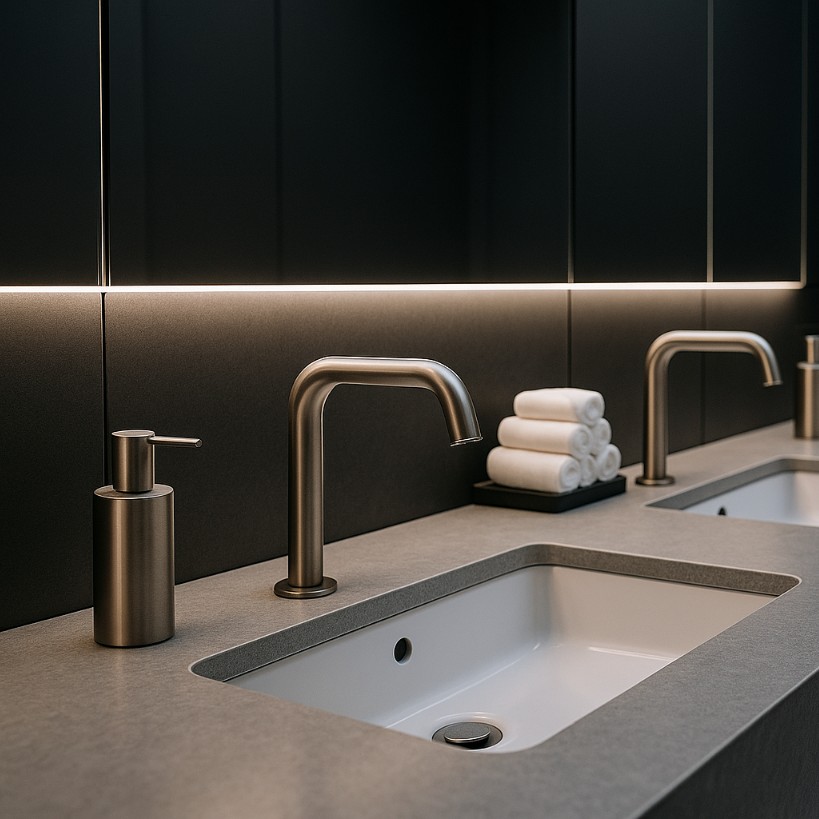
Sink Fixtures for Commercial Restrooms — System Performance • Accessibility • Long Term Serviceability
FontanaShowers® | Commercial Sink Fixture Guide
Sink Fixtures in High Use Restrooms: What AEC Teams Should Specify
In commercial and institutional restrooms, the
sink fixture is a system, not a single part. It typically includes the basin,
the faucet or valve set, the drain and trap, mounting and backing, and sometimes integrated soap dispensing and sensor controls.
For architects and engineers, performance depends on how these elements interact with water supply conditions, accessibility obligations,
and long term maintenance realities. This guide focuses on lavatories and handwashing stations in high use environments like schools,
hospitals, airports, offices, and public assembly.
Hydraulic Performance
Hygiene and Exposure Control
ADA Operability
Serviceability Planning
Specifier note: treat the sink fixture as an assembly. Basin geometry, faucet pattern, flow limits, and service access should be coordinated as one scope.
Design & Technical Visuals
System Definition and Scope
Functional Hydraulic Performance
The fixture must provide stable flow and temperature control across variable inlet pressures and temperatures.
In real buildings, upstream pressure fluctuates due to simultaneous use, booster pumps, and pressure reducing valves.
Specify an allowable operating pressure range and verify that performance does not depend on a narrow pressure window.
Hygiene and Exposure Control
Touch free activation reduces contact points. When sensors are used, define activation distance, shutoff delay,
and fail safe behavior during power loss. Also consider water age and stagnation. Facilities with low use periods may
benefit from flushing strategies aligned with building water risk programs and
ASHRAE 188
guidance.
Durability Under High Traffic
High cycle environments stress cartridges, seals, solenoids, and sensor windows. Durability also includes resistance
to corrosion, scaling, and cleaning chemistry. Require finish and alloy compatibility with disinfectants used on site,
including diluted bleach and quaternary cleaners.
Codes and Standards Alignment
Performance is not only mechanical. It is code acceptance. Coordinate faucet and lavatory selection with accessibility,
water efficiency, and plumbing fitting standards used for testing and approval.
Materials and Potable Water Compliance
Sink fixtures sit at the intersection of potable water and aggressive cleaning. Material selection should account for
corrosion and dezincification risk and for health effects and lead content documentation where required.
For touch free lavatory options, reference
FontanaTouchlessFaucets
for sensor faucet families.
Installation and Lifecycle Service
A sink fixture that is difficult to service will fail operationally. Plan mounting, backing, and access so wear parts can
be replaced without removing basins or opening finished walls. Include submittals and parts availability in the spec.
Materials, Water Quality, and Lead Free Compliance
Corrosion and Dezincification Resistance
- Local water profile matters: chloraminated or aggressive water can accelerate corrosion on certain brass alloys.
- Alloy and coating selection: require materials suitable for the local water chemistry and cleaning program.
- Institutional options: stainless steel may be appropriate where it matches the owner’s maintenance practice.
Health Effects and Lead Content Standards
- For water contact components, many projects reference NSF/ANSI 61 context for health effects.
- For lead content documentation workflows, many teams reference certification to NSF/ANSI/CAN 372 where required.
- Include certification statements and listings as part of the submittal package when specified by the project.
Applications in High Use Environments
Schools and Campuses
High frequency use increases wear on cartridges and aerators. Choose assemblies with accessible service parts and durable finishes.
Hospitals and Clinics
Low porosity surfaces, exposure control, and disinfectant compatibility matter. Define sensor behavior and cleaning resilience.
Airports and Transit
Pressure variability and intense traffic are common. Specify stable performance across variable supply conditions and maintenance access.
Offices and Corporate Campuses
Consistency across multi building programs benefits from standardized parts and predictable service procedures.
Public Assembly
Peak loads require reliable activation and clear user feedback. Define sensor tolerances and shutoff timing to reduce nuisance behavior.
Mixed Use and Retail
Aesthetics must hold up. Coordinate basin geometry, spout reach, and spray pattern to reduce splash and preserve appearance.
Codes, Standards, and Performance Targets
|
Accessibility
|
Coordinate lavatory clearances and faucet operability with
DOJ 2010 ADA Standards
and any locally adopted
ICC A117.1
provisions
|
|
Operability Notes
|
For metering faucets, verify open time expectations for accessible use; for sensors, define activation depth and hand position tolerance
(see touch free options at
FontanaTouchlessFaucets)
|
|
Water Efficiency
|
Set performance criteria aligned with
EPA WaterSense
specifications, and confirm effective handwashing without excessive splash at low flow
|
|
CALGreen
|
For California projects, confirm the locally enforced edition and specify compliant maximum flow rates by occupancy and scope
(see
CALGreen overview)
|
|
ASME Acceptance
|
Reference
ASME A112.18.1
for plumbing supply fittings; coordinate ceramic lavatories and sinks with
ASME A112.19.2
where applicable
|
|
Potable Water Documentation
|
Include
NSF/ANSI 61
context and lead content documentation workflows (commonly
NSF/ANSI/CAN 372)
when required by the project
|
|
Basin and Spout Coordination
|
Confirm basin geometry, spout reach, and aeration pattern support handwashing and minimize splash under real supply pressure conditions
|
Specification Priorities
Pressure Range Defined
Sensor Behavior Defined
Parts and Access Planned
Documentation Complete
Integration and Coordination
- Coordinate power strategy for touch free faucets: batteries or low voltage transformers, plus service access for power modules.
- If analytics or alerts are requested, define what is monitored: activations, runtime, battery status, and fault codes.
- Align plumbing and electrical drawings early so rough in, backing, and access are not solved in the field.
What to Put in the Specification
Applicable Codes
Identify the adopted accessibility and plumbing requirements for the jurisdiction and apply them to the lavatory and faucet selection,
including clear floor space, knee and toe clearance, and operable parts criteria.
Efficiency Criteria
Tie low flow selections to verified performance targets. Confirm handwashing effectiveness, splash control, and temperature stability at the point of use.
Standards for Acceptance
Use relevant ASME fitting and fixture standards as the basis for performance testing, marking, and technical acceptance.
Materials and Water Contact
Require materials suitable for local water chemistry and cleaning. Include water contact documentation and lead content statements when required.
Submittals and Parts
Require cut sheets, compliance statements, installation instructions, parts lists, and recommended maintenance schedules.
Confirm service parts availability and clarity of exploded diagrams.
Service Planning
Write access and maintainability into the design. Define mounting type and ensure solenoids, mixing valves, and power modules can be reached without demolition.
Reference Product Families and Cut Sheet Hubs
Project Notes
A sink fixture is often treated as a minor line item, but it drives user experience, water and energy demand, and operational workload for decades.
Treat it as a system, write performance and standards requirements clearly, and plan service access from day one.
|
|
|


 alt="Commercial sink fixture context image showing coordinated faucet finish direction"/>
 alt="Sensor faucet and sink fixture finish direction for commercial lavatories"/>