
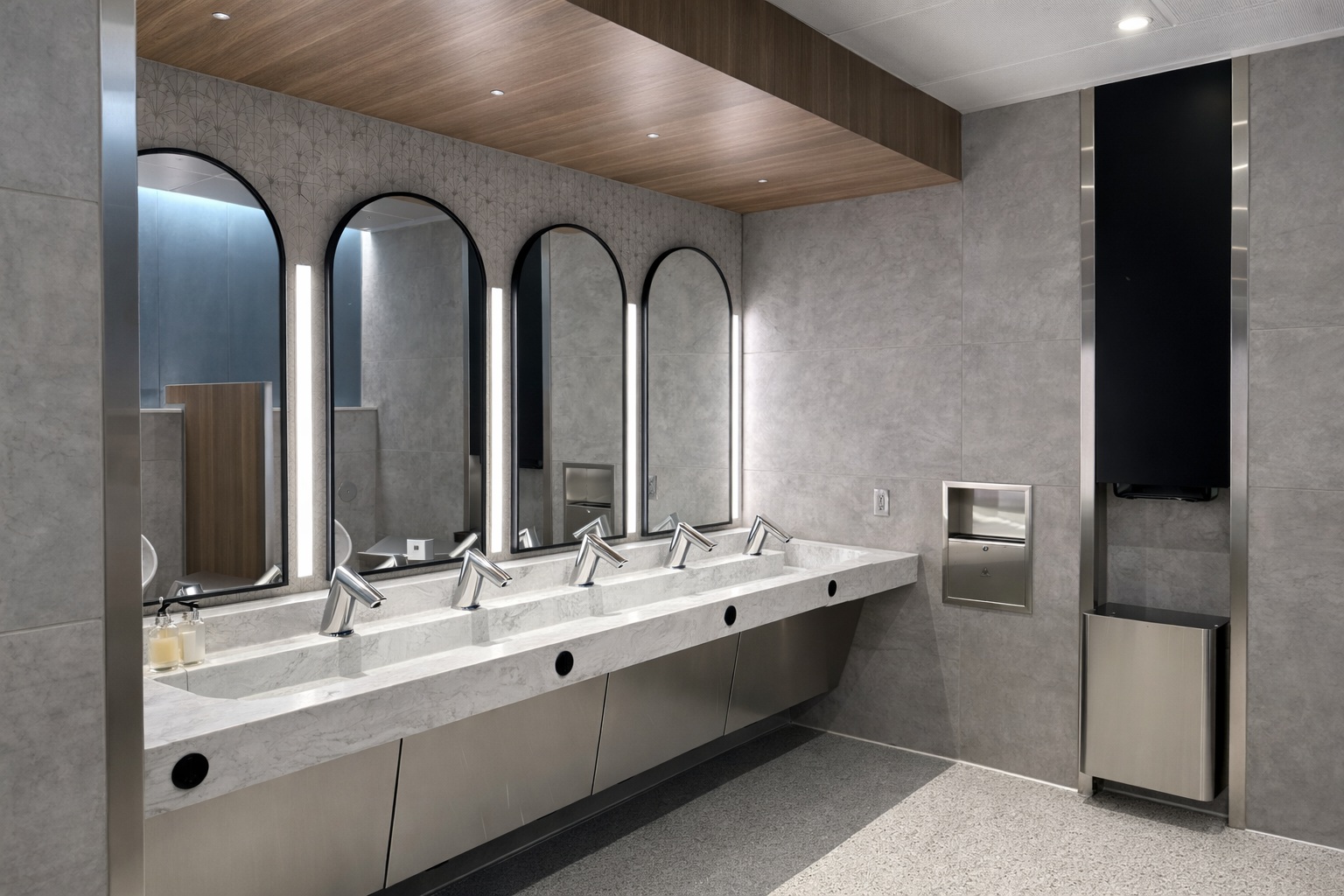
Soap Dispensers For Commercial Restrooms
Coordinate the dispenser, approved soap, pump and reservoir as one system. Verify repeatable delivery, accessible activation and a practical refill route.
Review Fontana’s commercial dispensers, CDC handwashing guidance and accessible restroom criteria before finalising the station.
Establish the Dispenser Design Brief
Record the approved soap, pump, reservoir, power supply and service clearances on one station schedule.
Coordinate the Complete Washstation
Separate soap and water activation zones. Test the installed hand sequence and preserve the accessible approach.
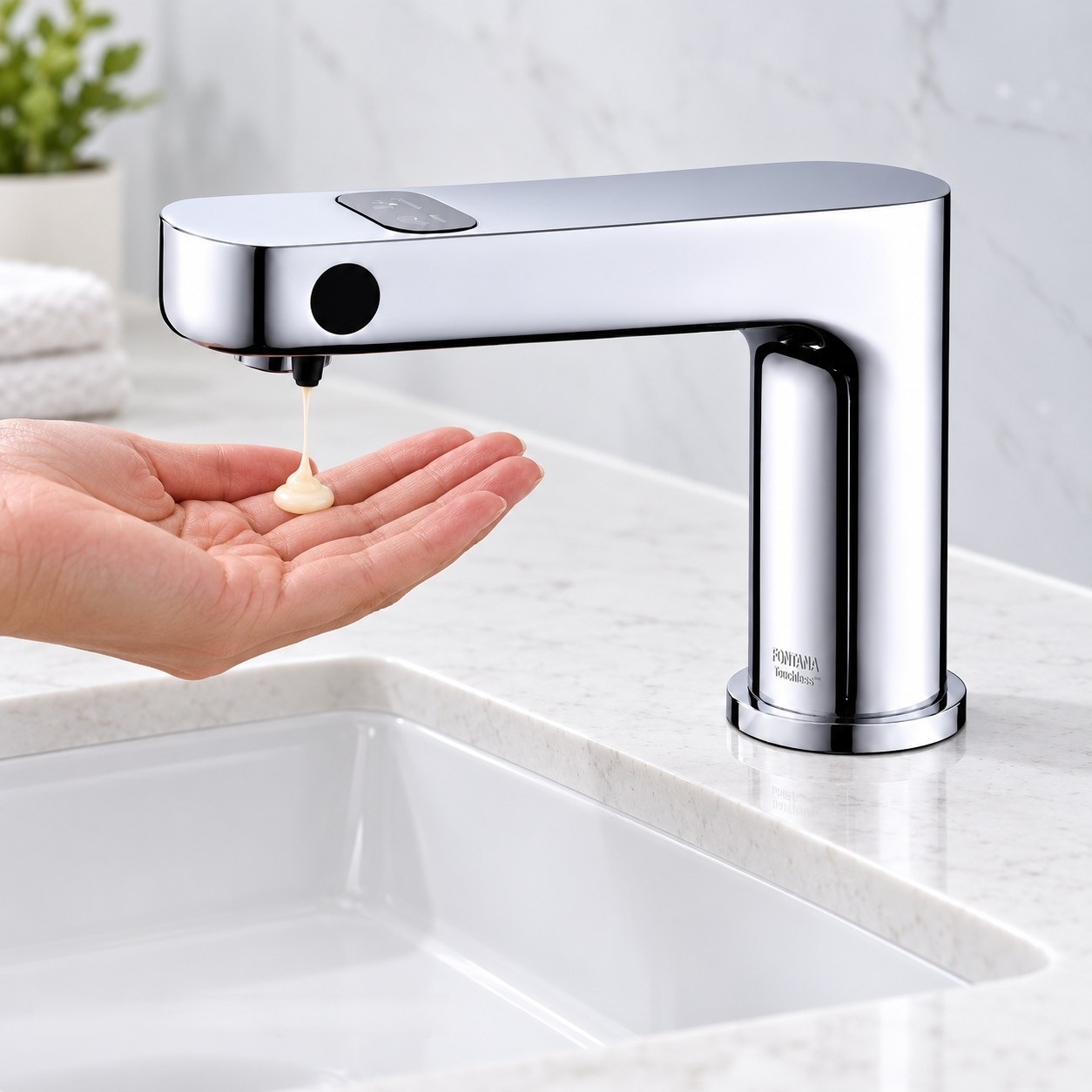
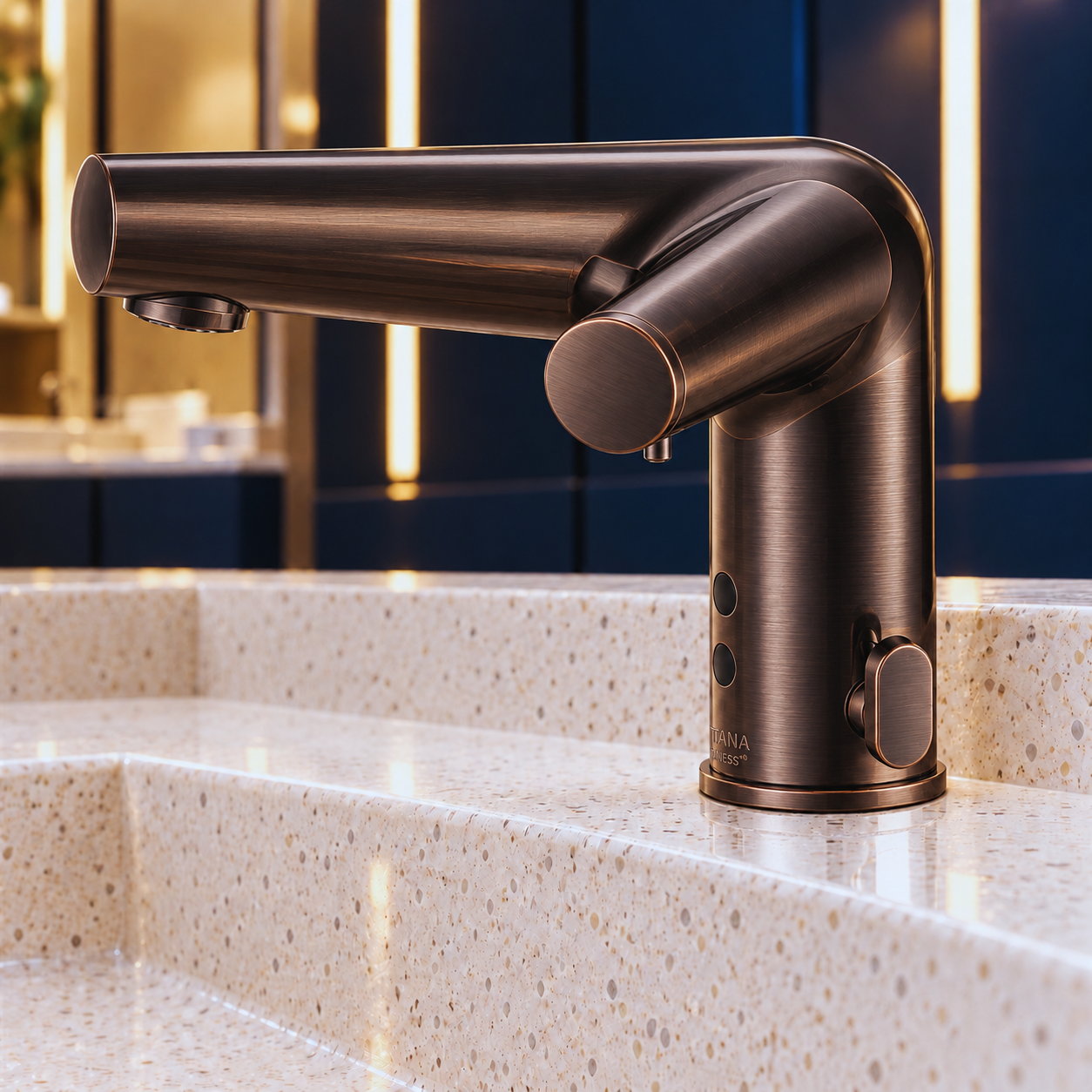
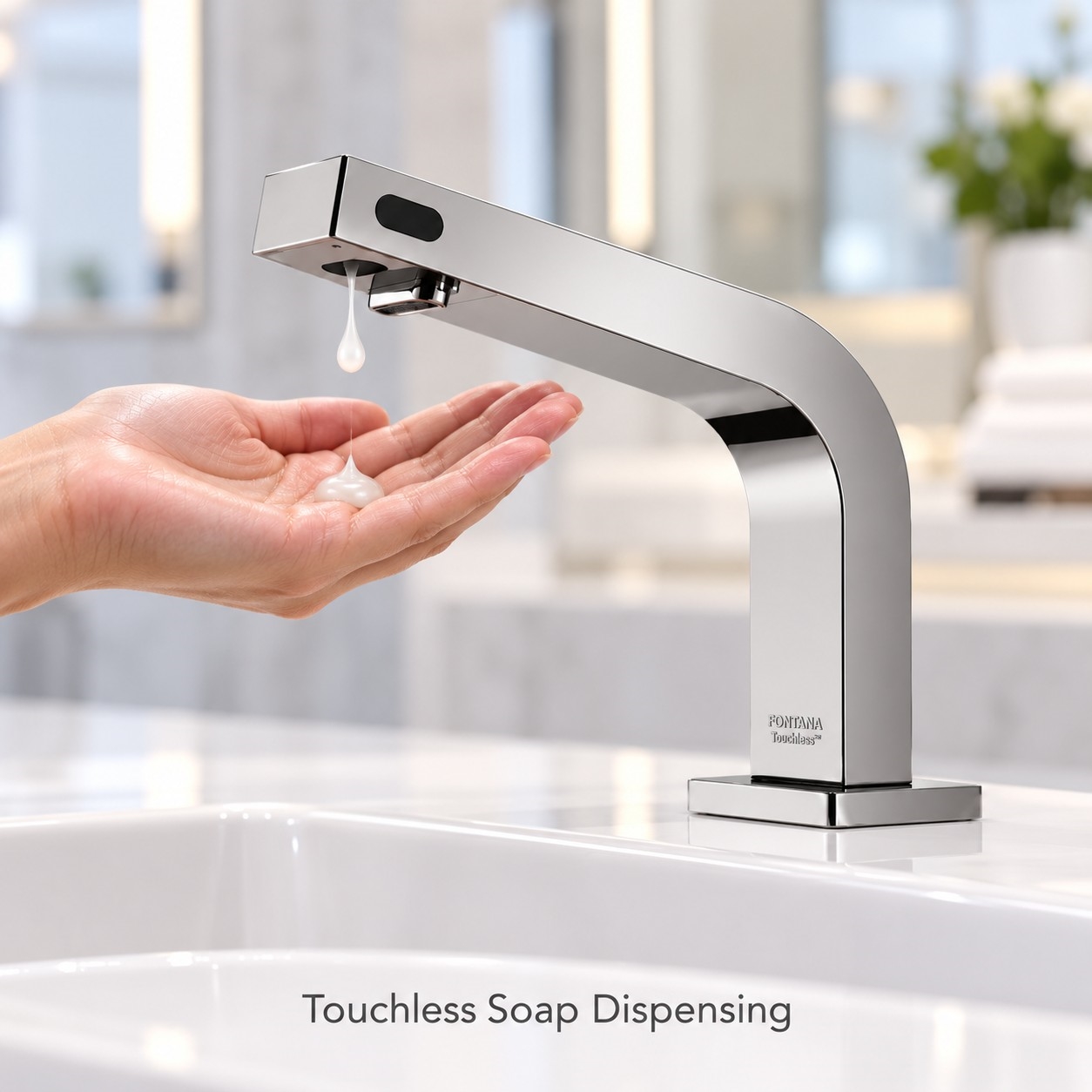
Separate Delivery Chemistry from Dispenser Appearance
Liquid, foam and cartridge systems are different supply arrangements. A matching finish or similar spout does not establish compatible pumps, tubing or soap formulations.

Formulation and Pump
Confirm the approved product type and any viscosity, temperature or formulation limits. Foam systems require the specified foam solution and dispensing components; foam appearance is not a liquid-dose measurement.
Check Formulation Acceptance
Retain the soap identifier and compatibility approval. Dilute or substitute formulations only where both manufacturers permit it.

Measured Dose
Specify dose using the approved soap after priming. Controller settings indicate an intended operating level; they do not replace a delivery measurement at the installed nozzle.
Define the Dose Measurement
After priming, collect several doses and record the mean and range. Convert mass using the soap’s density, not an assumed 1 g/mL.

Refill Architecture
Distinguish replaceable cartridges, individual reusable reservoirs and approved shared supply systems. Review the cleaning and replacement procedure for the actual architecture.
Review the Refill Procedure
CDC’s healthcare guidance advises against adding soap to partially empty dispensers. Follow the selected system’s refill procedure and facility policy.
Choose Mounting by the Service Route
Draw the user’s hand position and the technician’s access route on the same coordinated detail. Preserve access without compromising required lavatory clearances.

Deck-Mounted Dispensing
Coordinate drilling, deck thickness, spout reach, reservoir removal and underside connections. Keep service components outside required knee and toe clearances.
Evaluate Deck-Mount Options →
Wall and Coordinated Sets
Review wall support, outlet position, refill-cover movement and interaction with the basin. For a set, identify the water and soap outlets clearly.
| Interface | Required decision | Field verification |
|---|---|---|
| Reach and approach | Position the usable control or activation area for the intended approach and counter depth. | Verify hand placement, clear floor space and access to soap without overreaching. |
| Supply tubing | Use the supported tube type, routing, lift and connection arrangement. | Inspect for kinks, leakage, displaced pickup and restrictions; prime as instructed. |
| Electrical provision | Confirm exact input, approved supply, connector and supported battery arrangement. | Check cable protection, servicing access and recovery after supported power replacement. |
| Maintenance opening | Show the space needed to remove the container, pump or cartridge. | Demonstrate replacement with traps, waste bins and adjacent services installed. |
A generic mounting height does not establish an accessible dispenser. Counter depth, approach direction, obstructions and the actual operating location matter. Review Reach and Operable-Part Criteria ↗
Test the Hand Zone and the Most Demanding Supply Branch
Check the ordinary sequence of reaching for soap, withdrawing, moving to the faucet and rinsing. Include neighboring dispensers and the final lighting. Confirm the selected sensing technology; an automatic dispenser is not necessarily a ToF dispenser.
Verify Useful Activation
Test first-attempt delivery and unwanted repeats under final lighting. Distinguish sensor response from delayed flow caused by the supply path.
Coordinate a Shared Reservoir
Confirm approved outlet count, branch routing, lift and venting. Prime and test every outlet, including the most constrained branch.
Plan Refill Access and Service Recovery
Allow space to remove the refill, open its cap and reconnect the supply without disturbing the basin or trap. Label shared-supply branches and retain the approved recovery procedure.
Demonstrate a Complete Service Cycle
Demonstrate refill removal with adjacent services installed. Reconnect, prime, check for leaks and verify repeat delivery using the approved procedure.
Plan for Uneven Restroom Demand
Label shared branches and monitor use by reservoir or outlet group. Set inspections from observed demand rather than equal occupancy assumptions.

Translate Dose and Traffic into Service Coverage
Editable planning assumptions for one reservoir or shared supply. These are calculated scenarios, not measured Fontana performance, industry averages or recommended soap doses.
Match the event count to the outlets served by the entered reservoir. For foam systems, enter the measured liquid formulation consumed per dose, not the expanded foam volume in the user’s hand.
Inspect the Capacity Assumptions
Daily mL = events × doses × mL per dose. Usable mL = starting volume × (1 − reserve/100). Coverage = usable/daily. Annual litres = daily × operating days/1,000. Reserve is a planning allowance; priming, residual volume and service losses can reduce actual coverage.
Daily Consumption at Three Dose Assumptions
Event count and average doses remain fixed. Values describe liquid formulation volume.
Reservoir Planning Allocation
Before planning reserve
900 mL ·
90%
Planning reserve
100 mL ·
10%
One-Day Consumption Profile
Each segment represents 10% of the volume available before the planning reserve. Blue shows the share consumed in one operating day.
600 mL remain above the planning reserve after one operating day.
Annual Use by Demand Level
Calculated annual litres at 25%, 50%, 75% and 100% of the entered event count.
Diagnose the Fault Before Adjusting the Sensor
Keep the approved soap identity, settings, component identifiers and service history in the station record. A responsive sensor cannot compensate for an empty, restricted or unprimed supply path.
Sensor Responds, No Soap
Check formulation availability, container seating, pickup, tubing and the approved priming sequence. Confirm power and pump behaviour using the model’s procedure.
Trace the Delivery Path
Inspect pickup, tubing, connections and nozzle for restrictions or air entry. Use the approved recovery procedure before changing sensitivity.
Variable Dose or Dripping
Compare repeat doses after stable priming. Record the soap product, outlet condition and recent changes before substituting components.
Check Post-Service Stability
Distinguish residual dripping from repeated pump delivery. Check deposits and formulation changes, then repeat the delivery measurement.
Commissioning Handover
Demonstrate refill or cartridge replacement, cleaning, power access and recovery. Record measured delivery and the accepted hand-activation position.
Complete the Acceptance Record
Retain settings, approved soap, component identifiers and supply layout. Recheck activation and delivery after replacing operating components.
Resolve These Details Before Standardising the Restroom
Can liquid soap and foam soap be interchanged?
Only if the exact pump, nozzle and formulation instructions support the change. Similar appearance does not establish compatibility.
Does a larger reservoir guarantee fewer maintenance visits?
No. Capacity affects supply coverage; cleaning, inspection, power service and uneven demand still determine visits.
Is an antibacterial formulation necessary for every commercial restroom?
CDC recommends plain soap for community handwashing. Follow the facility’s applicable policy; clinical guidance has a different context.
Does touchless activation establish accessibility by itself?
No. Verify approach, obstructed reach, activation position and surrounding clearances in the installed arrangement.
Can a refill alert determine the cleaning procedure?
No. Follow the system’s maintenance instructions and facility procedures. An alert does not authorise topping off.
Resources for the Dispenser Specification
Accessible soap supplies, handwashing practice and plain-soap guidance.
Healthcare-context guidance on refill practices and avoiding soap top-offs.
Accessible placement and operation within the coordinated restroom layout.
Review commercial soap dispenser configurations and exact-model documentation.
Coordinate shared reservoirs, branches, supported components and service access.
Explore wall, deck and coordinated washstation arrangements for commercial projects.







22.jpg)


.png)