False Positive / False Negative Engineering
False Activations in Touchless Faucets: IR vs ToF vs mmWave Explained
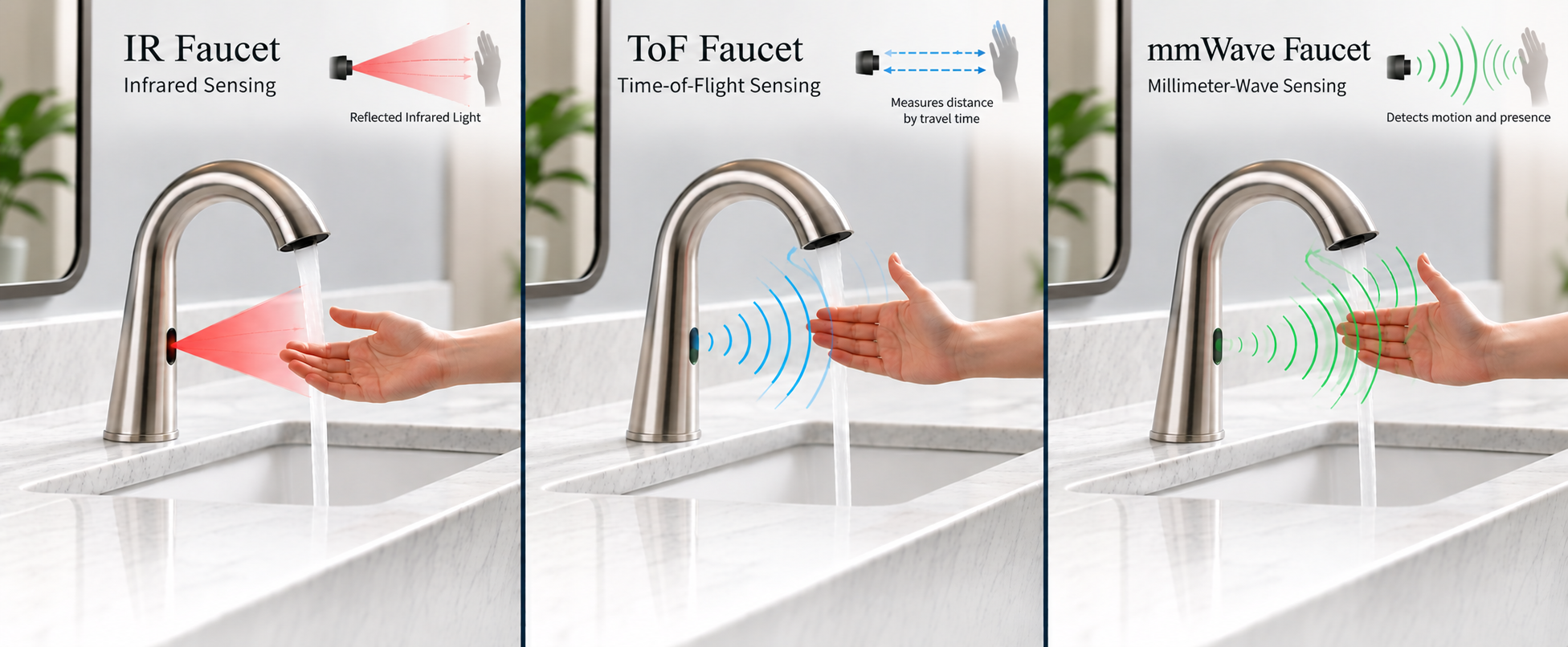
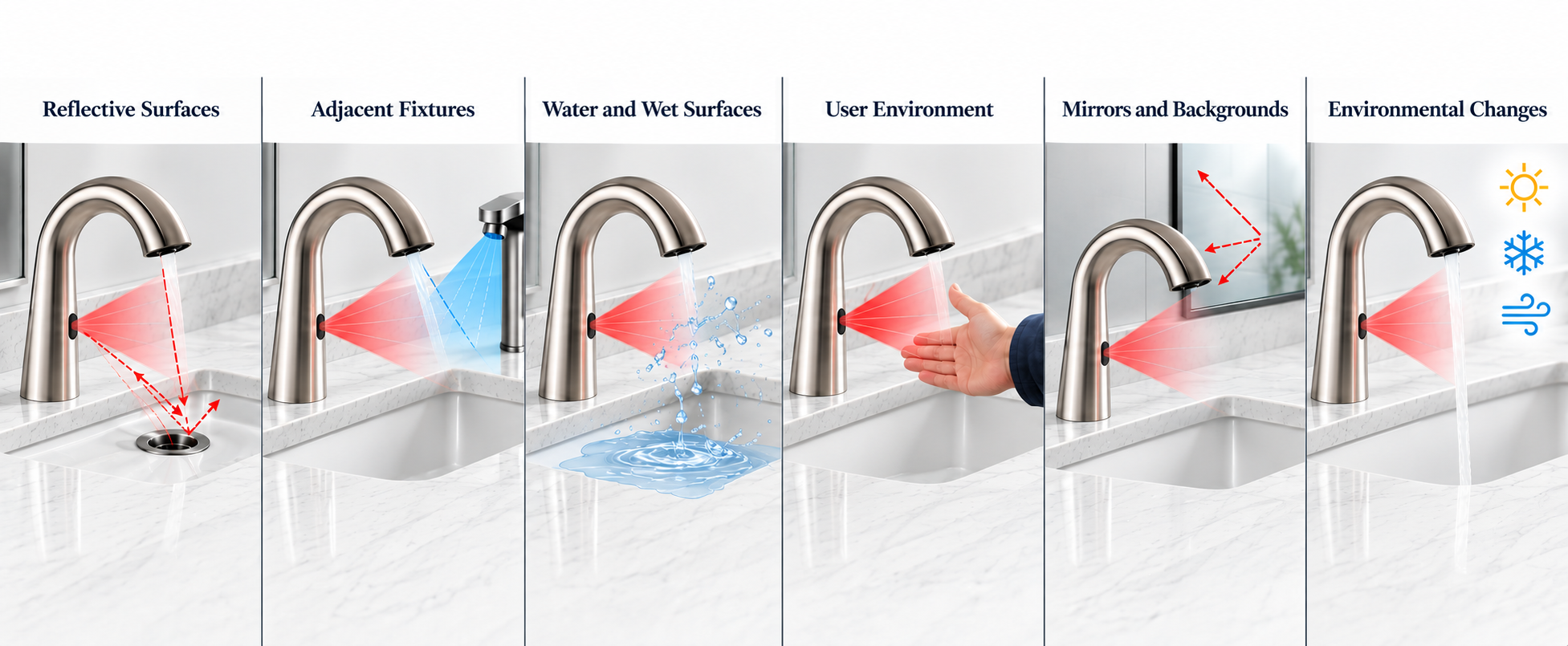
Ghost activation is not one failure mode. It can arise from sensing geometry, reflections, adjacent fixtures, wet surfaces, power behavior, firmware thresholds, or an overly broad activation zone. Here is how conventional IR, established direct ToF, and emerging mmWave architectures change the problem.
Define the two errors first
A false positive occurs when the faucet activates without an intended user action. A false negative occurs when a hand is intentionally presented but the faucet does not respond. A reliable system must minimize both; optimizing one by simply shrinking or expanding sensitivity can make the other worse.
Most false activations are scene problems
The sensor does not operate in free space. It sees a basin, drain, backsplash, water, mirrors, clothing, cleaning equipment, neighboring devices, and changing environmental conditions. The key engineering task is to distinguish the intended hand trajectory from those competing targets.
|
Potential cause
|
IR proximity response
|
ToF response
|
mmWave response
|
|
Potential cause: Highly reflective drain
|
IR proximity response: May increase reflected signal
|
ToF response: Distance may help reject if outside window
|
mmWave response: RF reflection and multipath may require clutter handling
|
|
Potential cause: Dark matte target
|
IR proximity response: Can reduce reflected intensity in simple systems
|
ToF response: Direct ranging is designed to reduce reflectivity dependence
|
mmWave response: Different radar cross-section considerations
|
|
Potential cause: Strong sunlight
|
IR proximity response: Optical interference must be managed
|
ToF response: Optical interference still must be managed
|
mmWave response: Not an optical-light issue
|
|
Potential cause: Adjacent faucet/soap sensor
|
IR proximity response: Optical cross-talk or overlap possible
|
ToF response: Cross-talk and overlap must be managed
|
mmWave response: RF coexistence and scene configuration must be managed
|
|
Potential cause: Water/cleaning motion
|
IR proximity response: Can enter proximity field
|
ToF response: Can be rejected if outside distance and zone logic
|
mmWave response: Motion sensitivity may require careful gating and target classification
|
|
Potential cause: Commercial faucet field history
|
IR proximity response: Extensive commercial deployment
|
ToF response: Established multi-year commercial deployment
|
mmWave response: Emerging; broad faucet-specific field history is not yet established
|
Engineering principle
The best false-trigger strategy is not maximum sensitivity. It is a deliberately bounded activation zone plus stable timing, interference control, and field verification in the actual basin geometry.
Evidence Context
mmWave Failure Modes Should Be Interpreted Differently
The mmWave observations on this page are based primarily on radar sensing principles, RF implementation behavior and known characteristics such as multipath, clutter, antenna geometry and motion sensitivity. They should not be interpreted as evidence from an equally large commercial-faucet deployment history. Conventional IR and direct ToF have substantially greater faucet-specific field experience, while mmWave remains comparatively emerging for faucet activation.
10–30 cm
Documented sensing-distance criterion; 12 cm preset target
<30°
Documented sensing-angle criterion
IP67
Documented PCB/electronics waterproofing criterion
200,000
Lifecycle activation cycles followed by performance checks
Scope note: these values come from Fontana's finished sensor-faucet inspection procedure. They should not be described as isolated qualification results for the ToF semiconductor itself.
Why overly long range is risky
A range setting that reaches deeply into the basin may continuously "see" the drain or flowing water. A setting that extends beyond the sink may respond to clothing, passing users, or cleaning staff. Reliable commissioning should find the shortest range that still captures normal hand placement.
How ToF can help
When actual distance is available, firmware can reject objects outside a defined range window even if they produce a strong optical return. That is a practical reason direct ranging can reduce certain nuisance triggers compared with a simple reflected-intensity threshold.
Why ToF is not magic
If the wrong object occupies the same distance window as the user's hands, distance alone cannot identify intent. Field of view, mounting angle, timing logic, hysteresis, signal quality, firmware and commissioning still matter.
How mmWave changes the potential failure modes
Radar eliminates ambient-light dependence and can provide motion and range information, but its sensing field still has to be constrained to the faucet interaction zone. Depending on implementation, movement outside the basin, antenna pattern, target classification and range gating can become important design variables.
Metal, water and surrounding structures can also create RF reflections, clutter or multipath that must be addressed in the implementation. These are engineering considerations derived from radar behavior; they should not be interpreted as evidence of equivalent long-term mmWave faucet field history.
What Fontana validates
Fontana's documented procedure includes sensing distance, sensing angle, nearby-device anti-interference, illumination-related range stability, opening/closing timing, automatic shutoff, low-voltage behavior, environmental tests and lifecycle performance. These checks attack several different paths to nuisance activation rather than relying on one sensor specification.
Engineering Assessment
Engineering Conclusions
False activation is not determined by sensor technology alone. It is the result of how sensing physics, range limits, field of view, basin geometry, firmware, timing, interference handling and installation conditions interact.
Traditional IR, direct ToF and mmWave each create different classification challenges. ToF can use measured distance to reject certain out-of-zone targets, while mmWave avoids optical-light dependence but introduces RF scene-management requirements. Neither architecture eliminates the need for controlled detection geometry and finished-product validation.
The maturity of the evidence must also be considered. Conventional IR and direct ToF have substantial faucet-specific deployment histories, while mmWave remains comparatively emerging for commercial faucet activation. Radar-based false-trigger analysis should therefore be treated as engineering evaluation until equivalent faucet field evidence exists.
Specification Considerations
Evaluate sensing technology together with detection-zone definition, faucet-application maturity, basin geometry, interference behavior, power-failure state, moisture protection, valve architecture, pressure performance, lifecycle testing and serviceability. A sensor name alone is not a reliability specification.
Continue the Sensor Engineering Series
|
|
|