Optical Sensing Fundamentals
ToF vs Traditional IR: Why Distance Measurement Changes Touchless Faucet Sensing
A deeper look at the engineering distinction between reflected-light proximity sensing and direct Time-of-Flight ranging—and why measured distance can improve control around reflective basins, changing targets, and tightly defined commercial faucet activation zones.
Same Infrared Technology, Different Measurements
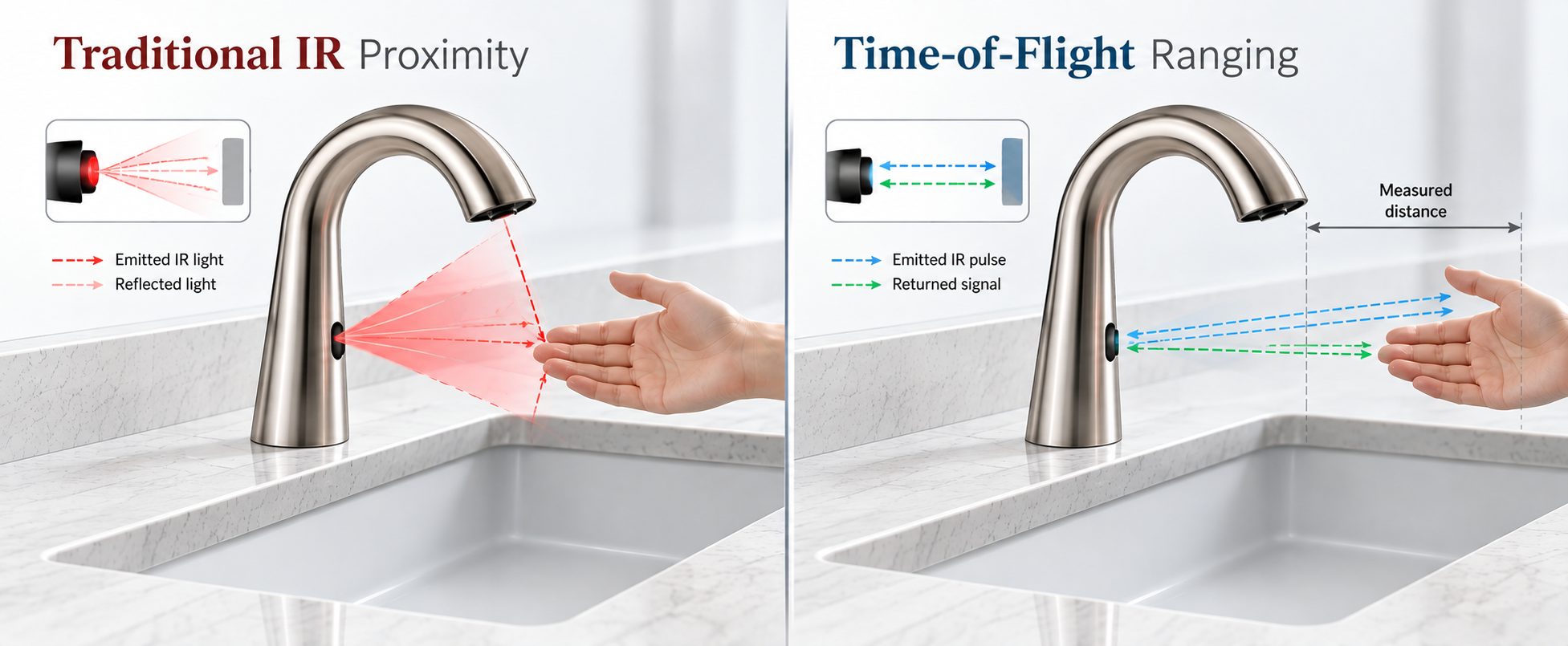
The phrase “IR sensor” is often used broadly. A traditional reflective proximity system may emit infrared light and judge proximity from the amount of energy returned. A direct ToF system can also use emitted infrared light, but calculates target distance from photon travel time. That distinction changes what the controller knows about the target and how activation thresholds can be defined.
The broader three-way comparison between IR, ToF and mmWave belongs on the
ToF vs IR vs mmWave engineering comparison.
This page isolates the optical distinction between conventional proximity sensing and direct ranging.
Read More
Signal strength versus distance
Reflected intensity can vary with surface color, reflectivity, angle, contamination, geometry and optical alignment. Direct ranging is designed to make target distance the primary result. That does not eliminate optical engineering challenges, but it reduces reliance on raw reflected intensity as the sole indication of proximity.
Measurement Principle
Proximity inference and direct ranging are different control inputs
In a simplified reflective-proximity architecture, the controller asks whether enough optical energy has returned to suggest that an object is close. In direct ToF ranging, the controller receives a measured distance result that can be compared with a defined operating window. The distinction is important because a strong optical return and a correctly positioned target are not necessarily the same thing.
|
Engineering characteristic
|
Traditional reflective IR proximity
|
Direct ToF ranging
|
|
Engineering characteristic: Primary output
|
Traditional reflective IR proximity: Presence or proximity inferred from returned optical signal
|
Direct ToF ranging: Measured target distance
|
|
Engineering characteristic: Target reflectivity influence
|
Traditional reflective IR proximity: Can be significant in simple reflective systems
|
Direct ToF ranging: Designed to reduce dependence on target reflectivity, although optical signal quality still matters
|
|
Engineering characteristic: Control threshold
|
Traditional reflective IR proximity: Often reflected-signal or proximity threshold
|
Direct ToF ranging: Distance threshold or defined range window
|
|
Engineering characteristic: Ability to reject a distant strong return
|
Traditional reflective IR proximity: Depends heavily on thresholding, optical geometry and implementation
|
Direct ToF ranging: Distance can be used directly to reject targets outside the accepted range
|
|
Engineering characteristic: Field geometry
|
Traditional reflective IR proximity: Emitter and receiver geometry are critical
|
Direct ToF ranging: Optics, field of view, sensor angle and ranging algorithm remain critical
|
|
Engineering characteristic: Ambient-light handling
|
Traditional reflective IR proximity: Filtering and modulation are important
|
Direct ToF ranging: Filtering, timing and signal processing remain important
|
|
Engineering characteristic: Commercial faucet maturity
|
Traditional reflective IR proximity: Established with decades of faucet deployment
|
Direct ToF ranging: Established with multi-year commercial faucet deployment
|
|
Engineering characteristic: Best fit
|
Traditional reflective IR proximity: Well-characterized proximity tasks
|
Direct ToF ranging: Applications where explicit distance improves control of a defined activation zone
|
Engineering principle
The important distinction is not infrared versus non-infrared. It is whether the control system primarily infers proximity from reflected intensity or directly measures target distance.
10–30 cm
Documented sensing-distance criterion; 12 cm preset target
<30°
Documented sensing-angle criterion
IP67
Documented PCB/electronics waterproofing criterion
200,000
Lifecycle activation cycles followed by performance checks
Scope note: these values come from Fontana’s finished sensor-faucet inspection procedure. They should not be described as isolated qualification results for the ToF semiconductor itself.
Why reflective surfaces are challenging
Commercial basins combine chrome drains, polished stone, glazed ceramic, mirrors, wet surfaces, metallic fixtures and dark finishes. These materials can return very different amounts of infrared energy and can change the optical environment as water, cleaning residue or user position changes.
A simple intensity-based system can therefore require careful gain, threshold, angle and installation tuning. This does not mean reflective IR cannot work reliably; it means the optical environment must be included in the design and validation of the finished faucet.
Distance as Data
What direct ranging contributes
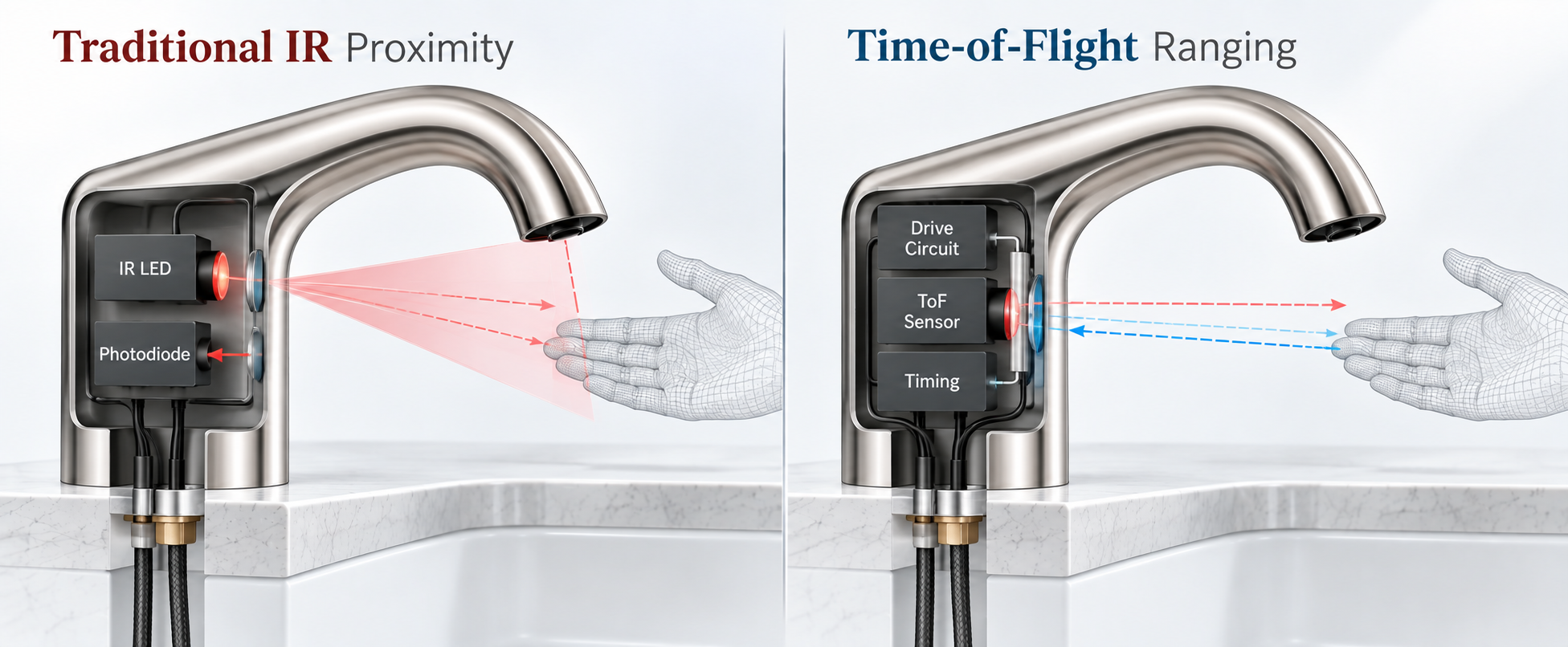
ST states that its FlightSense ToF sensors directly measure distance and are less dependent on object reflectivity than simple IR proximity sensors. Some devices also offer configurable regions of interest or reduced fields of view.
In a faucet, the useful outcome is not simply that distance can be measured. It is that measured distance can become part of a deliberate activation window used to separate the intended handwashing region from surrounding objects. This is the same precision-ranging principle developed in
why Fontana uses precision ranging for touchless faucets.
Control Logic
Why measured distance changes the decision logic
Distance allows the controller to evaluate target position relative to an intended range rather than treating every strong optical return as equally relevant.
Background Target
Detected outside the intended handwashing distance.
Valid Hand Zone
Target falls inside the configured activation range.
Target Leaves
Distance no longer satisfies the intended activation condition.
This is a simplified control model. Production sensing logic may also include timing, filtering, confidence thresholds, field-of-view constraints and implementation-specific decision rules.
Why this matters for false activation
A nuisance activation occurs when the control system classifies an unintended target as a valid user interaction.
Direct ranging gives the controller an additional way to reject targets that fall outside the intended distance window, but distance alone does not guarantee correct classification. Geometry, field of view, firmware, timing and installation still matter. The broader failure mechanisms are covered in
false activations in IR, ToF and mmWave touchless faucets.
Why ToF is not immune to installation errors
A ToF sensor still has an optical path. Cover glass, contamination, smudging, crosstalk, strong ambient light, mounting angle, field of view, target geometry and enclosure design can all affect implementation.
Good engineering therefore combines ranging with mechanical design, optical design, firmware, calibration and finished-product validation. Direct distance measurement is useful because it improves the control information available to the system; it does not remove the need to engineer the physical sensing environment.
Detection Geometry
Distance alone does not define the activation zone
Two targets can be the same distance from the sensor but occupy different positions inside the optical field. Sensor angle, field of view, spout projection, basin depth, drain location and surrounding fixture geometry therefore remain part of the specification.
That relationship is the subject of
why detection-zone control matters more than maximum sensor range.
What the Fontana test criteria add
Fontana’s finished-product test record includes sensing distance, sensing angle, illumination-related variation, adjacent-device behavior, moisture protection, environmental exposure and lifecycle performance.
Those checks matter because the theoretical advantage of direct ranging only becomes meaningful if the completed faucet preserves stable behavior under the operating conditions for which it was designed. Sensor architecture and finished-system validation must therefore be evaluated together.

Engineering Conclusions
Traditional reflective IR and direct ToF are both mature commercial-faucet sensing approaches, but they provide different information to the control system. Reflective IR typically infers proximity from returned optical energy, while direct ToF provides measured distance that can be compared with a defined activation range.
The practical value of ToF is therefore not that it uses a newer sensor label or eliminates optical engineering. Its value is that distance becomes an explicit control variable that can be combined with field of view, geometry, timing, firmware and finished-product validation to define a more deliberate short-range interaction zone.
Technical Selection Criteria
Do not specify “IR” or “ToF” as a buzzword. Ask what the sensor actually measures, how the activation zone is defined, how target reflectivity and geometry are handled, how adjacent fixtures are evaluated, and how the complete faucet performs under environmental and lifecycle testing.
Continue the Sensor Engineering Series
Return to the broad sensor comparison, review Fontana’s ToF selection rationale, or continue into false-activation and detection-zone engineering.
|
|
|