Sensor Technology Engineering Series
ToF vs IR vs mmWave Sensors for Touchless Faucets: An Engineering Comparison
A specification-focused comparison of three sensing approaches for hands-free faucets—what each technology measures, where each can perform well, how mature each architecture is within commercial faucet applications, and why the complete faucet implementation matters more than a sensor label alone.
The engineering question is not “Which sensor is newest?”
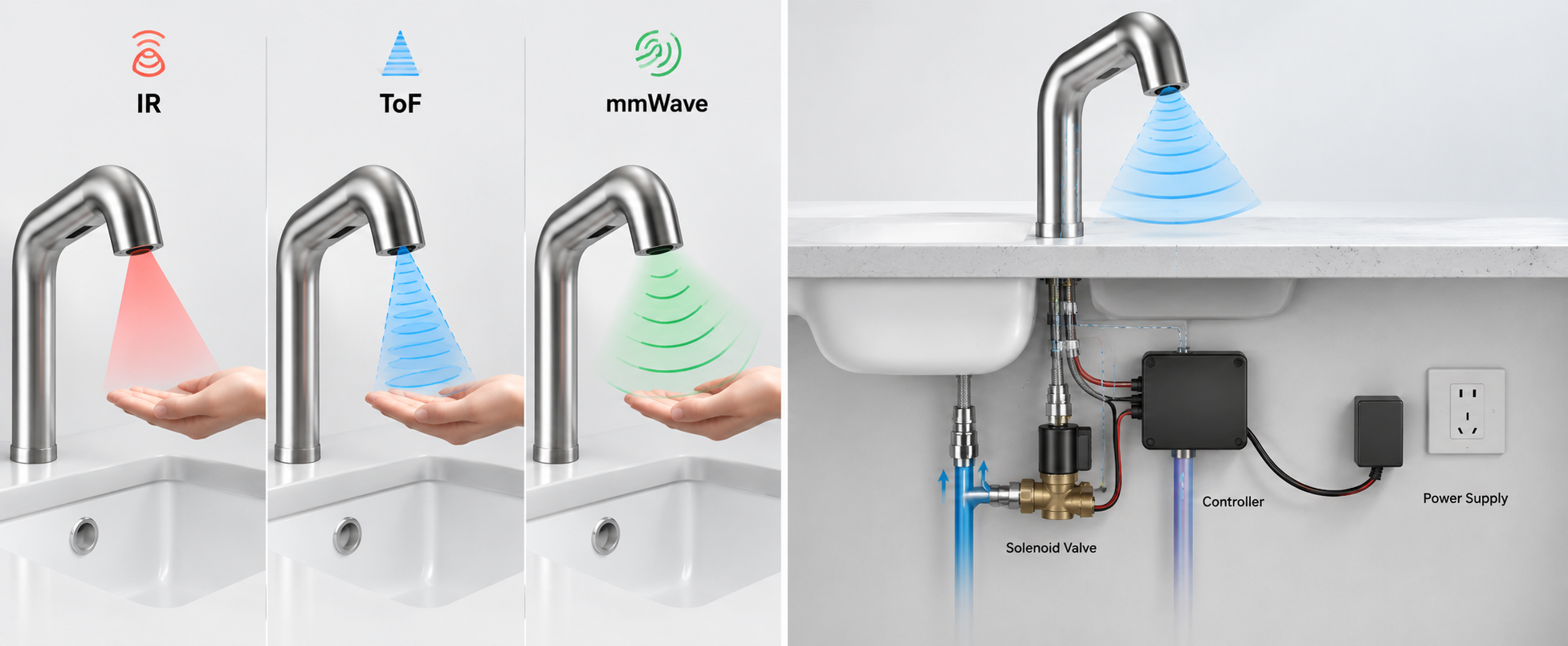
A commercial lavatory faucet needs a sensor system that recognizes an intended hand inside a small activation zone, ignores surrounding objects, and coordinates that decision with the power system and solenoid. Conventional infrared proximity and direct Time-of-Flight sensing have established commercial-faucet deployment histories, while mmWave radar represents a technically capable but comparatively emerging approach to faucet activation. All three can detect a target, but they obtain and interpret information differently—and their maturity within the faucet application is not the same.
Three technologies, three sensing models
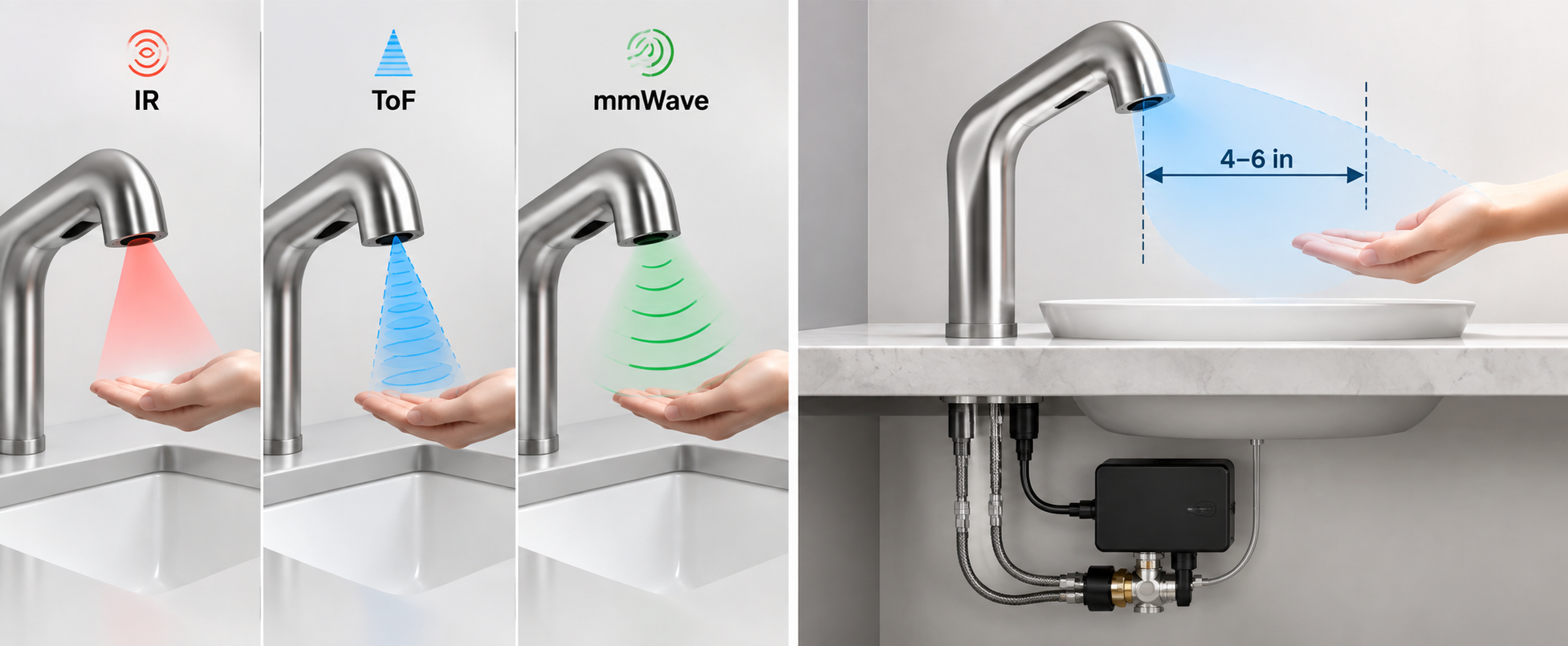
Traditional reflective IR proximity typically infers proximity from returned infrared energy. Direct Time-of-Flight (ToF) determines target distance from the travel time of emitted and returned light. mmWave radar uses radio-frequency energy and can resolve range, motion, and—in suitable architectures—angle and velocity. Those differences matter, but none removes the need for application-specific integration, calibration, finished-product validation, and lifecycle testing.
|
Engineering factor
|
Conventional IR
|
Direct ToF
|
mmWave
|
|
Engineering factor: Primary measurement
|
Conventional IR: Reflected IR response / proximity
|
Direct ToF: Direct optical distance
|
mmWave: RF range, motion; potentially velocity and angle
|
|
Engineering factor: Optical technology
|
Conventional IR: Yes
|
Direct ToF: Yes
|
mmWave: No
|
|
Engineering factor: Short controlled zone
|
Conventional IR: Established and practical
|
Direct ToF: Strong fit when distance thresholds are central
|
mmWave: Possible, but requires careful radar configuration and application-specific zone control
|
|
Engineering factor: Target reflectivity sensitivity
|
Conventional IR: Can influence simple reflective systems
|
Direct ToF: Reduced dependence on reflectivity in direct ToF ranging
|
mmWave: Different target physics; depends on radar cross section and configuration
|
|
Engineering factor: Ambient-light concern
|
Conventional IR: Must be engineered around
|
Direct ToF: Must be engineered around; modern ToF includes filtering and processing
|
mmWave: Not an optical-light issue
|
|
Engineering factor: Long-range presence sensing
|
Conventional IR: Not the primary strength
|
Direct ToF: Possible depending on device
|
mmWave: A major strength of mmWave
|
|
Engineering factor: Commercial faucet application maturity
|
Conventional IR: Established; decades of commercial faucet deployment
|
Direct ToF: Established in commercial faucet applications with documented multi-year field deployment
|
mmWave: Emerging for faucet activation; broad commercial faucet adoption is not yet established
|
|
Engineering factor: System validation required
|
Conventional IR: Yes
|
Direct ToF: Yes
|
mmWave: Yes
|
Engineering principle
For faucet engineering, the goal is not to detect more of the room. It is to detect the intended user, at the intended location, with repeatable timing and minimal unintended activation.
One of the most useful ways to evaluate these architectures is to separate intended detection from nuisance behavior. The mechanisms behind
false activations in IR, ToF and mmWave touchless faucets
deserve their own analysis because the three technologies do not classify targets in exactly the same way.
10–30 cm
Documented sensing-distance criterion; 12 cm preset target
<30°
Documented sensing-angle criterion
IP67
Documented PCB/electronics waterproofing criterion
200,000
Lifecycle activation cycles followed by performance checks
Scope note: these values come from Fontana’s finished sensor-faucet inspection procedure. They should not be described as isolated qualification results for the ToF semiconductor itself.
Why short-range control matters
The desired interaction is usually only a few inches below or in front of the spout. A wider or longer sensing field is not automatically better; it can increase the number of objects the control system must reject. Basin geometry, drains, backsplashes, neighboring fixtures, cleaning activity, and user hand positions all become part of the sensing environment. For a deeper engineering discussion, see why
detection-zone control matters more than maximum sensor range.
What ToF changes
STMicroelectronics describes direct ToF as measuring absolute distance rather than estimating proximity from reflected signal strength. That makes distance thresholds a first-class control variable. In a faucet, the practical value is not “laser technology” as a marketing phrase; it is the ability to build logic around a defined range window.
Where conventional IR remains strong
Infrared proximity has decades of field use, broad component availability, and well-understood installation practices. Properly designed IR faucets can be highly reliable. The engineering limitation to watch is that simple reflective architectures may react differently to target reflectivity, geometry, ambient conditions, or strongly reflective nearby surfaces. The distinction between reflected-signal proximity and direct ranging is examined in more detail in
ToF vs traditional IR sensing.
Where mmWave is genuinely impressive
Modern mmWave radar can measure range and motion and is highly capable for presence detection, occupancy sensing, automotive sensing, robotics, and applications where optical conditions are undesirable. Texas Instruments, for example, publishes 60 GHz modules designed for presence detection over distances measured in meters. These capabilities are technically impressive, but they should not be confused with established commercial-faucet deployment. At present, mmWave remains an emerging sensing architecture for touchless faucet activation, while conventional IR and direct ToF have substantially greater faucet-specific deployment history. A commercial lavatory faucet is also solving a very different sensing problem: reliable recognition of an intended hand within a tightly bounded, very short-range activation zone. For the faucet-specific engineering question, review whether
mmWave radar can replace ToF in commercial touchless faucets.
Application Maturity Matters
Sensor Capability Is Not the Same as Faucet Validation
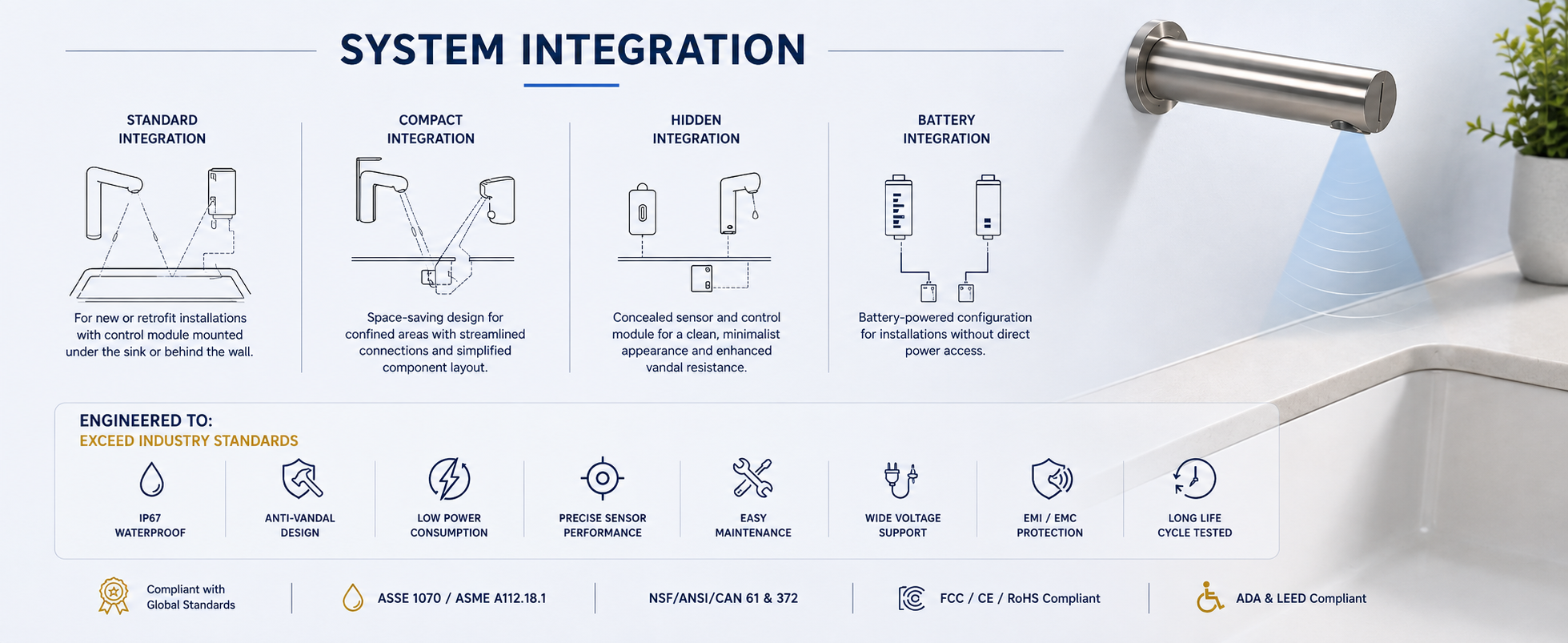
A sensing technology can be highly capable at the semiconductor or module level without yet having an extensive validation history inside commercial faucets. Faucet applications impose their own requirements: compact packaging, tightly controlled detection geometry, basin and surface interactions, moisture exposure, low-power operation, valve coordination, repeated activation, cleaning conditions, and long-term serviceability. For specification purposes, sensor capability should therefore be evaluated separately from application maturity and finished-product validation.
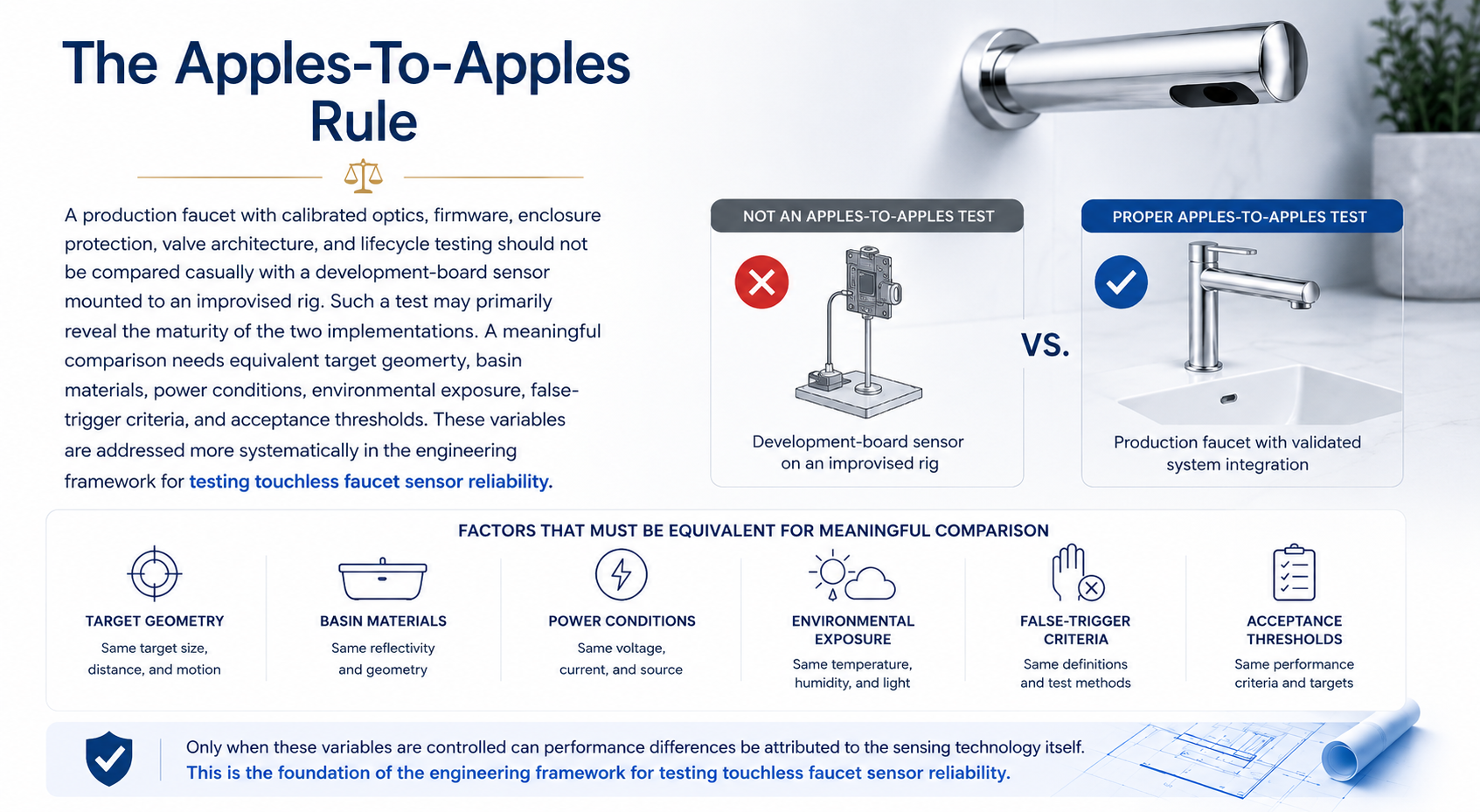
The apples-to-apples rule
A production faucet with calibrated optics, firmware, enclosure protection, valve architecture, and lifecycle testing should not be compared casually with a development-board sensor mounted to an improvised rig. Such a test may primarily reveal the maturity of the two implementations. A meaningful comparison needs equivalent target geometry, basin materials, power conditions, environmental exposure, false-trigger criteria, and acceptance thresholds. These variables are addressed more systematically in the engineering framework for
testing touchless faucet sensor reliability.
Specification Considerations
Evaluate sensing technology together with detection-zone definition, faucet-application maturity, basin geometry, interference behavior, power-failure state, moisture protection, valve architecture, pressure performance, lifecycle testing, and serviceability. A sensor name alone is not a reliability specification.
Continue the Sensor Engineering Series
Continue into the specialist engineering topics behind Time-of-Flight selection, conventional IR comparison, mmWave evaluation, reliability testing, false activation and detection-zone control.
|
|
|