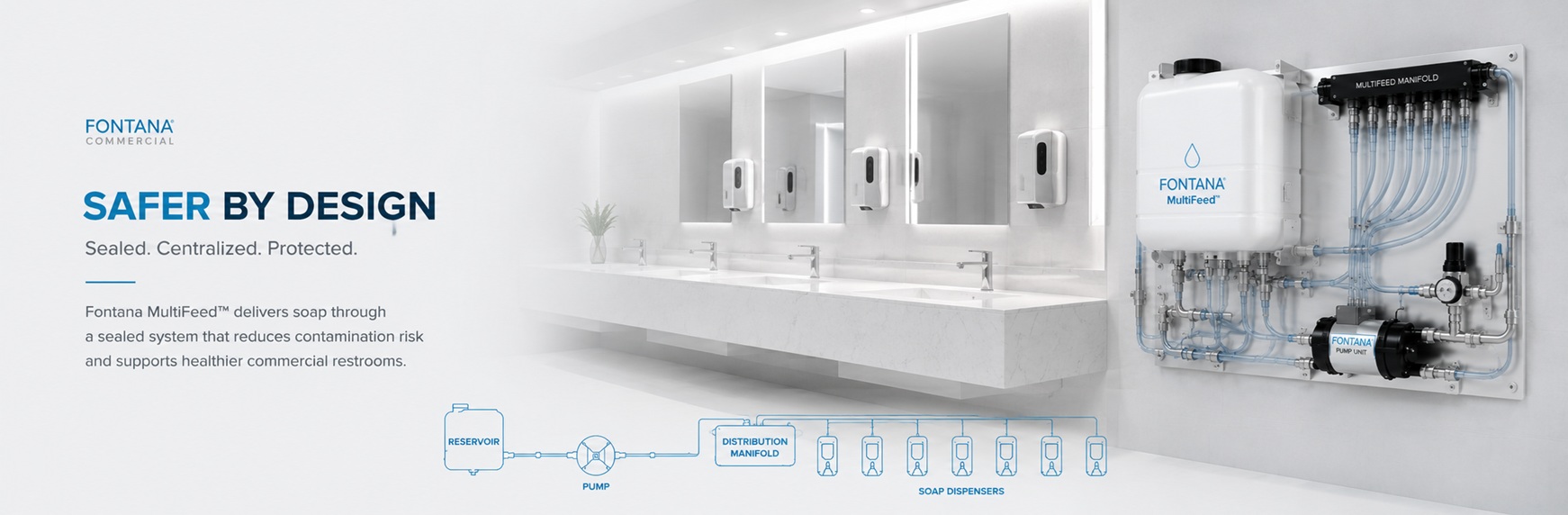
Why Fontana MultiFeed™ Is a Safer Commercial Soap Dispensing System
Discover the science behind sealed centralized soap dispensing systems and learn why commercial architects, facility managers, healthcare planners, and building professionals specify the
Fontana MultiFeed™ System to help reduce contamination risk, simplify maintenance, and improve hygiene performance across high-traffic commercial restrooms.
Scientific Background
The Science Behind Soap Contamination
Commercial soap dispensers may appear similar on the surface, yet their internal refill method has a significant impact on hygiene. When soap reservoirs are repeatedly opened for manual refilling, airborne particles, handling practices, and residual contamination can compromise soap quality over time. Understanding this process explains why sealed centralized dispensing systems have become the preferred specification for many commercial facilities.
How Contamination Can Develop
Open Reservoir
↓
Manual Soap Refill
↓
Air & Surface Exposure
↓
Potential Bacterial Growth
↓
Higher Cross-Contamination Risk
Sealed System Engineering
Why the Fontana MultiFeed™ System Is Different
Rather than relying on multiple independently refilled soap reservoirs, the Fontana MultiFeed™ System distributes soap from a single sealed supply through a protected delivery network. This engineering approach helps minimize unnecessary exposure during refilling while simplifying routine maintenance across commercial restroom installations.
Protected Soap Delivery Workflow
Sealed Central Reservoir
↓
Protected Distribution Tubing
↓
Controlled Soap Delivery
↓
Multiple Touchless Dispensers
↓
Reduced Exposure During Refilling
Centralized Supply
Sealed Reservoir
Touchless Operation
Commercial Hygiene
Centralized Operation
One sealed reservoir supplies multiple dispensers from a single managed source.
Reduced Manual Handling
Fewer refill locations help simplify routine servicing across commercial facilities.
Designed for High Traffic
Suitable for airports, healthcare, hospitality, education, offices and other demanding environments.
Evidence-Based Guidance
Scientific & Public Health Guidance
Leading public health organizations consistently recommend proper dispenser maintenance and discourage practices that may increase contamination risk. Sealed soap delivery systems support hygiene-focused facility management by minimizing unnecessary exposure during routine refilling.
Public Health Reference
CDC
The Centers for Disease Control and Prevention advises that partially filled soap dispensers should not be topped off because improper refilling practices can contribute to contamination.
Read Engineering FAQ →
International Guidance
World Health Organization
WHO guidance emphasizes correct dispenser management procedures as part of comprehensive hand hygiene programs within healthcare and commercial environments.
Explore Hygiene Benefits →
Healthcare Practice
Public Health Canada
Healthcare guidance promotes properly managed soap dispensing practices that help maintain hygienic handwashing environments while supporting infection prevention strategies.
Commercial Planning Guide →
Continue Exploring the MultiFeed™ Engineering Library
Learn more about centralized soap dispensing architecture, retrofit solutions, commercial planning, installation guidance, and engineering documentation designed for architects, facility managers, plumbing engineers, and commercial specifiers.
Engineering Perspective
Why Sealed Systems Matter
The difference between an open refillable dispenser and a sealed centralized system extends beyond maintenance convenience. A protected soap supply helps reduce unnecessary exposure during servicing, improves refill consistency, and supports hygiene-focused restroom management across commercial buildings.
✔ Protected centralized soap supply
✔ Fewer refill locations to service
✔ Reduced manual handling during maintenance
✔ Designed for high-traffic commercial facilities
✔ Supports long-term restroom hygiene programs
Commercial Comparison
Traditional Refilling vs. Sealed MultiFeed™ Architecture
Selecting a commercial soap dispensing system involves more than choosing a dispenser style. Refill strategy, maintenance workflow, exposure during servicing, and centralized management all influence long-term restroom performance.
|
Comparison
|
Traditional Open Refill
|
Fontana MultiFeed™
|
|
Soap Supply
|
Individual Reservoirs
|
Central Sealed Reservoir
|
|
Refill Method
|
Multiple Manual Refills
|
Single Central Filling Point
|
|
Soap Distribution
|
Independent Units
|
Protected Central Network
|
|
Maintenance
|
Service Each Dispenser
|
Centralized Servicing
|
|
Commercial Applications
|
General Installations
|
Healthcare, Hospitality, Airports, Offices & Education
|
|
⚡ Commercial Hygiene Innovation
The Hidden Hazard of
Bulk Refillable Soap Dispensers
Bulk refillable soap dispensers remain common throughout commercial facilities, yet their refill process differs significantly from sealed centralized systems. During routine servicing, repeated opening of individual reservoirs introduces additional handling steps that public health guidance recommends managing carefully through proper dispenser maintenance procedures.
|
|
|
⚠️ Risk Factor #01
Open Refillable
Systems
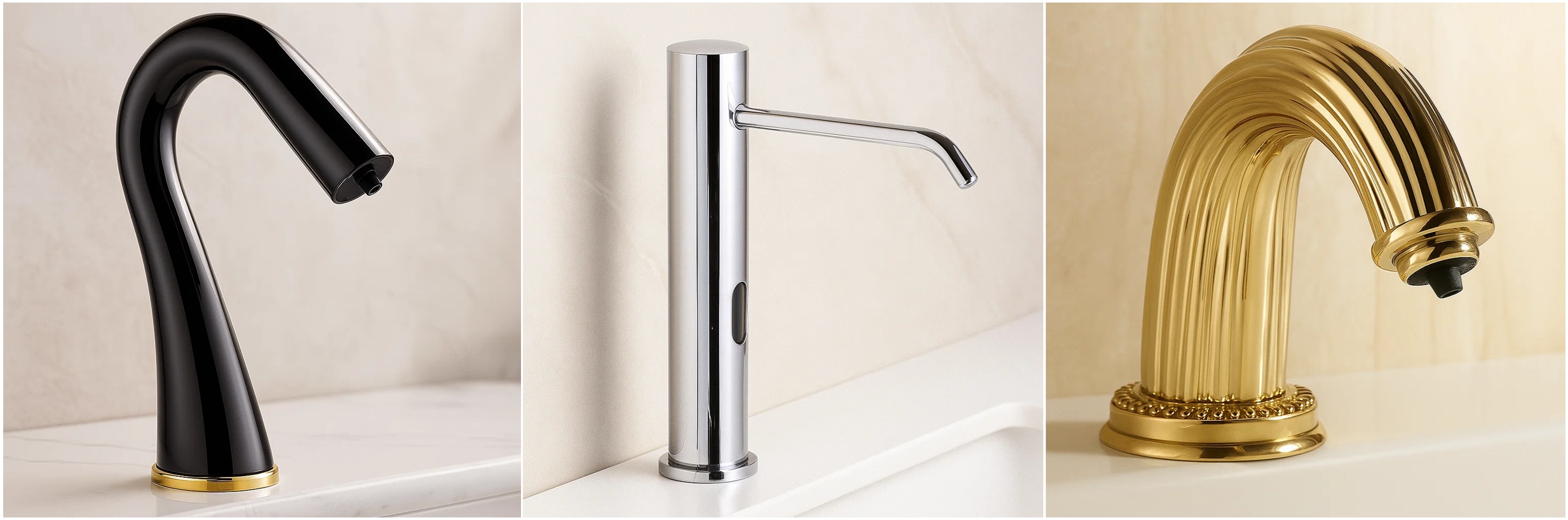
Repeated manual refilling requires opening individual soap reservoirs, increasing routine handling throughout commercial restroom maintenance. Each opening creates opportunities for contamination that sealed systems eliminate.
Explore Hygiene Benefits →
|
|
✦ Sealed Innovation
MultiFeed™ Sealed Technology
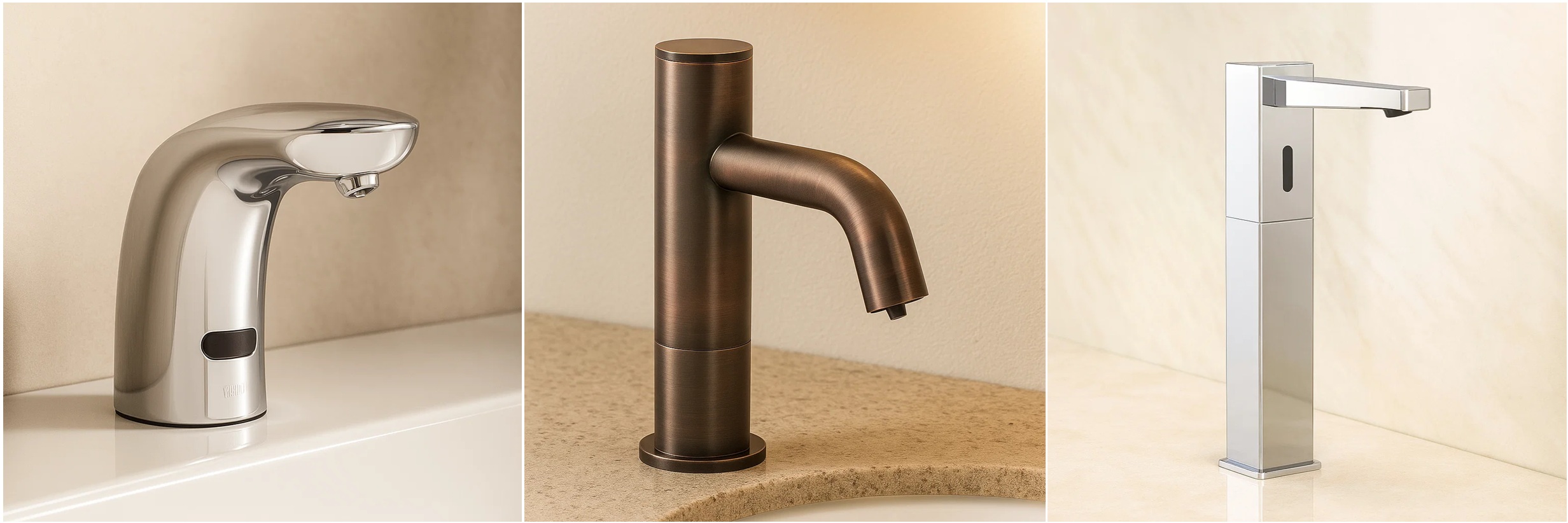
A centralized sealed reservoir distributes soap to multiple touchless dispensers through a protected commercial delivery network. No refilling. No contamination. No compromise.
Explore the System →
|
|
|
|
|
↻ Retrofit Solution
Upgrade Without Replacement
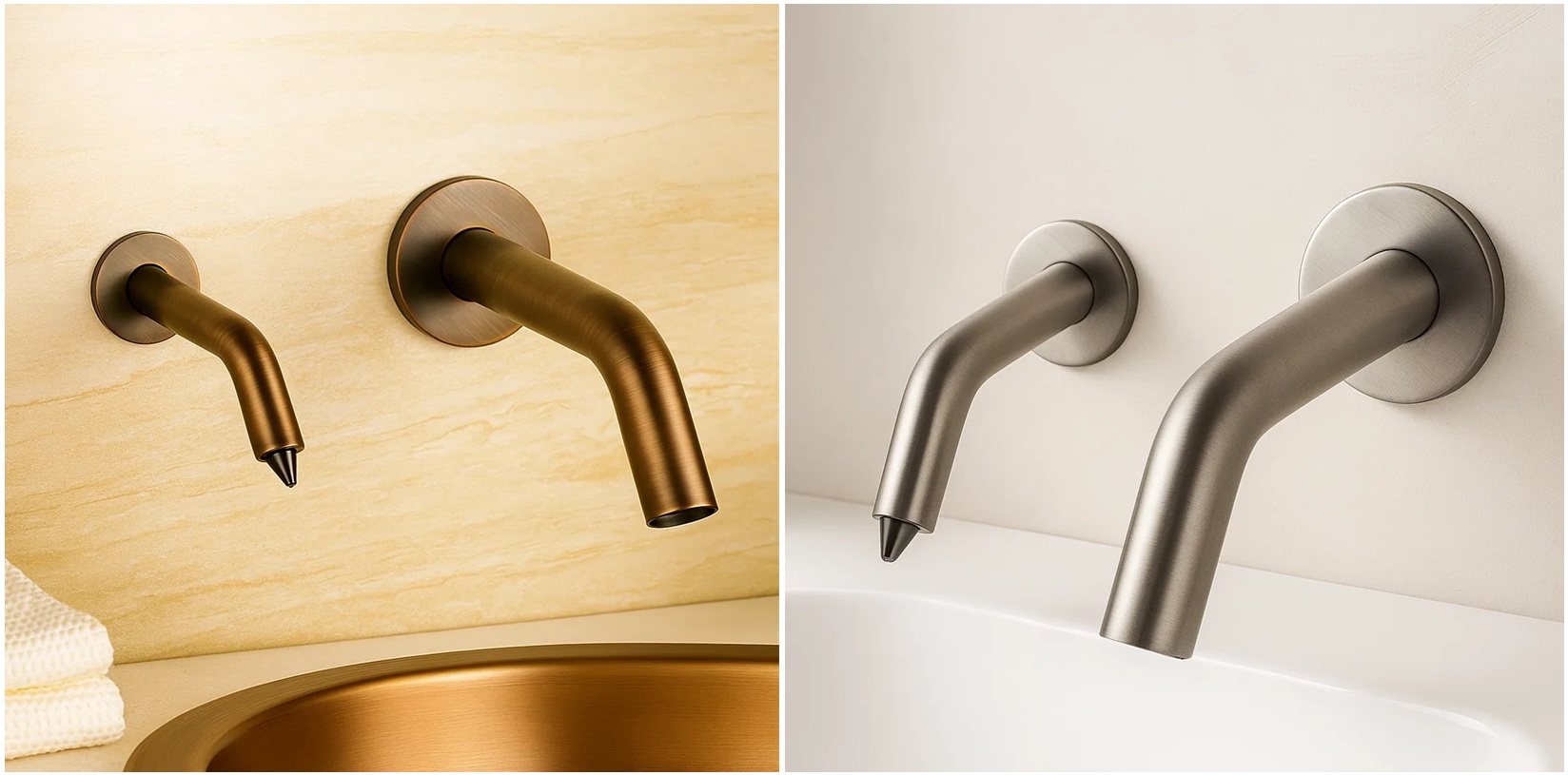
Upgrade compatible commercial restroom installations with centralized MultiFeed™ technology without replacing every dispenser. Smart. Sustainable. Seamless.
View Retrofit Kits →
|
|
|
|
|
|
🏛️
Why Public Health Organizations Recommend Proper Refill Procedures
Guidance published by organizations such as the
CDC, World Health Organization (WHO), and Public Health Agency of Canada emphasizes proper dispenser maintenance practices and recommends avoiding topping off partially filled soap dispensers. These recommendations have encouraged growing interest in sealed centralized dispensing systems for healthcare, hospitality, education, airports, offices, and other high-traffic commercial environments.
|
|
|
Evidence-Based Practice
Why Commercial Hygiene Guidelines Matter
Modern commercial restroom specifications are increasingly influenced by public health recommendations, maintenance efficiency, and long-term facility management. Rather than relying solely on product features, architects and facility managers often review guidance published by recognized health organizations when selecting soap dispensing solutions.

CDC Guidance
Recommendations emphasize proper dispenser maintenance procedures and discourage topping off partially filled soap dispensers.

WHO Guidance
International hand hygiene guidance promotes appropriate dispenser management and consistent maintenance practices.

Public Health Canada
Healthcare guidance supports controlled soap dispensing practices that help maintain hygienic handwashing environments.
Continue Exploring MultiFeed™ Engineering Resources
Explore engineering documentation, retrofit solutions, project planning resources, and technical guidance developed for architects, plumbing engineers, facility managers, and commercial specifiers.
|
⚡ Commercial Hygiene Innovation
The Hidden Hazard of
Bulk Refillable Soap Dispensers
Bulk refillable soap dispensers remain common throughout commercial facilities, yet their refill process differs significantly from sealed centralized systems. During routine servicing, repeated opening of individual reservoirs introduces additional handling steps that public health guidance recommends managing carefully through proper dispenser maintenance procedures.
|
|
|
|
⚠️ Risk Factor #01
Open Refillable
Systems
Repeated manual refilling requires opening individual soap reservoirs, increasing routine handling throughout commercial restroom maintenance. Each opening creates opportunities for contamination that sealed systems eliminate.
Explore Hygiene Benefits →
|
|
✦ Sealed Innovation
MultiFeed™ Sealed Technology
A centralized sealed reservoir distributes soap to multiple touchless dispensers through a protected commercial delivery network. No refilling. No contamination. No compromise.
Explore the System →
|
|
|
|
|
|
↻ Retrofit Solution
Upgrade Without Replacement
Upgrade compatible commercial restroom installations with centralized MultiFeed™ technology without replacing every dispenser. Smart. Sustainable. Seamless.
View Retrofit Kits →
|
|
|
|
|
|
What the Experts Have Said
The listing of the following
global health organizations dissuading the practice of 'topping off' bulk soap dispensers includes:
|
|
✔ CDC (Centers for Disease Control and Prevention)
"Do not add soap to a partially empty soap dispenser. The topping up of dispensers can lead to bacterial contamination of soap."
— Guideline for Hand Hygiene in Health-Care Settings (Page 33)
|
|
|
✔ WHO (World Health Organization)
"When selecting hand hygiene products: Do not add soap (IA) or alcohol-based formulations (II) to a partially empty soap dispenser. In case soap dispensers are reused, recommended procedures for cleansing shall be followed."
— WHO Guideline on Hand Hygiene in Health Care (Page 153)
|
|
|
✔ Public Health Agency of Canada
"Hand hygiene products should be supplied in single-use, appropriately labeled, tamper-proof containers. Containers should not be refilled or topped up."
— Hand Hygiene Practices in Healthcare Settings (Pages 44, 52)
|
⚠️ FACT: Antibacterial Soaps Can Get Contaminated!
Many think that
antibacterial soaps eliminate any risk of contamination — which is wrong. Once soap is poured into the bulk reservoir, bacteria will begin to multiply, making even antibacterial soap unsafe.
|
|
|
|
The Fontana Multifeed Soap Dispenser System
A new invention aimed at meeting the hygiene requirements:
|
|
🚫
Bans Cross Contamination
|
|
|
💰
Cuts down on Maintenance and Labor Costs
|
|
|
📦
Stocks Soap Reliably and Continuously
|
|
|
How the Fontana System Works
The reason this new technology was introduced was hygiene and efficiency, something that refillable bulk dispensers do not provide. Instead of using small reservoirs, a large and
a single sealed soap container can support up to twelve soap dispensers.
|
🔹 High capacity tank
Minimizes downtime with fewer filling.
|
|
|
🔹 Sealed system
Prevents soap contamination and bacterial growth.
|
|
|
🔹 Compatible with foam or liquid soap
Can be used with different dispenser types.
|
|
|
🔹 Smart sense system
LED indicators warn when soap is low, power supply is low, or there's an overflow.
|
|
|
🔹 Fillport
Made of brass, available in various finishes to integrate seamlessly into the restroom.
|
|
|
🔹 Audible and Overflow Alerts
Warns of being full to prevent spillage.
|
|
|
🔹 Retrofit Kit Available
With Fontana's Multifeed, it is easy to upgrade any already existing soap dispenser.
|
|
|
|
|
|
Key Advantages of Fontana's Multifeed Soap System
|
|
Feature
|
Fontana Multifeed System
|
Traditional Bulk Refillable Dispensers
|
|
Hygiene
|
✅ Excellent (sealed, contamination-free system)
|
⚠️ Poor (vertical risk of bacterial contamination)
|
|
Refill Frequency
|
✅ Low (very large reservoir lasts for a very long time)
|
⚠️ Quite often (small reservoirs need to be filled frequently)
|
|
Soap Wastage
|
✅ Low (controlled dispensing)
|
⚠️ Very High (top-ups lead to spillages and waste)
|
|
Cost Effectiveness
|
✅ High (bulk refills are cost saving)
|
⚠️ Very Low (manual refilling uses up more labor and soap wastage)
|
|
Ideal for High-Traffic Areas
|
✅ Yes
|
⚠️ No
|
|
|
|
💡 Did You Know?
|
🔹 It is also equipped with
smart LED and audible alerts to prohibit overfilling — in a way this technology doesn't exist in traditional bulk soap dispensers by Fontana.
|
|
|
🔹
Bulk soap dispensers are known for harboring soap contamination that leads to outbreaks of diseases, as discovered in research conducted by public health organizations.
|
|
|
🔹 In fact, these fully
sealed soap systems, such as the Multifeed system offered by Fontana, are regarded as most advantageous in healthcare facilities due to the absence of contamination risks.
|
|
|
🔹
A single Multifeed system can save up to 30% in soap wastage, translating to effective savings and "greening" the company.
|
|
|
|
|
Final Thoughts: Why to Switch to Fontana's Multifeed Soap Dispensing System?
In the wake of growing concerns about
hygiene, cost efficiency, and sustainability, companies are left to re-examine their soap dispensing systems. Fontana's Multifeed System introduces that innovative solution, satisfying the need for an alternative free from contamination, thus beating the traditional bulk soap dispensers at every one of the critical aspects.
|
|
|
💡 Key Aspects to Note:
|
✔
No contamination — Sealed system inhibits bacterial growth.
|
|
|
✔
Cost-effective — Uses bulk refills and dispenses soap efficiently, reducing wastage.
|
|
|
✔
Intelligent monitoring — LED alerts prevent overfilling.
|
|
|
✔
Ideal for high-traffic facilities — Maintain even supply with low maintenance.
|
|
|
✔
Retrofitted easily — Upgrades on existing installations.
|
|
|
|
|
Are you ready to take your restroom hygiene and efficiency to the next level?
This contact shall connect you to Fontana Showers for an explanation of how the
Multifeed Soap Dispenser System will transform your facility!
Contact Fontana Showers Today →
|
|
|
Soap Delivery Architecture
How the Soap Delivery Path Changes the Refill Process
The primary difference between a conventional bulk dispenser and the Fontana MultiFeed™ system is not simply reservoir capacity. It is the complete delivery architecture—from the soap supply and refill point to the tubing network and each touchless dispensing fixture.

Multiple Open Refill Points
Traditional Bulk Refill Path
Each dispenser contains its own reservoir and must be opened, inspected, cleaned when required, and refilled individually. In a large commercial restroom, the process is repeated across every fixture.
01
Individual dispenser opened
02
Partially filled reservoir accessed
03
Soap added during manual servicing
04
Process repeated at every fixture
Review Hygiene and Efficiency Considerations
→

One Centralized Supply Point
Fontana MultiFeed™ Delivery Path
A centralized reservoir supplies multiple compatible touchless dispensers through a planned tubing network. Facility teams service one designated supply location rather than opening every dispenser individually.
01
Central reservoir accessed
02
Soap supply managed from one location
03
Protected tubing distributes soap
04
Multiple dispensers remain connected
Explore the MultiFeed™ System
→
Engineering Summary
Fewer Openings. Fewer Individual Refill Points. A More Controlled Service Process.
MultiFeed™ does not eliminate the need for correct cleaning, inspection, soap compatibility, or scheduled maintenance. It reorganizes the supply architecture so commercial teams can manage multiple dispensers through a centralized service strategy.
High-Use Commercial Environments
Where Controlled Soap Delivery Matters Most
The operational value of a centralized soap dispensing system becomes more significant as restroom traffic, dispenser quantity, maintenance frequency, and hygiene expectations increase. Fontana MultiFeed™ is designed for facilities where individual refill points can create unnecessary servicing complexity.
01
Healthcare Facilities
Hospitals, clinics, and medical offices require disciplined hand-hygiene procedures, clearly defined maintenance protocols, and controlled servicing practices.
Review MultiFeed™ Architecture →
02
Schools and Universities
Large campuses may contain dozens or hundreds of dispensers, making refill consistency, maintenance scheduling, and supply monitoring important operational considerations.
Explore Hygiene Efficiency →
03
Airports and Transit Facilities
Continuous passenger traffic and extended operating hours demand dependable soap availability and service strategies that reduce repeated fixture-by-fixture maintenance.
Open the Planning Guide →
04
Hotels and Hospitality
Hotels, resorts, and conference facilities benefit from coordinated restroom systems that support presentation standards, reliable operation, and efficient housekeeping workflows.
View Retrofit Solutions →
05
Corporate and Office Buildings
Centralized supply planning can simplify soap servicing across multiple floors, restroom groups, tenant spaces, and shared workplace facilities.
Read Technical FAQs →
06
Public and Municipal Facilities
Stadiums, government buildings, rest areas, libraries, and public venues need durable systems designed around heavy traffic and repeatable maintenance procedures.
Explore Commercial Solutions →
Facility Planning Note
System Suitability Depends on More Than Building Type
A MultiFeed™ configuration should be evaluated according to dispenser quantity, reservoir capacity, soap consumption, tubing distance, service access, counter construction, maintenance staffing, and compatibility with the selected automatic dispensers. The final arrangement should be reviewed for each individual project.
MultiFeed™ Technical FAQ
Frequently Asked Questions About Safer Soap Dispensing
Review common questions about open refillable soap dispensers, centralized soap supply, system hygiene, maintenance procedures, retrofit planning, and commercial MultiFeed™ applications.
01
What is an open bulk refillable soap dispenser?
+
An open bulk dispenser contains a refillable reservoir located inside or below the individual fixture. Maintenance personnel open the reservoir and manually add liquid soap. Appropriate cleaning, drying, inspection, and refill procedures are important because the same container may be accessed repeatedly throughout its service life.
02
What does “topping off” a soap dispenser mean?
+
Topping off means adding new soap to a reservoir that still contains an existing quantity of soap. Commercial maintenance procedures should follow applicable public-health guidance, dispenser-manufacturer instructions, soap compatibility requirements, and facility cleaning protocols rather than continuously adding soap to a partially filled container.
03
How does Fontana MultiFeed™ reduce individual refill points?
+
MultiFeed™ supplies multiple compatible automatic soap dispensers from a centralized reservoir through a planned tubing network. Instead of opening and refilling a separate soap container at every fixture, facility personnel manage the soap supply from one designated service location.
04
Is MultiFeed™ a completely sealed and maintenance-free system?
+
No soap dispensing system should be considered maintenance-free. MultiFeed™ creates a more controlled centralized delivery architecture, but the reservoir, tubing, connections, pumps, sensors, and dispensers still require correct installation, inspection, cleaning, commissioning, and preventive maintenance according to project requirements.
05
Can an existing commercial restroom be converted to MultiFeed™?
+
Many existing installations may be suitable for a centralized retrofit, but compatibility must be reviewed before selection. Planning should consider the existing dispenser models, fixture quantity, tubing route, counter access, reservoir location, power configuration, pump requirements, and available maintenance space.
Explore MultiFeed™ Retrofit Solutions →
06
Can any liquid soap be used in a MultiFeed™ system?
+
No. Soap viscosity, formulation, foaming characteristics, chemical composition, and manufacturer compatibility can affect pump performance and dispensing consistency. The selected soap should be reviewed against the technical requirements of the reservoir, pump, tubing, and connected dispensers before commissioning.
07
Which commercial facilities are best suited for MultiFeed™?
+
MultiFeed™ is particularly relevant to high-use restrooms with multiple dispensers, frequent servicing requirements, or centralized maintenance teams. Typical applications include airports, healthcare buildings, educational campuses, hotels, office complexes, stadiums, transit facilities, government properties, and other public-use environments.
08
What information is needed to plan a MultiFeed™ project?
+
Project planning normally begins with dispenser quantity, dispenser model, expected restroom traffic, soap consumption, reservoir capacity, tubing distance, counter configuration, available service access, power requirements, and the proposed reservoir location. Drawings or photographs can also help the project team assess the installation.
Open the MultiFeed™ Planning Guide →
Need More Technical Information?
Review the complete Fontana MultiFeed™ FAQ for additional information about system sizing, installation planning, reservoir selection, dispenser compatibility, operation, and commercial project support.
View the Complete Engineering FAQ
|
|
What AEC-Industry Reviews for a MultiFeed Fontana Automatic Soap Dispenser Would Look Like
(Highly Technical Format)
Note: The reviews are for MultiFeed distribution, ToF sensor language, AC/DC or hybrid power logic, IP67 thinking, lifecycle reliability, and large-scale commercial deployment.
|
|
Dino R. MEP Engineer Review (Healthcare / Airport Concourse Restrooms)
Reviewer Role: MEP / Plumbing Engineer · Project: [Airport Terminal / Hospital Wing] · Scope: [24 sinks, 4 restrooms]
|
★★★★★ 5.0
|
We selected the Fontana MultiFeed approach because single-reservoir replenishment reduces service events and eliminates "out-of-soap" points across high-traffic sink banks. No doubt the Fontana MultiFeed manifold strategy also improved commissioning repeatability: once line priming and dosing calibration were dialed in, station-to-station consistency was stable under peak loads.
Technical Notes (Submittal-Grade)
|
MultiFeed topology: centralized reservoir feeding multiple dispense points via protected distribution lines; minimized refill frequency and reduced labor cycles for FM.
|
|
|
Dosing repeatability: consistent shot volume after commissioning; no drift observed during extended peak-traffic windows.
|
|
|
Sensor behavior (hands-free): stable triggering in bright ambient lighting; no nuisance actuations from reflected surfaces once detection window was tuned.
|
|
|
Power strategy: preferred AC/DC power logic for continuous operation; battery fallback used for resilience planning.
|
|
|
Ingress protection mindset: wet-zone exposure at lavatories requires sealed housings and protected cable/line routing; spec'd for commercial splash conditions.
|
|
|
Lifecycle serviceability: a centralized refill point shortens maintenance routes and recommends access panels sized for reservoir swap and line inspection.
|
|
Commissioning Checklist (What we actually verified)
|
✓ Line priming time and purge method documented; airlocks removed before handover.
|
|
|
✓ Shot volume verified against soap viscosity range; adjusted for foam vs liquid.
|
|
|
✓ False-trigger test performed: reflective countertop, mirrored backsplash, and high-lux conditions.
|
|
|
✓ Maintenance SOP issued: refill interval targets, filter/strainer inspection (if present), and seasonal viscosity considerations.
|
|
|
|
Steve Manno - Architect (Corporate HQ / Premium Restroom Core)
Reviewer Role: Project Architect · Project: [Corporate HQ / Large Office Tower] · Design Goal: Coordinated touchless fixtures
|
★★★★★ 5.0
|
We used Fontana MultiFeed to standardize user experience and reduce visible servicing. A key design win was keeping the dispense points uniform across the bank while moving replenishment into a secure service zone. This preserved the "clean counter" layout design and reduced maintenance intrusion during business hours.
Technical and Design Integration Notes
|
Finish & consistency: coordinated fixture appearance across multiple lavatories; avoided mixed dispenser bodies and mismatched trims.
|
|
|
Routing and concealment: Tubing/cabling laid out in early coordination drawings to avoid conflicts with drawer boxes, trap arms, and structural backing.
|
|
|
Access strategy: dedicated lockable access for reservoirs and service components, concealed from public side.
|
|
|
Hygiene narrative: Fully hands-free operation supports infection-control objectives without sacrificing user flow.
|
|
|
|
AEC Review #3 — General Contractor / Plumbing Sub (Large-Scale Deployment)
Reviewer Role: GC / Plumbing Sub · Project: [Mixed-Use / Stadium / Campus] · Deployment: [60+ dispense points]
|
★★★★★ 5.0
|
Our installation went smoothly once we treated MultiFeed like a distribution system—not a set of isolated dispensers. The critical path items were backing coordination, protected line routing, and making sure we had access clearances for refill and future troubleshooting. Thereafter, commissioning was repeatable across floors.
Field Notes (Install + QA/QC)
|
Coordination: confirmed rough-in elevations and cabinet clearances; prevented line pinch points and kinks.
|
|
|
Line protection: routed away from sharp edges and high-heat zones; used grommets and clamps at penetrations.
|
|
|
Pressure/flow sanity checks: confirmed stable delivery under simultaneous usage at multiple stations.
|
|
|
Handover package: provided as-builts showing manifold/reservoir location, line map by station, and service shutoff method.
|
|
|
|
Robert W. — Facilities Manager (Operations + Lifecycle)
Reviewer Role: Facilities/O&M · KPI Focus: Downtime, refill labor, complaint reduction
|
★★★★★ 5.0
|
From an operations standpoint, MultiFeed is a measurable improvement. We reduced refill touchpoints dramatically by moving to centralized replenishment. The biggest win is reliability during peak periods—multiple stations stay in service even when usage spikes.
Lifecycle Metrics We Track (Examples)
|
Refill event reduction: from 16-21 daily refills across 61 dispensers to a single scheduled refill.
|
|
|
Complaint rate: fewer "empty dispenser" incidents due to shared reservoir capacity planning.
|
|
|
Consistency: same soap chemistry across restroom banks reduces user complaints and clog/maintenance variability.
|
|
|
Maintenance SOP: weekly visual checks + monthly line inspection + periodic purge/clean cycle as needed for viscosity changes.
|
|
|
|
|
Fontana Multifeed Auto Soap Dispenser System
|
System type: MultiFeed (central reservoir + distributed dispense points).
|
|
|
Use-case: large-scale commercial restrooms (airports, large office buildings, 5-star hospitality developments, transit facilities).
|
|
|
Hygiene design intent: hands-free operation supports modern infection-control protocols without compromising durability, reliability, or user experience.
|
|
|
Power: AC/DC or hybrid preferred for continuous duty cycles; battery-only acceptable for low traffic or where power is constrained.
|
|
|
Environmental robustness: specify sealed components and protected routing appropriate for wet-zone splash exposure and frequent cleaning.
|
|
|
Commissioning: prime/bleed lines; calibrate shot volume for soap viscosity; validate sensor stability under high-lux and reflective surfaces.
|
|
|
Maintenance: centralized replenishment reduces labor; periodic line inspection and purge/clean recommended; keep spare check valves/tubing on hand for rapid restore.
|
|
|
Risk controls: vandal resistance via locked service access; isolate zones (where possible) so a single line issue does not take down an entire bank.
|
|
|
|
Reviews + Technical Proof Points — Fontana Commercial Multifeed-Soap Dispensers
Below are the strongest publicly visible 5-star reviews we can cite that come from trade/business purchasing channels (commonly used by AEC specifiers and facilities procurement). These reviews are for Fontana commercial automatic soap dispensers that are typically specified alongside centralized systems in large washroom projects.
|
Verified 5★ Ratings (Trade/Business/Procurement Channels)
|
Source
|
Product
|
Rating
|
Reviewer (Program)
|
Comment (excerpt)
|
|
Wayfair
|
Milan Commercial Automatic Liquid Soap Dispenser (FontanaShowers)
|
★★★★★ 5.0 (3 reviews)
|
Veronika — NY Trade Program
01/18/2024
|
"...best money I could have spent... Great and easy in use sensor along with a special design and finish..."
|
|
Wayfair
|
Milan Commercial Automatic Liquid Soap Dispenser (FontanaShowers)
|
★★★★★ 5.0
|
Benjamin — Escondido, CA Business Program
09/23/2023
|
"Works good"
|
|
Wayfair
|
Milan Commercial Automatic Liquid Soap Dispenser (FontanaShowers)
|
★★★★★ 5.0
|
Suzie — Rosharon, TX Verified Buyer
02/04/2023
|
(Verified Buyer rating recorded; no visible written excerpt)
|
|
|
|
|
Multifeed Technical Rationale (Spec-Grade Arguments for AEC Submittals)
In large commercial washrooms, the "best choice" question is usually about uptime, labor cycles, and consistency across fixture banks. Multifeed architecture wins when you need:
|
Central reservoir + manifold distribution: one bulk tank feeds multiple dispensers through controlled lines, improving service efficiency.
|
|
|
Refill-labor compression: refill one service point instead of many individual cartridges—reduces downtime and staffing burden.
|
|
|
Standardized soap chemistry/viscosity: reduces variation across a restroom bank and helps avoid inconsistent dosing and clogs.
|
|
|
High-traffic readiness: designed for airports, campuses, hospitals, malls, and government facilities where empty dispensers are unacceptable.
|
|
|
Project workflow support: spec pages reference BIM/submittal positioning for AEC workflows (useful for approvals and documentation).
|
|
Reference page for the Multifeed system overview:
Fontana Multifeed Soap Dispenser (Spec-Grade / AEC positioning)
|
|
|
Important note: These are public review sources, mainly architecture/engineering firm clients with star ratings for Multifeed hygiene fixtures in large commercial restrooms.
|
|
|
|
|