Precision Ranging in Commercial Washrooms
ToF vs IR vs mmWave: Why Fontana Uses Precision Ranging for Touchless Faucets
Why Fontana prioritizes a tightly controlled activation zone over maximum sensing capability—and how that design objective changes the evaluation of conventional IR, established direct ToF ranging, and emerging mmWave radar for commercial faucet activation.
The right sensor is the one matched to the control problem
A faucet does not need to map a room. It needs to determine whether a user’s hands are inside a defined operating zone immediately around a sink and then control water flow predictably. That changes how sensor capability should be judged. Maximum range, additional motion data, or a longer feature list do not automatically improve a faucet if those capabilities do not improve control of the intended handwashing zone.
Fontana’s broader reasoning for selecting Time-of-Flight sensing is explained in
why Fontana selected Time-of-Flight sensing for commercial faucets.
This page focuses on the narrower engineering question: why direct distance measurement is useful once ToF has been selected.
More sensing is not always more useful
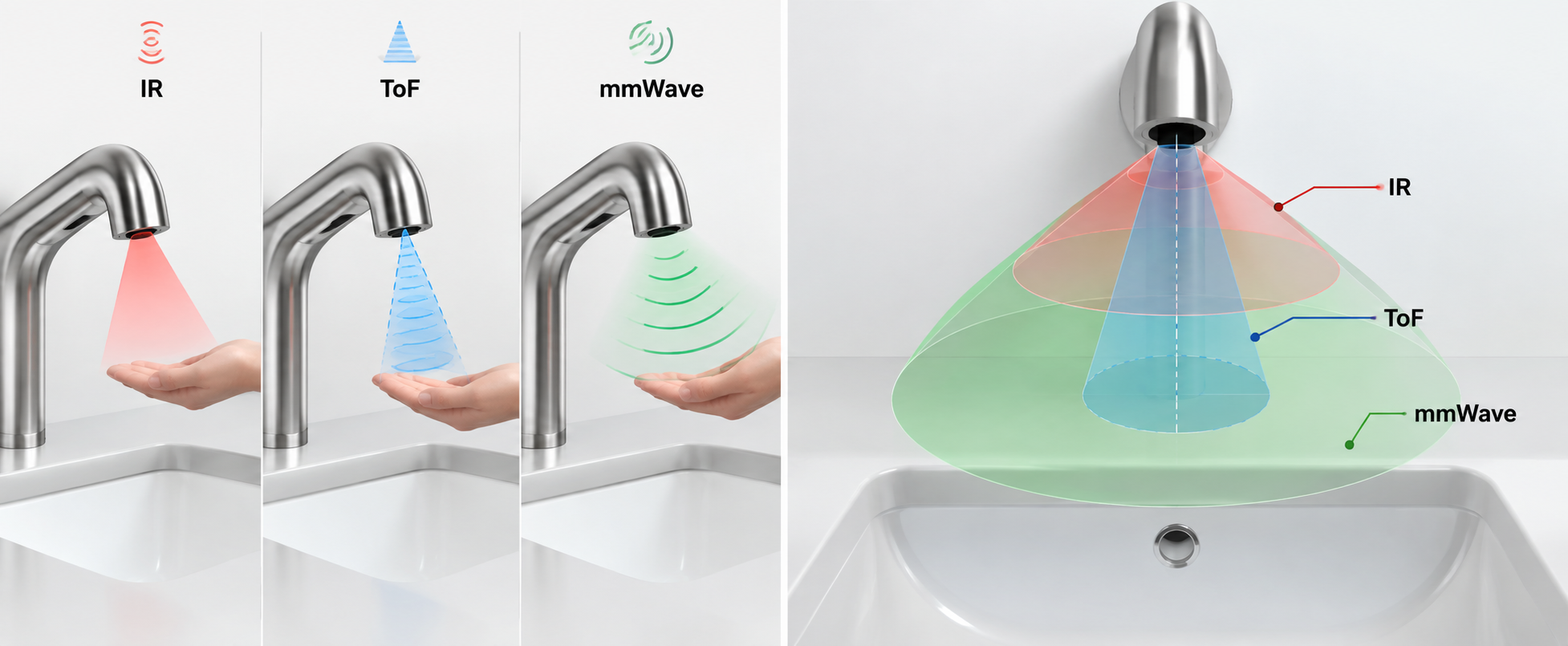
mmWave radar can provide long-range presence detection, motion information and additional radar-derived variables. Conventional IR provides proven proximity detection with decades of faucet use. Direct ToF provides measured distance and has established commercial faucet deployment. Fontana’s architecture favors the information most directly tied to the faucet decision: where the target is relative to a short calibrated range window.
Precision Ranging Principle
Maximum sensing capability is different from useful sensing capability
A commercial lavatory normally needs a small and deliberately constrained sensing field. The engineering value of ranging is therefore not that a sensor can detect farther. It is that distance can become an explicit variable used to determine whether a target belongs inside or outside the intended activation zone.
|
Engineering question
|
Conventional IR
|
Direct ToF
|
mmWave radar
|
|
Engineering question: Can it detect a user?
|
Conventional IR: Yes
|
Direct ToF: Yes
|
mmWave radar: Yes
|
|
Engineering question: Can distance be a direct control variable?
|
Conventional IR: Architecture-dependent
|
Direct ToF: Yes
|
mmWave radar: Yes
|
|
Engineering question: Is long-range presence a core strength?
|
Conventional IR: No
|
Direct ToF: Device-dependent
|
mmWave radar: Yes; a major radar capability
|
|
Engineering question: Is optical reflectivity a design consideration?
|
Conventional IR: Yes
|
Direct ToF: Reduced versus simple reflective IR, but optics still matter
|
mmWave radar: No optical-light dependency; RF target and reflection behavior still matter
|
|
Engineering question: Does a faucet normally need velocity data?
|
Conventional IR: Usually no
|
Direct ToF: Usually no
|
mmWave radar: Available in many systems, but not normally required for basic faucet activation
|
|
Engineering question: Commercial faucet application maturity
|
Conventional IR: Established; decades of commercial faucet use
|
Direct ToF: Established with multi-year commercial deployment
|
mmWave radar: Emerging; broad commercial faucet deployment is not yet established
|
|
Engineering question: Does the complete faucet still require validation?
|
Conventional IR: Yes
|
Direct ToF: Yes
|
mmWave radar: Yes
|
Engineering principle
The engineering objective is not to detect more of the environment. It is to reliably detect the intended user within the correct portion of the environment.
10–30 cm
Documented sensing-distance criterion; 12 cm preset target
<30°
Documented sensing-angle criterion
IP67
Documented PCB/electronics waterproofing criterion
200,000
Lifecycle activation cycles followed by performance checks
Scope note: these values come from Fontana’s finished sensor-faucet inspection procedure. They should not be described as isolated qualification results for the ToF semiconductor itself.
The faucet decision is binary—but the environment is not
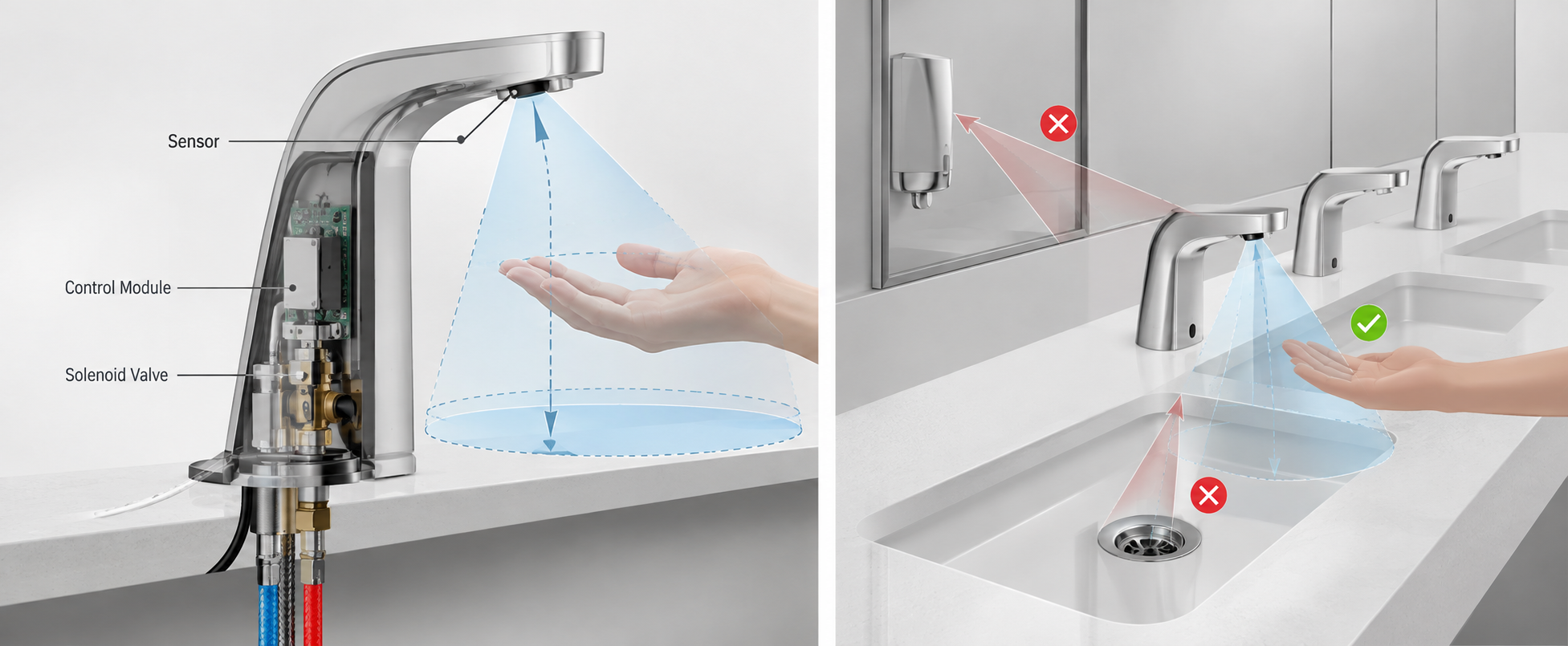
Water on/water off appears simple, yet the sensor sees changing targets, wet surfaces, chrome drains, countertop edges, soap dispensers, neighboring faucets, and cleaning tools. Better control comes from limiting the acceptable activation space and validating the installed geometry.
This is why
detection-zone control matters more than maximum sensor range.
The useful engineering question is whether the system can distinguish the handwashing zone from everything surrounding it.
Direct Ranging
Why ToF is attractive for this problem
Direct ranging makes the target’s measured distance available to the control logic. ST notes that its ToF devices determine absolute distance and that some devices support programmable regions of interest and field-of-view controls. Those capabilities align with the need to restrict what a faucet considers an intentional interaction.
The important distinction from simpler reflective proximity sensing is developed further in
ToF vs traditional IR: why distance measurement changes faucet sensing.
Control Logic Concept
Think in terms of an accepted distance window
A simplified ranging model divides the environment into targets that are too far away, targets that enter the intended handwashing region, and targets that leave that region.
Outside Zone
Reject
Background surfaces or activity beyond the intended interaction distance.
Activation Window
Accept
Target is located where deliberate handwashing interaction is expected.
Target Leaves
Shut Off
Controller no longer sees the intended target inside the accepted window.
This diagram is conceptual. Actual sensor algorithms may use additional filtering, timing, confidence thresholds and implementation-specific logic.
Why mmWave is not dismissed
mmWave radar is a highly capable sensing technology when non-optical detection, wide-area presence sensing, motion sensitivity, range, velocity or additional spatial information is valuable. Current 60 GHz radar platforms demonstrate sophisticated presence detection over distances measured in meters and are well suited to applications such as occupancy sensing, building automation, industrial sensing, robotics and automotive systems.
Those capabilities, however, should not be confused with commercial-faucet maturity. mmWave remains an emerging architecture for touchless faucet activation, with substantially less documented faucet-specific deployment than conventional IR or direct ToF. A lavatory faucet also presents a very different sensing objective from room-scale presence detection: the system must repeatedly recognize an intended hand inside a compact basin interaction zone while rejecting surrounding fixtures, surfaces, cleaning activity and other irrelevant targets.
The engineering question is therefore not whether mmWave can detect a hand—it can. The question is whether its additional sensing capabilities produce a measurable advantage after they are constrained, packaged, powered, calibrated and validated inside a commercial faucet. That question is explored in
whether mmWave radar can replace ToF in commercial touchless faucets.

Application Maturity
Capability at the Sensor Level Does Not Equal Validation at the Faucet Level
An advanced sensing module can demonstrate impressive range, motion discrimination or spatial information and still require substantial engineering before it becomes a proven faucet architecture. Commercial faucets impose their own constraints: compact packaging, controlled detection geometry, nearby metal and water surfaces, moisture exposure, power consumption, response timing, solenoid coordination, hydraulic behavior, cleaning conditions, repeated cycling and long-term serviceability. Sensor capability and faucet maturity should therefore be evaluated as separate engineering questions.
Why conventional IR remains valid—but different
Conventional IR proximity remains a practical and mature commercial-faucet architecture and can perform very well when the optical field, reflective surfaces, ambient-light conditions and installed geometry are properly managed.
The argument for ToF is not that IR is obsolete. It is that direct ranging offers a different control variable that can simplify the definition of a short activation zone. That difference—not the age or novelty of the technology—is what matters in this comparison.
Distance does not replace geometry
A distance measurement still exists inside a physical field of view. Spout projection, sensor orientation, basin depth, drain location, neighboring fixtures and user hand positions continue to affect the installed interaction.
Spout Projection
Influences natural hand position.
Sensor Angle
Controls where distance is being measured.
Basin Depth
Changes separation between hand zone and background.
Drain Location
Defines a persistent object inside the sensing environment.
For that reason, precision ranging and detection geometry should be specified together rather than treated as separate subjects.
System Validation
Precision ranging is only one layer of faucet reliability
Fontana’s factory procedure does not stop at the sensor. It defines sensing range, sensing angle, anti-interference behavior, response and shutoff timing, moisture protection, temperature and humidity exposure, pressure endurance, and lifecycle cycling.
That system-level evidence is what turns a sensing concept into a commercial faucet implementation. Precision ranging improves the quality of the sensing decision; it does not replace validation of electronics, power, firmware, solenoid, valve, enclosure and hydraulics.

Engineering Conclusions
The commercial-faucet sensing problem is not a contest for maximum range or maximum information. It is a control problem centered on repeatedly identifying deliberate hand placement within a compact and predictable interaction zone.
Direct ToF is well aligned with that requirement because measured distance becomes an explicit control variable. Conventional IR remains a mature and valid faucet architecture, while mmWave radar offers significant sensing capability but remains comparatively emerging in commercial faucet activation. For Fontana, the engineering priority remains the architecture that can be integrated, calibrated and validated around the actual basin interaction rather than the technology offering the greatest theoretical sensing capability.
Engineering Decision Criteria
For a commercial faucet, sensor technology should be evaluated against the actual control requirement: detection-zone definition, target distance, basin geometry, false-target rejection, neighboring-fixture behavior, application maturity and complete system validation. Maximum range, novelty and feature count are secondary if those capabilities do not improve the faucet’s intended interaction.
Continue the Sensor Engineering Series
Return to the technology-comparison hub, review Fontana’s overall ToF selection rationale, or continue into the specialist pages for traditional IR, mmWave and detection-zone control.
|
|
|