Radar vs Field-Proven Precision Ranging
Can mmWave Radar Replace ToF in Commercial Touchless Faucets?
mmWave radar is technically powerful, but it remains an emerging sensing architecture for commercial faucet activation. Replacing an established faucet sensing platform requires more than demonstrating that radar can detect a hand. Fontana ToF systems have been deployed, tested and operated across hundreds upon hundreds of commercial projects for approximately eight years.
The burden of proof changes when the existing technology already has a field record
This is not a comparison between two laboratory concepts.
Fontana's Time-of-Flight sensing architecture has been implemented in commercial touchless faucet installations for approximately eight years across hundreds upon hundreds of projects.
Those installations represent years of manufacturing, factory testing, commissioning and field exposure across different buildings, basins, finishes, plumbing conditions, user populations and maintenance environments.
Read More →
The Correct Engineering Question
Can mmWave demonstrate a meaningful improvement over an established ToF baseline?
It is not enough to demonstrate that mmWave can sense movement or measure distance. A replacement must demonstrate that a complete radar-based faucet can meet or exceed the short-range control, false-trigger resistance, reliability, environmental behavior, power requirements and lifecycle performance already established by the existing ToF implementation.
Established Field Baseline
Eight Years of Deployment Changes the Comparison
Fontana ToF faucets have not simply passed a development test and entered production. The sensing architecture has accumulated approximately eight years of commercial field use across hundreds upon hundreds of projects.
Each completed project adds information that cannot be reproduced by a short laboratory demonstration: different countertops, reflective drains, dark and light basins, faucet finishes, water quality, electrical conditions, plumbing pressure, installation geometry, cleaning practices, user behavior and maintenance cycles.
A replacement technology therefore has to compete not only with ToF sensor physics, but with years of accumulated implementation knowledge.
~8 Years
Commercial ToF deployment history
Hundreds
of commercial projects
Repeated
factory and lifecycle testing
Real Field
installation and operating conditions

Commercial Application Maturity
mmWave Is Advanced Sensor Technology—But Still Emerging in Commercial Faucets
mmWave radar is well established in applications such as automotive sensing, occupancy detection, industrial monitoring and robotics. That maturity at the semiconductor and module level should not be confused with maturity inside commercial touchless faucets.
At present, broad commercial deployment of mmWave as the primary faucet-activation architecture is not established in the way conventional infrared and direct ToF faucet sensing are established.
This distinction matters because a capable radar module is only the starting point. Commercial faucet maturity requires integrated hardware, firmware, power architecture, packaging, environmental protection, valve coordination, calibration, manufacturing control, installation experience, lifecycle testing and field validation.
Radar Capability
mmWave is genuinely powerful technology
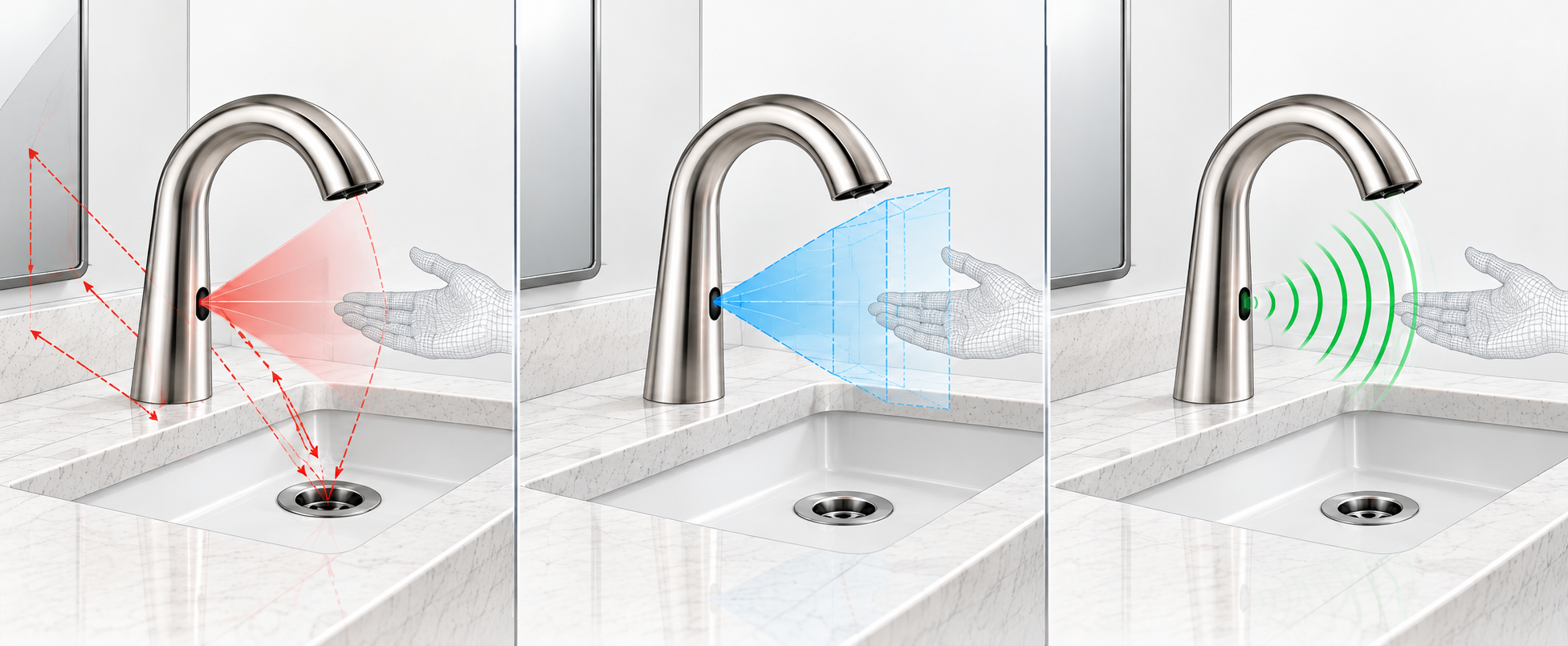
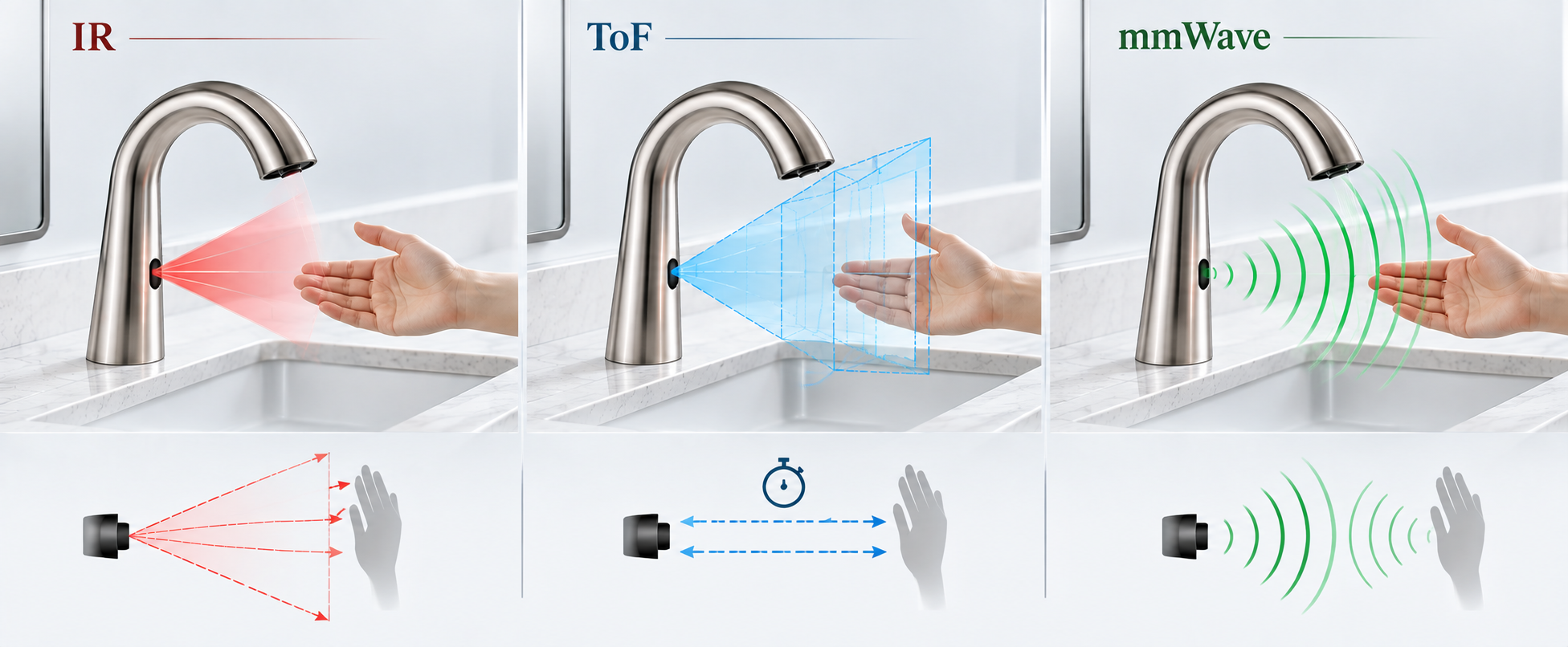
Modern mmWave radar can measure range and movement and can support presence detection, velocity estimation, angle information and micro-motion analysis depending on architecture.
Those capabilities make radar highly valuable in automotive systems, occupancy sensing, robotics, industrial sensing and other applications where larger spatial awareness or optical independence is important.
But a lavatory faucet has a much narrower job
A commercial faucet does not need to determine where a person is standing several meters away.
It normally needs to determine whether hands have entered a relatively small operating zone beneath or immediately in front of the spout.
That is why Fontana's architecture focuses on
precision ranging within a controlled faucet activation zone
rather than maximizing total sensing capability.
|
Engineering Factor
|
Fontana ToF
|
mmWave Radar
|
|
Engineering Factor: Direct range measurement
|
Fontana ToF: Yes
|
mmWave Radar: Yes
|
|
Engineering Factor: Short-range faucet control
|
Fontana ToF: Established application architecture
|
mmWave Radar: Technically feasible; requires faucet-specific integration, calibration and validation
|
|
Engineering Factor: Commercial faucet maturity
|
Fontana ToF: Established with multi-year field deployment
|
mmWave Radar: Emerging; broad commercial faucet adoption is not yet established
|
|
Engineering Factor: Commercial field history in Fontana faucets
|
Fontana ToF: Approximately eight years across hundreds upon hundreds of projects
|
mmWave Radar: No equivalent Fontana faucet field history established
|
|
Engineering Factor: Optical-light dependency
|
Fontana ToF: Yes; managed through optical design and signal processing
|
mmWave Radar: No optical-light dependency
|
|
Engineering Factor: Scene-reflection challenge
|
Fontana ToF: Optical reflections, crosstalk and target geometry
|
mmWave Radar: RF reflections, multipath, antenna pattern, clutter and surrounding metal/water geometry
|
|
Engineering Factor: Maximum range capability
|
Fontana ToF: Can be deliberately constrained for faucet use
|
mmWave Radar: Often substantially greater than the faucet requirement and must be deliberately constrained
|
|
Engineering Factor: Velocity / micro-motion information
|
Fontana ToF: Not normally required
|
mmWave Radar: Potentially available, but not inherently necessary for faucet activation
|
|
Engineering Factor: Lifecycle / finished-product validation
|
Fontana ToF: Existing Fontana testing and field history
|
mmWave Radar: Must be demonstrated in the completed faucet architecture
|
|
Engineering Factor: Replacement burden
|
Fontana ToF: Established baseline
|
mmWave Radar: Must demonstrate equal or better faucet-level performance with a meaningful project benefit
|
Engineering Baseline
The question is no longer whether ToF can work in a commercial faucet. Eight years of implementation across hundreds upon hundreds of projects have already answered that question.
The remaining question is whether mmWave can do materially better
A replacement is justified when it solves a documented deficiency, materially improves performance, reduces lifecycle risk, simplifies integration, improves serviceability, or provides another project-relevant advantage.
Simply demonstrating that a radar module can detect a hand does not satisfy that standard.
Field-Proven Baseline
A Prototype Is Not Eight Years of Implementation
A development-board mmWave sensor may demonstrate excellent raw sensing capability.
But a production faucet incorporates considerably more: sensing hardware, firmware, filtering, mechanical geometry, environmental protection, power management, solenoid control, hydraulic design, manufacturing tolerances, installation procedures and service requirements.
Fontana's ToF architecture has accumulated these layers through years of repeated implementation. A comparative test should acknowledge that difference rather than treating two sensor boards as if they represent two equally mature faucet systems.
Read More
Accumulated Engineering Knowledge
What Eight Years of Projects Actually Provides
Different Basin Geometries
Real installations expose the sensor to different depths, drain positions and counter configurations.
Different Surface Finishes
Chrome, brushed finishes, dark basins and reflective materials alter the sensing environment.
Different User Populations
High-traffic commercial use creates a much broader range of hand positions and interactions.
Different Plumbing Conditions
Pressure, flow, water quality and system layout vary between projects.
Cleaning & Maintenance Exposure
Real facilities introduce water splash, cleaning activity and repeated service interaction.
Manufacturing Feedback
Repeated production provides opportunities to refine assembly, inspection and quality-control processes.

mmWave removes optical problems—but introduces RF engineering
One legitimate mmWave advantage is that radar is not dependent on optical illumination.
But that does not make the sensing environment irrelevant. A lavatory contains metal faucet bodies, chrome drains, water, plumbing, mirrors, partitions and neighboring fixtures.
Radar must manage antenna geometry, reflections, multipath, clutter, range gating and target classification just as optical systems must manage optical geometry, reflections, ambient conditions and crosstalk.
The Metric That Matters
The challenge is not detecting a hand—it is rejecting everything else
Any credible faucet sensor evaluation must measure intended activation and unintended activation separately.
A system that detects hands reliably but also reacts to neighboring users, nearby motion or environmental objects has not solved the complete control problem. This is examined in detail in
false activations in IR, ToF and mmWave touchless faucets.
10–30 cm
Sensing-distance criterion with 12 cm preset target
<30°
Documented sensing-angle criterion
IP67
PCB/electronics waterproofing criterion
200,000
Lifecycle activation cycles with post-test checks
Scope: these are finished-faucet factory criteria, not isolated semiconductor qualification results. They demonstrate that sensor selection is evaluated as part of the complete commercial faucet.
A fair comparison must challenge the established baseline
If mmWave is being evaluated as a replacement, both technologies should be tested under equivalent faucet conditions.
The test should control the basin, target paths, activation zone, valve, power conditions, wet and dry surfaces, adjacent fixtures, false-positive definition, false-negative definition, response criteria and lifecycle requirements. A rigorous framework is described in
how touchless faucet sensor reliability should actually be tested.
|
Test Area
|
Required Question
|
|
Test Area: Intended activation
|
Required Question: Does radar recognize normal hand positions as consistently as the established ToF implementation?
|
|
Test Area: False activation
|
Required Question: Does radar reject neighboring movement and irrelevant targets at least as effectively?
|
|
Test Area: Detection geometry
|
Required Question: Can the radar field be constrained to the required short-range washing zone?
|
|
Test Area: RF environment
|
Required Question: Does the implementation remain stable around metal surfaces, water, mirrors, drains, plumbing and other RF-reflective geometry?
|
|
Test Area: Environmental operation
|
Required Question: Does performance remain stable with water, cleaning activity, temperature and humidity?
|
|
Test Area: Adjacent fixtures
|
Required Question: Does a dense fixture bank remain stable when multiple systems operate simultaneously?
|
|
Test Area: Power architecture
|
Required Question: Is radar power demand acceptable for the intended faucet system and power source?
|
|
Test Area: Lifecycle
|
Required Question: Does the complete mmWave faucet maintain performance after repeated cycling?
|
|
Test Area: Field validation
|
Required Question: Can laboratory success be reproduced across real commercial installations?
|
|
Test Area: Project benefit
|
Required Question: Does mmWave provide a measurable advantage that justifies replacing an already established architecture?
|
System Reliability
Replacing ToF means replacing part of a validated system
The faucet does not end at the sensor. Detection is followed by controller logic, electrical power, solenoid actuation, valve movement, hydraulic response and shutoff.
Changing the sensing architecture therefore requires validating the complete operating chain, not merely demonstrating a successful radar detection. See
sensor-to-solenoid system reliability.
Engineering Conclusions
mmWave Can Be Evaluated—But It Must Beat an Established Baseline
There is no technical reason to dismiss mmWave radar. It is an advanced sensing technology with genuine advantages in applications where optical independence, motion analysis, presence classification or broader spatial awareness are valuable.
But those capabilities do not establish mmWave as a mature commercial-faucet architecture. At present, its use for faucet activation remains comparatively emerging, while Fontana ToF has already accumulated approximately eight years of production implementation, repeated testing and field exposure across hundreds upon hundreds of commercial projects.
The relevant engineering comparison is therefore not "new radar versus old optical sensing." It is an emerging faucet architecture versus an established precision-ranging implementation with years of field experience.
A replacement technology should be required to demonstrate a measurable faucet-level advantage over that record—not simply technological novelty.
Continue the Sensor Engineering Series
|
|
|