Fontana Engineering Position
Why Fontana Selected Time-of-Flight Sensing for Commercial Touchless Faucets
A technical explanation of the sensing requirements behind Fontana’s ToF architecture: controlled short-range ranging, defined activation zones, interference management, multi-year commercial deployment, and validation of the complete faucet—not a claim that one sensor is universally superior.
The selection started with the application
A commercial touchless faucet has a narrow job: recognize deliberate hand placement near the outlet, start flow promptly, stop when the user leaves, and ignore the many other objects and activities around the basin. For Fontana, that favors a sensing architecture in which distance can be explicitly measured and constrained. The decision was therefore driven by the geometry and control requirements of the lavatory application rather than by maximum sensor range or technology novelty.
Why distance is useful
Direct ToF provides an actual ranging measurement. That makes it possible to design around a calibrated activation window rather than rely only on the strength of reflected optical energy. The advantage is not theoretical distance range; it is control over a small, repeatable operating zone.
|
Design requirement
|
Why it matters at a lavatory
|
Why ToF was selected
|
|
Design requirement: Defined activation zone
|
Why it matters at a lavatory: Reduces interaction with basin, drain, backsplash and passersby
|
Why ToF was selected: Distance thresholds directly support controlled zone definition
|
|
Design requirement: Repeatable hand ranging
|
Why it matters at a lavatory: Users approach at different speeds and angles
|
Why ToF was selected: Ranging provides a measurable position variable for the control system
|
|
Design requirement: Adjacent-fixture coordination
|
Why it matters at a lavatory: Dense wash stations place multiple sensor fixtures close together
|
Why ToF was selected: The finished implementation can be calibrated and validated for nearby-device behavior
|
|
Design requirement: Wet-environment robustness
|
Why it matters at a lavatory: Electronics operate near splashing, humidity, condensation and cleaning activity
|
Why ToF was selected: Sensor selection is paired with enclosure protection and PCB waterproofing criteria
|
|
Design requirement: Lifecycle performance
|
Why it matters at a lavatory: High-traffic facilities create repeated daily activations over extended service periods
|
Why ToF was selected: The sensing architecture is validated as part of the complete faucet, valve and power system
|
Engineering principle
Fontana’s rationale is not that ToF is universally “better.” It is that precise short-range ranging is well matched to the control problem a commercial touchless faucet must solve—and that architecture has been carried forward through multi-year commercial deployment and finished-product validation.
Commercial Deployment Perspective
ToF Is Not Being Evaluated as a Laboratory-Only Concept
Fontana’s ToF sensing direction has been used across commercial touchless-faucet applications over multiple years and across a broad range of project conditions. That distinction matters. Engineering decisions for production fixtures should be judged not only by what a sensor can demonstrate on a development board, but also by how the completed faucet performs after integration with optics, firmware, power electronics, solenoid control, hydraulic components, enclosure protection and real installation geometry.
10–30 cm
Documented sensing-distance criterion; 12 cm preset target
<30°
Documented sensing-angle criterion
IP67
Documented PCB/electronics waterproofing criterion
200,000
Lifecycle activation cycles followed by performance checks
Scope note: these values come from Fontana’s finished sensor-faucet inspection procedure. They should not be described as isolated qualification results for the ToF semiconductor itself.
Not simply “IR versus ToF”
ToF itself uses infrared light in many implementations. The useful distinction is between direct distance ranging and simpler reflective proximity methods. ST describes its ToF architecture as direct distance measurement that is less dependent on target surface reflectivity than conventional IR proximity sensing. For the detailed sensing comparison, see
ToF vs traditional IR sensing.
Precision Ranging
Distance measurement changes the control problem
The important design objective is not maximum sensing distance. It is establishing a controlled window in which the intended hand can be distinguished from surrounding basin geometry and activity. Direct ranging gives the control system a measurable distance variable that can be used as part of that decision.
This is the central technical reason behind Fontana’s sensing direction. The next engineering layer explains
why Fontana uses precision ranging for commercial touchless faucets.
PRECISION RANGING
A faucet does not need room-scale perception
Long-range presence detection can be valuable in occupancy sensing, building automation, automotive and other applications. At a sink, however, the useful field is deliberately small. Fontana factory criteria include a 10–30 cm sensing range with a 12 cm preset target and less than 30° sensing angle. Those values reflect a short-range design philosophy rather than a maximum-range contest. This distinction is explored further in
detection-zone control versus maximum sensor range.
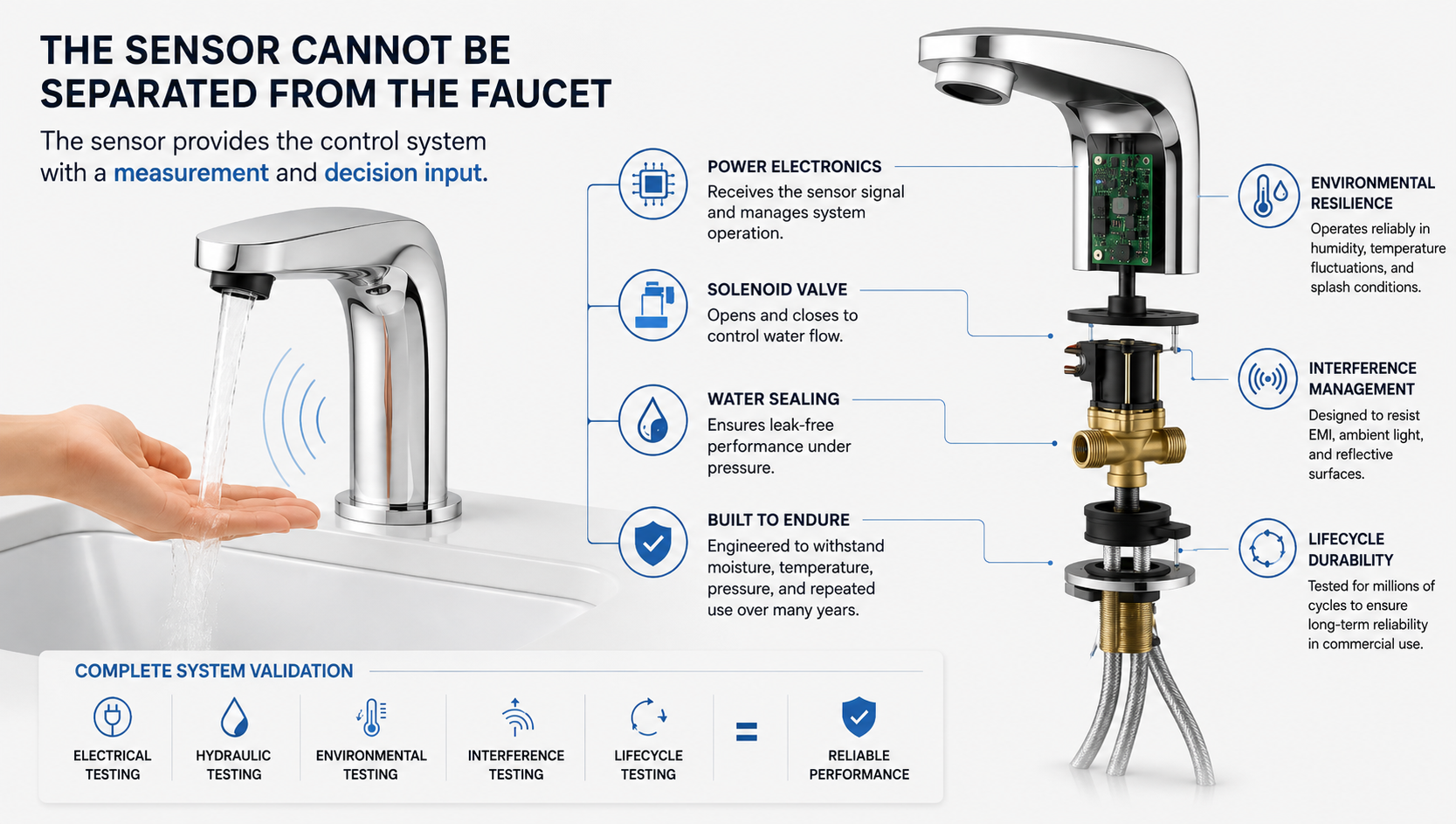
The sensor cannot be separated from the faucet
The sensor provides the control system with a measurement and decision input. The complete product must then power the electronics, drive the solenoid, maintain water sealing, tolerate pressure, survive moisture and temperature exposure, and continue to behave after repeated cycling. That is why Fontana’s validation record includes electrical, hydraulic, environmental, interference and lifecycle criteria in addition to sensing checks.
What the current factory record demonstrates
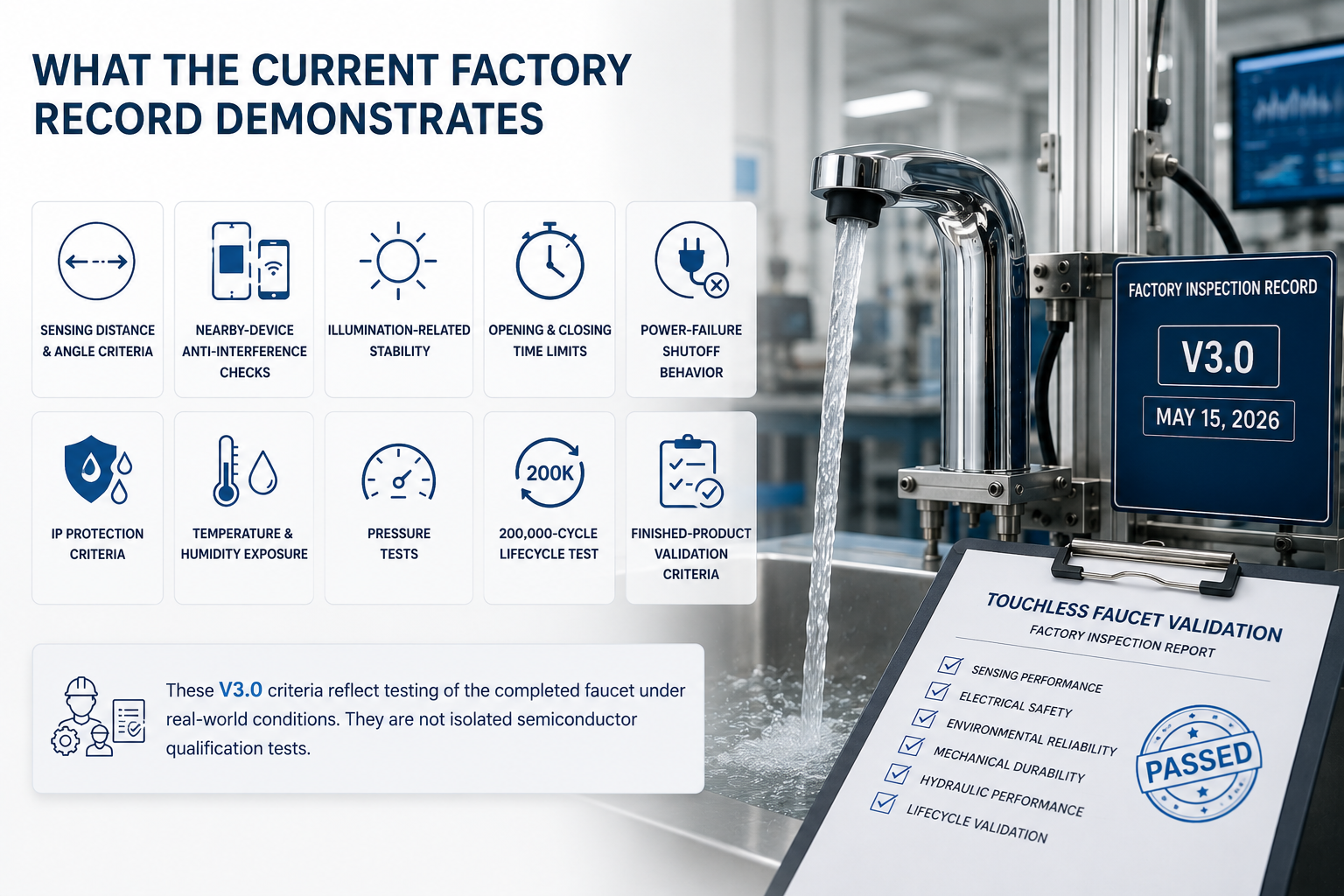
The V3.0 factory inspection record dated May 15, 2026 includes sensing distance and angle criteria, nearby-device anti-interference checks, illumination-related stability, opening and closing time limits, power-failure shutoff behavior, IP protection criteria, temperature and humidity exposure, pressure tests, and a 200,000-cycle lifecycle test. These are finished-product criteria; they should not be misrepresented as isolated semiconductor qualification tests.
For engineers evaluating the strength of such evidence, the more useful question is how the sensor and completed faucet should be challenged under repeatable conditions. See the framework for
testing touchless faucet sensor reliability.
Engineering Conclusions
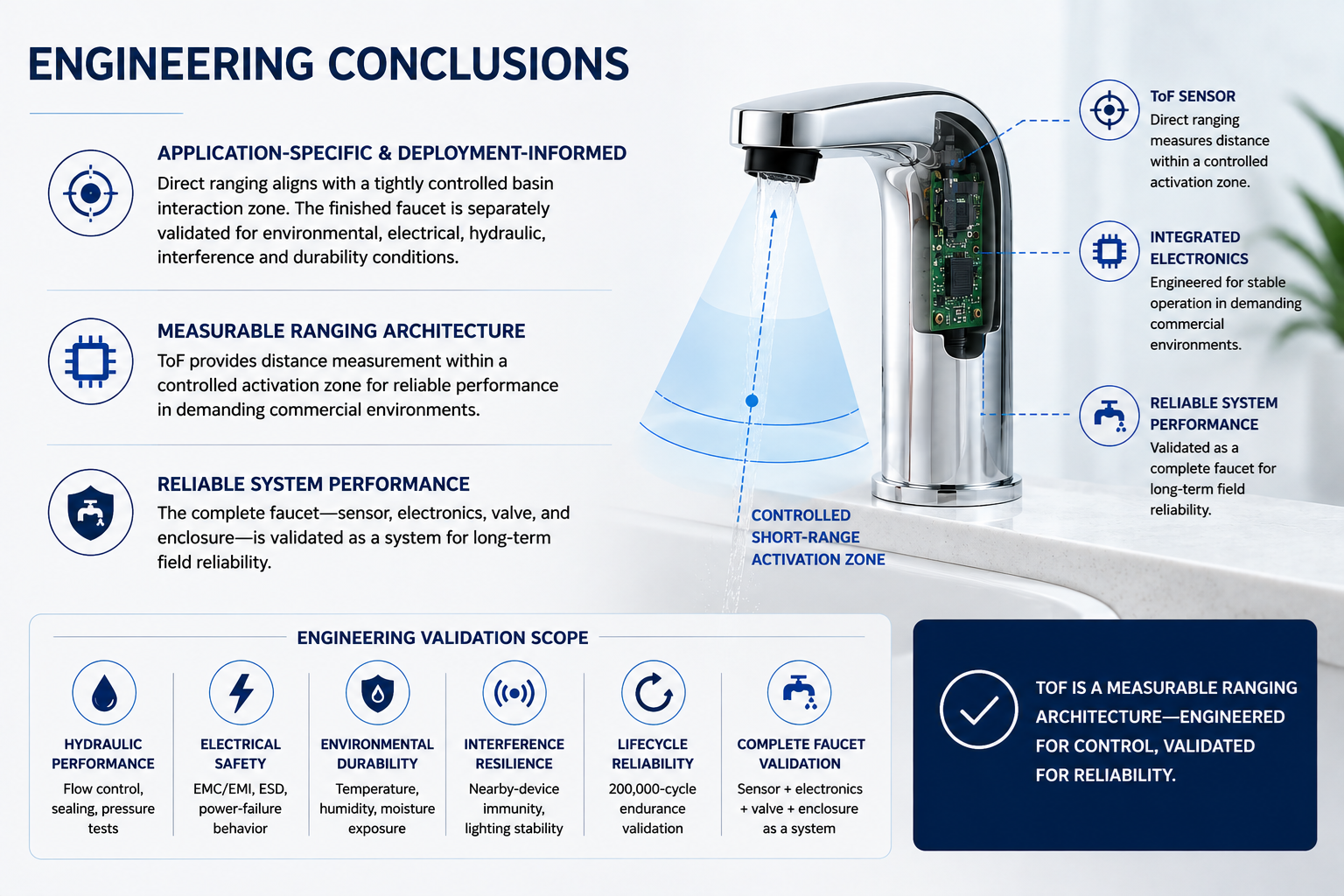
Fontana’s case for ToF is application-specific and deployment-informed: direct ranging aligns well with a tightly controlled basin interaction zone, while the finished faucet is separately validated for the environmental, electrical, hydraulic, interference and durability conditions that determine field reliability.
Selecting ToF does not eliminate the engineering work around firmware, optics, enclosure design, power, valves or hydraulics. It provides a measurable ranging architecture that Fontana has integrated into commercial faucet systems over multiple years and that can be engineered around controlled short-range activation rather than maximum sensing distance.

Technical Selection Criteria
For commercial faucet specification, evaluate the sensing method as one part of the complete control architecture. Detection-zone definition, application maturity, basin geometry, interference behavior, power-failure state, environmental protection, valve performance, pressure behavior, lifecycle testing and serviceability remain part of the engineering decision.
Continue the Sensor Engineering Series
Start with the broader sensor comparison, continue into Fontana’s precision-ranging rationale, or examine the specialist engineering topics behind conventional IR, detection-zone control and reliability testing.
|
|
|