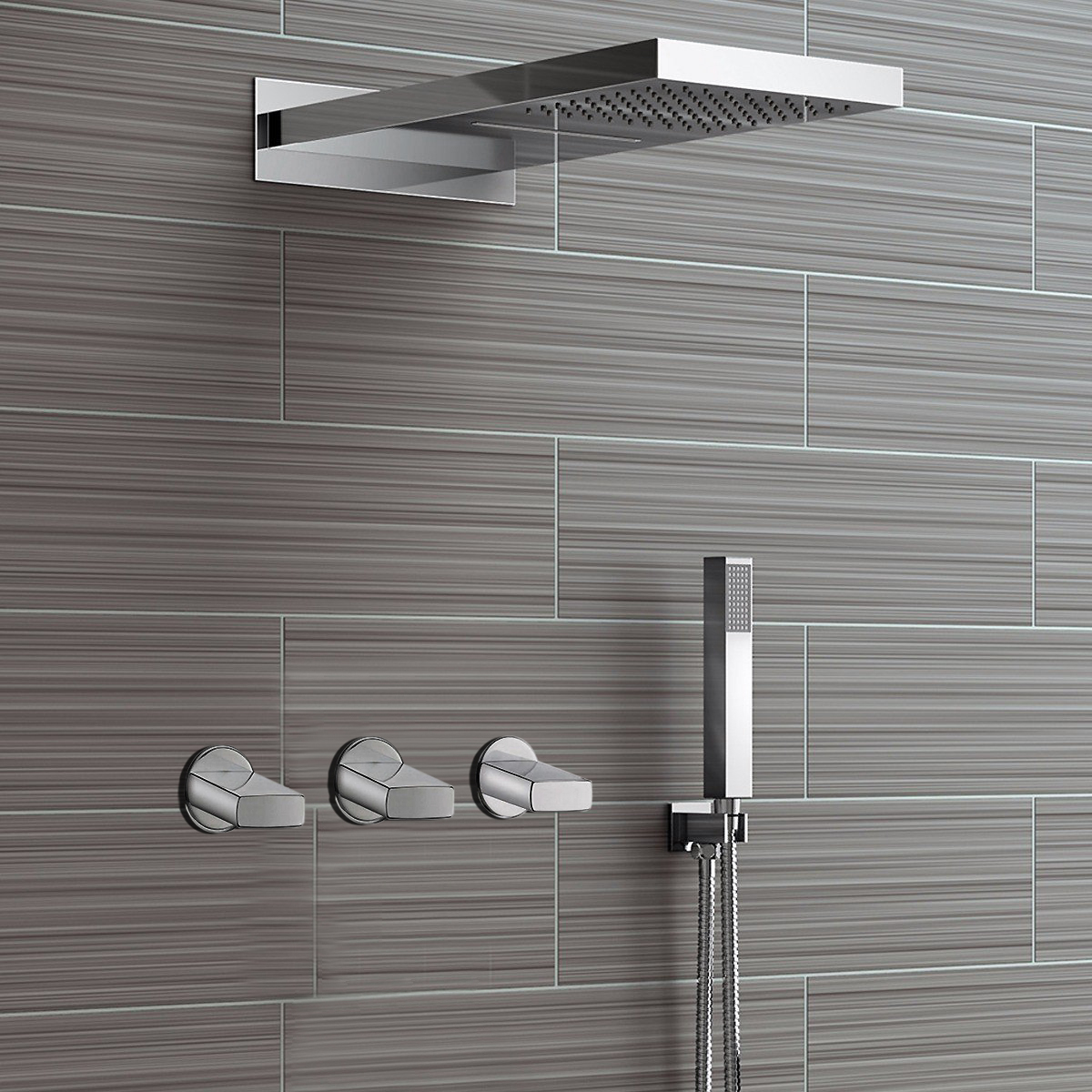
What are the benefits of a large-flow shower head?
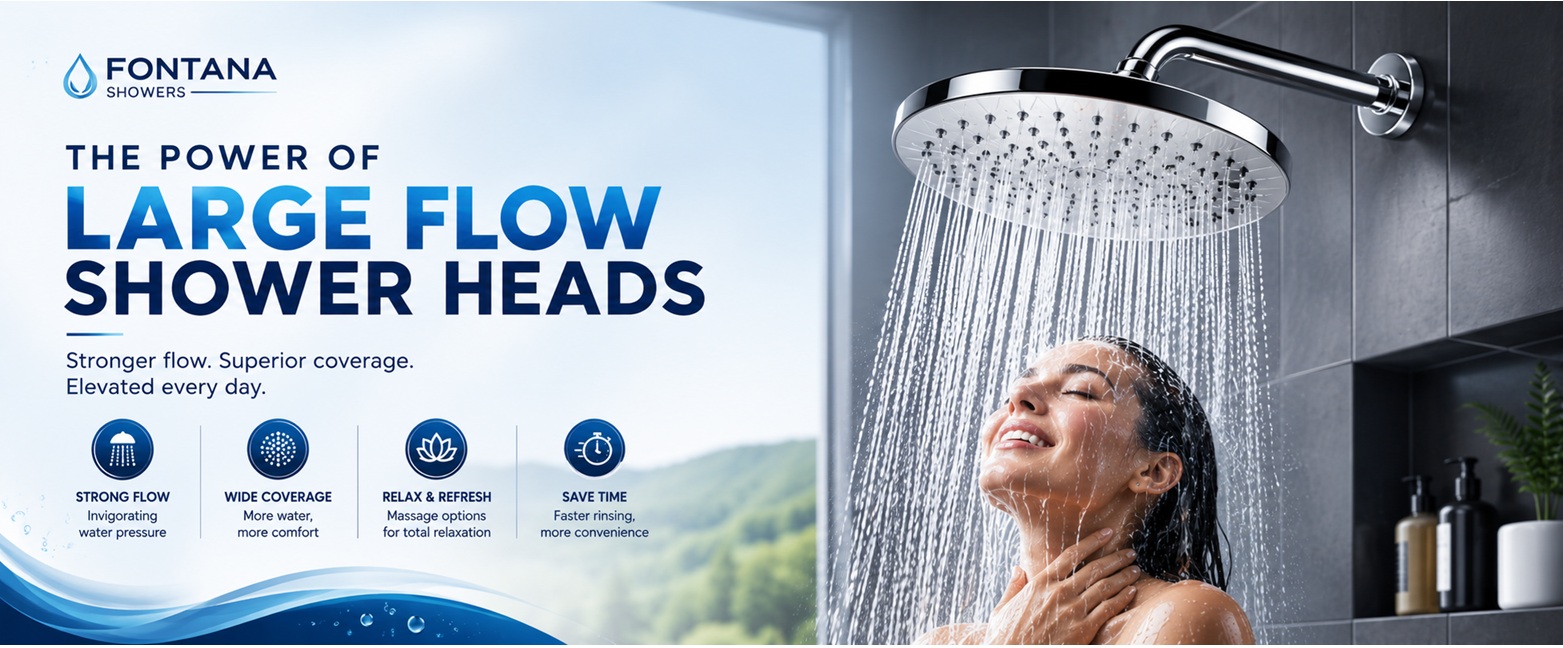
A large flow shower head offers several benefits that cater to individuals seeking a more robust and luxurious showering experience. Here are some of the key advantages:
1. Enhanced Water Pressure and Flow:
Invigorating Showers: Large flow shower heads are designed to deliver a strong and consistent water flow, providing a more invigorating shower experience compared to standard or low-flow shower heads. The increased water pressure can help in rinsing off shampoo, conditioner, and soap more effectively.
Comfortable and Spa-like Experience: The strong water flow envelops the body, creating a spa-like sensation that enhances relaxation and enjoyment during showers.
2. Comprehensive Coverage:
Wide Spray Patterns: Many large flow shower heads feature larger diameters and multiple or larger nozzles. This design allows for broader water coverage, ensuring that water reaches more areas of the body simultaneously.
Customizable Settings: Some models offer adjustable spray settings such as rainfall, massage, or combination modes. This versatility allows users to personalize their shower experience based on their preferences for water pressure and coverage.
3. Efficiency in Rinsing and Time Savings:
Quick Rinsing: The higher flow rate of large flow shower heads facilitates quicker rinsing of hair and body, which can save time during morning routines or after workouts.
Efficient Removal of Products: More water volume helps in efficiently washing away hair products and body washes, reducing the time spent in the shower.
4. Therapeutic and Relaxation Benefits:
Massage Features: Some large flow shower heads include massage settings that can help alleviate muscle tension and promote relaxation. These settings typically use pulsating or concentrated streams of water to massage specific areas of the body.
Stress Relief: A powerful shower experience can contribute to stress relief and improve overall well-being, making it an essential part of daily self-care routines.
5. Suitable for Various Preferences:
Family-Friendly: Large flow shower heads are suitable for households with multiple members or varying preferences in showering intensity. They can accommodate different needs without compromising comfort or efficiency.
Considerations:
Water Usage: While large flow shower heads provide a luxurious showering experience, they typically use more water compared to low-flow alternatives. Consider water conservation goals and local regulations when choosing a shower head.
Plumbing Compatibility: Ensure that your plumbing system can support a large flow shower head without causing issues such as reduced water pressure in other parts of the house or strain on pipes.
Conclusion:
A large flow shower head offers a blend of comfort, efficiency, and customization, making it a popular choice for those who prioritize a powerful and enjoyable shower experience. By selecting a shower head that meets both personal preferences and regulatory requirements, individuals can enhance their daily routine while promoting responsible water use and sustainability.
Let's delve deeper into the benefits of using a large flow shower head, considering various aspects that make it a preferred choice for many:
6. Superior Shower Experience:
Luxurious Feel: Large flow shower heads provide a luxurious showering experience by enveloping the body in a generous amount of water. This creates a sensation of being under a rainfall or in a spa-like environment, enhancing relaxation and enjoyment.
Soothing Effect: The strong water pressure from large flow shower heads can have a soothing effect, helping to relieve stress and tension after a long day.
7. Improved Shower Efficiency:
Effective Cleaning: The higher flow rate ensures thorough rinsing of soap, shampoo, and conditioner, leaving skin and hair feeling clean and refreshed in a shorter amount of time.
Convenience: Efficient rinsing reduces the time spent in the shower, making it more convenient for individuals with busy schedules or multiple household members sharing the bathroom.
8. Customizable Features:
Multiple Spray Patterns: Many large flow shower heads offer versatile spray patterns, allowing users to adjust the water flow to their liking. This customization can include options such as massage, rainfall, or combination settings, catering to different preferences for water pressure and coverage.
Adjustable Settings: Some models come with adjustable settings that enable users to control the intensity and direction of the water flow, providing a personalized shower experience.
9. Family and Household Considerations:
Versatility: Large flow shower heads are suitable for households with varying preferences in showering intensity. They can accommodate different age groups and individual needs without sacrificing comfort or efficiency.
Durability: High-quality large flow shower heads are often made from durable materials such as stainless steel or robust plastics, ensuring longevity and resistance to corrosion.
10. Psychological Benefits:
Mental Refreshment: A powerful and satisfying shower can contribute to mental refreshment and rejuvenation, boosting mood and overall well-being.
Daily Ritual Enhancement: For many, the shower is a daily ritual that sets the tone for the day or provides relaxation at night. A large flow shower head enhances this experience, making it a highlight of the daily routine.
Considerations for Installation and Use:
Regulatory Compliance: Before installing a large flow shower head, ensure it complies with local regulations regarding maximum flow rates and efficiency standards. This ensures legal compliance and supports water conservation efforts in your community.
Maintenance: Regular cleaning and maintenance of the shower head are essential to maintain optimal water flow and performance over time. Removing mineral deposits and debris helps prevent clogs and ensures consistent water pressure.
Conclusion:
The benefits of using a large flow shower head extend beyond mere functionality to include enhanced comfort, efficiency, customization, and psychological well-being. By choosing a shower head that meets both personal preferences and regulatory requirements, individuals can enjoy a superior showering experience while promoting responsible water use and sustainability in their homes. Whether for relaxation, efficiency, or family convenience, large flow shower heads offer a compelling solution to elevate the daily shower routine.
FontanaShowers Engineering and Field Experience
A large flow shower head does not automatically increase
incoming water pressure; the strength of the shower depends on dynamic PSI, available GPM,
internal hydraulic design, flow-control engineering, and nozzle geometry.
A Large Shower Head Will Not Make Your Shower Feel Stronger
Based on 40+ years of engineering evaluation, product
development, field installation, troubleshooting, and hands-on performance
testing, we have examined shower behavior across thousands upon
thousands of residential, luxury hospitality, multifamily, and commercial
applications. That experience has established one consistent engineering
conclusion: shower strength is determined by the combined performance of
water pressure, flow rate, valve capacity, internal hydraulic design, flow
control, and nozzle geometry—not by the visible diameter of the shower head alone.
A larger spray face can create broader and more immersive coverage, but size
alone does not create additional plumbing pressure. The strongest-performing
high-pressure shower heads
are engineered to convert the pressure and water volume already available
in the building into stable outlet velocity, balanced coverage, and a
satisfying water impact.
A properly engineered large shower head can provide wide spray patterns, comprehensive body coverage, efficient rinsing, customizable rainfall or massage settings, and a more immersive shower experience. These benefits depend on the available pressure and flow, not size alone.
Our direct answer: A large shower head can make the shower
feel stronger, but only when its water channels, distribution chamber,
flow-control components, outlet diameters, and rainfall geometry are
properly engineered for the available dynamic PSI and permitted GPM.
A poorly engineered oversized head can feel weaker than a compact head
connected to the same plumbing system.
What Thousands of Applications Have Confirmed
Over four decades, we have compared compact, medium-format, and oversized
shower heads under a wide range of real operating conditions. These have
included municipal water systems, regulated residential supplies,
multifamily buildings, luxury hotel bathrooms, commercial installations,
thermostatic shower systems, pressure-balancing valves, diverter assemblies,
long pipe runs, and hard-water environments.
Across these applications, properly engineered pressure-compensating designs
consistently produced more stable and authoritative spray performance than
larger non-engineered designs operating under comparable supply conditions.
This does not mean the shower head creates pressure. It means that effective
internal engineering uses the available pressure with less imbalance,
turbulence, and uncontrolled loss.
We have repeatedly found that increasing spray-face dimensions without
redesigning the internal water-distribution system divides the available
flow across more outlets and a larger surface. The result is often broad
coverage with weak perimeter streams, uneven discharge, or a softer point
of impact. Well-designed
large shower heads
overcome this limitation through balanced chambers, calculated passage
dimensions, optimized nozzle density, controlled outlet geometry, and
deliberate spray overlap.
Our most important field finding: Shower-head diameter
determines potential coverage. Hydraulic engineering determines whether
that coverage feels full, uniform, stable, and powerful.
PSI, GPM, Spray Force and Coverage Are Not the Same
The
PSI: Available Pressure
PSI, or pounds per square inch, describes pressure within the supply
system. Static PSI is measured while water is not moving. Dynamic PSI
is measured while the shower operates and is generally more useful when
evaluating real shower performance.
The
GPM: Delivered Water Volume
GPM, or gallons per minute, measures the quantity of water passing
through the shower head. More GPM may provide greater volume, but it does
not guarantee concentrated spray force, balanced coverage, or greater
outlet velocity.
Why
Spray Force: Water Impact
Spray force describes the impact of discharged water. It is affected by
dynamic pressure, outlet area, nozzle geometry, droplet formation,
pattern selection, and the number of outlets sharing the available flow.
The
Coverage: Effective Spray Area
Coverage describes how completely the spray reaches the intended area.
Properly designed
large rain shower heads
can provide significantly broader coverage without necessarily increasing
the fixture's rated GPM.
Internal Comparison Matrix: Size, Pressure and Perceived Strength
The following matrix summarizes recurring performance patterns observed in
Fontana product-development comparisons and field evaluations. It is
not intended to certify every shower head, actual
performance depends on the product, supply conditions, valve, pipe layout,
installation height, flow-control system, nozzle configuration, and state
or local water-use requirements.
Representative Dynamic Pressure
Shower-Head Configuration
Observed Performance Pattern
Engineering Explanation
Approximately 40 PSI
Compact 6-inch head with concentrated spray
Strong central impact with a smaller coverage area
Fewer active outlets and a compact spray face concentrate the
available flow into a smaller target area.
Approximately 40 PSI
Basic 12-inch rainfall head without balanced distribution
Broad coverage with softer impact and weaker perimeter streams
The available water is divided among more outlets without adequate
compensation for the expanded spray surface.
Approximately 40 PSI
Engineered 12-inch rainfall head
More uniform coverage with stronger perceived performance
Balanced flow paths and optimized nozzle geometry reduce center-to-edge
variation and improve effective distribution.
Approximately 60 PSI
Engineered 12-inch rainfall head
Full-body rainfall coverage with authoritative water impact
Greater available dynamic pressure supports stable outlet velocity
across the larger distribution area.
Approximately 60 PSI
Oversized head with poorly balanced internal chamber
Strong center discharge but inconsistent outer-zone performance
Increased pressure cannot fully correct an internally unbalanced
water-distribution design.
Different
rain shower head designs
can therefore feel substantially different even when their published flow
rates appear similar. The decisive factors are how the water is distributed,
accelerated, divided, and discharged.
Interpretation: An engineered large-format head does not
increase the building's incoming pressure. It preserves more usable
performance by controlling distribution losses and converting the available
PSI and GPM into more stable spray force and coverage.
PSI vs. GPM: The Measurement Most Homeowners Misunderstand
One of the most persistent misconceptions encountered during our field work
is that a higher GPM automatically creates a stronger shower. GPM describes
volume. PSI describes pressure, but does not predicts
how the water will feel after it passes through the valve, flow control,
internal channels, distribution chamber, and spray outlets.
Representative Dynamic PSI
Representative Flow
Typical Perceived Character
Technical Interpretation
35 PSI
2.5 GPM test condition
Moderate-volume spray with reduced impact potential
Water volume may be adequate, but lower dynamic pressure can limit
outlet velocity and perimeter stability.
55 PSI
2.5 GPM test condition
More energetic spray with stronger perceived impact
Comparable volume is delivered with greater available pressure.
55 PSI
1.8 GPM test condition
Lower volume with potentially concentrated and satisfying impact
Efficient nozzle engineering can preserve spray character while
limiting total water use.
35 PSI
3.0 GPM controlled comparison
Higher volume with potentially softer or less uniform impact
Greater volume does not automatically provide greater velocity,
pattern stability, or distribution uniformity.
Data qualification: These values represent internal
engineering comparison scenarios used to explain relationships among
pressure, volume, outlet design, and user perception. The 3.0-GPM example
is a controlled comparison condition, not a recommendation for use where
lower federal, state, or local limits apply.
Seven Engineering Factors That Determine Shower Strength
1. Dynamic Flow Stability
Dynamic pressure is the pressure remaining while water is flowing.
Performance can change when toilets, faucets, washing machines, or
other fixtures operate simultaneously. A strong design manages these
fluctuations without allowing the spray pattern to collapse.
2. Internal Hydraulic Channels
Passage diameter, channel length, chamber volume, inlet position, and
outlet distribution influence how evenly water reaches the entire face.
Poor channel geometry commonly produces strong center flow and weak
perimeter discharge.
3. Rainfall Geometry
Rainfall geometry includes nozzle spacing, outlet angle, spray-cone
overlap, droplet formation, chamber depth, and installation height.
Effective geometry minimizes dry zones while maintaining a consistent
full-body pattern.
4. Pressure Compensation
Pressure-compensating components do not manufacture new pressure.
They regulate the way water is released as inlet conditions vary,
helping maintain a more predictable flow and spray pattern within
the component's intended operating range.
5. Valve and Cartridge Capacity
The shower head is downstream of the control valve. Valve capacity,
cartridge condition, check valves, filters, diverters, and thermostatic
components can all restrict water before it reaches the head.
6. Pipe Layout and Installation
Pipe diameter, pipe length, elbows, elevation, fittings, supply balance,
and installation height introduce losses. A large head cannot recover
pressure already lost through an undersized or restricted system.
7. Nozzle Condition
Sediment and mineral accumulation reduce effective outlet area and
distort the spray. Nozzle condition must be evaluated before concluding
that the property has inadequate water pressure.
System-Level Engineering
Properly selected
thermostatic shower systems
integrate temperature control, valve capacity, outlet management, and
user safety with the hydraulic requirements of the shower head.
Flow Restrictor Design Comparison
Modern shower heads use flow-control components to manage water consumption
and satisfy applicable regulatory requirements. Our testing has repeatedly
demonstrated that two fixtures with the same nominal flow rating can feel
very different because the restrictor is only one part of the hydraulic
system. Restrictor geometry, chamber design, nozzle area, and pressure
response must work together.
Flow-Control Design
Observed Spray Character
Engineering Advantage
Common Limitation
Basic fixed-orifice control
Predictable maximum volume under the intended test condition
Simple component design and straightforward flow limitation
Spray consistency may vary more noticeably when inlet pressure changes.
Pressure-compensating flow control
More stable discharge across its intended operating range
Improved consistency as supply conditions fluctuate
It still requires sufficient inlet pressure and compatible nozzle engineering.
High-efficiency nozzle system
Controlled droplets or concentrated outlet streams
Can provide satisfying perceived force at a lower rated flow
Small passages may require more regular sediment and scale management.
Oversized chamber with unbalanced distribution
Strong central flow with weak or inconsistent perimeter streams
Creates a visually large rainfall surface
Physical size does not guarantee balanced coverage or powerful performance.
Long-term spray consistency depends on clean nozzles, unobstructed flow controls, and balanced internal water distribution.
Silicone Jets, Mineral Buildup and Long-Term Performance
Across thousands of applications, we have repeatedly diagnosed weak or
irregular spray that was initially blamed on poor building pressure but
was actually caused by partial nozzle obstruction, inlet-screen contamination,
valve debris, or internal mineral accumulation.
Hard-water deposits can progressively reduce the effective opening of each
outlet. This changes stream direction, increases overspray, creates weak
perimeter zones, and disrupts the engineered rainfall pattern. Flexible
silicone jets provide a practical maintenance advantage because deposits
can often be loosened by gently rubbing the outlet surface.
Nozzle or System Condition
Typical Performance Effect
Recommended Diagnostic Action
Clean nozzles and clear inlet screen
Uniform streams and intended coverage pattern
Use as the baseline for performance comparison.
Light mineral film
Minor directional irregularity or scattered overspray
Clean the nozzle face and repeat the observation.
Partially blocked outlets
Uneven streams, weak zones, or distorted rainfall geometry
Descale the head and inspect the inlet screen.
Heavy internal accumulation
Reduced effective flow and substantial pattern instability
Inspect internal passages, restrictor, screen, valve, and supply.
Valve or cartridge restriction
Low overall volume despite a clean shower head
Inspect upstream components rather than replacing only the head.
Reliable comparison requires control of the complete installation. Changing
multiple variables at once makes the findings difficult to interpret. Our
long-term testing and field-evaluation process compares products under
controlled, repeatable conditions whenever the installation permits.
Use the same supply line and shower arm.
Use the same valve, cartridge and diverter.
Record static pressure before operation.
Record dynamic pressure during operation.
Measure GPM after flow stabilizes.
Maintain a consistent test temperature.
Observe center and perimeter uniformity.
Measure coverage at a fixed distance.
Repeat with another fixture operating.
Inspect nozzles, screens and flow controls.
Repeat readings rather than relying on one test.
Document the exact product configuration.
For product-specific published data: We recommend recording
the model number, measuring instruments, calibration status, valve type,
supply-line dimensions, water temperature, installation height, stabilization
period, number of repetitions, static PSI, dynamic PSI, measured GPM, and
exact outlet configuration.
The installation height supports the intended rainfall pattern.
It May Feel Weaker When:
The spray face is enlarged without hydraulic redesign.
The valve, cartridge, diverter, or pipework is restrictive.
Available dynamic pressure is low.
Too many outlets divide a limited flow volume.
Mineral deposits obstruct the nozzles.
Perimeter channels receive insufficient water.
The shower head is installed outside its intended conditions.
Recognized Standards and Independent Authority Sources
Our field experience explains how shower systems perform in real applications.
Recognized standards and government programs provide the independent framework
for testing, conservation requirements, and regulated performance.
The harmonized ASME/CSA standard applies to plumbing supply fittings,
including showerheads and related shower fittings. It establishes recognized
requirements and test methods addressing areas such as flow performance,
pressure integrity, durability, leakage, materials, and mechanical operation.
EPA WaterSense — Showerhead Efficiency and Performance
EPA states that WaterSense-labeled showerheads use no more than 2.0 GPM
and must satisfy performance criteria addressing spray force and coverage.
This is important because efficient shower performance is evaluated using
more than water consumption alone.
Federal conservation requirements establish the generally applicable
maximum showerhead flow rate and the associated test conditions. More
restrictive state or local limits may also apply and should be confirmed
for the project location.
The Department of Energy administers federal showerhead energy and
water-conservation requirements, including regulatory and testing information
relevant to manufacturers and regulated products.
Read additional technical context about pressure, spray optimization,
and high-pressure shower-head behavior.
Frequently Asked Questions
Does a larger shower head increase water pressure?
No. A larger shower head does not raise the building's incoming water
pressure. It can make better or worse use of the available pressure
depending on its internal hydraulic design, nozzle arrangement, and
flow-control system.
Why can a small shower head feel stronger?
A compact head can concentrate the available flow through fewer outlets
and a smaller spray area. This can create a stronger central impact,
although it normally provides less body coverage than a large rainfall head.
Can a large rainfall shower head work at 40 PSI?
It can, provided the product is engineered for the available pressure and
the valve, pipework, and flow-control components do not create excessive
restriction. Performance must be evaluated at dynamic rather than static
pressure.
Does a higher GPM always create a stronger shower?
No. GPM measures water volume, not spray force. Outlet velocity, pressure,
nozzle size, distribution uniformity, and spray pattern determine how that
volume feels.
Can mineral buildup reduce apparent water pressure?
Yes. Mineral deposits can obstruct outlets and distort the pattern, making
the shower feel weak or uneven even when the building's supply pressure
has not changed.
What does a pressure-compensating component do?
It manages the discharge as inlet conditions vary, helping produce more
consistent flow within its designed operating range. It does not create
additional plumbing pressure.
Should the shower head be replaced before testing the valve?
Not automatically. A weak shower may result from the cartridge, diverter,
filter, check valve, flow control, pipe restriction, sediment, or mineral
accumulation. The full system should be inspected.
What is the best large shower head for stronger performance?
The best choice is a model matched to the property's measured dynamic
pressure, available flow, valve capacity, installation type, desired
coverage, and applicable water-use requirements. Diameter alone should
never be the deciding specification.
Our Engineering Conclusion
After more than 40 years of product engineering, field installation,
troubleshooting, and direct evaluation across thousands upon thousands of
applications, our conclusion is firm: a large shower head is only
as strong as the hydraulic system behind it and the engineering inside it.
A larger spray face can provide superior whole-body coverage and a more
immersive rainfall experience, but it cannot independently increase the
building's water pressure. Strong, stable large-format performance is achieved
by balancing dynamic PSI, available GPM, valve capacity, flow restriction,
chamber geometry, pressure compensation, nozzle density, outlet dimensions,
rainfall overlap, installation conditions, and long-term maintainability.
When a shower feels weak, the correct process is not to assume that a larger
fixture or a higher stated flow rate will solve the problem. The complete
system should be evaluated: static and dynamic pressure, measured GPM, valve
condition, cartridge capacity, diverters, flow controls, pipe restrictions,
inlet screens, mineral buildup, nozzle condition, installation height, and
shower-head design.
Internal testing disclosure: The matrices and engineering
observations presented on this page summarize FontanaShowers' internally
reported product-development experience, hands-on testing, and long-term
field findings across residential, hospitality, and commercial applications.
They explain established performance relationships and are not presented
as certification data for every individual model. Product-specific values
should be supported by the applicable technical sheet, retained test record,
and third-party certification documentation.
Sought after for their ability to transform daily bathing routines into luxurious and rejuvenating experiences
Who Are
We
FontanaShowers® provide contemporary bathroom fixtures; contemporary showers, hydromassage bathtubs, LED shower head & shower systems, and commercial touchless sensor faucets.
FontanaShowers® full line of showers are available in many different styles, functions and finishes. Browse our exclusive line of from dual thermo shower sets, and smart remote digital control wifi showers.
FontanaShowers is committed to transforming ordinary spaces into extraordinary experiences through groundbreaking design and innovation. We take great pride in our partnerships with esteemed designers, architects, and artists from across the globe. Together, we create bathroom fixtures and accessories that are truly unparalleled and exude a unique charm.
Renowned for their superior craftsmanship and attention to detail our products have gained immense popularity among architects and designers, making them the preferred choice for global projects. Architects and designers entrust our brand to deliver excellence, from iconic landmarks to prestigious residential and commercial developments.
Our distinguished designers reimagine luxury for the commercial bathroom industry. Their expert skills and knowledge in the commercial industry visionary their work will elevate the design aspects to up scale sophistication.
Hospitality
Entertainment
Residential
SPA Resorts
Office Building
QC About Us
Fontana Projects
Architectural Clients
Luxury Interior Design at Your Fingertips
Fontana is a top pick for architects like Gensler, AECOM, HDR, Perkins and Will, DP Architects, and more due to delivering high-quality products, ensuring reliability and longevity in commercial projects. We boast a wide range of contemporary designs, allowing architects to find the perfect fit for various designs and themes. It is no surprise that our products have gained the trust and preference of architectural firms for their projects. Immerse yourself in our favorite design ideas by following our Instagram. Share your own Fontana projects by including the #MyFontana hashtag in your post for the opportunity to be included on our website and social media accounts.


.png)


.jpg)
.jpg)






.jpg)









.jpg)