Touchless Washroom Design
No-Touch Hygiene
Explore how sensor-operated commercial faucets limit routine contact with shared controls, simplify handwashing, and support more consistent restroom workflows in offices, schools, healthcare facilities and other busy public environments.
Less Contact, More Convenient Handwashing
In a busy restroom, faucet handles can be touched by many different users throughout the day. With a sensor-operated faucet, water begins when hands enter the detection area, avoiding a manual turning action. This changes one recurring part of the handwashing sequence while still requiring adequate soap, rinsing time, surface cleaning, and sensible facility maintenance.
Sensor selection influences whether a faucet responds reliably without handle contact. The linked
ToF vs IR vs mmWave engineering comparison explains the underlying technology; the hygiene priority here is simple, dependable hands-free handwashing.
Read More
Shared controls versus touchless operation
Manual faucets commonly require users to touch handles before washing and sometimes after rinsing. Sensor-operated fixtures can remove those routine control contacts. Their hygiene benefit depends on appropriate installation, reliable sensing, regular cleaning, and user behavior—not on the faucet alone.
Contact Reduction
How hands-free faucet operation supports daily hygiene
A conventional manual faucet places a shared handle in the handwashing path. A properly configured touchless faucet allows hands to approach the spout without gripping a control. The resulting workflow can be simpler, especially when multiple people use the same washroom repeatedly throughout the day. The design does not remove every shared surface in the room.
|
Hygiene consideration
|
Manual handle operation
|
Sensor-operated water control
|
|
Hygiene consideration: Routine activation
|
Manual handle operation: Touching a shared handle is normally required
|
Sensor-operated water control: Hands activate water without manipulating the faucet handle
|
|
Hygiene consideration: Shared surface contact
|
Manual handle operation: Handle contact is part of the normal workflow
|
Sensor-operated water control: Can eliminate routine handle contact during washing
|
|
Hygiene consideration: User action
|
Manual handle operation: Grasping or turning a control
|
Sensor-operated water control: Entering the configured hand-detection zone
|
|
Hygiene consideration: Unintended interaction
|
Manual handle operation: Users may need to readjust the handle
|
Sensor-operated water control: Depends on sensing alignment, timing and configuration
|
|
Hygiene consideration: Basin geometry
|
Manual handle operation: Handle reach and access remain important
|
Sensor-operated water control: Sensor angle, basin shape and spout placement remain important
|
|
Hygiene consideration: Cleaning requirements
|
Manual handle operation: Handles and surrounding surfaces need regular cleaning
|
Sensor-operated water control: Sensor windows, spouts and surrounding surfaces still need cleaning
|
|
Hygiene consideration: Commercial suitability
|
Manual handle operation: Widely used across many commercial environments
|
Sensor-operated water control: Established across many high-traffic washroom applications
|
|
Hygiene consideration: Best fit
|
Manual handle operation: Facilities preferring a familiar manual control
|
Sensor-operated water control: Facilities seeking fewer routine touchpoints at washbasins
|
Hygiene principle
The practical benefit is not that a sensor makes a restroom sterile. It is that routine water activation can occur without touching a shared faucet handle, reducing one common contact point during handwashing.
10–30 cm
Documented sensing-distance criterion; 12 cm preset target
<30°
Documented sensing-angle criterion
IP67
Documented PCB/electronics waterproofing criterion
200,000
Lifecycle activation cycles followed by performance checks
Scope note: these figures describe Fontana’s finished-faucet inspection criteria; they should not be interpreted as proof of reduced disease transmission or isolated hygiene-testing results for a sensing component.
Why shared faucet handles increase touchpoints
Busy public washrooms combine shared countertops, basin edges, door hardware, soap dispensers, mirrors, and frequently used faucet controls. Different people may touch the same fixtures in quick succession, making hand-contact patterns important when evaluating how a restroom is used.
Removing the need to operate a handle can eliminate one repeated contact action. However, reducing contact is not the same as disinfecting surfaces, and a touchless faucet must remain part of a broader cleaning and hand-hygiene program.
Hands-Free Workflow
How hands-free activation supports hygiene
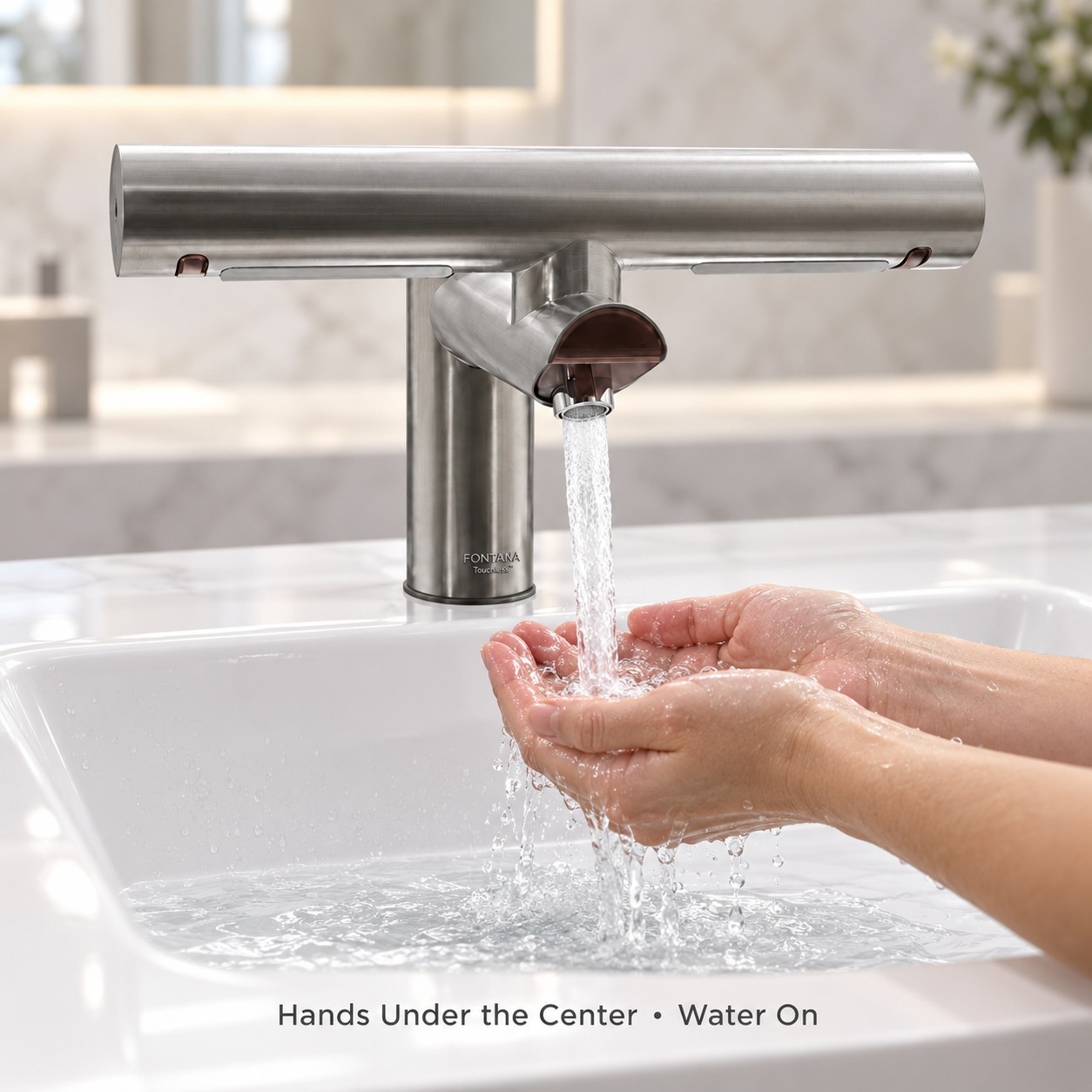
Sensor-enabled faucets activate without a physical handle movement, enabling users to approach the basin, place their hands under the outlet, and begin rinsing. That simple interaction can be valuable in commercial facilities where fixtures see frequent daily use.
For busy washrooms, the practical benefit is a predictable handwashing sequence: water starts when hands are presented and stops after they leave, without users handling a shared control. The linked technical article explains the sensor configuration behind that behavior in
why Fontana uses precision ranging for touchless faucets .
Washroom Workflow
Why hygienic operation depends on placement
Natural hand placement helps users start rinsing without contacting a shared faucet handle.
Nearby Object
Detected beyond the intended handwashing area.
Hands Detected
Hands enter the configured sensing area to start water.
Hands Withdrawn
Position no longer meets the intended activation condition.
This is a simplified hand-detection sequence. Actual products may also use timing, signal filtering, detection thresholds, field-of-view constraints and implementation-specific logic to support consistent operation.
Reducing unnecessary faucet interactions
False starts and unintended water flow can undermine the ease of hands-free operation. Reliable sensor response helps users complete washing without searching for a control or touching adjacent fixtures.
Reliable control helps users wash without having to touch the spout, tap body or nearby controls. Detection still depends on correct placement and maintenance; for a deeper explanation of nuisance activations, see
false activations in IR, ToF and mmWave touchless faucets .
Why routine maintenance still matters
A sensor faucet still relies on a clean detection window and correctly positioned components. Mineral deposits, residue, moisture, poor alignment, unsuitable mounting geometry and inconsistent power can affect operation and the user experience.
Maintenance teams should therefore include sensor inspection, aerator care, cleaning and functional checks in their restroom routines. The reduction in routine handle contact is meaningful, but dependable everyday use still depends on regular upkeep of the complete fixture.
User Interaction Zone
Hands-free use still needs careful faucet placement
Two users can approach a faucet from different positions even when their hands appear close to the spout. Sensor angle, field of view, basin depth, spout projection, drain location and nearby fixtures all influence whether touchless activation feels natural and consistent.
For the placement decisions that support a predictable, no-contact handwashing area, see
why detection-zone control matters more than maximum sensor range .
What reliable hygiene performance requires
Fontana’s finished-product inspection criteria include sensing distance, angle, light-related variation, adjacent-fixture behavior, moisture protection, environmental exposure and repeated activation performance.
These evaluations matter because a touch-free workflow depends on consistent activation during repeated daily use. A dependable sensor should recognize intended hand positions, avoid unnecessary operation and continue functioning in the washroom environment for which the fixture was selected.
Operational Conclusions
Manual and sensor-operated faucets can both support effective handwashing when installed and maintained properly. Their main operational distinction is that a touchless faucet allows users to start and stop water through sensor detection, without grasping a shared handle as part of the usual routine.
The practical value of no-touch operation is therefore not a promise of a germ-free restroom. It is one practical measure that can reduce common contact points while supporting a convenient handwashing sequence. Cleaning procedures, reliable water delivery, fixture placement and consistent maintenance remain essential to the overall washroom hygiene strategy.
Hygiene Selection Criteria
Do not select a touchless faucet on the word “hygienic” alone. Confirm how hands activate the water, whether the sensing zone suits the basin, how cleaning access and power are managed, how nearby fixtures affect operation, and what finished-product testing supports consistent use.
Further No-Touch Design Guidance
Use these supporting technical articles to assess reliable touch-free activation, installation alignment and washroom fixture selection. They explain sensor details rather than claim clinically proven hygiene outcomes.
Technical references
Supporting sensor-design references (not hygiene-efficacy studies): STMicroelectronics,
Proximity sensors / direct Time-of-Flight overview
and
proximity & ranging sensing applications
. These sources describe sensing technologies, not specific hygiene or infection-prevention outcomes.
Fontana finished-product inspection procedure V3.0 (May 15, 2026) documents sensing, electrical, environmental, hydraulic and lifecycle acceptance criteria. These address fixture operation, not measured reductions in infection, contamination or disease transmission.
|
|
|