Be it a washroom or a kitchen, commercial use, or individual, the choice of the right faucet definitely counts. With the turn of the century, new technological advancements have revolutionized the world we once knew. Today, the rising trend of touchless faucets has replaced the trend of using traditional, manual faucets. Here is your complete guide to understanding touchless faucets. The recent reviews of such touchless faucet have also definitely pointed to is importance today. Touchless faucets are sensor set that immediately turns on, allowing water to flow when they detect the presence of a hand. These sensors have high sensitivity, immediately turning the tap on when you place your hand below it. Touchless faucets, also called automatic faucets, have four main components which are; power source, spout, sensor, and solenoid-controlled valve. The sensor detects the hand and the solenoid-controlled valve controls the flow of water. The water flows through the spout once a hand is detected. The power source is usually dry-cell batteries or an AC transformer that provide energy for opening and closing of the valve and for working on the whole system.
Touchless faucet differs in the source that they use to work. Based on this division, there are two types; dry-cell battery operated and AC transformer operated. In the former case, energy is derived from dry batteries whereas the latter one uses a low-voltage current drawn from an AC transformer. Both do differ in the way that they operate to make the water run.
Being a new technology, its emergence is found abundantly in new societies as well as newly developed areas such as hospitals, airports, petrol stations, restaurant kitchens, and washrooms, etc. Be it for commercial use or for private use, touchless faucets are winning the game with traditional faucets because of the many benefits that they have to offer, ease, and durability of use being among the top benefits.
If we look at it from a commercial viewpoint, touchless faucets have replaced older faucets in public washrooms in airports, restaurants, petrol stations, etc.
From a residential viewpoint, all the new developing societies are now installing touchless faucets as a way of keeping themselves updated with the latest technology. So, in the case of its use, touchless faucets have been a serious game-changer.
Reviews of the Best Touchless Faucets
Sometimes it gets hard to find a company or brand that can guarantee a quality product. Whether you shop online or otherwise, customer reviews are a great help for you in buying things because they provide other's experience of the same thing.
In very much the same line, best touchless faucet reviews come as a great help to those searching for the right faucet, which is both; durable and long-lasting.
So, whether you're buying a touchless faucet or anything else, keep in mind to overlook the customer reviews of the particular product that you plan to buy!
Why, then, do people prefer the use of touchless faucets over the traditional manual ones? Here is a list of reasons, "why."
No-touch operation
To make the water start running you don't need to touch anywhere, and that's the best part. All you have to do is place your hand below the faucet, and the water starts running. Isn't that easy? This is especially helpful when you're holding something or when your hands are dirty.
Control of water flow
The sensors of the touchless faucet can easily detect when objects are in front of it and will immediately shut off when there isn't any present. This makes it a good way to save water.
Spray heads pull-down feature
Some new touchless faucets come with a pull-down spray head feature that allows you to wash larger dishes much more easily.
Touchless faucets have increasingly become popular because of the strength, durability, ease of use and customer satisfaction. Although the initial buying cost may seem a little high and setting it up may cost you a bit, but it'sdefinitely worth the money because of the benefit it has to offer.
What is a touchless faucet and how does it fundamentally work?
A touchless faucet is an electronically controlled plumbing fixture designed to dispense water automatically without manual contact, using sensor-based activation. At its core, the system integrates an infrared or capacitive sensor, a control module, a solenoid valve, and a power source. When a user places their hands within the detection zone, the sensor detects either reflected infrared light or a change in an electrostatic field, which is then processed by the control module. This module sends an electrical signal to the solenoid valve, causing it to open and allow water flow. Once the hands are removed, the signal ceases, prompting the valve to close and stop the water, ensuring precise, on-demand operation.
What types of sensors are used in touchless faucets?
Touchless faucets primarily rely on infrared sensors, capacitive sensors, or, less commonly, ultrasonic sensors. Infrared sensors are the most widely used because they emit a beam of infrared light and measure the reflection off nearby objects, making them reliable and cost-effective for most environments. Capacitive sensors, on the other hand, detect changes in an electrostatic field and are less dependent on surface reflectivity, offering more consistent performance in certain lighting conditions, although they are generally more expensive. Ultrasonic sensors use sound waves to detect objects and provide high accuracy, but their higher cost and complexity limit their use in standard faucet designs.
What is a solenoid valve and why is it critical?
The solenoid valve is the essential mechanical component that controls water flow in a touchless faucet. It consists of an electromagnetic coil, a movable plunger, and a sealing diaphragm or piston. When the control module sends an electrical current through the coil, it generates a magnetic field that lifts the plunger, opening the valve and allowing water to pass through. Most touchless faucets use normally closed solenoid valves, meaning the valve remains shut until activated, ensuring water conservation and safety. In advanced systems, latching solenoids are used to reduce power consumption by requiring energy only during state changes rather than continuous operation.
What power options are available?
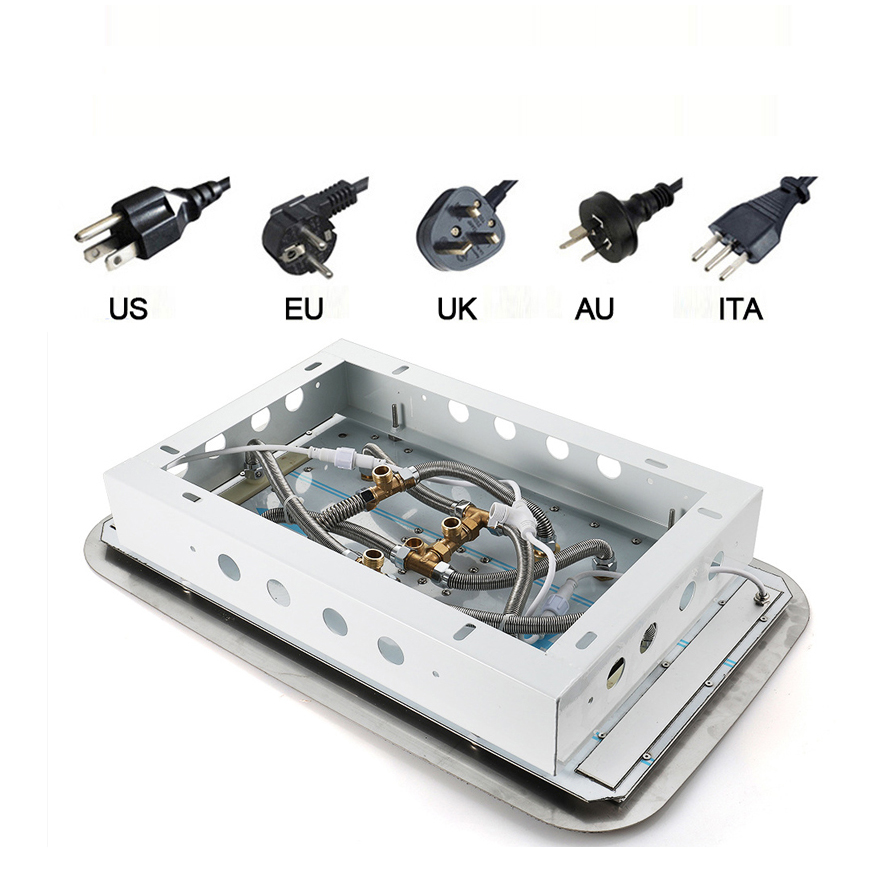
Touchless faucets are powered through battery-operated systems, hardwired electrical connections, or hybrid configurations. Battery-powered models typically use AA or lithium batteries and are favored for retrofit installations due to their ease of installation and independence from electrical wiring, although they require periodic replacement. Hardwired systems connect to an AC power source through a transformer that converts voltage to a safe low level, providing continuous operation without maintenance interruptions. Hybrid systems combine both approaches, using AC power as the primary source and batteries as a backup, ensuring uninterrupted performance in critical environments such as healthcare facilities.
What is sensor range and how is it calibrated?
Sensor range refers to the distance within which the faucet can detect the presence of a user’s hands, typically between two to six inches. Proper calibration is essential to ensure accurate detection and prevent unintended activation. Calibration can be performed manually through potentiometers or digitally via control modules, depending on the faucet model. Factors such as sink geometry, ambient lighting conditions, and surface reflectivity influence sensor performance. Advanced faucets incorporate adaptive sensing technology that automatically adjusts sensitivity in real time to maintain optimal operation across varying environments.
What is flow rate and how is it controlled?
Flow rate is the volume of water dispensed per minute, commonly measured in gallons per minute (GPM), and is a critical parameter for both performance and water efficiency. Touchless faucets typically operate within a range of 0.35 to 1.5 GPM, with lower rates used in commercial and environmentally regulated settings. Flow is controlled through a combination of internal pressure regulators, flow restrictors, and aerators. These components ensure consistent output regardless of fluctuations in supply pressure while meeting water conservation standards such as EPA WaterSense requirements.
What are laminar versus aerated flow systems?
Laminar flow systems produce a clear, non-aerated stream of water that minimizes splashing and reduces the spread of airborne contaminants, making them ideal for healthcare environments where hygiene is critical. Aerated flow systems mix air with water to create a softer, more voluminous stream that enhances user comfort while conserving water. While aerated streams are common in residential and commercial settings, laminar flow is preferred in sterile or high-sensitivity applications due to its controlled and predictable behavior.
How do touchless faucets handle water temperature?
Temperature control in touchless faucets is typically achieved through external or integrated mixing systems. In many installations, a thermostatic mixing valve blends hot and cold water to deliver a consistent and safe temperature, preventing scalding. Some faucets feature dual supply lines with built-in mechanical or digital mixing controls, allowing precise adjustment. In environments where hygiene standards are strict, pre-set temperature systems are used to maintain a constant output without user intervention, ensuring compliance with safety regulations.
What is a thermostatic mixing valve (TMV)?
A thermostatic mixing valve is a device designed to blend hot and cold water to a predetermined temperature while maintaining stability despite pressure or temperature fluctuations in the supply lines. It incorporates a temperature-sensitive element that adjusts the ratio of hot and cold water in real time. TMVs are essential in public and healthcare facilities because they prevent scalding and ensure consistent water temperature, typically within a narrow tolerance range of one to two degrees Celsius.
What are the common installation configurations?
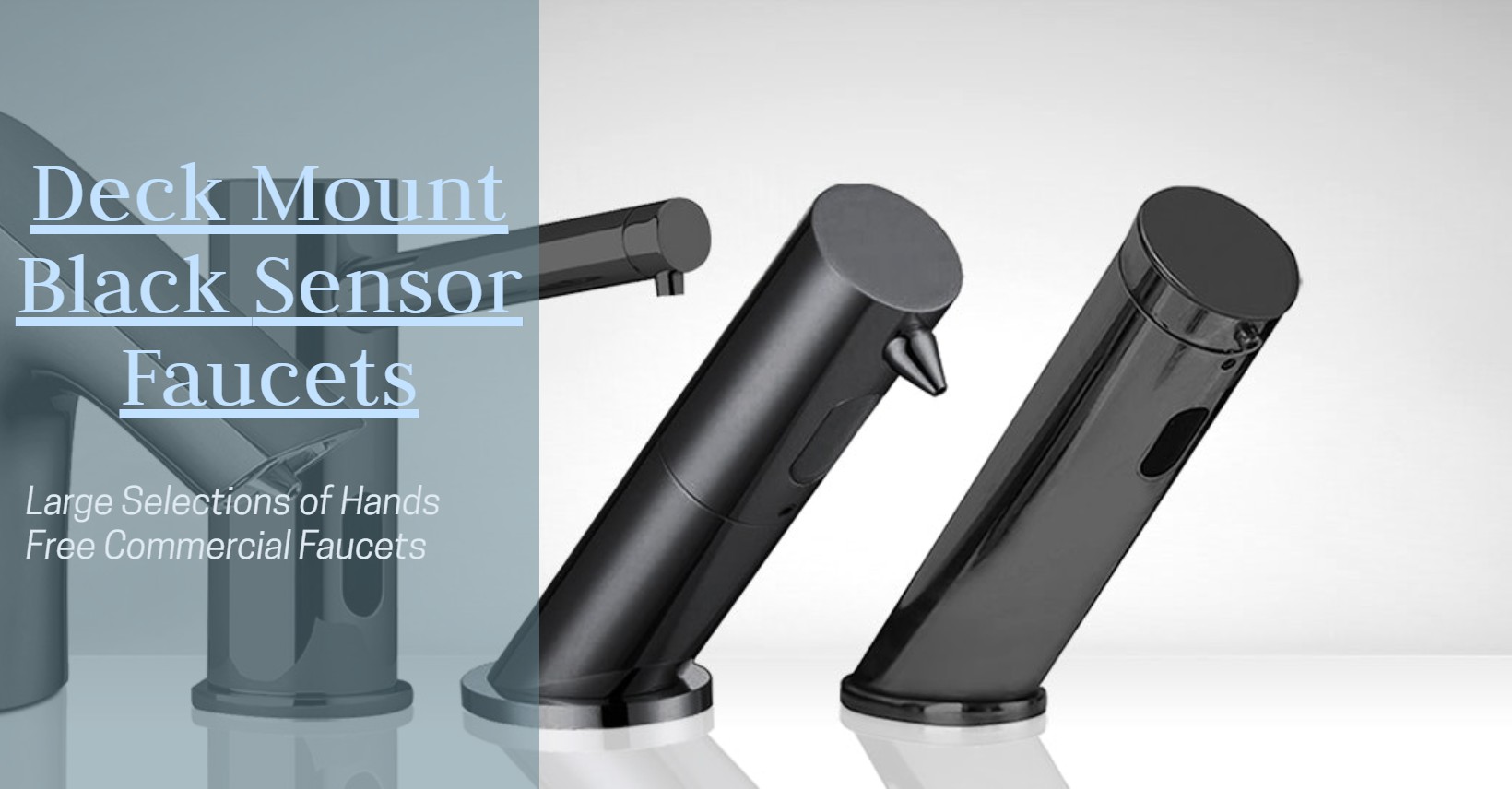
Touchless faucets are commonly installed as deck-mounted or wall-mounted systems, depending on the design and application requirements. Deck-mounted faucets are installed directly on the sink or countertop and are the most widely used due to their straightforward installation. Wall-mounted faucets require in-wall plumbing and offer a cleaner, more hygienic design by eliminating countertop contact points. In some cases, integrated systems combine the faucet and sink into a single unit, commonly used in commercial or prefabricated restroom installations for efficiency and ease of maintenance.
The appeal of this faucet is not only visual. It brings together a bold architectural finish, contactless operation, and specs that fit real commercial settings. That combination makes it more than a decorative statement piece.
A strong commercial fixture should install cleanly, perform right away, and still deliver the visual impact designers want. This model checks all three boxes.
Product overview
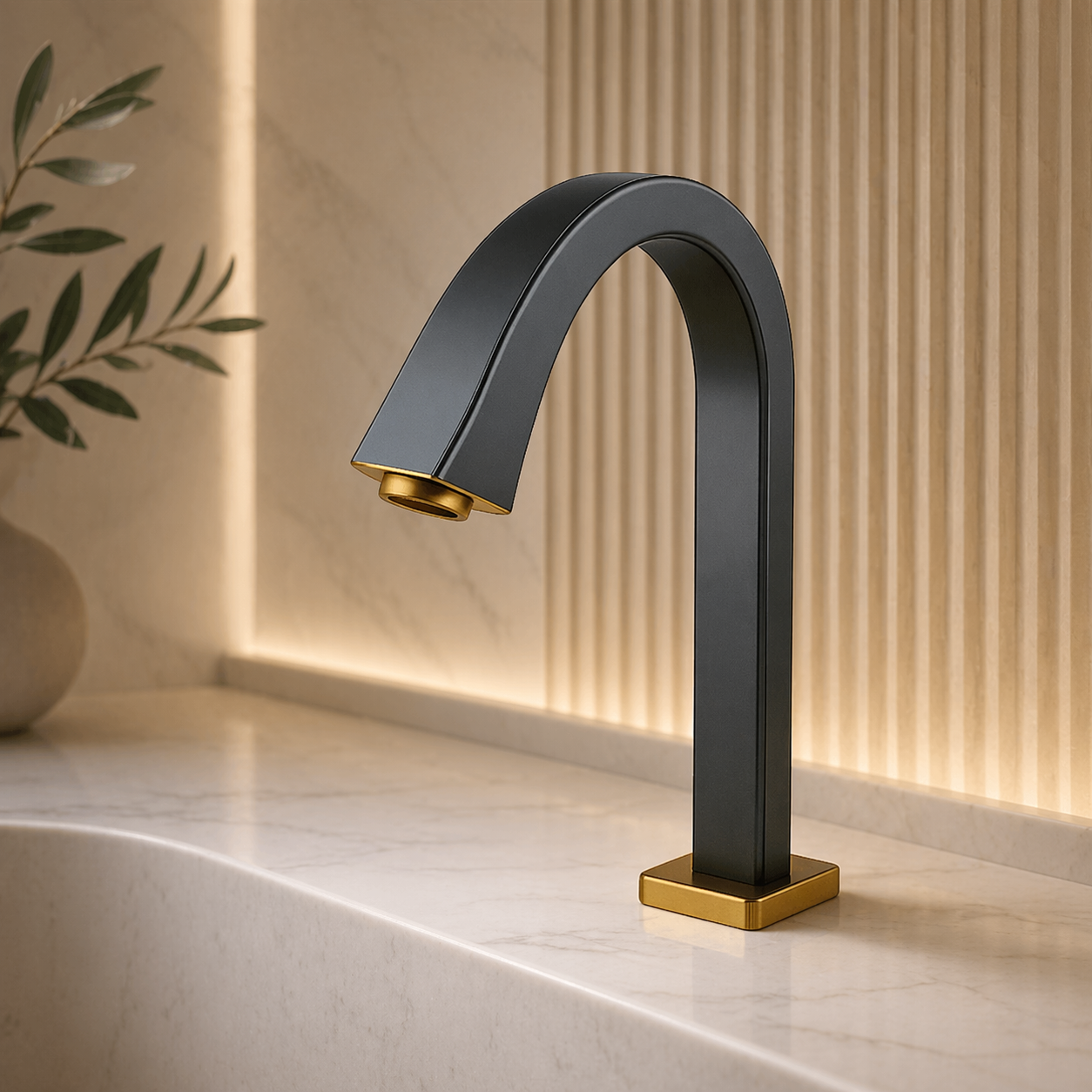
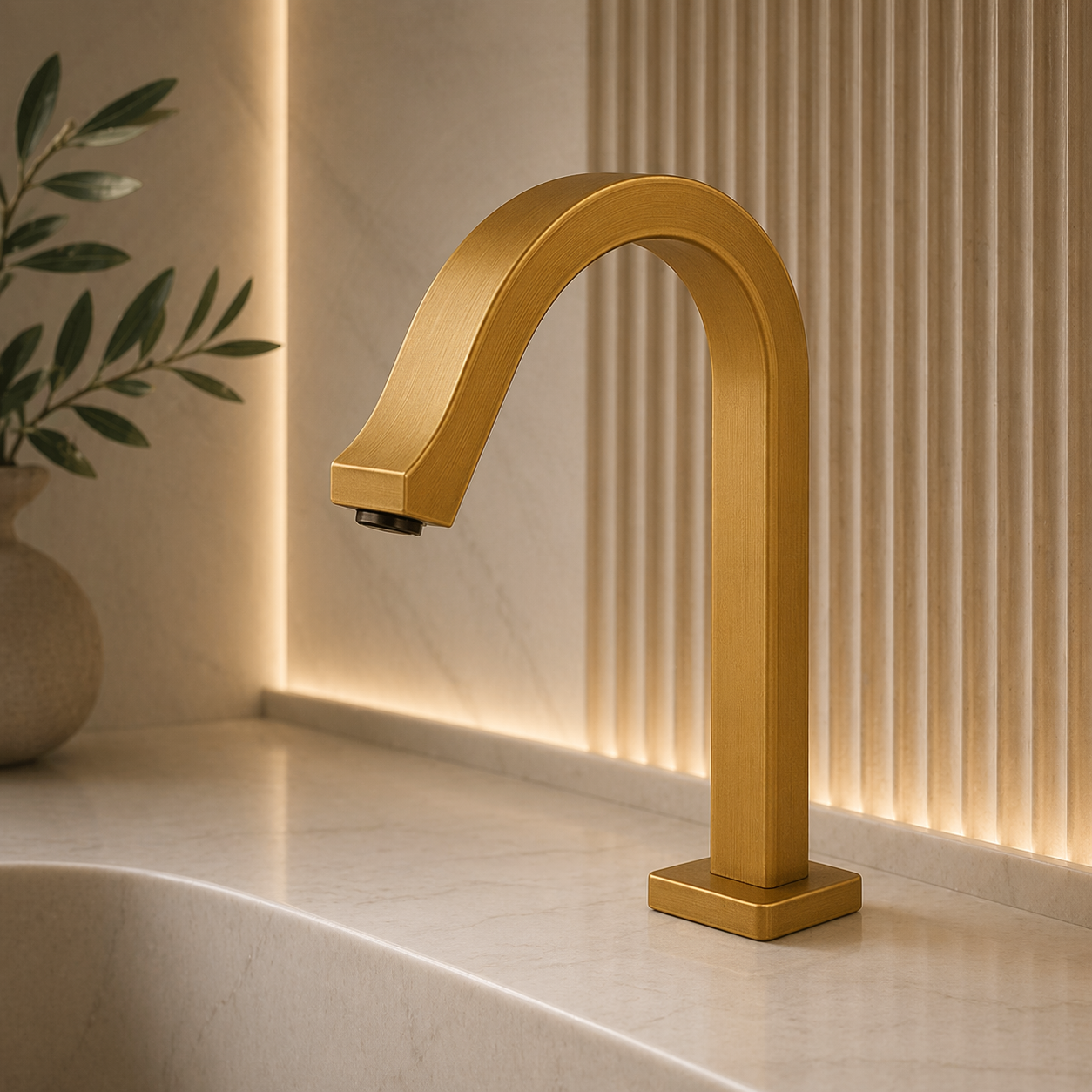
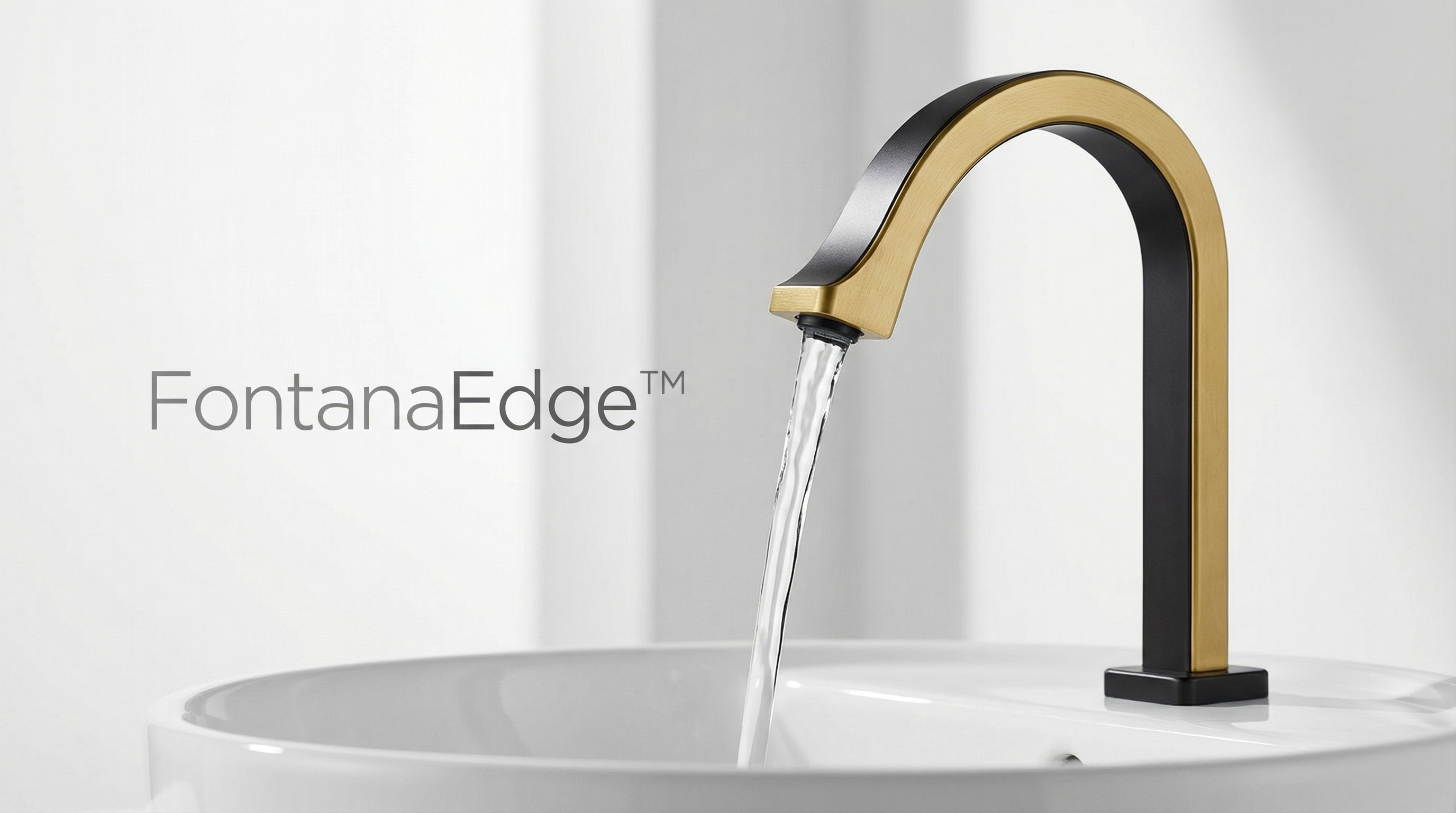
The FontanaEdge™ DualTone Gold & Black Fusion is a deck-mounted touchless lavatory faucet built with a solid brass body and a sharply defined geometric form. It is designed for commercial, hospitality, and institutional settings where finish quality and functional consistency both matter.
Read More
The published spec sheet positions this unit as a contemporary touchless faucet with a dual PVD brushed gold and matte black finish, ceramic valve components, laminar low-flow aerator, and a service life rated above 500,000 cycles. That makes it a practical option for spaces that expect repeat use and need controlled water delivery.
Product image gallery
Editorial review
Simple to install, refined in appearance, and steady in use
For a commercial faucet, this model makes a strong first impression without creating extra work on site. The silhouette is clean and upscale, but the bigger advantage is that it appears built around efficient installation and dependable touchless operation. That balance is what gives it value beyond appearance alone.
Read More
In practical terms, this is the kind of fixture that suits a project team looking for visual distinction without sacrificing simplicity. The two-tone finish offers more personality than a standard single-finish sensor faucet, yet the overall design stays disciplined and commercial in tone. Once in place, the emphasis shifts from styling to performance, which is where products like this need to hold up.
The strongest signal here is that the product is presented as something installers can put in, test quickly, and move on from with confidence. That is often more important than dramatic styling because it reduces friction during project delivery. When a faucet looks premium and avoids unnecessary recalibration or follow-up attention, it becomes easier to recommend.
Design reading
Architectural finish with a more tailored feel
The combination of brushed gold and matte black gives the faucet a more intentional visual identity than many standard sensor models. It feels suited to hospitality, premium office, and upscale public washroom environments where fixtures are expected to support the interior concept rather than disappear into it.
Read More
What keeps the finish from feeling excessive is the shape. The lines stay crisp, the body is compact, and the form remains disciplined. That allows the finish contrast to work as an accent rather than turning the fixture into a distraction.
What the review signals about performance
Installation efficiency
A clean deck-mounted layout and straightforward commercial configuration suggest a product meant to reduce setup friction.
Read More
Single-hole format keeps the installation process more direct.
Commercial-ready specs reduce the need for compromise in planning.
Less calibration effort supports smoother turnover on site.
Reliable operation
The touchless functionality is reinforced by a published service life of more than 500,000 cycles and a ceramic-based valve system.
Read More
Designed for repeat use in commercial and institutional settings.
Laminar low-flow delivery supports a controlled water stream.
Operating pressure range helps it adapt across different site conditions.
Commercial-grade presence
The solid brass body, low acoustic rating, and certification profile all point to a product intended for serious project use rather than decorative-only applications.
Dual-tone finish adds visual value for design-led environments.
Best fit environments
Commercial restrooms seeking a more upscale fixture language
Hospitality projects where touchless performance and appearance both matter
Institutional and office spaces upgrading from generic sensor faucets
Interior programs that use black and warm metallic finishes together
Read More
The published application categories include commercial, hospitality, and institutional projects. That gives the faucet broad placement potential, especially in washrooms where the fixture needs to contribute to the overall finish story while still meeting practical usage expectations.
The wording has been adjusted for a more original editorial tone while preserving the same practical meaning: easier installation, dependable sensor response, durable feel, and better fit for commercial settings.
Read More
The result is designed to read more like a polished product feature than a raw testimonial. It keeps the substance, removes unnecessary filler, and presents the information in a format that is easier to publish on a design or commercial fixtures website.
Suggested editorial angle
Position it as a design-led commercial faucet
Readers will likely respond best when the story balances three ideas: visual impact, project efficiency, and dependable daily use. That framing fits the product’s live specs and the existing customer feedback well.
Find Out First
Get FontanaShowers emails of inspiration, new product releases, and more!