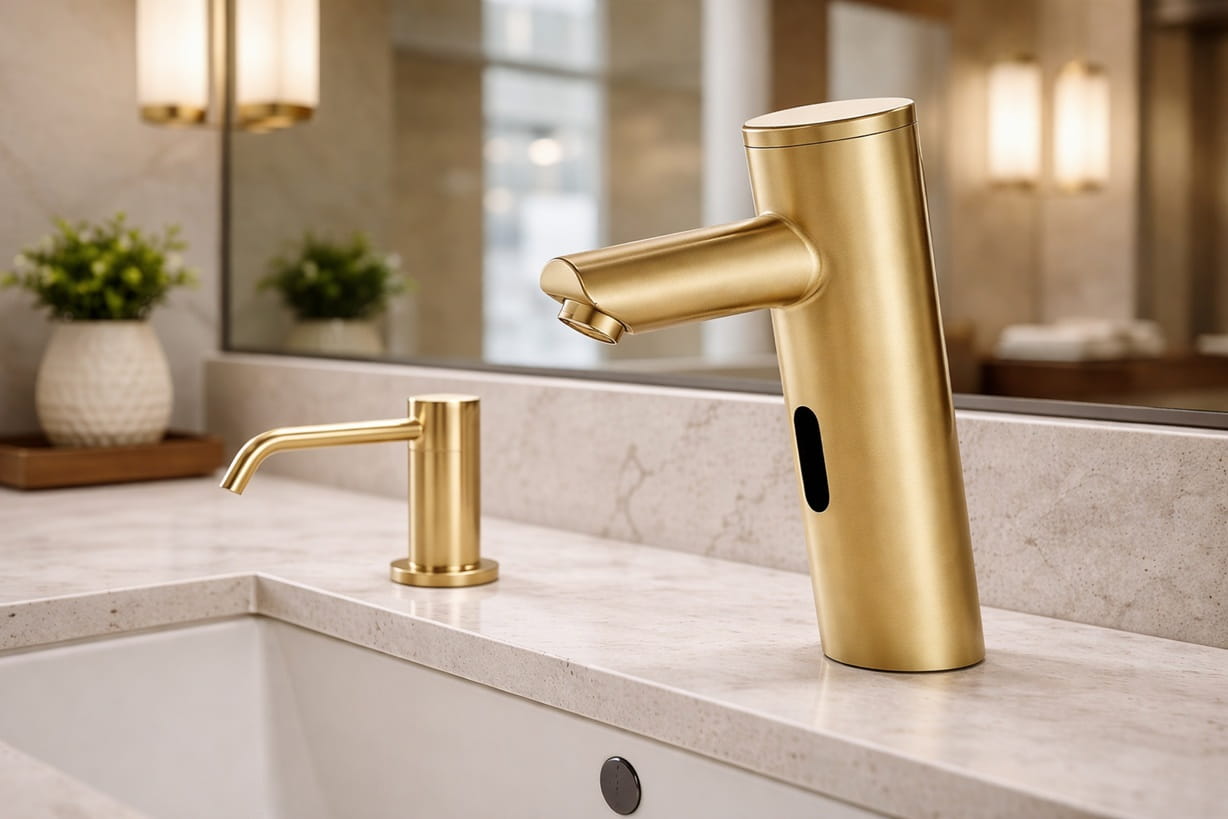

Elegant integrated faucet and soap dispenser system for modern commercial restrooms
The Fontana Skyline Curve Polished Chrome Classic is designed to bring a refined architectural look to commercial and hospitality washrooms while improving hygiene and daily usability. Its coordinated faucet and soap dispenser configuration creates a clean, organized sink area with a polished chrome finish that complements contemporary restroom designs.
Built for performance in high-traffic environments, this integrated fixture supports efficient handwashing with dependable hands-free operation and a streamlined deck-mounted layout. The curved profile softens the overall look while maintaining the durability and practicality required for upscale public, hospitality, and institutional applications.
This polished chrome combination is an excellent choice for projects that need both design consistency and long-term functionality. By pairing the faucet and soap dispenser in one coordinated setup, it helps improve restroom presentation, simplifies user interaction, and supports a more professional finish across premium commercial interiors where hygiene, appearance, and reliability all matter.
Learn more
How to Specify Fontana Touchless Faucets and Soap Dispensers in Bid Documents and Architectural Plans
Bid-ready language, Division 22 placement, BIM resources, and a coordination checklist — all in one place.
How to Specify Fontana Touchless Faucets and Soap Dispensers in Bid Documents and Architectural Plans
Defining touchless restroom fixtures correctly accelerates submittals, prevents value-engineering surprises, and enables your GC to deliver a hygienic, long-lasting restroom. This guide focuses on
Fontana Showers
touchless faucets and automatic soap dispensers—how to specify them in drawings, what to put in Division 22, and where to find BIM and cut sheets. It closes with a snappy MEP coordination checklist you can paste into your QA process.
Division 22 (MasterFormat)
BIM/Revit Files
ASME A112.18.1 / CSA B125.1
ANSI/ICC A117.1 (ADA)
WaterSense
CSI 3-Part Sample
Images are illustrative. Links point to live BIM, spec, and standards resources.
Design & Technical Visuals
Specifying commercial touchless faucets in bid documents and architectural plans requires coordinated fixture selection, accessibility criteria, plumbing performance, power requirements, and technical documentation across architectural and MEP disciplines. Project teams can evaluate
architect-specified touchless faucet systems,
compare
commercial touchless sensor faucets for high-traffic restrooms,
and access Fontana's
BIM, Revit, CAD and technical specification resources
when preparing fixture schedules, submittals, Division 22 specifications, and coordinated commercial restroom construction documents.
2) BIM, CAD, and Cut-Sheet Assets (Fontana)
Revit Families
- Fontana Showers BIM/Revit Library – central access to faucet and dispenser families.
- Automatic Soap Dispenser BIM Files – wall- and deck-mount objects.
- BIMobject – Fontana Library as an alternate source.
Product Data & Cuts
- FS-SF-126-LORB Sensor Faucet – dimensions, flow, and installation notes.
- Technical Specs & Power Data Hub – wiring diagrams and transformer VA tables.
Quick Spec Links
Download BIM, view dispenser resources, and access product libraries early so drawings, schedules, and submittals stay aligned throughout design and procurement.
3) Performance & Compliance References
Plumbing Supply Fittings
Reference ASME A112.18.1 / CSA B125.1 in specifications so alternates meet equal certification.
WaterSense
Include EPA WaterSense flow rates where applicable to project sustainability goals.
Accessibility
Coordinate mounting heights and reach ranges per ANSI/ICC A117.1 (ADA) and local amendments.
4) Sample CSI Division 22 Specification (3-Part Format)
Section 22 42 39 – Commercial Faucets, Supplies, and Trim
PART 1 – GENERAL
Summary: Touchless lavatory faucets and automatic soap dispensers, including power supplies, mounting hardware, and accessories for a complete installation.
Related Sections: 22 11 00 – Facility Water Distribution; 22 40 00 – Plumbing Fixtures; 26 05 00 – Common Work Results for Electrical.
Action Submittals: Product data, BIM/Revit families (.RFA) with shared parameters, and wiring diagrams.
Quality Assurance: Conform to ASME A112.18.1 / CSA B125.1. Provide fixtures from a single manufacturer for finish consistency. Installers shall be licensed plumbers experienced with sensor systems.
Closeout Submittals: O&M manuals covering calibration, soap viscosity range, battery replacement, and troubleshooting.
PART 2 – PRODUCTS
Basis of Design – Touchless Faucet: Fontana Showers® FS-SF-126-LORB. Cast brass body; nominal flow 0.35–0.5 GPM @ 60 PSI; battery or transformer power.
Basis of Design – Automatic Soap Dispenser: Fontana Automatic Dispenser Series; adjustable dose; deck- or wall-mounted with refill bottle.
Performance Requirements: Adjustable sensor range; auto-shutoff; 6 V DC battery pack or 110 V AC transformer power options; soap viscosity 5–3500 cP per manufacturer.
Finishes: Architectural PVD or electroplated finishes coordinated with adjacent fixtures.
Accessories: TMV for tempered water; multi-feed soap system or bottle-fill extensions.
PART 3 – EXECUTION
Examination: Verify rough-ins, centerlines, and power provisions.
Installation: Per manufacturer instructions and approved BIM shop drawings; maintain ADA clearances.
Field Quality Control: Test sensor function and flow calibration; demonstrate to Owner’s representative.
Cleaning & Protection: Flush lines; clean aerators; protect finishes until turnover.
5) Placement in Drawings and Fixture Schedules
Plan/Elevation Tags
Use Revit family types from the Fontana BIM Library. Set type marks and parameters such as flow, power, and finish to match the fixture schedule.
Electrical Coordination
Size transformers and circuits using Fontana power and wiring data. Verify VA per fixture count and run length.
Lavatory Coordination
Confirm spout and soap nozzle reach align with bowl centerlines to satisfy ADA reach ranges and maintain consistent aesthetics.
6) Quick MEP/Architect Coordination Checklist
|
Loaded BIM Families
|
Faucet and dispenser RFAs with flow and power parameters from the Fontana BIM Library.
|
|
Compliance to Standard
|
ASME A112.18.1 / CSA B125.1 listed in specification.
|
|
Power Strategy
|
Battery vs. transformer selected and VA verified per spec sheet.
|
|
Soap Compatibility
|
Verify viscosity and pH range against automatic dispenser data.
|
|
ADA Mounting Heights
|
Coordinate per ICC A117.1 and local code requirements.
|
|
Finish Matching
|
Match faucet and soap dispenser finishes for a consistent paired appearance.
|
|
Fixture Schedule
|
Insert model, finish, GPM, power, and sensor data for each type.
|
|
Submittal Package
|
Include BIM, cut sheet, and wiring diagram for every restroom type.
|
Coordination Focus Areas
BIM Families Loaded
Power Verified
ADA Checked
Finish Matched
Final Observation about Alternates
- Allow “or equal,” but tie approval to ASME/CSA compliance, flow, power, and finish requirements.
- Require matching faucet and dispenser appearance when installed as a coordinated set.
- Maintain uniform hygiene, performance, and visual consistency across restroom banks.
Why This Specification Approach Works
Faster Submittals
Clear basis-of-design language and preselected BIM assets reduce review cycles and coordination gaps.
Better Coordination
Plumbing, architectural, and electrical requirements remain aligned when power, finish, and fixture schedule data are defined together.
Fewer Surprises
Performance standards and equal-product criteria help prevent mismatched substitutions during bidding and procurement.
Consistent Appearance
Coordinated faucet and dispenser selections preserve the intended design language across all restroom types.
Code Readiness
Accessibility, certification, and efficiency requirements are addressed early in the documentation set.
Lifecycle Value
Well-documented sensor fixtures support maintainability, replacement planning, and long-term restroom performance.
Request the Architect Kit
Included
- BIM / Revit Families
- Cut Sheets (PDF)
- Power & Wiring Data
- Fixture Schedule Inputs
Project Notes
For multi-restroom projects, coordinate fixture schedules, transformer sizing, finish pairings, and dispenser compatibility early in QA to avoid bid-phase revisions.
|
|
|


.jpg)
.jpg)
.jpg)