

Sustainable Commercial Soap Dispenser
Specify commercial soap dispensing as a measurable washstation system. Dose control, refill capacity, touchless operation, service access and maintenance strategy should be coordinated before procurement.

Define Sustainability as an Operating Requirement
A sustainable commercial soap dispenser should be evaluated through measurable operating characteristics rather than finish or touchless activation alone. Establish soap dose, expected daily demand, refill capacity, packaging strategy, power arrangement and the replacement-part route for the selected model.
CDC workplace guidance emphasizes access to soap, water and appropriate hand-drying facilities. The dispenser should therefore support reliable handwashing while remaining practical to refill, clean and maintain.
Establish the Soap-Delivery Baseline
Record configured dose per activation, soap formulation, expected activations per operating day and refill volume. Calculate annual liquid demand from those project-specific inputs rather than assuming a universal saving percentage.
Coordinate the Handwashing Sequence
Check the sequence from soap presentation to faucet activation and hand drying. Users should not need to cross an adjacent station or reach through the water stream to obtain soap.
Controlled Soap Dose
Document actual dose delivered per activation and verify repeatability using the approved soap formulation.
Model Annual Soap Demand ↓Refill Logistics
Size the reservoir and refill route against traffic, service frequency and available maintenance access.
Coordinate Refill Access ↓Hand-Hygiene Provision
Soap availability is part of the complete workplace handwashing environment rather than an isolated accessory.
CDC Workplace Guidance ↗Engineer the Dose Before Selecting the Reservoir
Reservoir capacity alone does not determine operational efficiency. Dose volume, traffic, priming behaviour, soap formulation and refill frequency should be evaluated together.
Dose Repeatability
Establish the intended liquid quantity per successful activation and confirm stable delivery after the system is fully primed.
Verify Dispensing Consistency
Collect several consecutive doses using the approved soap. Compare delivered mass or volume and investigate air entry, viscosity mismatch, weak power supply or outlet obstruction before altering the intended setting.

Reservoir Utilization
Compare usable refill volume with calculated daily consumption and the maintenance team's practical service interval.
Calculate the Refill Interval
Estimate service days from usable reservoir volume divided by daily soap demand. Maintain an operating reserve instead of planning for the system to run completely dry.

Soap Compatibility
Confirm the selected soap formulation is appropriate for the dispenser instead of assuming all liquid soaps have identical pumping characteristics.
Record the Approved Soap Specification
Retain the accepted soap type with the maintenance record. Changes in viscosity or formulation can affect priming, delivered quantity and outlet condition.
Specify the Dispenser as Part of the Complete Basin Assembly
The soap dispenser should not be positioned independently of the faucet and basin. Coordinate reach, hand movement, splash exposure, sensor location and maintenance access before drilling or finalizing the counter layout.
Decorative finish selection also affects maintenance planning. Cleaning chemistry and abrasive tools that may be acceptable for surrounding surfaces should not automatically be assumed suitable for the dispenser finish.
Check the User Hand Path
Position the soap outlet where a user can obtain soap without crossing the water stream or reaching into an adjacent station.
Define Finish-Safe Cleaning
Retain the approved finish-care procedure with the facility maintenance documentation and avoid unapproved abrasive or aggressive cleaning methods.
Compare Sustainable Commercial Dispenser Options
Confirm dimensions, mounting, finish, power, reservoir and soap requirements for the exact product selected for the project.
Sustainable Gold-Finish Commercial Soap Dispenser
Coordinate the gold finish with surrounding exposed trim and verify mounting and refill access against the finished wall or counter assembly.
Examine Gold Configuration →
Sustainable Chrome-Finish Commercial Soap Dispenser
Use the chrome configuration where a bright architectural finish is appropriate and confirm surface-care and service requirements before standardizing the fixture.
Review Chrome Configuration →
Sustainable Automatic Soap Dispenser
Coordinate sensing position, electrical or battery service route, soap delivery and basin relationship as one operational assembly.
Inspect Automatic Operation →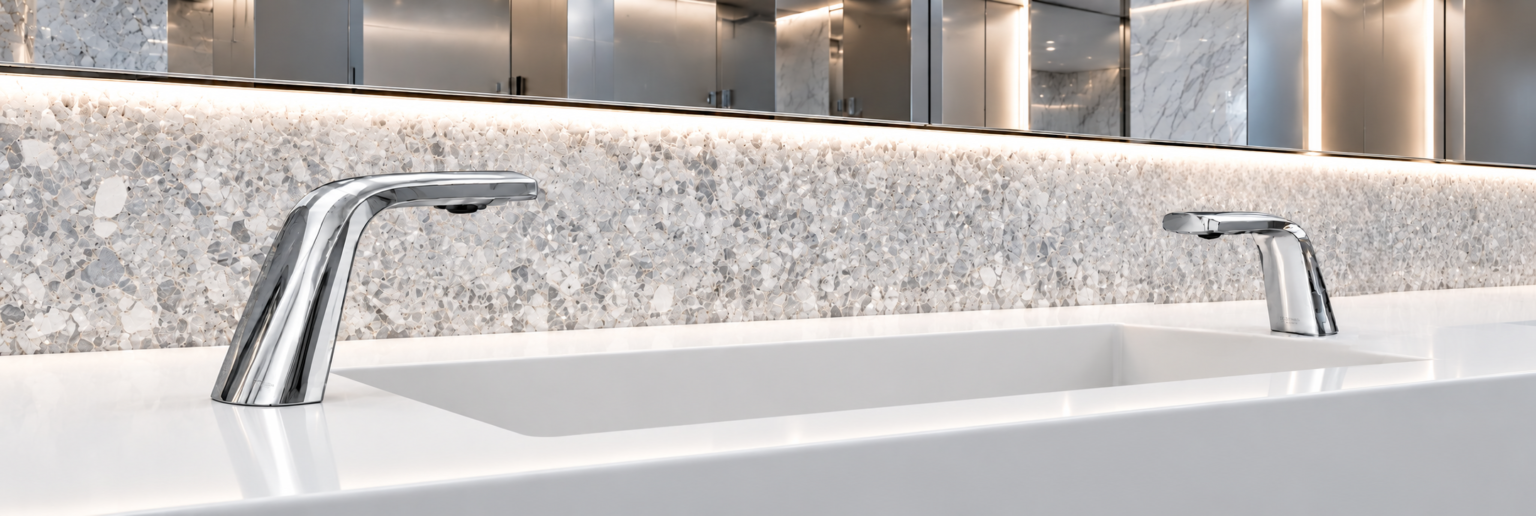
Coordinate Mounting, Soap Delivery and Service Access
The visible outlet is only one part of the assembly. Reservoir, tubing, pump, sensor, power and maintenance access determine whether the installation remains practical over its service life.
| Interface | Design Evidence | Field Verification |
|---|---|---|
| Soap Dose | Approved formulation, intended dose and supported adjustment method. | Prime the dispenser and verify repeatable delivery using several consecutive activations. |
| Reservoir | Nominal and usable capacity, refill opening and permitted soap type. | Demonstrate filling without removing unrelated plumbing or contaminating finished surfaces. |
| Sensor | Detection location, supported adjustment and environmental limitations. | Test intended hand presentation and nearby movement without unwanted activation. |
| Power | Battery, transformer or other supplied power arrangement. | Demonstrate replacement or isolation access without dismantling unrelated components. |
| Tubing & Pump | Routing, connections, priming requirements and service clearances. | Inspect for kinks, leakage, air entry and serviceability. |
| Finish | Exact supplied finish and approved cleaning procedure. | Record initial surface condition and hand over the maintenance method. |
Service access should be tested as a real maintenance movement. Staff should be able to inspect, refill and isolate the dispenser without removing unrelated plumbing or damaging finished surfaces.
Design the Refill Movement, Not Just the Container Location
A reservoir can appear accessible on a drawing yet remain difficult to service once traps, supply lines, cabinetry and electrical components are installed. Review the actual refill movement before approving the concealed layout.
Verify Under-Counter Clearance
Check whether the reservoir can be opened, removed or refilled without interference from the trap, faucet supplies, electrical equipment or structural framing.
Define the Refill Threshold
Establish a maintenance threshold that leaves operational reserve instead of requiring staff to wait for complete depletion before refilling the dispenser.
Calculate Soap Demand from Actual Operating Inputs
The model below is a planning calculation rather than a manufacturer performance claim. Enter project-specific traffic and dose assumptions to understand how small changes in dose affect annual soap demand.
Planning equation: annual soap demand = activations per day × operating days × dose per activation ÷ 1,000.
Annual Soap Demand by Delivered Dose
Calculated from the entered activation count and operating days.
Commissioned Volume vs. Baseline Difference
Commissioned volume: 75%
Difference from baseline: 25%
This graphic compares the two user-entered planning scenarios; it is not a certified environmental performance value.
Annual Demand Rises with Activation Volume
At the entered traffic level, each 0.1 mL change in dose represents approximately 15 litres per year.
Keep Soap Consumption and Faucet Water Use as Separate Metrics
Touchless operation can support hygiene and controlled activation, but it should not be treated as automatic evidence of water or soap savings. Measure each resource independently.
Soap-Side Measurement
Track delivered dose, activation count, repeated activations, refill volume and service frequency.
Define the Soap KPI
Useful project metrics include mL per successful activation, litres per operating month, activations per refill and refill interventions per station.
Water-Side Measurement
Faucet water use depends on flow rate, water-on duration, activation behaviour and maintenance condition.
Review Water-Efficiency Criteria
Use the applicable project criteria and selected faucet documentation when establishing water-use performance.
Diagnose the Dispensing System Before Replacing Components
Sustainable operation also depends on keeping installed equipment functional. Separate soap, sensing, power, pump, tubing and finish issues before replacing the complete assembly.
No Soap Delivery
Confirm reservoir level, approved soap, priming, tubing, pump operation and outlet condition before replacing the dispenser.
Repeated Activation
Check sensor condition, hand position, mounting geometry, nearby surfaces and power before altering supported settings.
Surface Deterioration
Review cleaning chemistry, application method and service history before assuming discoloration or residue requires component replacement.
DOE water-equipment O&M guidance emphasizes inspection and maintenance as part of efficient facility operation. Manufacturer instructions for the exact installed product remain controlling. Consult DOE O&M Guidance ↗
Create a Repeatable Dispenser Acceptance Record
Record the installed condition before the washroom enters service so future maintenance can compare performance with a known accepted baseline.
Confirm the Supplied Assembly
Record product reference, finish, soap type, reservoir, pump, sensor and power arrangement. Photograph initial surface condition.
Measure the Delivered Dose
Prime the dispenser and document repeatable output under accepted soap and power conditions. Retain any supported adjustment setting.
Demonstrate Service Access
Show refill access, supported power replacement, cleaning procedure and removal route for serviceable components without damaging the finish.
Specification Decisions for Sustainable Commercial Soap Dispensers
Does an automatic dispenser automatically use less soap?
Not necessarily. Consumption depends on delivered dose, successful versus repeated activations, daily traffic, maintenance and user behaviour. Measure actual dose and model demand from project-specific use.
Is a larger reservoir always more sustainable?
No. Capacity should be matched to demand and service strategy. Evaluate usable volume, refill logistics, soap requirements and maintenance access rather than capacity alone.
Can any liquid soap be used in the dispenser?
Use the soap type permitted by the selected product documentation. Formulation and viscosity can influence pumping, priming and delivered quantity.
Should gold and chrome finishes use the same cleaning procedure?
Do not assume so. Use the care method approved for the exact supplied finish and avoid aggressive cleaners or abrasive tools unless specifically permitted.
What should be recorded after adjusting the soap dose?
Record the supported setting, soap formulation, measured output and date of adjustment. Repeat several activations to confirm stable delivery before returning the station to service.
Should soap and faucet water savings be reported together?
Measure them separately first. Soap volume is governed by dispenser dose and activation count; faucet water depends on flow rate, water-on duration and activation behaviour.
References for Commercial Washroom Planning
Workplace provision of sinks, soap, water and hand-drying facilities.
CDC guidance concerning soap-and-water handwashing and hand hygiene.
Coordinate regular facility cleaning with products appropriate for the surfaces being maintained.
Commercial and institutional facility water-management guidance.
Coordinate dispenser planning with evidence-based faucet and commercial washroom water-efficiency practices.
Support facility inspection and maintenance while retaining manufacturer-specific instructions.
Review the gold-finish commercial dispenser configuration.
Review the chrome-finish commercial dispenser configuration.
Review the automatic dispenser configuration and project-specific product documentation.
Specification note: sustainability claims should be supported by the characteristics of the exact ordered product and measured project operating data. The interactive calculations above are planning tools and are not environmental certifications, laboratory test results or guaranteed FontanaShowers savings.