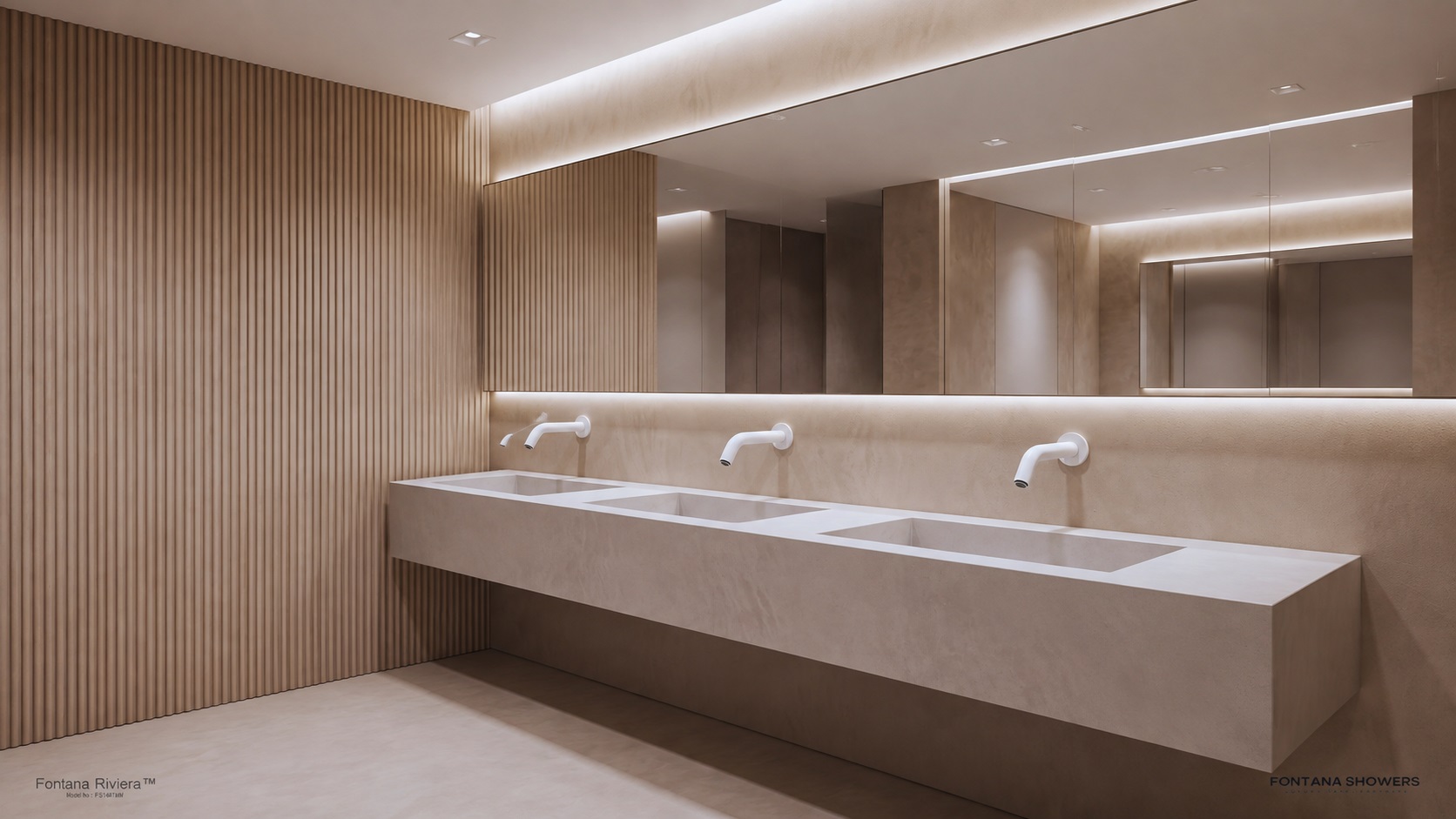
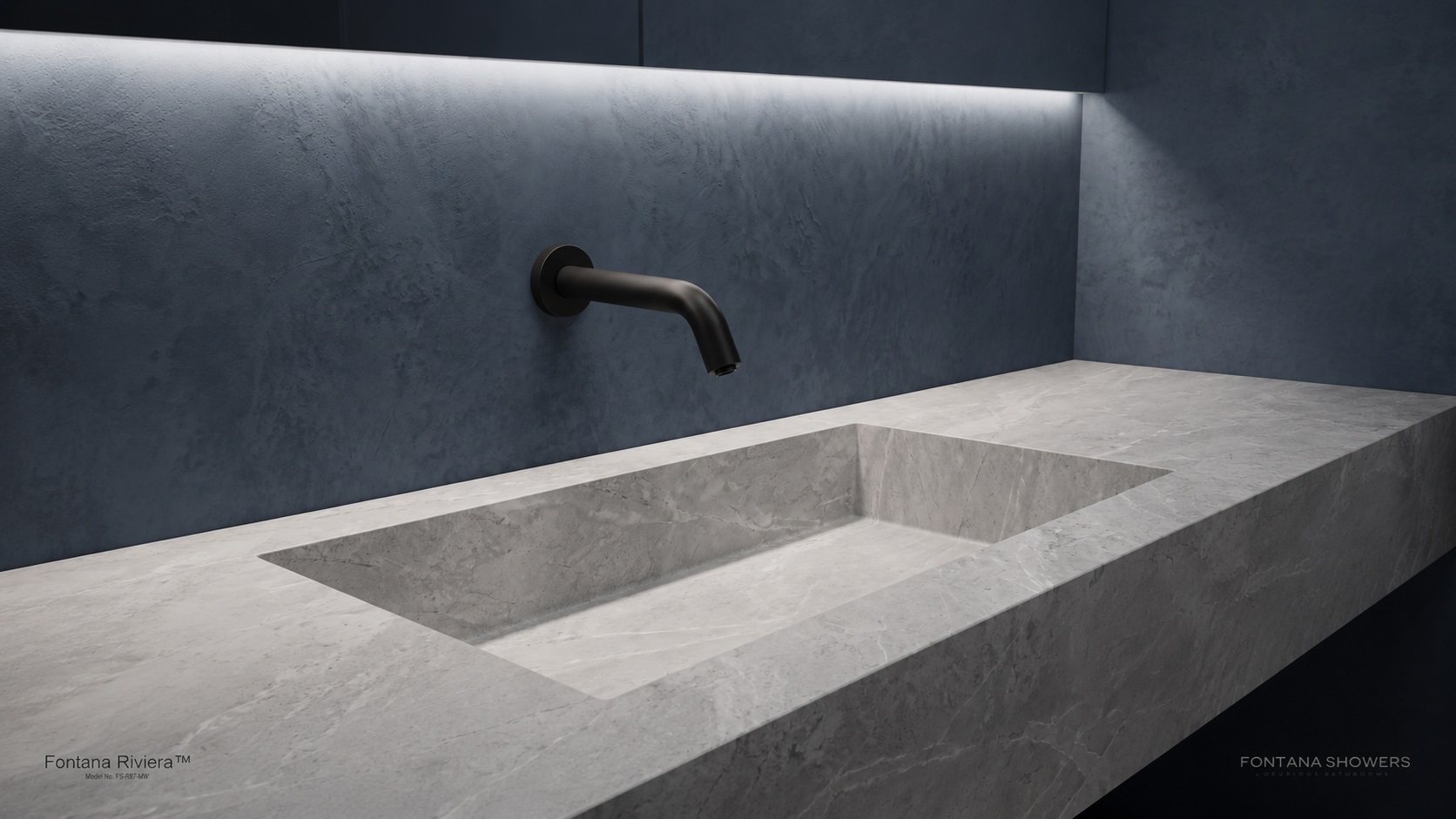
The Challenges of Designing Bathroom Fixtures for Airports
Airports are a special kind of public environment: gigantic,
high-pressure, and always high-speed. Terminal restroom fixtures
must accommodate waves of transit passengers, cultural differences
in expectations, and stringent sanitary standards—without slowing
down the traveler experience. What follows is a detailed examination
of seven characteristic difficulties airports face when specifying
bathroom fixtures, and the ways in which Fontana Faucets' portfolios,
options, and best-practice applications can address them in mass-market
applications such as concourses, lounges, and baggage claim.
The Challenges of Designing Bathroom Fixtures for Airports:
7 Special Challenges
1) Managing Peak User Flow Without Congestion
Why it's difficult in airports
Surges of peak loads arrive in waves—when multiple gates
deplane at the same time, during weather-related delays,
or between flights that are banked. Traditional restroom
design accommodates these floods by bending: traffic jams
at sinks, splashing that forces people to slow down, and
fixtures that can't reset fast enough for the next user.
Read More
What to enhance
Turnaround time per user: Quick sensor response,
consistent water delivery, and quick shutoff to enable
high throughput.
Traffic choreography: Position soap, water, and drying
in a left-to-right or right-to-left flow lane to
discourage cross-traffic.
Splash mitigation: Less splash means less wiping,
more speed, and safer floors.
How Fontana helps
Responsive, touchless operation: Adjustable detection
ranges and run-time adjustments on some Fontana sensor
faucets help eliminate unnecessary hand movement and
keep line flow intact.
Flexible delivery: Multiple spout extensions, deck or
wall-mount arrangements, and anti-splash aerators or
laminar outlets allow each station to be configured
to its counter and basin geometry.
Streamlined stations: Coordinate faucets with matching
touchless soap dispensers to reduce lateral movement
between washing functions.
2) Multilingual, Multicultural, and Accessible by Design
Why it's hard in airports
Passengers speak many languages, carry bags, travel with
children, and have different mobility requirements.
Signs can be overlooked in a rush, while inconsistent
fixtures can create confusion and delay.
Read More
What to enhance
Universal affordances: Easy, intuitive operation without
relying heavily on written instructions.
Accessibility:
Reach distances, clear knee/toe space at counters
,
and consistent sensor response.
Consistency across terminals: Travelers should encounter
a familiar wash-station sequence throughout the facility.
How Fontana helps
Touchless operation reduces dependence on written
instructions: hands enter the activation zone and water
flows automatically.
Adjustable sensor windows enable facility teams to
standardize activation areas across restroom banks.
Appropriate fixture geometry can support accessible
counter and basin arrangements while maintaining
consistent activation.
3) Sensor Reliability in Reflective, RF-Dense,
and Variable-Light Environments
Why it's hard in airports
Daylight swings, glass walls, high-gloss finishes, and
complex electronic environments can create difficult
operating conditions for sensor fixtures. False triggers
waste water, while missed activations interrupt user flow.
Read More
What to tweak
Stable detection: Sensors should resist reflective
interference while responding promptly to users.
Environmental resilience: Changing ambient-light
conditions should not require frequent recalibration.
Power continuity: Battery and hardwired systems should
be selected according to location, access, and
maintenance requirements.
How Fontana helps
Adjustable sensitivity and timeout settings can help
adapt fixtures to reflective countertops and changing
ambient conditions.
Available power configurations allow fixture selection
to match specific airport installation requirements.
Protected electronics help support operation in humid
restroom environments and routine cleaning conditions.
4) Hygiene and Infection Control at Scale
Why it's challenging in airports
Travelers move rapidly through terminals from many regions.
Fixtures must reduce unnecessary contact, control splash,
and support efficient cleaning while remaining dependable
through continuous daily use.
Read More
What to streamline
No-touch operation: Reduce unnecessary contact with
faucet controls where feasible.
Stream control: Laminar or low-splash outlets can help
keep water within the intended basin area.
Thermal safety: Coordinate outlet temperatures with
the project's mixing and plumbing strategy.
How Fontana helps
Pairing sensor faucets with touchless soap dispensers
enables a largely hands-free wash sequence.
Laminar and low-splash outlet options can be coordinated
with basin geometry for high-traffic installations.
Thermostatic mixing compatibility allows designers to
coordinate delivery temperature with the broader
plumbing system.
Durable finish options can support frequent cleaning
routines in commercial environments.
5) Water-Saving Strategies Without Compromising Experience
Why it's tricky in airports
Extremely low flow that does not coordinate with basin
geometry or user needs can increase washing time.
Conservation therefore depends on balancing water delivery,
sensor timing, and wash-station design.
Read More
What to optimize
Right-sized flow rates: Select appropriate flow rates
according to basin geometry and applicable requirements.
Programmed run-times: Coordinate activation and shutoff
timing to reduce unnecessary tail-flow.
Leak prevention: Even small continuous losses can become
significant across large restroom fixture inventories.
How Fontana helps
Available flow regulators allow designers and facility
teams to coordinate water delivery with specific
wash-station conditions.
Adjustable run-time parameters can help balance water
use and effective handwashing.
On compatible configurations, operational data can
assist facility teams in identifying abnormal usage
patterns.
6) Longevity, Vandal Resistance, and Serviceability
Why it's challenging in airports
Airport restroom fixtures experience intensive use,
accidental impacts, aggressive cleaning, and occasional
tampering. Maintenance access is equally important because
restroom-bank downtime can reduce passenger capacity.
Read More
What to optimize
Materials that endure: Corrosion-resistant materials and
finishes suited to commercial cleaning.
Protected components: Concealed fasteners and secure
mounting help reduce opportunities for tampering.
Serviceability: Accessible filters, connections, and
replaceable components can shorten maintenance time.
How Fontana helps
Commercial fixture construction and available finish
options are intended for demanding installation
environments.
Concealed mounting and protected electronics can support
vandal-resistant restroom planning.
Serviceable components and accessible supply connections
help support maintenance planning across large facilities.
7) Integration with Airport Operations and Building Systems
Why it's difficult in airports & What to enhance
Read More
Airports function as complex campuses. Engineering
teams may manage plumbing, building systems,
maintenance schedules, energy programs, and emergency
procedures across large facilities.
Remote visibility:
Identify abnormal fixture usage, leaks, faults, or
battery conditions where supported.
Policy enforcement:
Coordinate programmed purge or water-management
operations with facility procedures.
Vendor interoperability:
Define integration requirements before specifying
connected fixtures.
How Fontana helps
Read More
Management visibility:
Compatible connected systems may provide usage,
activation, or fault information by zone depending
on the selected configuration.
Programmable operation:
Compatible systems can coordinate scheduled operating
functions with maintenance procedures.
Integration planning:
Define required telemetry and control points with
the project's BMS or controls integrator before
final equipment selection.
Practical Applications Throughout Airport Zones
Ticketing and Pre-Security
Read More
Low-splash, responsive wash stations can support busy
pre-security restroom environments while helping
maintain dry counters and efficient passenger movement.
Wall-mounted spouts and touchless soap systems can also
reduce counter clutter.
Airside Concourse Banks
Read More
These areas typically require high-capacity fixture
arrangements. Consistent sensor settings and wash-station
layouts can help travelers understand the operating
sequence quickly across multiple terminals.
Family/All-Gender Rooms
Read More
Coordinate accessible counter heights, basin geometry,
spout reach, and activation areas. Integrated faucet
and soap arrangements can also help reduce unnecessary
movement within compact restroom layouts.
Lounges and Premium Zones
Read More
Fixture selection can combine commercial durability
with quieter water delivery and architectural finishes.
Laminar outlet configurations can help control splash
while supporting a refined restroom environment.
Staff and Crew Spaces
Read More
Emphasize maintainability, reliable operation, accessible
service components, and standardized replacement parts
where practical across the facility.
Technical Specifications
Operation
Automatic / touchless sensor actuation
(ToF or IR; model dependent)
Installation
Exposed, recessed/wall-in concealed body
(per model)
Front Panel
Stainless steel; architectural finishes available
Valve Body
Copper/Brass internals; serviceable subassemblies
Power
Battery and/or AC options; low-power standby
(per model)
Coordinate spout projection with bowl geometry for
appropriate reach and splash control.
Select outlet type according to basin geometry and
project requirements.
Coordinate run-time profiles with applicable requirements,
hygiene procedures, and expected user throughput.
Sensors & Power
Standardize sensor activation zones and document
exceptions for unusual countertop or basin conditions.
Select hardwired or battery configurations according
to fixture location and maintenance access.
Water Management
Choose flow regulators according to basin geometry,
project requirements, and local regulations.
Where supported, use operational monitoring to identify
abnormal or persistent fixture activity.
Durability & Safety
Specify appropriate mounting, concealed fasteners,
and protected electronics for high-traffic areas.
Coordinate fixture finishes with project cleaning
protocols and adjacent accessories.
Systems & Operations
Define required monitoring or control points before
connected fixtures are specified.
Plan replacement components and maintenance training
for frequently serviced fixture elements.
Application Imagery
From Strategy to Execution
Water- & Cost-Performance:
Scale Thinking
Read More
Performance at scale
Small adjustments to flow, activation timing,
and maintenance practices can become significant
when multiplied across large numbers of restroom
fixtures and thousands of daily activations.
Facility teams should therefore evaluate both
individual fixture performance and cumulative
campus-level operating requirements.
Implementation Roadmap (1/2)
Read More
1. Pilot and Mock-Up
Build a representative wash-station mock-up using
the intended basin, counter, fixture, and lighting
conditions.
Review spout projection, outlet configuration,
splash behavior, and sensor activation.
2. Parameter Playbook
Establish site-standard detection ranges,
run-times, flow settings, and any applicable
maintenance parameters.
Document legitimate variations by restroom zone.
Implementation Roadmap (2/2)
Read More
3. Rollout in Waves
Begin with representative or high-use restroom banks
and confirm installation, operation, and maintenance
procedures before broader deployment.
4. Verify and Tune
Use facility observations and available operational
data to identify settings that need adjustment.
Keep documented property standards so future
installations remain consistent.
Coordinate sensor module selection,
power requirements, service access,
and building-wide fixture standards
during project specification.
Customer Field Review
Fontana Le Havre Gun Metal Gray Touchless Sensor Faucet Commercial Review
A field-evidence evaluation of infrared sensing stability, wall-mounted coordination,
stream regulation, dark-finish service considerations, commissioning behavior,
and suitability for high-use commercial restroom applications.
✔ Related Gun-Metal Field Record✔ Multi-Site Public Restroom Evidence✔ Five-Star RatingBismarck, North Dakota • January 2026
Related Commercial Field ReviewGun Metal Gray Sensor FaucetModel FS9824GMG
Holden Sinclair, Systems Specialist — Bismarck, North Dakota
Municipal and Transportation Restroom Evaluation / Related-Model Evidence
Review record date: January 12, 2026 • Rating: 5 out of 5
Customer Review
The related field record covers gun-metal-gray touchless faucets used across municipal
and transportation restroom modernization projects, with repeated operation under high-use
public conditions and fewer interruption-related service requests after installation.
Read More
The reviewer specifically tracked infrared stability, stream behavior, shutoff timing,
recalibration demand, and maintenance interruptions. One compact-basin installation needed
extra sensitivity adjustment, but operation remained dependable after calibration.
Installation
FS9824GMG is specified as a single-hole, wall-mounted sensor faucet, supporting a clear
countertop while placing the operating body and service connections within the wall zone.
Read More
Rough-in height, basin centerline, backsplash depth, sensing path, concealed power routing,
water-supply access, and future valve service should be coordinated before wall closure.
Final stream landing should be checked against the selected basin geometry during commissioning.
Sensor Response
The exact FS9824GMG specification lists infrared sensing with an adjustable 6.30–12.60-inch
detection distance, providing a defined commissioning range for hands-free activation.
Read More
The related multi-site record adds useful field context: earlier fixtures needed repeated
recalibration under changing ambient light and reflective sink conditions, while the reviewed
gun-metal system maintained steadier motion recognition after sensitivity optimization.
Finish and Design
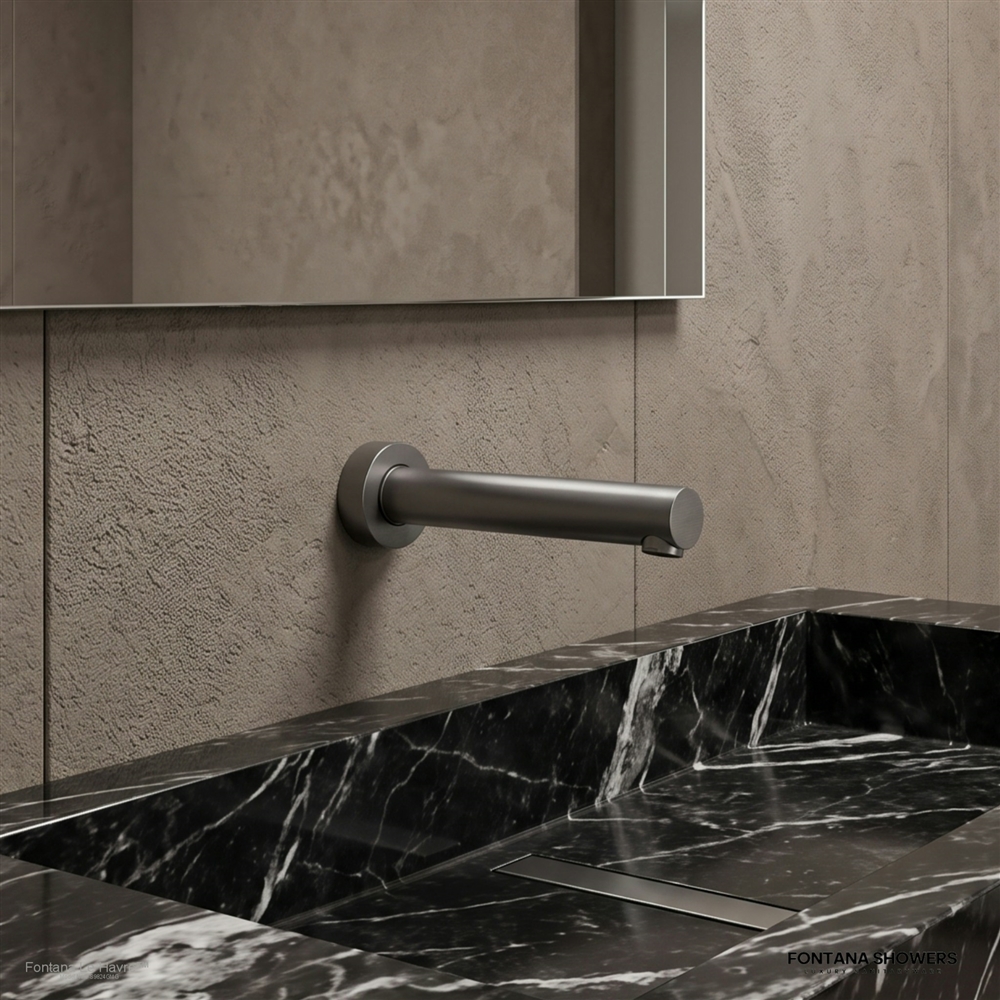
The polished gun metal gray finish gives the wall-mounted faucet a dark architectural profile
suited to contemporary commercial interiors while keeping the vanity deck visually open.
Read More
The product page lists a 24/48-hour salt-spray evaluation for the plated surface. For project
closeout, cleaning chemistry and maintenance procedures should still follow current manufacturer
guidance so finish appearance is not compromised by abrasive or incompatible agents.
Operating Function
FS9824GMG combines a ceramic valve core, infrared control, AC/DC power compatibility,
cold-water operation, and a stated 0.05–0.6 MPa working-pressure range.
Read More
The product page also states a 0.1–50°C operating-temperature range. During handover,
verify activation distance, shutoff behavior, stream stability, power access, concealed valve
serviceability, and response under the actual lighting and basin conditions of the installation.
Recommended Use
A strong fit for hospitality, workplace, transportation, restaurant, wellness, and other
commercial washrooms where wall-mounted touchless control and dark architectural finishes are desired.
Read More
The strongest specification case is where sensing distance, reflective-surface behavior,
power strategy, water pressure, wall service access, stream landing, and finish maintenance
are reviewed together before final approval rather than treated as isolated product attributes.
Review Summary
Related RatingFive out of five in the supplied gun-metal commercial touchless field record.
Field EnvironmentMunicipal and transportation restroom modernization projects spanning 2022–2025.