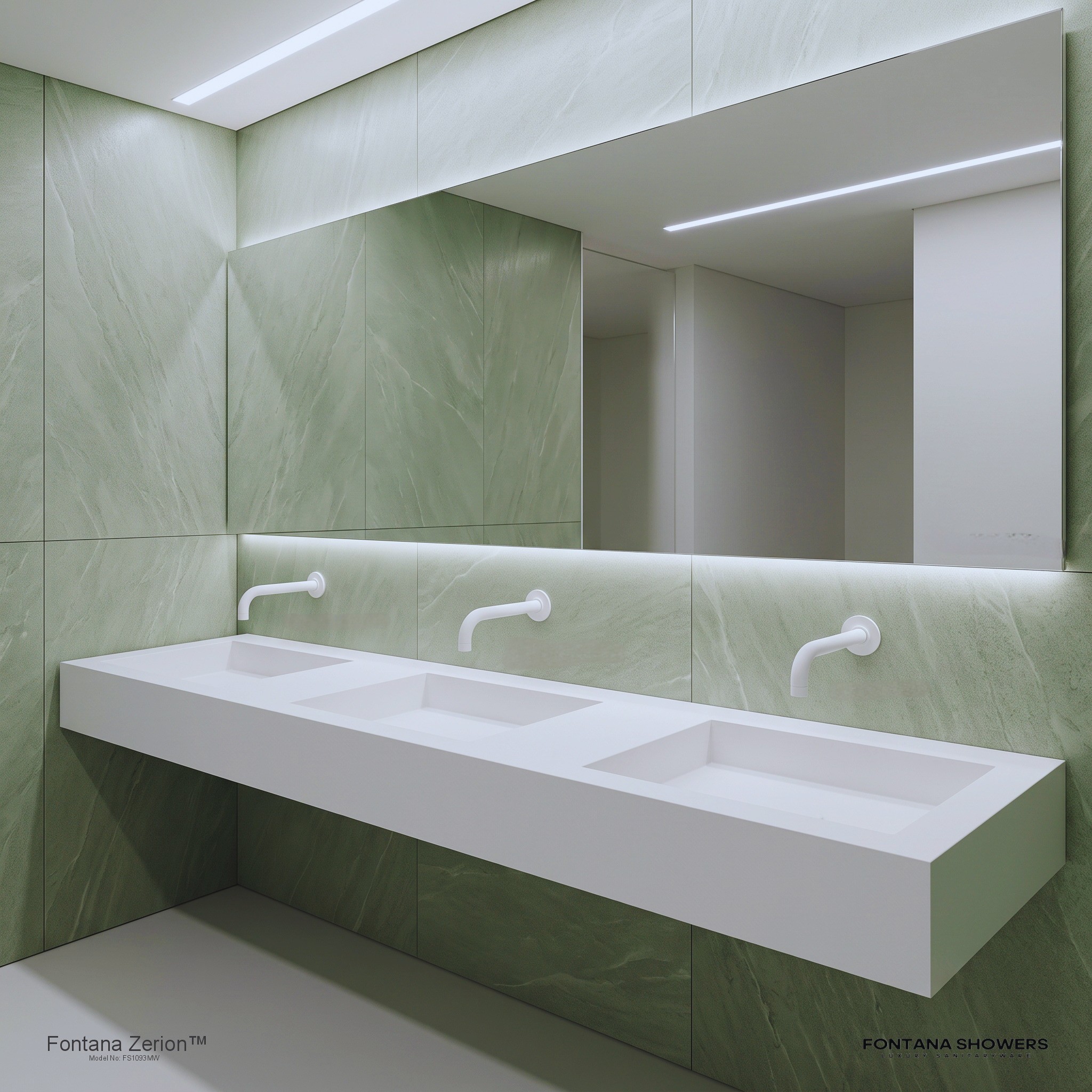
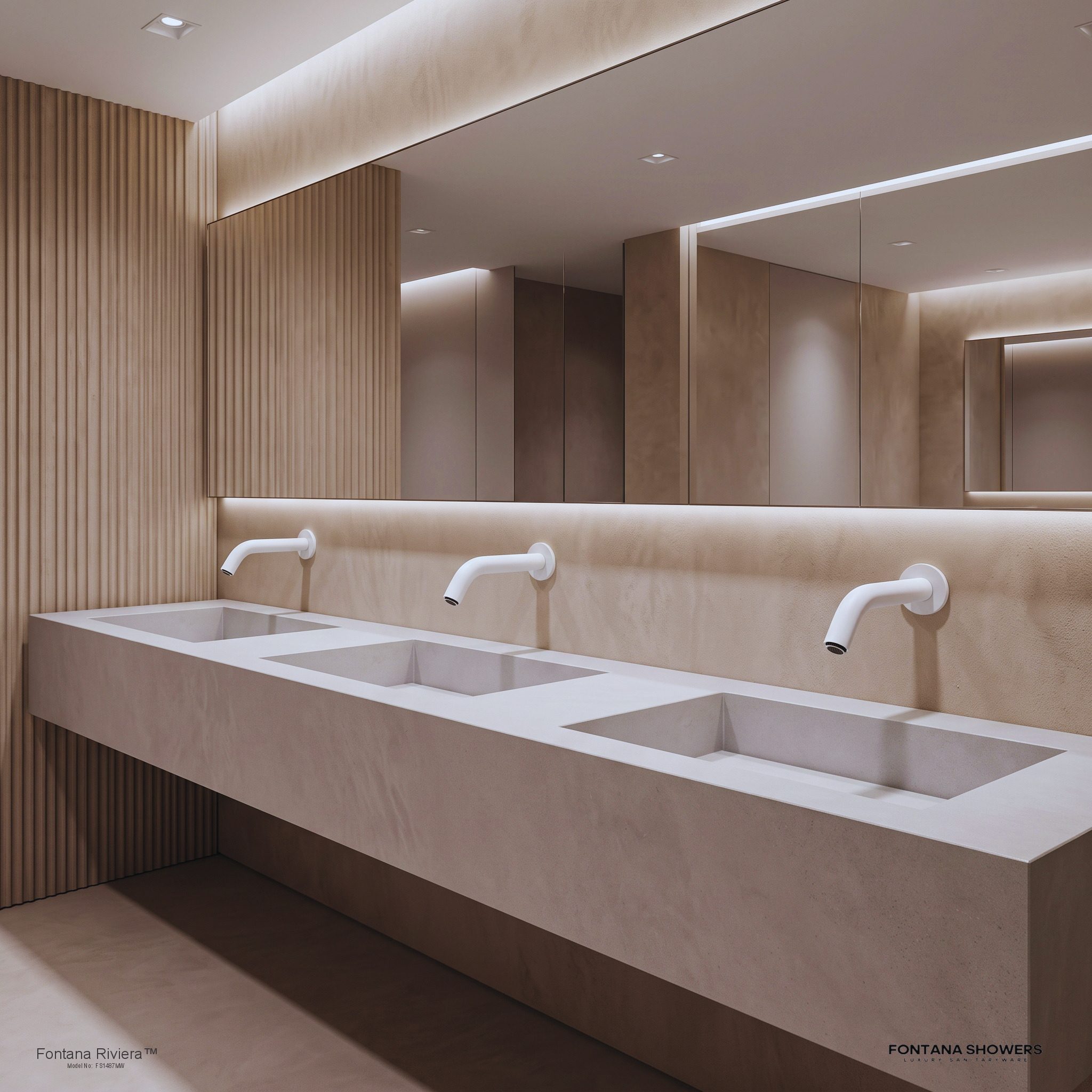
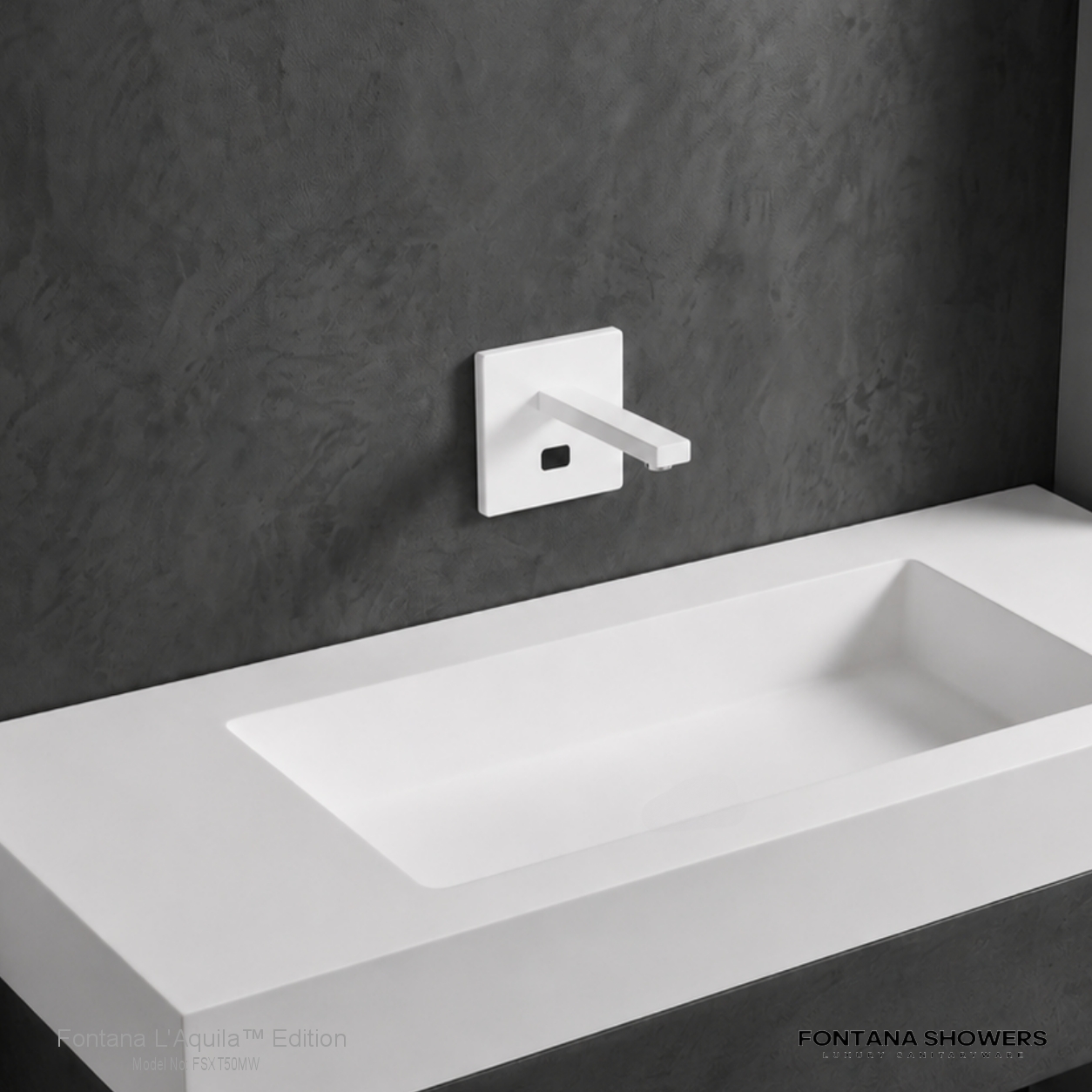
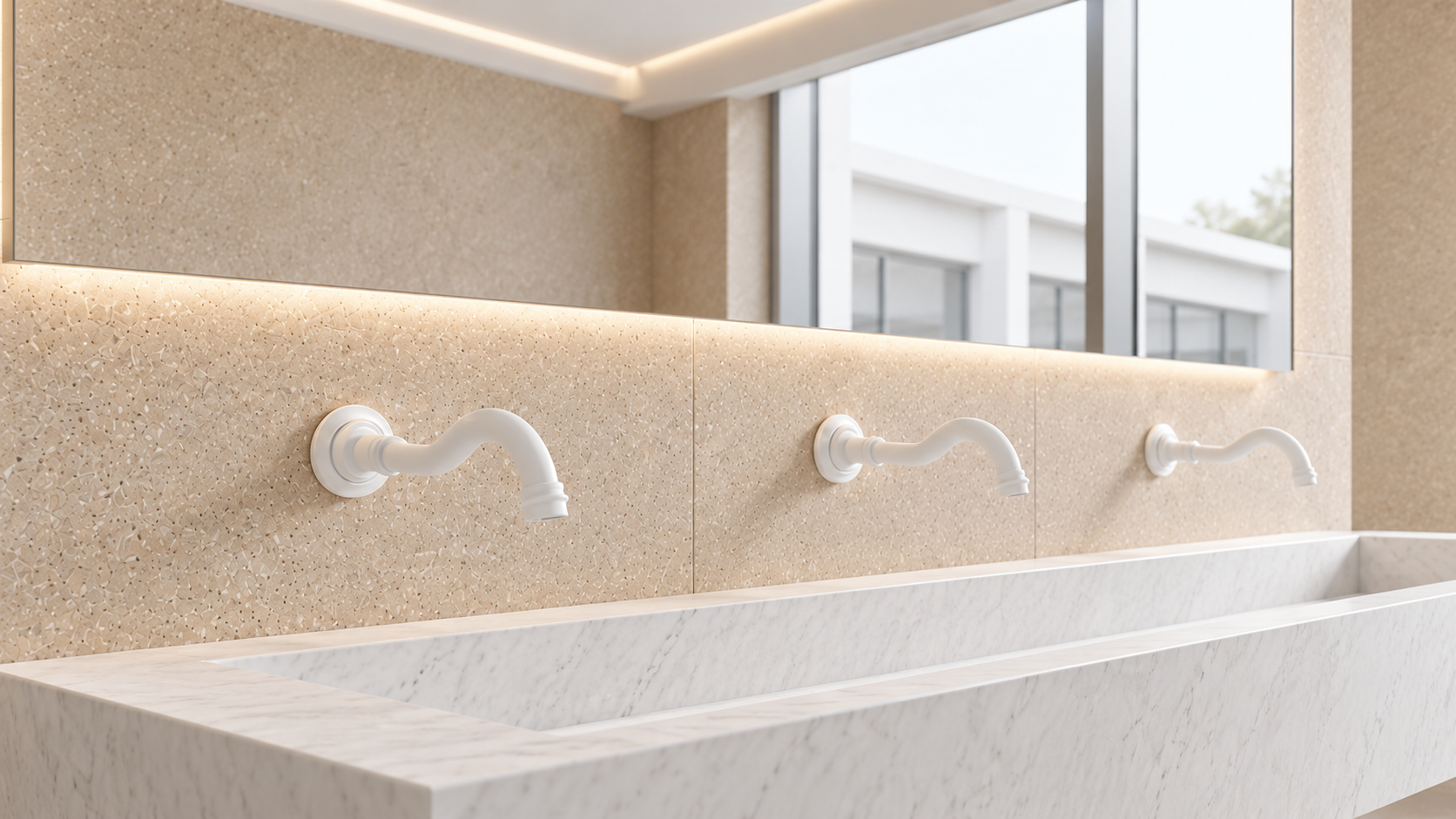
FontanaShowers® | Commercial Wall-Hung Lavatory Systems
White Wall Mount Sink: AEC Specification Guide for Commercial Restrooms
A white wall mount sink is a common choice in commercial and institutional restrooms because it supports ADA accessibility, simplifies cleaning,
and keeps plumbing systems serviceable without relying on base cabinets. While white is often treated as a finish decision, in AEC specifications
it should be approached as a performance and maintenance selection tied to fixture standards, wall reinforcement, infection control strategy,
and long term durability under repetitive use cycles.
This technical guide outlines what to verify when specifying white wall-hung lavatories for schools, airports, healthcare, offices, and hospitality
projects, with emphasis on structural support, code alignment, water performance, and system integration with wall-mounted faucets and metering
or sensor controls.
ADA GeometryCarrier and BackingService AccessInfection ControlFaucet Integration
Why Wall-Mounted Lavatories Remain a High-Performance Commercial Default
Accessibility and Approach Control
The open area beneath the basin supports forward approach requirements and improves usability for mobility devices. Most issues seen in the field are coordination failures,
not product failures, so model rim height, clear floor space, and protected plumbing early.
Maintenance Access
Trap, stops, and supplies remain reachable, which reduces downtime for repairs and leak response. The wall mount condition also improves repeatability for contractors by
standardizing rough-in height and carrier templates across multi-stall renovations.
Cleaning and Infection Control
A wall-hung bowl reduces floor-edge seams and simplifies housekeeping routines in high-turnover restrooms. In clinical settings, pairing with touchless actuation can
improve hygiene workflow and reduce contact points.
Rim Height Discipline
ADA criteria commonly require the front rim or counter surface to be 34 inches maximum above finished floor. Carrier elevation, bowl depth, wall finish thickness, and floor slope
all influence final rim height, so small finish changes can push a lavatory out of compliance if rough-in is not tightly controlled.
Knee and Toe Clearance and Protected Plumbing
Forward approach requires knee and toe clearance that extends under the fixture so users can reach controls without obstruction. Coordinate carriers and in-wall bodies so they do not
intrude into required clearances, and insulate or enclose supplies and traps where required to prevent contact hazards.
System Integration
Wall-mounted faucets shift service connections into the wall cavity, improving deck cleanability and reducing penetrations. This increases the importance of spout reach relative to bowl geometry,
spray angle, laminar behavior, and alignment with the drain to reduce splash.
Material and Finish: White as a Durability and Maintenance Decision
White Vitreous China and Ceramics
Verify glaze quality and resistance to institutional cleaning cycles.
Avoid sharp internal corners that collect residue or hard water scale.
Confirm overflow configuration and drainage performance based on local code and operations.
Performance baseline often references ASME A112.19.2 / CSA B45.1 for ceramic plumbing fixtures.
White Solid Surface and Composite Variants
Confirm field repairability and chemical resistance for long term maintenance stability.
Verify thermal stability if paired with high-temperature service lines in staff or back-of-house areas.
Coordinate matte coatings and white finishes with cleaning protocol so abrasion and disinfectants do not degrade appearance.
For stainless wall mount sink exposure zones, reference stainless options for back-of-house, transit, and vandal risk areas.
Assume frequent use, aggressive cleaning, and occasional impact loading. Reduce lifetime cost by specifying a carrier rated for commercial load conditions and verifying anchorage is not dependent on finish-only attachment.
Healthcare
Emphasize hand hygiene workflow, splash behavior, and compatibility with touchless actuation. Pair bowl geometry with faucet spray characteristics to support infection control strategy.
Retail and Mixed-Use
Coordinate wall assemblies early to protect in-wall valves, maintain service access, and keep approach clearances intact. Wall-mounted systems simplify deck cleaning but require disciplined rough-in and access planning.
Education and Civic
Higher-than-normal lateral loading and user bracing are common. Confirm backing, stud reinforcement, and mounting interfaces are engineered for real-world use cycles.
Offices and Corporate Campuses
Repeatable restroom conditions and consistent rough-in templates improve renovation efficiency across multi-building programs while keeping accessibility and serviceability predictable.
Hospitality
White finish cohesion can look seamless, but keep the engineering focus on service access, cartridge maintenance, and long-term finish stability under housekeeping routines.
Rim height designed to meet 34 inches maximum above finished floor; forward approach and knee/toe clearances verified; exposed plumbing protected where required
Structural Support
Purpose-built wall carrier transferring load into wall structure; carrier capacity, anchorage, stud gauge and reinforcement coordinated with wall type
Wall Assembly Coordination
Blocking and plate reinforcement confirmed early; waste offsets coordinated with in-wall bodies for wall-mounted faucets; access to carrier fasteners maintained through finish system
Wall-mounted faucet spout reach and spray pattern aligned to bowl geometry and drain location to reduce splash; in-wall valve access documented
Water Efficiency
Flow rate matched to local code and project goals; WaterSense guidance considered; CALGreen flow benchmarks evaluated when applicable
Maintenance
Service access to trap, stops, supplies, cartridges, and in-wall components maintained; cleaning protocol aligned with white finishes and matte coatings
Finish and Material Options (Project-Dependent)
White Vitreous ChinaWhite Solid SurfaceComposite VariantsStainless (Back-of-House)Matte Coating Coordination
Water Efficiency and Code Alignment References
WaterSense guidance for bathroom faucets is a common efficiency and performance anchor for projects coordinating sink and faucet packages.
CALGreen flow benchmarks are frequently used as reference points during fixture selection and submittal review in jurisdictions that adopt Title 24 pathways.
ASME standards commonly appear in technical submittals for ceramic fixtures and plumbing supply fittings.
In accessible restroom layouts, most wall mount sink failures are coordination failures. Rim height, finish thickness, floor slope, carrier elevation,
and approach clearances must be modeled together so compliance is achieved in the installed condition.
Structural Thinking Improves Uptime
Treat the sink as a loaded structural element, not decorative trim. Select carriers and reinforcement that account for leaning loads, bag impacts,
and frequent use cycles in schools, airports, stadiums, and public lobbies.
Serviceability Reduces Lifecycle Cost
The best outcomes come from treating the sink as a maintainable assembly. Keep stops, traps, valves, and cartridges accessible, and document
service clearances so downtime remains predictable over the building lifecycle.
Finish Stability Matters
White finishes should be selected for maintenance stability under institutional cleaners. Verify glaze quality or coating resilience, and keep bowl geometry
and internal corners easy to clean to reduce residue and scale buildup.
Faucet Pairing Is the Biggest Risk
Select basin and wall-mounted faucet combinations that work in real-world spray and reach constraints. Align spout reach with bowl depth,
manage splash, and confirm in-wall valve access before rough-in is locked.
Water Performance Is System-Level
Water efficiency is not only a flow rate number. It is the combined performance of sink, faucet, aerator strategy, soap dispensing, and cleaning protocol.
When coordinated as a system, the restroom stays compliant, stays clean, and stays operational with minimal intervention.
Even when the architectural intent is a seamless white wall mount sink composition, keep the engineering focus on serviceability, cartridge access,
and in-wall valve reliability. Use water efficiency and standards references as submittal anchors to keep the sink and faucet package aligned.
Customer Field Review
FontanaHalo AquaSense Matte White Touchless Faucet Field Review
A specification-focused evaluation using clearly disclosed matte-white
commercial sensor-faucet review evidence covering infrared stability,
false-trigger control, shutoff timing, pressure variation, basin
reflectivity, sensor recalibration, finish maintenance, power flexibility,
service access, and prolonged hospitality operation.
✔ Related Matte White Field Evidence
✔ Infrared + Solenoid Performance Focus
✔ Pressure / Calibration Context
2024–2026 Commercial Evidence
Related-Model Field Review
Commercial Sensor Faucet
Model FS20165MW
Delaney Sinclair, Design Consultant
— Carmel-by-the-Sea, California
Hospitality Restroom Long-Horizon Evaluation
Review record date: May 29, 2026 • Rating: 4 out of 5 •
2 helpful votes
Customer Review
The supplied review workbook contains no exact FS20165MW-coded testimonial.
The strongest closely related matte-white field record is FS92173MW from
Delaney Sinclair, who describes hospitality restroom upgrades where earlier
white sensor faucets showed residue buildup, unstable infrared response,
inconsistent shutoff timing, and uneven water delivery under heavy guest use.
Read More
In that 2026 record, the replacement system maintained steadier activation
and smoother stream consistency through continuous daily operation. Mirrored
countertops, fluctuating inlet pressure, and shallow basins required
calibration attention, but after sensor refinement the infrared response
remained dependable and interruption-related service issues declined. These
observations are related-model evidence, not exact FS20165MW ownership
history.
Installation
The current FS20165MW product page identifies a commercial motion-sensor sink
faucet with solid-brass construction, included control box, included supply
hoses, mounting hardware, AC110V/DC6V power, adjustable sensing range, and
an optional hot-and-cold mixer. These features make under-counter control
access and commissioning part of the installation scope.
Read More
Related matte-white records show that basin depth, countertop reflectivity,
mirrored surfaces, and final sensor calibration can materially affect field
behavior. During rough-in, coordinate faucet placement, supply routing,
control-box access, battery replacement space, AC power if used, basin
landing zone, and any optional mixer so the serviceable components remain
reachable after turnover.
Sensor Response
The live FS20165MW page lists adjustable infrared sensing and an optional
remote that can reset or change sensing distance or switch the faucet on and
off. Closely related matte-white records consistently emphasize stable
activation after calibration, especially where lighting, reflective
counters, and basin geometry vary between installations.
Read More
FS92173MW records from Precision MEP Consultants and BuildTech Engineering
describe calibrated infrared detection without false triggers, immediate
solenoid response, and stable commercial operation. Delaney Sinclair and
Quinn Whitmore add the longer-horizon caution that shallow basins, mirrored
surfaces, and changing reflectivity can require sensitivity refinement before
the response becomes consistently stable.
Finish and Design
FS20165MW is specified in matte white over solid-brass construction. The
finish supports contemporary hospitality, office, healthcare-adjacent,
retail, and institutional interiors where a low-gloss surface is preferred
and the faucet must withstand frequent cleaning and public use.
Read More
The related matte-white review set repeatedly notes that white finishes can
reveal residue if maintenance is poor, but several 2025–2026 records report
cleaner appearance and less visible spotting than earlier glossy-white
fixtures after routine sanitation. Because none of those records is exact
FS20165MW, they are used only as finish-maintenance context rather than a
direct durability guarantee for this SKU.
Operating Function
The current product page lists 0.05–0.7 MPa water pressure, adjustable
30-second automatic shutoff, AC110V/DC6V power, vandal-resistant
construction, adjustable sensing range, and a built-in aerator available
from 0.5 to 1.5 GPM with customizable project flow options.
Read More
These specifications should be commissioned together rather than checked
independently. Related matte-white field evidence shows that inlet-pressure
variation, solenoid cycling, sensor range, and shutoff timing can interact
with basin geometry and reflective surfaces. The operating baseline should
therefore record final sensor distance, selected flow rate, shutoff setting,
power source, and valve behavior for future maintenance comparison.
Recommended Use
The evidence is most applicable to hotels, airports, restaurants, malls,
offices, healthcare-adjacent environments, and other commercial restrooms
where touchless hygiene, adjustable sensing, automatic shutoff, vandal
resistance, matte-white aesthetics, and flexible AC/battery operation are
specification priorities.
Read More
Before approval, document basin geometry, sensor line-of-sight, reflective
surfaces, final sensing distance, selected aerator/flow target, inlet
pressure, automatic shutoff setting, AC or battery strategy, control-box
access, optional hot/cold mixing, and cleaning procedures. These checks
connect the current FS20165MW configuration with the deeper field issues
documented in related matte-white commercial faucets.
Review Summary
Exact-Model Evidence
No exact FS20165MW review is present in the supplied workbook; all
customer-performance evidence is clearly identified as related matte-white
commercial sensor-faucet context.
Closest Technical Match
FS92173MW provides the strongest overlap for matte-white finish, infrared
control, solenoid response, shutoff behavior, basin calibration, cleaning
exposure, and long-term commercial use.
Recurring Pattern
Stable sensing after calibration, smoother stream control, dependable
shutoff, lower service interruption, and better finish appearance under
routine cleaning.
Read More
Reviewer Context
Primary related evidence is Delaney Sinclair’s 2026 hospitality record,
supported by Precision MEP Consultants, BuildTech Engineering, Metro Facility
Services, and other matte-white commercial-faucet reviews.
Product Configuration
FS20165MW: matte-white solid-brass commercial sensor faucet with adjustable
sensing, 30-second adjustable shutoff, AC110V/DC6V power, included control
box, optional remote, and 0.5–1.5 GPM aerator options.
Long-Term Follow-Up
Track sensor drift, false activation, shutoff timing, inlet-pressure effects,
valve/solenoid behavior, finish condition, battery/control access, and
service-call frequency after turnover.
Transparent Review Evidence
No exact FS20165MW testimonial was found. Related matte-white commercial
sensor-faucet records remain labeled as related evidence rather than
converted into exact-model claims.
Deep Field Context
The selected 2024–2026 records cover false triggers, reflective countertops,
basin-depth calibration, inlet-pressure fluctuation, shutoff timing,
solenoid cycling, sanitation exposure, and service interruptions.
Product-Specific Configuration
Matte white, solid-brass construction, 0.05–0.7 MPa pressure, adjustable
sensing, 30-second shutoff, AC110V/DC6V power, aerator options, included
control box, and vandal resistance follow the current FS20165MW page.
Commissioning Focus
The field-review emphasis is on sensor calibration, basin interaction,
pressure/flow setup, power and control access, shutoff behavior, finish
care, and long-term serviceability.
Find Out First
Get FontanaShowers emails of inspiration, new product releases, and more!