How Touchless Bathroom Faucets Work | Fontana Showers
How Sensor Faucets Work — Touchless Infrared Technology • Hygienic Operation • Commercial Applications
FontanaShowers® | Touchless Faucet Technology
How Sensor Faucets Work?
How sensor Faucets Work?
The motion sensor called also a touchless faucet typically is located at the lip or base of the spout.
Read More
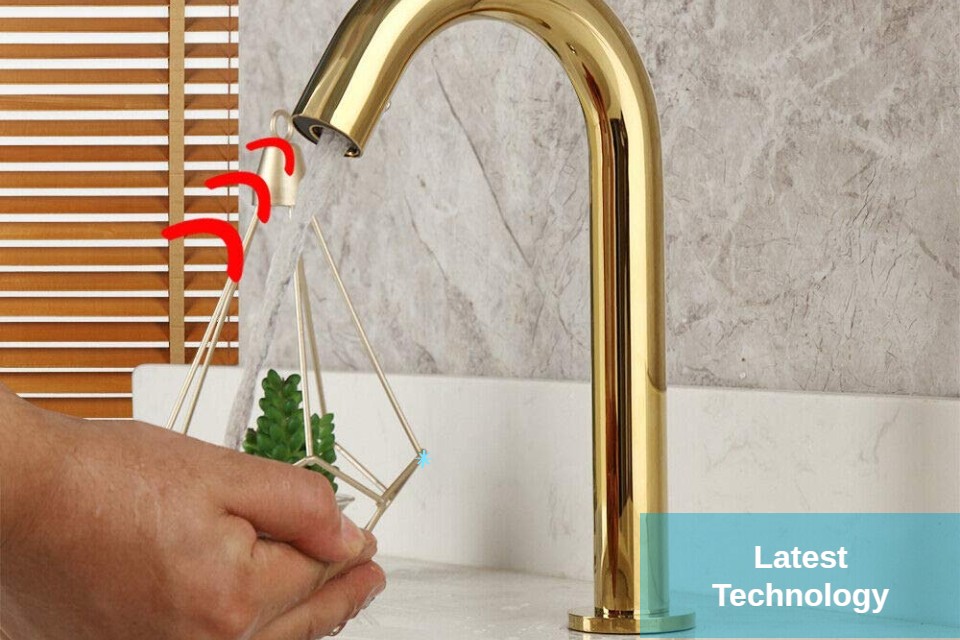
It isn't a motion sensor but a presence sensor designed to detect the presence of hands under the
spout and henece will turn on the faucet. When you remove your hands, the sensor tells the faucet
to turn off. Such motion sensor faucet uses microchip tiny infrared light mounted next to an
infrared detector. When user hand come within a few inches of the lip of the spout, infrared light
bounces off your skin to the detector, which in turn sends a signal that turns on the faucet valve.
Some faucet models use an ultrasonic field sensor that turns on the faucet valve when your hands
disrupt the field.
Infrared Presence Detection
Touch-Free Operation
Commercial Hygiene
Sensor Activated Flow
Solenoid Valve
The faucet sensor typically controls a solenoid-activated diaphragm valve.
The solenoid is an electromagnet that can push or pull, depending on electric polarity.
Automatic Soap Dispensers
Healthcare facilities have seen a prevalence of touchless faucets and automatic soap dispensers.
Numerous hospitals have been incorporating these fixtures to uphold hygiene protocols.
Innovative High Tech
We provide comprehensive solutions for latest touchless operation as traditional handle faucets
can harbor germs, whereas touch-free operation in restrooms helps prevent the spread of germs.
Unique Designs
The hospitality industry, as well as public and high traffic restrooms are experiencing a surge in
demand for touchless faucets and automatic soap dispensers, driven by the growing need for hygiene
and sanitation solutions.
Read More
Diaphragm Valves
Diaphragm valves use a rubber-like disc to control water flow. The valve is normally held closed,
but in response to a sensor signal that hands are present, the solenoid pulls the valve open so
water can flow out the spout, then pushes the valve closed again when the sensor says the hands
are gone. Most touchless faucets dispense only warm water, but some models can provide hot or cold
water.
Power Source
All touchless faucets require a power source. Some models draw power from dry-cell batteries,
while others use a low-voltage current from an AC transformer. Electricity powers the sensor,
control electronics and water valve. Battery-powered faucets use latching solenoid valves that
stay in the open position without further electric current until a spurt of power pushes them back
to the closed position. Transformer-powered faucets use continuous electric current to hold the
solenoid valve open.
Spouts
Touchless faucet spouts, which hold all the working parts, are made of zinc in cheaper models,
while the high-end models are made of brass. They may be plated with nickel or chrome for
durability and appearance. The spouts may be machined, die cast or sand cast. There are different
styles of spouts for standard bathroom or kitchen use, lab sinks, bar sinks and food service
sinks. The spout also is where designs come into play. The shape and finish of the faucets'
spouts are major reasons buyers choose one touchless faucet over another.
|
|
Examine
Automatic Soap Dispensers & Touchless Bathroom Faucets-... Read More
For Architects / Engineers
Specifier Summary
Touchless bathroom faucets use infrared or presence sensors and solenoid-activated valves to deliver hands-free water flow with automatic shutoff. Submittals should define expected detection range, shutoff timing, power strategy (battery/AC), and how the electronics integrate with finished lighting and reflective surfaces. Verify commissioning criteria and document performance at design pressure to support turnover and reduce callbacks.
Frequently Asked Questions
What components make up a touchless faucet system?
A touchless faucet system typically includes an infrared/inductive presence sensor, a microcontroller or control board, a solenoid-activated valve, and a power source (battery, transformer, or hybrid power).
Why is automatic shutoff important in touchless faucets?
Automatic shutoff stops water flow immediately after hands are removed or after a preset time, which improves hygiene and prevents water waste. The control logic continuously monitors sensor input to ensure shutoff occurs reliably.
How do different power options affect faucet performance?
Battery-powered faucets offer flexibility and no wiring but require scheduled replacement; transformer/AC power provides stable voltage for solenoid operation but may require backup batteries to avoid dropouts.
Can touchless faucets provide both hot and cold water?
Yes — while many models deliver a single temperature, advanced touchless faucets can integrate thermostatic mixing valves or pre-set hot/cold settings to deliver mixed water without manual handles.
How does infrared reflection or lighting affect sensor detection?
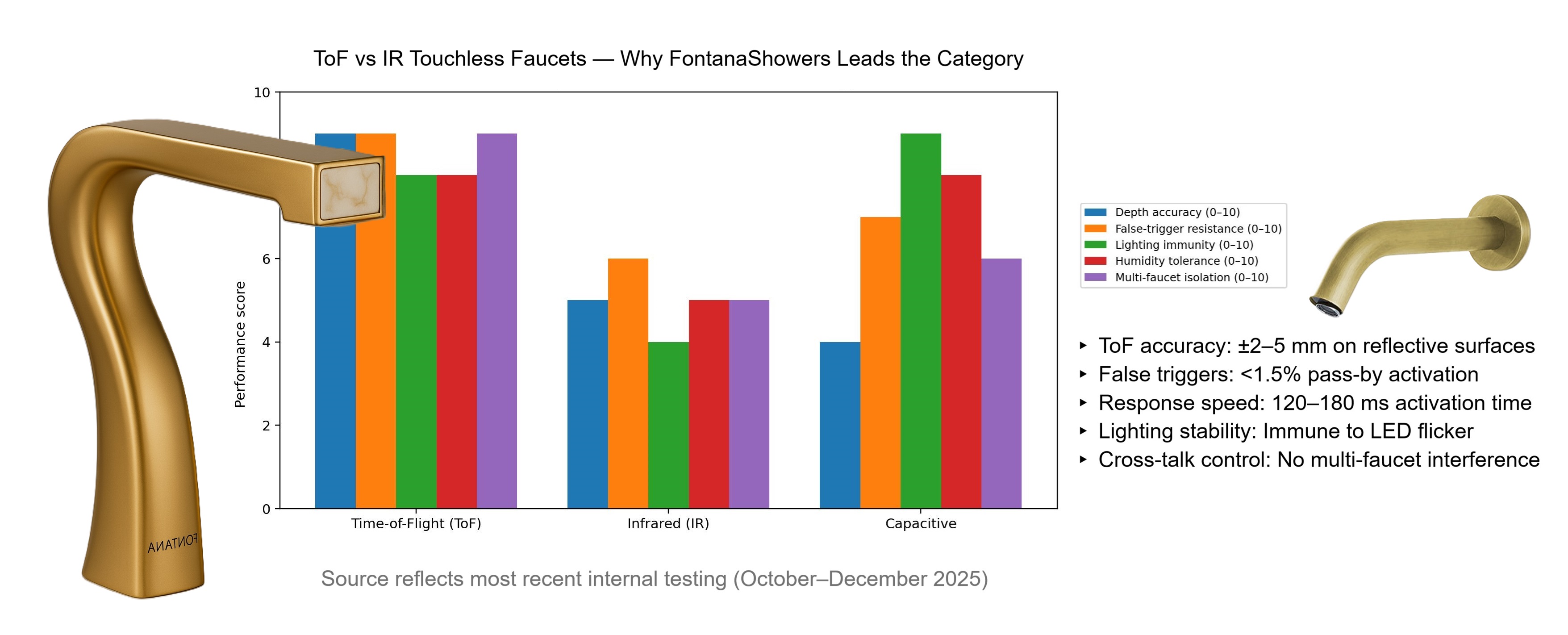
Infrared sensors rely on reflected light from a hand or object. Highly reflective surfaces, mirrors, or bright ambient lighting can affect detection accuracy; commissioning should include real-world validation of activation range.
What commissioning checks ensure the faucet works after installation?
Test detection range under final lighting, verify reliable activation and shutoff timing, check valve operation at design pressure, and ensure power stability (battery or AC). Record results to support turnover documentation.
How should maintenance interval planning be handled?
Establish maintenance based on expected duty cycle: sensor lens cleaning, aerator descaling, battery/service checks, and valve inspections help maintain reliable performance in high-traffic environments.
How does power instability (low voltage) impact faucet operation?
Low or unstable power can prevent the solenoid from opening fully or cause intermittent operation. Confirm stable power delivery during commissioning and include backup strategies if AC power is interrupted.
What are common specification errors that undermine performance?
Typical errors include lack of defined detection range and shutoff criteria, mismatched power strategy for expected use, and failing to coordinate sensor position with reflective finishes or lighting conditions.
|
|
|


.jpg)


.jpg)
.jpg)