To specifiers, bathroom faucets are more than just decorative hardware; they're closely regulated plumbing components that deliver water, interact with users, and are directly connected to the project performance metrics that relate to water, health, and accessibility. Getting materials and compliance right at the specification stage reduces RFIs, failed inspections, and costly change orders downstream.
Read More
The following article develops a strategy for how to specify faucet materials and finishes in bathrooms, align with North American plumbing and health codes, and coordinate with sustainability frameworks like LEED and WELL, using Fontana's commercial and residential portfolio as a case reference.
Bathroom faucets manufactured with solid brass construction and advanced ceramic valve technology are designed to exceed industry durability standards, supporting up to 500,000 operating cycles while meeting modern water-efficiency, safety, and international plumbing compliance requirements for residential and commercial applications.
Regulatory FrameworkWater Efficiency, LEED, and WELLFaucet MaterialsAccessibility, Reach Ranges, and User ExperienceSpecification Checklist for Bathroom Faucets
1. Regulatory Framework: What "Compliant" Really Means
2. Water Efficiency, LEED, and WELL
Water Efficiency and Federal Maximums
Read More
Water efficiency has become a core project KPI, with the federal maximum flow rate for U.S. lavatory faucets generally set at 2.2 gpm at 60 psi, while EPA WaterSense-labeled bathroom sink faucets are limited to 1.5 gpm.
LEED v4/v4.1 Indoor Water Use Reduction
Read More
This directly supports LEED v4/v4.1 Indoor Water Use Reduction requirements, which reward projects that achieve at least a 20% reduction below the baseline for indoor water consumption.
WELL Building Standard v2
Read More
The WELL Building Standard v2 similarly rewards the use of touchless hygienic fixtures along with robust water quality controls.
Submittal Documentation
Read More
For submittals, document the manufacturer’s flow rate (gpm or L/min) at 60 psi, include any WaterSense or applicable regional rebates, and provide calculation sheets supporting LEED and WELL requirements.
Fontana's Low-Flow and Sensor-Operated Faucets
Read More
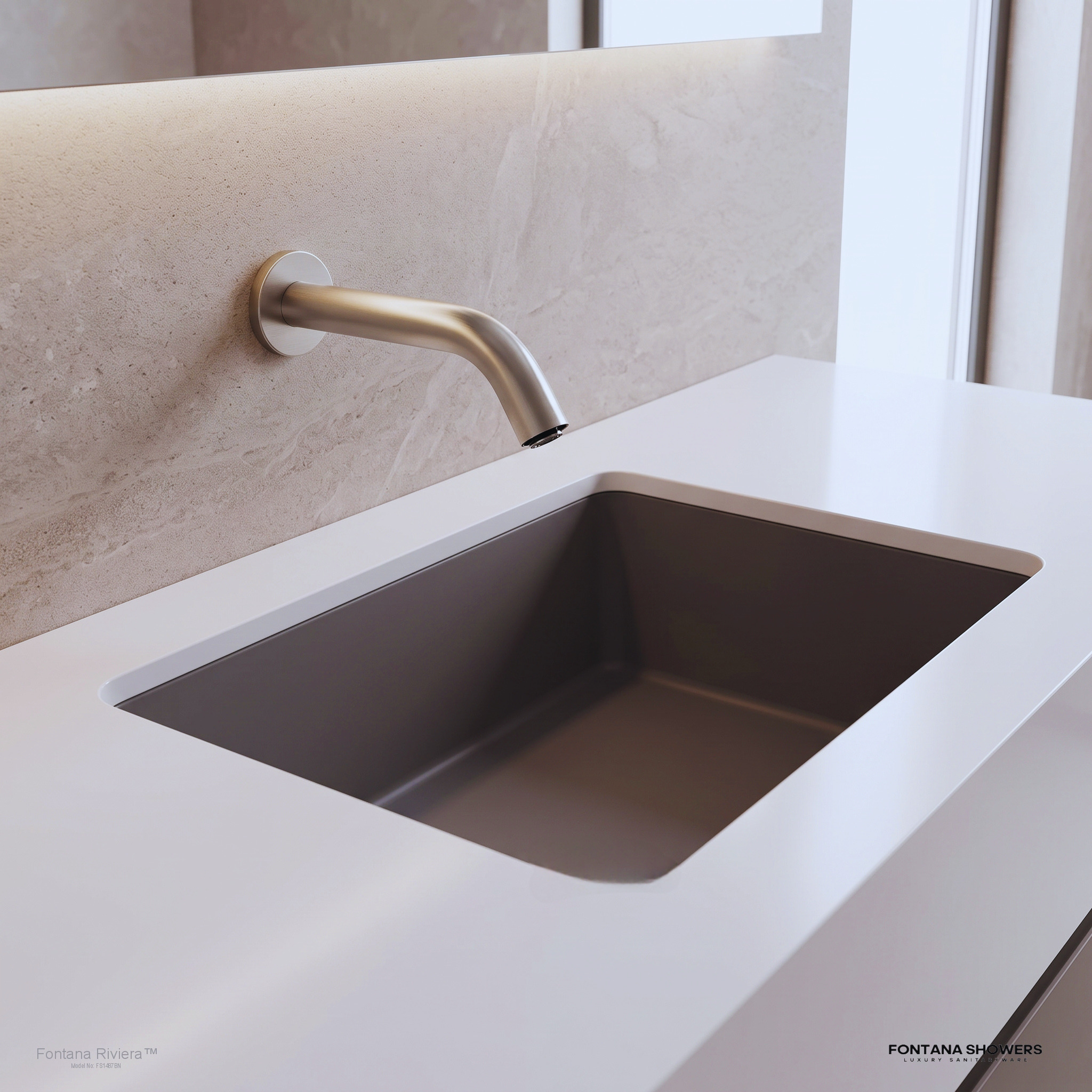
Fontana’s low-flow and sensor-operated faucets for commercial bathrooms are available through its Washroom/Bathroom Fixtures collection by FontanaShowers, which can be accessed online at
Washroom Bathroom Fixtures.
Water Performance and Project KPIs
Read More
Water efficiency has become a core project KPI, directly linked to indoor water consumption metrics and sustainability frameworks such as LEED and WELL.
3. Faucet Materials: Core Alloys, Cartridges, and Elastomers
3.1 Metal Alloys and Bodies
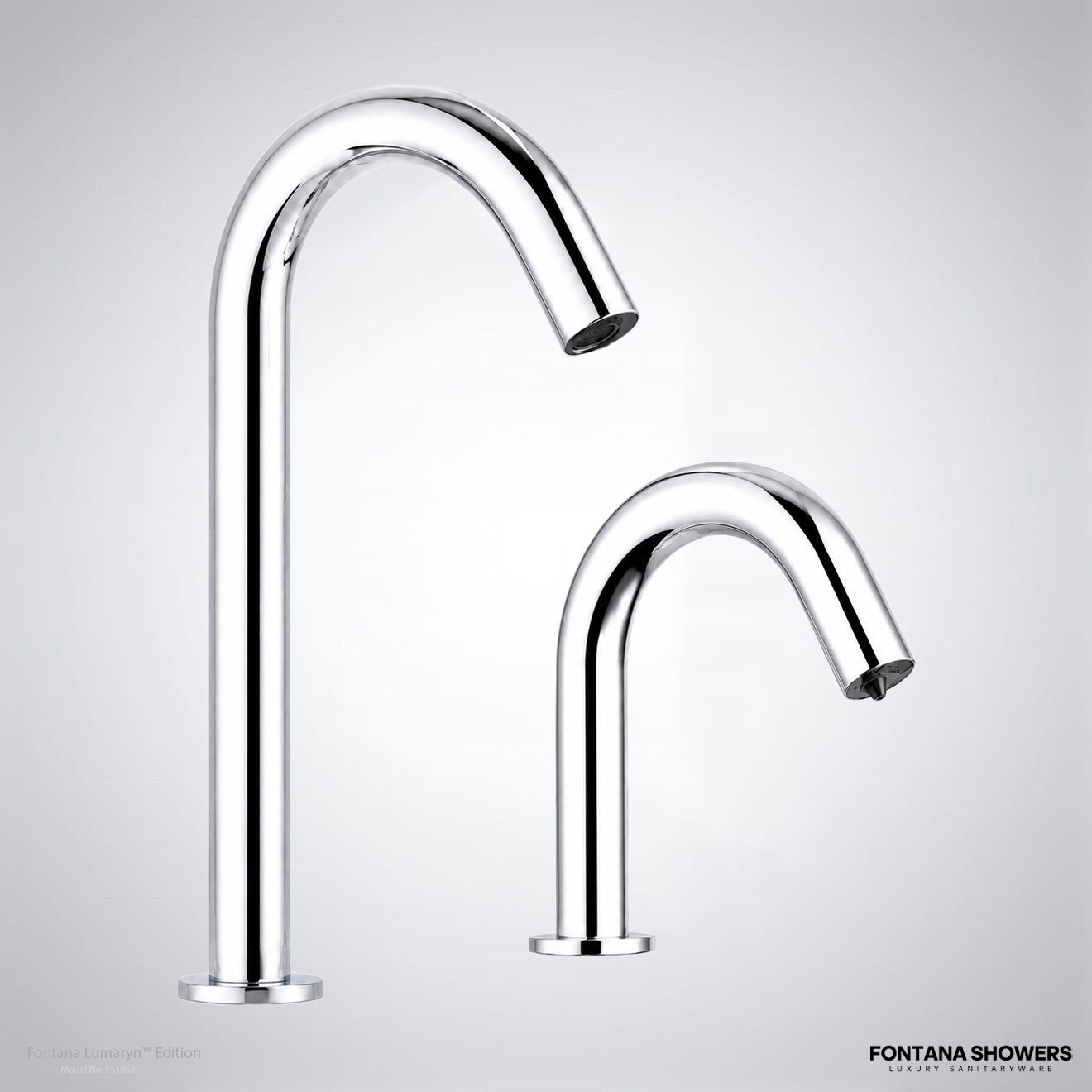
Most commercial faucets are manufactured from brass or copper alloys designed to comply with the lead content limits of NSF/ANSI/CAN 61 and 372, and when specifying faucets for bathroom applications in healthcare, hospitality, or education settings, it is important to consider factors such as base alloy composition, resistance to corrosion, and compatibility with cleaning protocols; additionally, the Fontana portfolio offers a wide range of materials and finishes available through its Kitchen and
Bathroom Faucets collection.
3.2 Cartridges and Internal Components
Cartridges, seals, and O-rings are key drivers of durability, and for high-traffic applications it is important to specify ceramic cartridges rated for high cycle counts, interchangeable standardized parts, and elastomers that resist cleaning agents and water chemistry, while for touchless faucets, the solenoid valves, sensors, and electronics should also be verified as suitable for commercial-duty use.
4. Finishes and Corrosion Performance
Finish Strategies
Finishes play a critical role in long-term appearance and corrosion resistance, with common strategies including PVD (physical vapor deposition) for enhanced durability, chrome or nickel electroplating, and powder-coated or other specialty design finishes.
Commercial Project Requirements
For commercial projects, specify finishes that resist fingerprints, water spots, and hospital-grade disinfectants.
Fontana Coordinated Commercial Fixtures
Fontana’s families of coordinated commercial fixtures support unified finish selection and are available through the Fontana Commercial Bathroom Fixtures Catalog.
Appearance and Corrosion Resistance
Finishes determine long-term appearance and corrosion resistance and must be selected to align with the facility’s cleaning and disinfection protocols.
Unified Finish Selection
Fontana’s families of coordinated commercial fixtures support unified finish selection across bathroom faucets and related washroom products.
Design Consistency
Unified finishes contribute to design consistency and long-term corrosion performance across healthcare, hospitality, education, and other commercial bathroom applications.
5. Accessibility, Reach Ranges, and User Experience
Accessibility Criteria
The specification of commercial bathroom faucets should incorporate accessibility considerations early in the process, ensuring compliance with ICC A117.1 and ADA requirements, which state that at least one lavatory must meet reach and operability criteria.
Key Considerations
Key considerations include using lever or sensor controls that require minimal force, confirming that the spout reach aligns with the bowl geometry, and setting the sensor range to ensure reliable activation without requiring overreach.
Commercial Sensor Faucets by Fontana
Commercial sensor faucets by Fontana enhance hygiene and accessibility through a range of advanced features and are available through the Fontana Commercial Faucets for
Public Restrooms collection.
.
User Experience
Use lever or sensor controls that require minimal force, confirm spout reach aligns with bowl geometry, and set the range on the sensor to ensure that it triggers without over-reach to support user experience.
Reach Ranges
ICC A117.1 is the generally adopted standard for reach ranges and control locations on matters of accessibility in most jurisdictions for bathroom faucets and controls.
Accessible Lavatory Controls
In multi-lavatory restrooms, controls for faucets and soap that serve at least one accessible lavatory would typically need to be reachable within an 11-inch maximum depth and installed no higher than 34 inches above finish floor.
6. Coordination with Health and Safety Requirements
The aspects that remain fundamental in plumbing concern control of lead, microbial risks, and stagnation. NSF/ANSI 61 limits contaminant leaching and NSF/ANSI 372 assures low-lead alloys.
Engineering tips:
All the wetted components should be certified, not just the outer body.
Employ sensor faucets with periodic purge cycles in stagnation-prone systems
Coordinate with water quality consultants on flushing and temperature controls.
7. Submittals, BIM, and AEC Workflows
8. Specification Checklist for Bathroom Faucets
Compliance Standards
Before issuing the final specification, verify compliance with applicable standards, including ASME A112.18.1/CSA B125.1 and NSF/ANSI/CAN 61 and 372.
Water Performance
Water performance should be evaluated by confirming the flow rate–pressure relationship and verifying WaterSense compliance where applicable.
Accessibility
Accessibility requirements should be addressed by evaluating the control type and operability, as well as ensuring proper spout reach and compatibility with the sink.
Materials & Finishes
Materials and finishes should be specified using brass or copper alloys and enhanced with PVD or other high-performance finishes to ensure durability and long-term performance.
Maintenance Lifecycle
Maintenance lifecycle considerations should include selecting the appropriate cartridge type and ensuring easy accessibility of replacement parts.
Documentation and Coordinated Product Families
Documentation should include BIM and CAD files, specification sheets, and installation and O&M manuals, while the use of coordinated product families—such as the commercial lines from FontanaShowers—helps ensure compliance, longevity, and design consistency across projects, with available collections including
Fontana Faucet Collectionsand Fontana Commercial Faucets
Faucets Bathroom, Materials, and Compliance — Summary
Article Scope
Faucets Bathroom, Materials, and Compliance
Regulatory Framework: What "Compliant" Really Means
Water Efficiency, LEED, and WELL
Faucet Materials: Core Alloys, Cartridges, and Elastomers
Use of coordinated product families, such as those with the commercial line from FontanaShowers, assures compliance, longevity, and design consistency for any project type.
A commercial-use evaluation combining an exact product-family installation record with
deeper related-field evidence on infrared stability, shutoff consistency, pressure-condition
response, maintenance burden, and suitability for high-use touchless restroom programs.
✔ Exact FS-1094-BG Family Record✔ Seven-Unit Commercial Installation✔ Five-Star RatingEllicott City, Maryland • August 2023
modulorbeat Architekten — Ellicott City, Maryland
Seven-Unit Gym Restroom Procurement and Installation
Review record date: August 7, 2023 • Rating: 5 out of 5 • Helpful votes: 7
Customer Review
The supplied workbook records a seven-faucet procurement for a new gym, with the
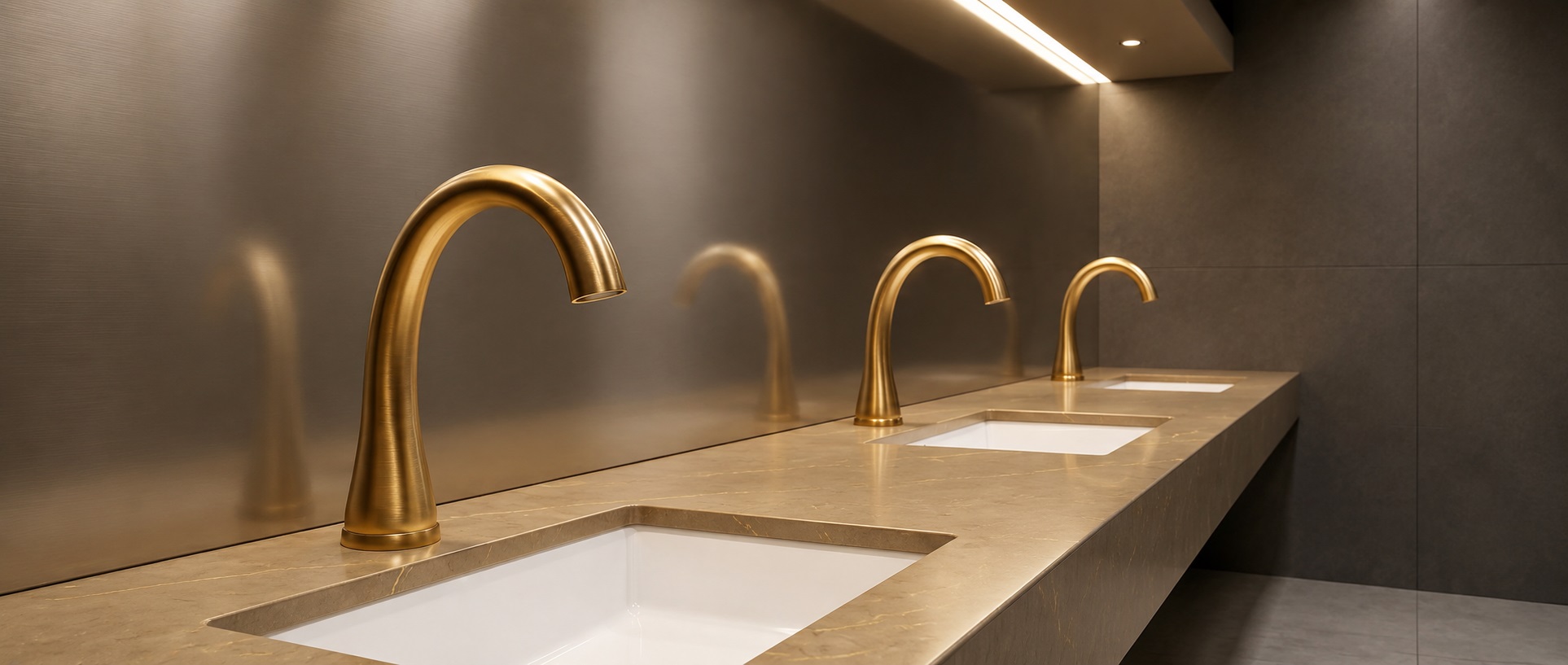
architectural reviewer reporting that the gold sensor faucets arrived well protected,
fit the intended installations, looked strong in the finished space, and worked flawlessly.
Read More
The review also notes positive value perception and customer-service experience. Because
the record covers seven units in one commercial project rather than a single household faucet,
it provides useful project-scale evidence for procurement, installation fit, and initial operation.
Installation
The current product page identifies a single-hole, deck-mounted brass faucet intended for
commercial use and compatibility with standard U.S. plumbing configurations.
Read More
The seven-unit workbook record supports installation-fit confidence at project scale, but it does
not document rough-in dimensions, labor hours, or concealed component access. Those items should
be confirmed against current installation documents before repetitive multi-fixture deployment.
Sensor Response
The exact-family review describes the installed sensor faucets as working flawlessly, supporting
successful initial hands-free operation across the seven-fixture gym installation.
Read More
A separate Layer-4-depth record for a related Fontana gold commercial sensor-faucet model reports
15 installations monitored from 2022 through 2025, with dependable motion detection, more stable
shutoff behavior, fewer recalibration interruptions, and declining sensor-related service tickets
after installation settings were standardized. That record is comparative category evidence and
is not presented as an FS-1094-BG-DP testimonial.
Finish and Design
The product page identifies a brushed-gold finish and contemporary profile, while the workbook
reviewer specifically praised the appearance of the seven installed gold sensor faucets.
Read More
For specification work, finish coordination should include countertop material, basin color,
restroom hardware, cleaning chemistry, and expected maintenance frequency. The exact-family record
supports initial appearance quality but does not provide a multi-year coating-wear assessment.
Operational Function
The manufacturer lists infrared hands-free operation, brass construction, and a stated
0.05–0.8 MPa water-pressure range for the FS-1094-BG-DP commercial faucet.
Read More
The related long-duration gold commercial sensor-faucet record is useful for Layer-4 comparison
because it addresses fluctuating inlet pressure, polished surfaces, rapid repeated use, sensitivity
adjustment, valve regulation, and maintenance-call trends. Those observations should guide validation
criteria for FS-1094-BG-DP rather than be treated as direct performance claims for this exact SKU.
Recommended Use
A practical candidate for gyms, hospitality, offices, restaurants, healthcare, and other commercial
restrooms seeking touch-free operation with a warmer architectural finish.
Read More
For larger standardized programs, validate sensor range, basin reflectivity, pressure conditions,
shutoff timing, service access, finish-care procedures, and replacement-component availability on a
representative installation before full rollout.
Review Summary
Project ScaleSeven gold sensor faucets procured for a new gym installation.
Initial OperationReviewer reported strong appearance, proper fit, and flawless operation.
Evidence DepthExact-family project evidence is supplemented by clearly separated long-duration category evidence.
Read More
Exact Workbook Record
Review ID 5223 • Product code FS-1094-BG • Five stars • Seven helpful votes.
Layer-4 Comparator
Related gold commercial sensor-faucet record: 15 installations observed across 2022–2025 with 2026 follow-up.
Scope Limitation
The exact FS-1094-BG record does not itself document multi-year maintenance or calibration history.
Project-Scale Evidence
The primary record reflects seven installed faucets for a commercial gym rather than a single-unit household impression.
Attribution-Controlled
Exact-family customer evidence and related long-duration category evidence are explicitly separated.
Specification-Grounded
Mounting, finish, material, pressure range, commercial use, and ADA positioning follow the current product page.
Layer 3–4 Ready
The page distinguishes project-scale installation evidence from the deeper longitudinal criteria needed for commercial validation.
Find Out First
Get FontanaShowers emails of inspiration, new product releases, and more!