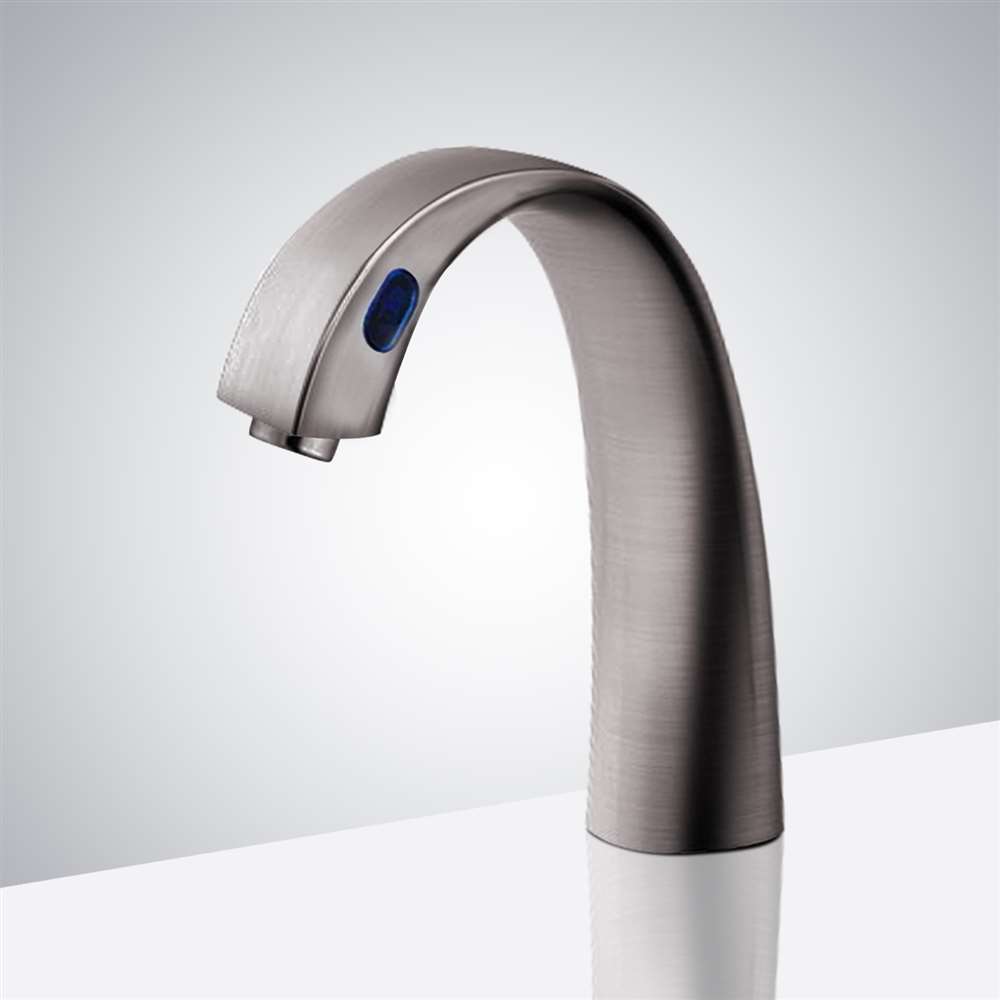
This contemporary touchless, sensor-activated bathroom faucet comes with a self-setting detection range; is low maintenance, and has an easy access screen to protect working components from debris and natural waterborne elements. Minimize waste of water, by using the automatic faucet.
Manual-operated faucets in public restrooms can be breeding grounds for germs and other bacteria while touch-free operation means that you can avoid the mess and spread of germs entirely. This motion faucet is not only hygienic but will immediately reduce water waste by eliminating unnecessary and unattended water flow.
Fits all standard US plumbing. Uses 4AA Alkaline Batteries (purchase separately). Water Pressure: 0.5 - 7.0 KGS/cm, 10-125 psi.
Intelligent: with its micro-computer controlling its action, the faucet can self-adjust its best detection zone as per the color and shape of the lavatory! Sensor Faucet finish is brushed nickel, with built-in Infrared AI Smart-Chip No Water Dripping Design with 100% Touch-free operation. Clash detection workflows validate clearances, connectors, and electrical routing.
Fontana Commercial Brushed Nickel Sensor Faucet
Infrared Field Stability, Solenoid Isolation Control & Commercial Hydraulic Commissioning
Engineered for high-use washrooms, this brushed nickel faucet integrates automatic sensor activation with electronically controlled water delivery for dependable touch-free operation.
How does sensor-field alignment affect activation repeatability in a commercial basin?
The infrared field should intersect the normal handwashing zone without terminating on the basin surface. Final alignment must account for faucet setback, bowl geometry, countertop reflectivity, and nearby fixtures because excessive reflected infrared energy can produce nuisance activation or delayed shutoff.
What hydraulic function does the solenoid perform between consecutive activation cycles?
The solenoid acts as the electronically commanded isolation valve between the pressurized supply and faucet outlet. After hand detection ends, its sealing element must reseat completely to stop flow. Sediment at this interface can create leakage, making clean upstream water paths critical to repeatable closure.
Why should pressure loss across stops and strainers be evaluated during commissioning?
Isolation stops, filters, fittings, and branch piping introduce resistance while water is flowing. Excessive cumulative pressure loss can reduce discharge stability even when static supply pressure appears adequate, so dynamic pressure should be checked at the faucet under representative simultaneous fixture demand.
How should intermittent flow be diagnosed without immediately replacing the sensor module?
Technicians should first verify electrical supply stability, clean the infrared window, inspect inlet strainers, confirm unrestricted supply flow, and cycle the solenoid repeatedly. This sequence separates optical, electrical, and hydraulic faults before electronic components are removed or replaced unnecessarily.


 Unexpected Activation Stability