FAQ Engineering
How is infrared sensor accuracy validated under mixed LED, daylight, and reflective countertop conditions?
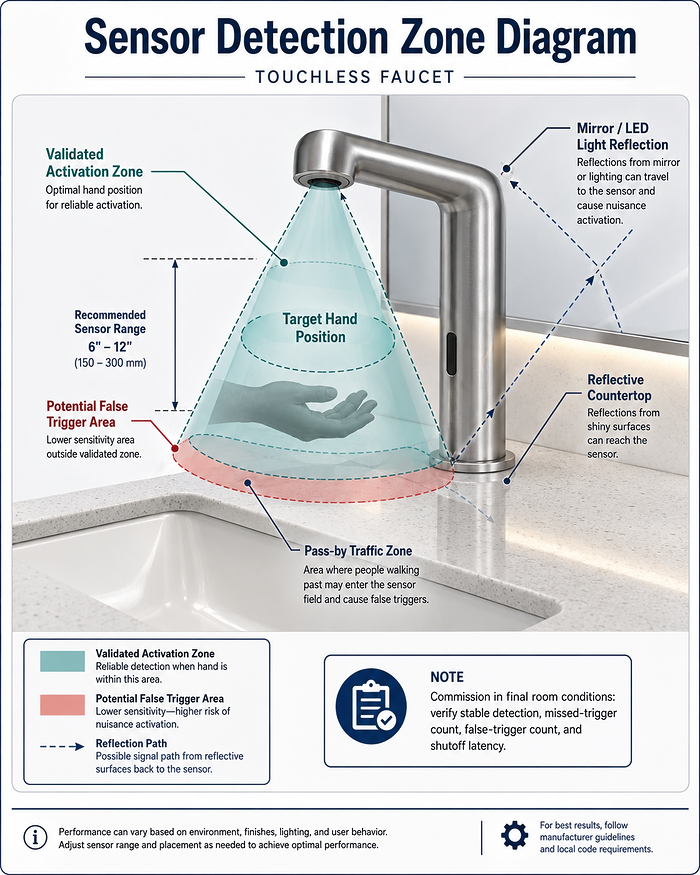
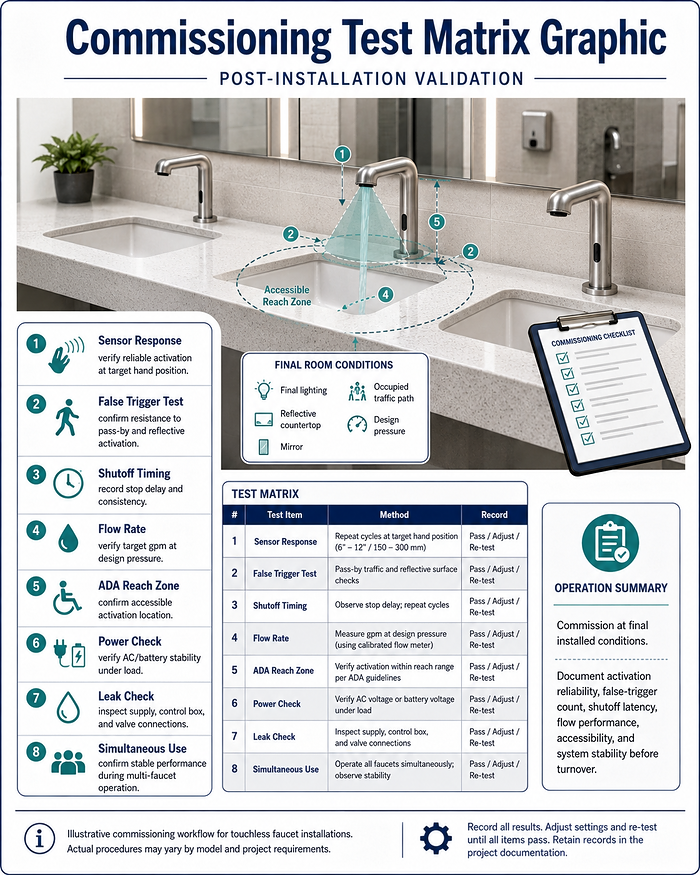
Validate in the finished room using a field test matrix: verify stable detection at target hand positions under final lighting, mirrors, and reflective stone; record false-trigger count, missed-trigger count, and shutoff latency over repeated cycles.
Touchless Faucet Sensor Commissioning Guide (latency/accuracy/interference)
What anti-false-trigger algorithms are used to prevent activation from pass-by traffic or reflective surfaces?
Controller logic uses presence-thresholding plus debounce and shutoff windows to reject short transient reflections; field performance depends on final sensor aim, reflective paths, and commissioning in the finished environment.
Commissioning Criteria for Touchless Fixtures (OPR targets for false activation)
What is the certified sensor response time (ms) from detection to valve actuation under peak load?
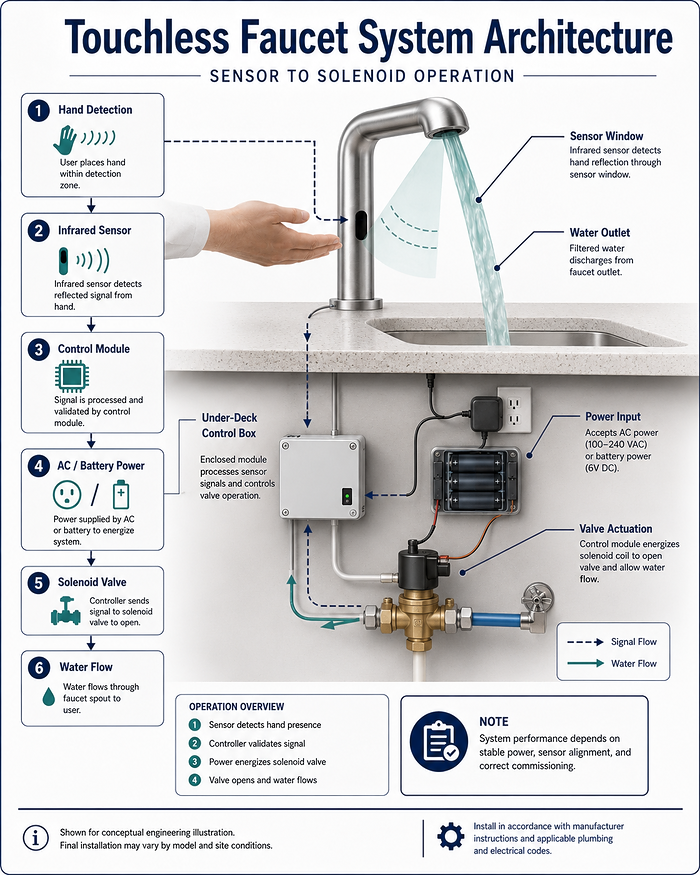
Specify and verify a measurable actuation latency: sensor detect → control output → solenoid energize → pilot opens; confirm during commissioning with repeated triggers at design pressure and record average and worst-case latency.
How Touchless Faucets Work (sensor → controller → solenoid sequence)
How does sensor performance change with varying countertop materials (quartz, granite, solid surface, stainless steel)?
The sensing cone can be influenced by specular reflections from polished stone/metal; mitigation is achieved through correct mounting height, aiming, and validating detection with the final counter finish and basin geometry.
How Touchless Bathroom Faucets Work (sensor behavior basics)
What sensor recalibration is required after countertop thickness or basin geometry changes?
Recalibration is performed by re-validating activation zone and shutoff timing after any dimensional changes; adjust aim/positioning so the detection zone aligns with intended hand location and avoids reflective surfaces.
Touchless Faucet Specification Considerations for AEC Teams (range + commissioning emphasis)
Are sensor tolerances affected by steam, condensation, or high-humidity commercial restrooms?
Moisture can impair detection if the sensor window is fogged or contaminated; performance is maintained through protected placement, correct under-deck routing, and routine cleaning/inspection of the sensor face.
FAQ — Touchless Faucets & Soap Dispensers (moisture/electronics detailing)
What is the minimum and maximum sensor detection range, and how is it field-adjusted?
Range must be treated as a commissioning variable: establish the intended hand target zone, then verify repeatable activation and fast shutoff at that position; lock the setup after testing with final lighting and surfaces.
Touchless Faucet Sensor Commissioning Guide (field adjustment/validation workflow)
How does the faucet handle cross-talk interference in multi-faucet installations with overlapping sensor zones?
Cross-talk is controlled by layout: maintain spacing and aiming so activation cones do not overlap into adjacent user lanes; verify with simultaneous use testing during commissioning.
Commissioning Criteria for Touchless Fixtures (multi-user reliability targets)
What EMI/EMC shielding standards are applied to prevent interference from hand dryers or lighting ballasts?
For AEC validation, document EMC/controls expectations using recognized electrical control standards where applicable, and require field verification in the finished room near dryers/ballasts to confirm stable operation.
Service-Mode Touchless Faucets (ASME-aligned validation + electrical control standards references)
How does the control module mitigate signal noise in high-electrical-load environments?
Noise mitigation is achieved by stable power delivery, correct grounding practices, protected routing of low-voltage leads, and commissioning tests performed with nearby high-load devices operating.
Touchless Faucet Spec Considerations (commissioning + field verification focus)
What solenoid valve cycle life rating (in actuations) is certified for continuous commercial use?
Use cycle-life as a measurable requirement tied to usage profile (activations/day) and service interval planning; confirm via documented maintenance expectations and battery/valve performance checks.
Repair & Maintenance Guide (battery voltage thresholds + service diagnostics)
How does valve performance vary with fluctuating municipal water pressure?
Performance is stabilized by verifying design pressure at commissioning, ensuring stops are fully open, and maintaining clean aerators/screens; pressure instability typically presents as weak flow or intermittent behavior.
Touchless Faucets Issues (pressure/flow symptom diagnostics)
What internal flow-stabilization mechanisms prevent pressure shock and water hammer?
Specify anti-water-hammer behavior as a valve requirement and validate by abrupt shutoff testing at design pressure; confirm quiet closure and absence of shock in adjacent branches during commissioning.
Touchless Faucet Spec Considerations (performance verification at design pressure)
How is thermal expansion managed within the valve body during hot-cold cycling?
Manage thermal cycling through correct hot/cold routing, stable mixing strategy, and commissioning checks for repeatable shutoff and flow after temperature shifts; improper mixing can mimic valve instability.
How to Install Touchless Faucets (installation + functional validation steps)
What is the fail-safe behavior during partial solenoid degradation?
Treat fail-safe as “no unintended flow”: if actuation becomes inconsistent, the diagnostic path isolates power, sensor, and valve so the system does not remain open; persistent valve faults require service or replacement.
FAQ Problems with Touchless Bathroom Faucets (continuous flow / valve failure modes)
What are the exact flow-rate tolerances at 0.5, 1.0, and 1.5 GPM under ASME test conditions?
Define flow tolerance as a submittal requirement tied to recognized performance standards; verify with field flow testing at design pressure and confirm aerator/regulator selection matches the specified gpm target.
ADA + WaterSense + CALGreen + ASME Integration (spec alignment)
How does laminar flow stability change with low-pressure or gravity-fed systems?
Low pressure increases sensitivity to aerator condition and debris; stabilize by cleaning/descaling aerators and confirming supply valves and screens are unobstructed to maintain a coherent, low-splash stream.
How to Descale Faucet Aerators (hydraulic performance restoration)
Are aerators engineered to resist mineral scaling in hard-water regions?
Specify serviceable aerators and maintenance access; scaling resistance is operationally achieved by periodic cleaning schedules and, where needed, anti-vandal/cache aerator strategies suited to commercial facilities.
Aerated Stream Outlet Touchless Faucets (hard-water cleaning + anti-vandal notes)
What is the maximum allowable debris size before pre-filtration is required?
Use strainer/aerator maintenance as the baseline protection; if repeated clogging occurs, add upstream filtration to prevent debris from reaching pilot passages and outlet aerators.
Touchless Faucets Issues (aerator debris/mineral buildup symptoms)
How does flow consistency perform across simultaneous multi-faucet demand?
Consistency is governed by system hydraulics: confirm branch sizing, pressure stability, and consistent aerator/regulator configuration; verify with simultaneous-use testing during commissioning.
Wall-Mounted Sink: AEC Team Technical Considerations (hydraulics + code coordination)
How does the faucet comply with ADA reach, clearance, and activation-force equivalency requirements?
No-touch activation removes mechanical force requirements; ADA compliance must still be ensured by proper placement, reach envelope, and clearance coordination within the full lavatory assembly.
ADA + WaterSense + CALGreen + ASME Integration (ADA spec alignment)
Are there specific basin depth and setback requirements to maintain ADA compliance?
Basin geometry and spout setback must keep handwashing within reach ranges and avoid splash/backflow; verify with mockups and commissioning tests using the final basin/counter configuration.
Touchless Faucet Spec Considerations (ADA references + placement/commissioning)
How is activation zone placement validated for wheelchair users?
Validate by field testing with ADA user approach angles and hand positions: confirm consistent activation at reachable positions and verify shutoff behavior without requiring fine positioning.
Commissioning Criteria for Touchless Fixtures (activation reliability incl. ADA users)
What accessibility risks arise from improper countertop cutout alignment?
Misaligned cutouts can shift spout reach and the activation zone away from intended hand positions; the result is missed triggers, nuisance triggers, or users reaching into non-ideal zones—correct by re-positioning to the design template.
How to Install Touchless Faucets (placement + alignment verification)
What certifications apply to potable water safety (NSF/ANSI 61 & 372)?
NSF/ANSI 61 addresses potable water system component health effects; NSF/ANSI 372 addresses low-lead content. Require documented listings for the submitted SKU and include them in the submittal package.
FAQ — Touchless Faucets & Soap Dispensers (NSF/ANSI 61/372 documentation guidance)
Are materials compliant with low-lead commercial plumbing codes across all US states?
Treat low-lead compliance as a documented requirement at submittal: verify the applicable low-lead standard for the jurisdiction and confirm the model’s listed compliance in product documentation.
ADA/WaterSense/CALGreen/ASME Spec Integration (submittal-ready compliance structure)
What third-party testing verifies durability in high-traffic restrooms?
Require alignment to recognized performance standards for fixtures and control systems; include test-condition expectations in the spec, then verify by commissioning criteria and documented submittals.
Service-Mode Touchless Faucets (standards trail + validation mindset)
How does the faucet support LEED, WELL, or CALGreen water-efficiency credits?
Efficiency support is achieved through low-flow targets, consistent shutoff behavior, and documentation of flow strategy for sustainability reporting; align project requirements early and validate at commissioning.
AEC Technical Considerations (WaterSense/CALGreen + documentation workflow)
What power-supply options are available (AC, battery, hybrid), and how do they affect response time?
Response stability is tied to voltage under solenoid load: AC/hybrid reduces voltage sag risk; battery-only requires voltage management and scheduled replacement to maintain consistent actuation.
FAQ Problems with Touchless Faucets (power source issues + symptoms)
What is the battery life expectancy under continuous commercial usage patterns?
Battery life is usage-cycle dependent; manage with cycle-based replacement planning and voltage checks under load to prevent weak actuation and intermittent behavior.
Repair & Maintenance Guide (battery voltage ranges + service intervals)
How does the system behave during low-voltage or brown-out conditions?
Low voltage can prevent the pilot/solenoid from reliably opening/closing, presenting as no flow or inconsistent operation; verify voltage and replace power source before mechanical service actions.
Why Touchless Bathroom Faucets Stopped Working (low power + obstruction diagnostics)
Are power modules hot-swappable without system shutdown?
Treat power servicing as a controlled maintenance action: isolate the power module, replace batteries/PSU per instructions, then re-commission activation zone and shutoff timing before returning to service.
Service-Mode Touchless Faucets (service/diagnostics/validation approach)
What commissioning steps are required to validate proper operation post-installation?
Commission at final conditions: verify activation reliability, false-trigger resistance, shutoff response, run-time behavior, temperature control (if present), and flow at design pressure; document results for turnover.
Commissioning Criteria for Touchless Fixtures (AEC OPR + closeout checks)
What diagnostic indicators identify sensor, valve, or power faults?
Diagnose in this order: power (battery voltage under load) → sensor obstruction/alignment → solenoid actuation/pilot behavior → aerator/screens; symptoms map to the failing subsystem.
Common Touchless Faucet Issues (symptom-to-cause diagnostic path)
How is firmware updated or reset in the field, if applicable?
For most commercial touchless assemblies, field reset is performed via controlled power cycling and re-validation of activation zone; after reset, re-check shutoff timing and repeatability.
How Do Automatic Faucets Work (control logic + operating sequence)
What maintenance intervals are recommended for commercial environments exceeding 500 uses/day?
Use usage-based PM: frequent sensor window cleaning, scheduled aerator/strainer service, periodic power checks, and shutoff/latency verification to prevent drift and downtime.
Low-Maintenance Touchless Faucets / Commissioning Criteria (maintenance + verification mindset)
How does the faucet support lifecycle cost optimization over a 10-year service period?
Lifecycle cost control comes from predictable service points (aerator/screens/power), minimized nuisance triggers, stable shutoff, and commissioning-driven consistency that reduces call-backs and water waste.
Why Touchless Fixtures Are Standard in Class A Offices (efficiency targets + operational logic)
What installation tolerances are required for countertop thickness and deck mounting stability?
Mechanical stability depends on correct deck-hole size, rigid fastening, protected cable routing, and secure control-module placement; after tightening, validate that the spout/sensor orientation does not rotate under use.
How to Install Touchless Automatic Sensor Faucet (deck install + control box steps)
How does improper grounding affect sensor reliability?
Poor grounding and noisy electrical environments can introduce instability in control electronics; best practice is correct grounding, stable power, and separation of low-voltage wiring from high-load device wiring.
Service-Mode Touchless Faucets (controls standards context + validation approach)
What are the most common specification errors that lead to premature failure in countertop touchless installations?
Top spec errors: ignoring commissioning requirements, not defining measurable activation/false-trigger targets, mismatching power strategy to duty cycle, omitting maintenance access, and failing to coordinate basin/counter geometry with activation zone.
Touchless Faucet Specification Considerations for AEC Teams (common pitfalls + commissioning)