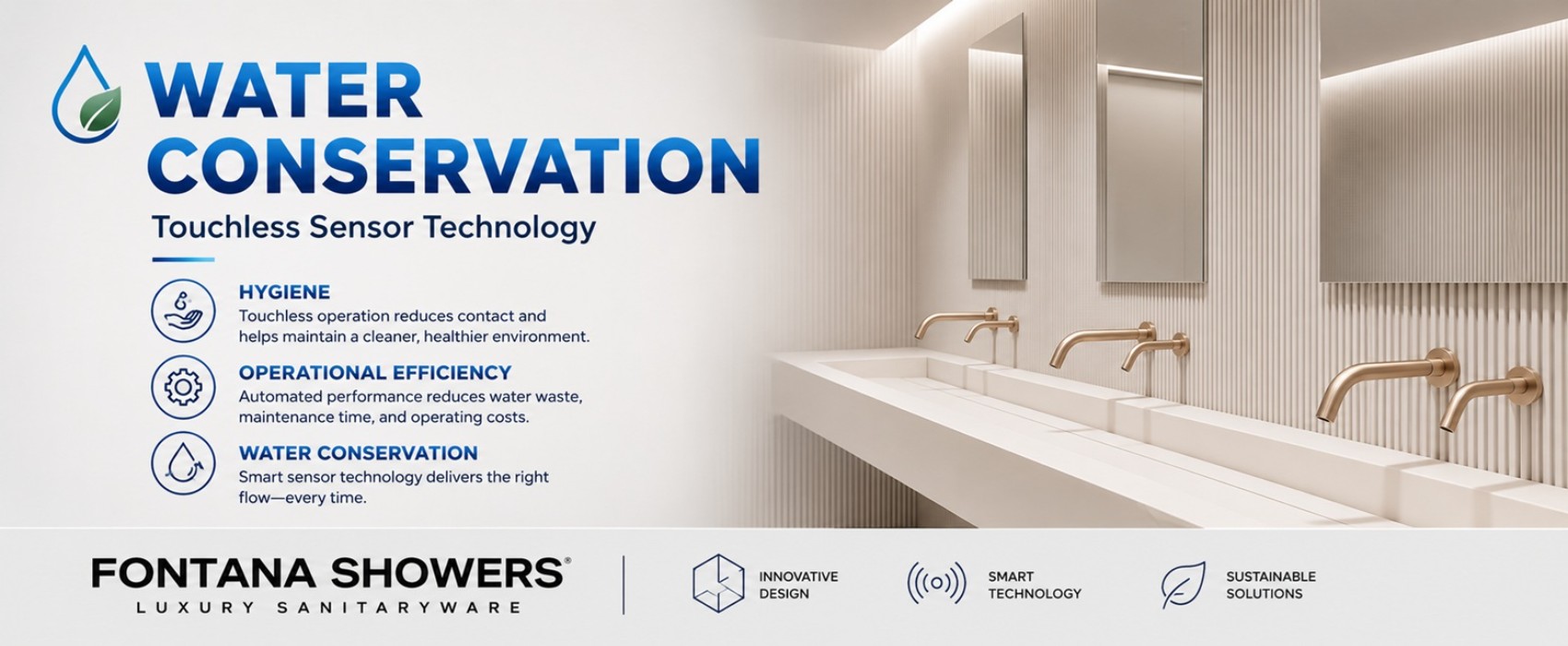
Water Conservation — Touchless Sensor Technology • Hygiene • Operational Efficiency
FontanaShowers® | Water Conservation Technology
Water Conservation
Most FAQ's
Advanced infrared and ToF sensor systems help eliminate excessive flow, reduce water consumption, and support compliance with modern green-building initiatives. In large office buildings, healthcare facilities, airports, and hospitality developments, these systems contribute to significant long-term reductions in water usage while maintaining a seamless user experience.. This technology is commonly used in various applications, including faucets, soap dispensers, paper towel dispensers, and flush systems in public and private restrooms. Here’s an overview of how touchless sensor technology works and its benefits:
Water Saving
Touch-Free Hygiene
Commercial Efficiency
Smart Restrooms
Commercial touchless faucet water conservation depends on controlling both how much water is delivered and how long each activation is allowed to run, making flow rate, sensor response, automatic shutoff timing, re-trigger behavior, pressure compensation, and commissioning important parts of a measurable restroom water-efficiency strategy. Architects, plumbing engineers, sustainability teams, and facility managers can review
commercial-building field testing of touchless faucet water use, activation duration, user experience, and maintenance performance,
examine
commercial touchless faucet water, energy, and operating-cost savings data,
and evaluate
the broader sustainability relationship between touchless faucet water conservation, reduced hot-water energy demand, and carbon-footprint reduction
when establishing performance criteria for high-traffic commercial restrooms where water savings must remain consistent throughout the fixture lifecycle.
Types of Touchless Sensor Technology
Infrared Sensors
Detection: Infrared sensors emit an infrared light that reflects off a surface (like a hand) and returns to the sensor.
Activation: Once an object is detected within a specific range, the device is activated.
Capacitive Sensors
Detection: These sensors detect changes in capacitance caused by proximity.
Activation: The change in capacitance triggers operation.
Ultrasonic Sensors
Detection: Ultrasonic sensors emit sound waves that bounce back when they hit an object.
Activation: When the object is within range, the device activates.
Applications of Touchless Sensor Technology
Public Restrooms
Touchless faucets, soap dispensers, paper towel dispensers, and flush systems enhance hygiene and user experience.
Healthcare Facilities
Hospitals and clinics use touchless technology to prevent cross-contamination and ensure a sterile environment.
Food Service Industry
Kitchens and food preparation areas benefit from touchless faucets and dispensers.
Residential Use
Increasingly popular in homes for faucets, toilets, and kitchen appliances.
Commercial Buildings
Office buildings, malls, and airports improve sanitation and reduce maintenance costs.
Airport Facilities/Restroom
Airports, with high foot traffic, benefit significantly from touchless faucets & soap dispensers minimizing cross-contamination while conserving resources.
Pros of Sensor Technology
Hygiene
Reduced contact minimizes spread of germs and bacteria.
Convenience
No physical contact required for operation.
Efficiency
Water conservation through controlled activation.
Durability
Reduced wear and longer operational lifespan.
Aesthetics
Modern minimalist architectural appearance.
Cons of Sensor Technology
Cost
Higher upfront and maintenance costs.
Technical Issues
Sensor sensitivity and power dependency.
Complex Installation
Electrical wiring and calibration required.
User Adaptation
Learning curve and unintended activation.
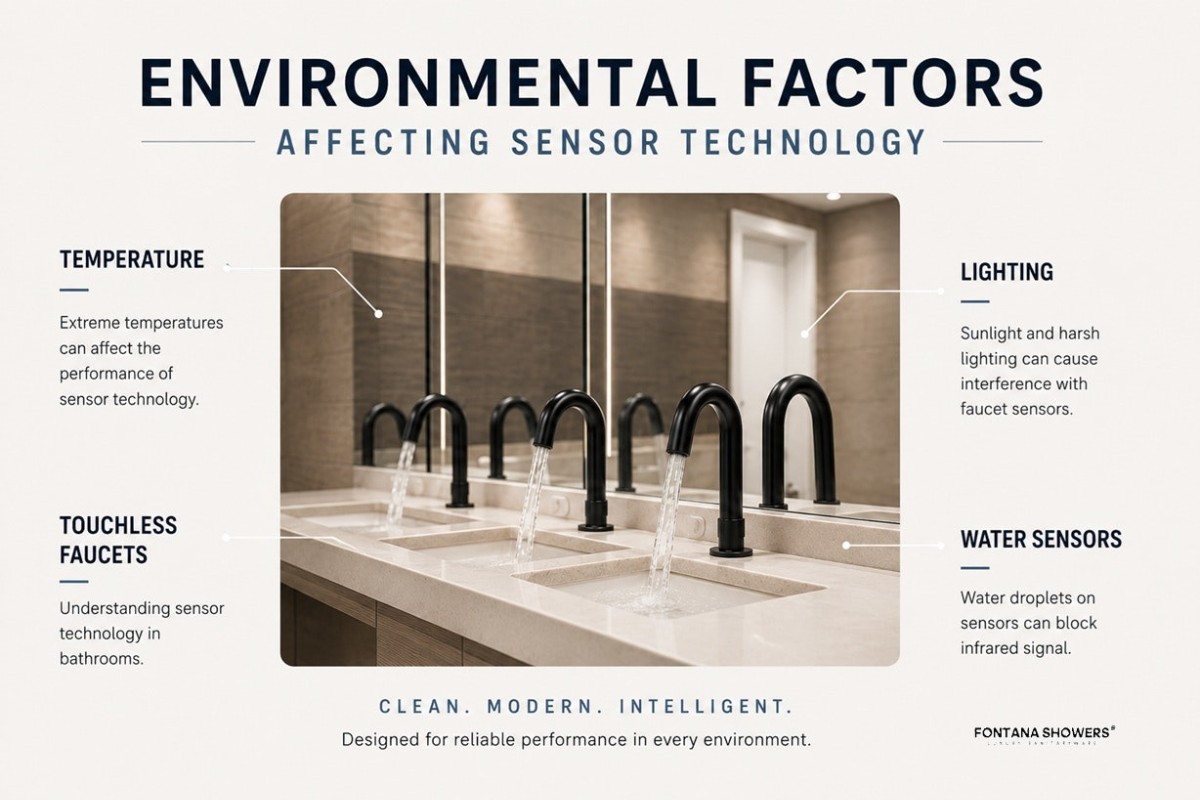
Environmental Factors
Lighting, moisture and interference impacts.
Environmental Factors Affecting Sensor Technology
Touchless sensor technology is invaluable for enhancing hygiene, convenience, and efficiency across various applications. However, environmental factors such as lighting, moisture, temperature, and physical damage can significantly impact sensor performance.
|
|
For Architects / Engineers
Quick Navigation — Technical Resources
Water-efficiency targets, verification methods, and documentation pathways for commercial touchless fixtures.
For Architects / Engineers
Specifier Summary — Water Conservation (Commercial Touchless Fixtures)
As a facility manager overseeing high-traffic commercial restrooms, I have found that water conservation is no longer just an environmental goal—it is a measurable operational strategy. One of the biggest challenges in traditional restroom environments is unnecessary water waste caused by manual faucets left running, user negligence, and inconsistent flow control. These issues not only increase utility costs but also place additional strain on building infrastructure and sustainability objectives. Water conservation in high-traffic restrooms is achieved through measurable flow targets, repeatable shutoff behavior,
and commissioning that validates performance under final site conditions. Specify the intended GPM at design pressure,
confirm outlet device strategy (aerated/laminar), and require a field verification step that checks flow consistency,
activation reliability, and shutoff latency. The best long-term results come from pairing low-flow hydraulics with a
maintenance plan for aerators/screens and a documentation trail that supports sustainability reporting and closeout.
Frequently Asked Questions
Which water-conservation benefits are most measurable in touchless commercial faucets?
The most measurable savings come from automatic shutoff that reduces run-on time, consistent low-flow outlet regulation at the specified GPM, and minimized nuisance activation through commissioning. Savings should be verified using site flow tests and activation-cycle observations under real traffic.
Read more on water conservation
Which flow-rate targets should be specified for 0.5, 1.0, or 1.5 GPM performance?
Flow targets should be treated as submittal requirements tied to design pressure. Validate with a field flow test, confirm the regulator/aerator selection matches the target, and document the measured GPM during commissioning for closeout.
See AEC hydraulic coordination notes
Which commissioning checks confirm the fixture is not wasting water via nuisance triggers?
Use a field test matrix that records nuisance-trigger count, missed-trigger count, and shutoff latency under final lighting, mirrors, and reflective countertops. Confirm that pass-by traffic does not activate flow and that shutoff occurs immediately when hands leave the target zone.
See commissioning criteria targets
Which field symptoms indicate conservation failure due to aerator clogging or scaling?
A clogged or scaled outlet commonly presents as reduced GPM, uneven stream shape, increased splash, or intermittent flow. Correct by cleaning/descaling the outlet device, then re-check flow at design pressure to confirm the original GPM target is restored.
See aerator descaling steps
Which diagnostics separate a true low-pressure problem from outlet restriction?
Confirm stops are fully open and verify supply pressure stability, then inspect aerators/screens for debris. If pressure is unstable, multiple fixtures may show weak flow at peak demand; if restriction is localized, the affected outlet will show a distorted stream or severe GPM drop.
See pressure/flow symptom mapping
Which maintenance cadence protects water-efficiency performance in 500+ uses/day environments?
Use usage-based PM: frequent sensor-window cleaning, scheduled aerator/strainer service, periodic flow spot-checks, and shutoff latency verification. This prevents drift, reduces water waste from nuisance triggers, and maintains consistent low-splash flow.
See the maintenance guide
Which power issues can quietly increase water waste through inconsistent shutoff?
Weak voltage under solenoid load can create inconsistent opening/closing behavior and intermittent actuation. Stabilize performance by matching the power strategy to the duty cycle, replacing batteries on a schedule, and re-validating shutoff repeatability after power service.
See power strategy guidance
Which specification mistakes most often undermine water conservation goals?
Common mistakes include omitting measurable commissioning targets, failing to coordinate basin/setback geometry with the activation zone, using the wrong outlet device for the intended GPM, and not planning service access for outlet cleaning and power checks. These drive nuisance triggers, unstable flow, and poor closeout results.
See spec-driven durability planning
Which installation details should be verified so conservation performance matches the submittal?
Verify stable deck mounting (no rotation), protected low-voltage routing, correct outlet device installation, and repeatable activation/shutoff behavior under final room conditions. After tightening and routing, test multiple cycles and document flow at design pressure for turnover.
See install/maintenance coordination
Which restroom scenarios most strongly justify touchless fixtures for water conservation?
High-traffic public restrooms benefit most: automatic shutoff reduces run-on waste, standardizes user behavior, and supports sustainability reporting. The largest gains appear where usage is frequent, supervision is limited, and outlet maintenance is scheduled to preserve target GPM.
See public restroom guidance
.jpg)
We are leading supplier of touchless faucets and automatic soap dispensers
-
Public Restrooms:
- Touchless faucets, soap dispensers, paper towel dispensers, and flush systems enhance hygiene and user experience.
-
Healthcare Facilities:
- Hospitals and clinics use Fontana touchless technology to prevent cross-contamination and ensure a sterile environment.
-
Food Service Industry:
- Kitchens and food preparation areas benefit from Fontana touchless faucets and dispensers to maintain cleanliness and hygiene.
-
Commercial Buildings:
- Office buildings, malls, and airports use Fontana touchless technology to improve sanitation and reduce maintenance costs.
FontanaShowers, a leading provider in this space, integrates advanced touchless sensor technology in their products to ensure high performance, sustainability, and user satisfaction.
Our Distinguished Clientele
Valued
We're proud of our extensive clientele, a testament to our quality products and service
Contact Address:
Fontana Showers® LLC
4270-I Henninger Ct.
Chantilly, Virginia 20151
Customer Care:
703-378-2808
Corporate Contact Info
To reach Fontana Showers on a corporate level,
you can send us email
[email protected]
We Play Pivotal Role in the Touchless Faucet Industry
FontanaShowers Articles on Quality and Durability
-
Designing Public Restrooms & Avoiding Mistakes
- This article highlights the importance of using robust fixtures in public restrooms to ensure longevity and reduce maintenance. FontanaShowers fixtures are designed to withstand high-traffic usage, making them durable and reliable.
- Read more
-
Touchless Faucet Bathroom Commercial
- Discusses the durability of FontanaShowers touchless faucets, which are built to last in busy commercial settings. Emphasizes their water-saving features and advanced technology.
- Read more
-
Fontana Restroom Wall Mount Commercial Touchless Operation Sensor Faucet in Matte Black
- Details the high-quality materials and construction of Fontana's touchless faucets, designed for long-term performance in demanding environments like airports.
- Read more
-
Touchless Faucets for Transportation Terminals and Hubs
- Highlights the durability and reliability of touchless faucets in high-traffic transportation hubs, including airports and train stations.
- Read more
-
Best for Public Restroom Hygiene: Fontana Lenox Commercial Deck Mount Automatic Soap Dispenser in Brushed Gold
- Discusses the quality and durability of Fontana's automatic soap dispensers, which are designed to provide long-lasting performance in commercial settings.
- Read more
-
Architectural Firms Collaborating with FontanaShowers
- Provides examples of successful collaborations with architectural firms, showcasing the reliability and quality of FontanaShowers products in various high-profile projects.
- Read more
-
Integrating Touchless Faucets, Soap Dispensers, and Dryers into Airline Fleet
- Details the integration of FontanaShowers' durable and high-quality touchless technology in airline restrooms to enhance hygiene and user experience.
- Read more
Quality and Durability
Key Aspects of FontanaShowers' Quality and Durability:
-
Robust Construction:
- FontanaShowers products are made from high-quality materials such as stainless steel and brass, ensuring durability and resistance to corrosion and wear.
- The fixtures are designed to withstand high-traffic usage, making them ideal for commercial environments like airports, hospitals, and public restrooms.
-
Advanced Technology:
- Incorporation of advanced sensor technology in touchless faucets and soap dispensers to enhance performance and reduce the need for manual operation.
- Features such as water-saving mechanisms and precise temperature control systems ensure efficient and reliable operation.
-
Long-Term Performance:
- Products are engineered to provide long-lasting performance with minimal maintenance. This includes features like durable sensor life, high-quality solenoid valves, and reliable battery life in touchless devices.
- Regular testing and quality checks are conducted to ensure that each product meets high standards of reliability and performance.
-
Positive Customer Feedback:
- FontanaShowers has received positive reviews from customers, reflecting their satisfaction with the quality, durability, and performance of the products.
- Customer testimonials and case studies highlight the successful use of FontanaShowers products in various high-profile projects and commercial settings.
By prioritizing quality materials, innovative technology, and rigorous testing, FontanaShowers ensures that their fixtures and accessories offer exceptional durability and reliability, making them a trusted choice for commercial applications.
Water conservation is another focus, encouraging the consideration of touchless faucets with sensors that regulate
water flow, contributing to reduced waste. Power source diversity, ease of installation and maintenance, soap
dispenser capacity evaluation, hygiene features like antimicrobial coatings, integration capabilities with other
restroom systems, and attention to brand reputation and reviews are additional factors highlighted by FSF. Lastly,
compliance with regulations, including ADA requirements, is underscored, emphasizing the importance of adhering to
local standards for enhanced accessibility. By thoroughly assessing these factors, users can make informed decisions
to select touchless bathroom fixtures that align with the specific needs of commercial or public restrooms,
ultimately enhancing cleanliness, efficiency, and user satisfaction.
Here are some key considerations and Best Factors
when Selecting Fontana Touchless Faucets:
Our touchless fixtures with reliable sensor technology. Infrared sensors are commonly used in touchless
faucets and soap dispensers. EnsurIing that the sensors are sensitive enough to detect motion accurately
without being overly sensitive.
FSF opt for fixtures made from durable and high-quality materials, as commercial restrooms experience
heavy usage. Stainless steel and chrome finishes are common choices due to their durability and
resistance to corrosion
FSF touchless faucets with water-saving features; as many of our modern touchless faucets come with
sensors that control water flow, reducing waste and promoting water conservation.
Check the power source for touchless fixtures. Some operate on batteries, while others are hardwired. Consider the
availability of power sources in your restroom and choose accordingly.
Select fixtures that are easy to install and maintain. Look for touchless systems with user-friendly interfaces for
adjustments and troubleshooting. Additionally, choose fixtures with easy-to-replace components to simplify
maintenance.
Evaluate the capacity of touchless soap dispensers, especially in high-traffic areas. Larger capacity dispensers may
require less frequent refilling.
Look for additional hygiene features, such as antimicrobial coatings or materials that inhibit the growth of
bacteria. This is particularly important in public spaces where maintaining a high level of cleanliness is
crucial.
Consider fixtures that can integrate with other restroom systems, such as automated hand dryers or flushometers. This integration can provide a more seamless and efficient restroom
Ensure that the selected touchless fixtures comply with local regulations and accessibility standards. Compliance may
involve factors such as ADA (Americans with Disabilities Act) requirements. By considering these factors, you can
select touchless bathroom fixtures that meet the specific needs of commercial or public restrooms, promoting
cleanliness, efficiency, and user satisfaction.
AEC Water Efficiency Framework
Water Conservation — Spec-Grade Controls for Touchless Faucets
Water savings in commercial restrooms are driven by controlled flow rate, controlled runtime, and controlled
re-trigger behavior. Use this AEC framework to specify measurable performance, commission under real conditions,
and protect savings over the full lifecycle.
Jump to Related Spec Topics
Six essential blocks used across Fontana FAQ pages.
Specifier Summary
In high-traffic restrooms, water conservation is not just “lower GPM.” It is the combined effect of
flow rate limiting, short controlled runtime, and fast reliable shutoff with
minimal nuisance re-triggers. To preserve savings, specify a commissioning acceptance test that validates
shutoff timing under mixed lighting, reflective counters, and peak electrical loads.
- Flow Rate (GPM)
- Runtime / Auto Shutoff
- Re-Trigger Control
- Pressure Stability
- Aerator / Screen Maintenance
- Commissioning
AE Note: When “water-saving” fixtures disappoint, the root cause is usually
(1) drifted sensor tuning causing longer runtime, (2) clogged screens reducing flow and extending hand time,
or (3) unstable power affecting consistent shutoff. Specify and verify all three.
Water-Savings Drivers (What actually moves the needle)
Controlled flow Aerator/flow regulator matched to basin geometry
Controlled runtime Short, repeatable on-time + fast shutoff
Re-trigger control Anti-pass-by + stable detection window
Pressure behavior Stable performance across supply fluctuations
Maintenance Screens/aerators kept clean to avoid “overuse”
Spec tip: Pair “flow target” with “runtime target.” Low flow with long runtime can waste
as much as higher flow with fast shutoff.
|
Input
|
Why it Matters
|
How to Measure / Define
|
Common Pitfall
|
|
Flow rate target (GPM)
|
Sets maximum water use per second of runtime.
|
Specify regulator rating; verify at design pressure.
|
Low flow causes longer hand time.
|
|
Average runtime per use (sec)
|
Primary driver of per-user consumption.
|
Commission under real lighting + traffic; time shutoff.
|
Sensor drift increases runtime.
|
|
Re-triggers per handwash
|
Hidden waste in high-traffic zones.
|
Test pass-by + reflective scenarios; count unintended activations.
|
Poor filtering inflates activations.
|
|
Supply pressure variability
|
Affects valve stability and perceived performance.
|
Verify acceptable operating range; confirm consistent shutoff.
|
Pressure shocks cause water hammer.
|
|
Water quality (sediment/scale)
|
Clogs screens and alters “effective” flow.
|
Define PM interval for screens/aerators; flush plan.
|
Clogs increase user time at basin.
|
|
Control Area
|
What to Specify (Measurable)
|
Commissioning / Verification
|
FontanaShowers Implementation Focus
|
Risk if Ignored
|
|
Flow regulation
|
Flow target + regulator type; stable output at design pressure.
|
Verify actual flow at site pressure; document baseline readings.
|
Flow control designed to reduce consumption without compromising usability.
|
Medium user frustration, longer runtime.
|
|
Auto shutoff timing
|
Defined shutoff latency and repeatability under real conditions.
|
Time shutoff across multiple cycles under final lighting.
|
Fast, consistent shutoff to prevent overrun waste.
|
High runaway runtime, water loss.
|
|
Anti-false-trigger logic
|
Allowable pass-by activation rate (threshold requirement).
|
Test pass-by + reflective surfaces; count unintended activations.
|
Filtering strategy to reduce nuisance activation in corridors and queues.
|
High hidden waste + complaints.
|
|
Pressure stability
|
Operating range requirements; stable actuation under fluctuations.
|
Verify repeatability during peak-demand building conditions.
|
Valve behavior designed to remain consistent across municipal variations.
|
Medium inconsistent output, re-triggers.
|
|
Aerator/screen serviceability
|
Tool access and PM interval defined in O&M plan.
|
Confirm access and train staff; log baseline flow changes.
|
Service-ready design supports long-term water savings retention.
|
Medium clog-driven “overuse.”
|
|
Power under load
|
Battery/AC/hybrid aligned to duty cycle; stable voltage requirement.
|
Measure voltage during actuation; confirm no brownout behavior.
|
Power strategy supports consistent shutoff and sensor stability.
|
High erratic shutoff, extra water use.
|
|
User-experience balance
|
Usability requirement: adequate wetting + fast activation.
|
Observe handwash behavior; validate no “double-pass” pattern.
|
Engineering aims to preserve comfort while reducing waste.
|
Medium users “hunt” for water.
|
|
Long-term drift controls
|
Commissioning + periodic verification of shutoff/activation zone.
|
Quarterly spot checks + corrective tuning if patterns shift.
|
Stable control logic reduces drift-related overrun.
|
High savings disappear over time.
|
Source note: AEC framework derived from the FontanaShowers Water Conservation ,
expressed as measurable spec language & commissioning/PM methods for high-traffic commercial restrooms.
Commissioning Checklist (Protect Water Savings)
- Confirm flow target at site pressure; record baseline values.
- Time activation + shutoff latency under final lighting and counter finish.
- Test pass-by conditions; verify nuisance activation stays within target.
- Flush lines and verify screens/aerators are clean at turnover.
- Verify power stability under actuation load during peak electrical use.
Preventive Maintenance (High-Traffic Retention Plan)
- Weekly: wipe sensor window; look for re-trigger patterns.
- Monthly: clean aerator; inspect screens if flow drops.
- Quarterly: spot-check shutoff timing; correct drift if needed.
- Semiannual: verify power under load; replace batteries as required.
- Annual: review logs; verify baseline flow and runtime targets.
What saves more water: lower flow or faster shutoff?
In high-traffic restrooms, faster and consistent shutoff often produces the biggest savings because it prevents
overrun and nuisance re-triggers. The best result is achieved when flow is limited to a target that still supports
comfortable handwashing while runtime stays short and repeatable.
Why do “water-saving” faucets sometimes increase complaints?
If flow is reduced too far or sensors drift, users “hunt” for activation, re-trigger the sensor, or keep hands
under the spout longer. That behavior can erase savings. Commissioning under final lighting and maintaining clean
aerators/screens keeps performance stable and predictable.
What should a spec require to prove water savings on-site?
Require a commissioning acceptance test: verify flow at site pressure, time shutoff latency, and test nuisance
activation under pass-by traffic. Document baseline results at turnover and define a quarterly spot-check interval
to preserve savings.
How do aerators and inlet screens affect water conservation?
Screens and aerators control the effective flow path. As they clog, users stay longer at the sink, re-trigger more,
and perceived performance drops. A simple PM interval for cleaning these components is one of the most effective
ways to retain water savings long-term.
How does power strategy impact water savings?
Unstable voltage under solenoid load can delay shutoff or cause inconsistent actuation. Align battery/AC/hybrid
strategy with duty cycle, verify voltage stability during commissioning, and check power health periodically to
prevent drift-related water overuse.
What finish-related factor influences water conservation?
Highly reflective counters and sink finishes can increase nuisance triggering if sensor tuning is not commissioned
under final conditions. That drives unintended activations and extra runtime. Commissioning under the actual finish
set helps maintain water-control performance.
|
|
|


.jpg)
.jpg)
.jpg)
.jpg)

.jpg)
.jpg)